When Fear and Belief Swept Indonesia
Indonesia’s history of collective fear and contagious belief is not one single story of “mass hysteria”.
Page outline Jump by section
Introduction
The clearest lesson is that belief alone rarely explains what happened. Indonesia’s panics have grown where supernatural ideas met exhausting working conditions, school pressure, economic insecurity, political transition, weak policing, sensational reporting or disputes over religious authority. Some events were collective stress reactions in which symptoms were real but no shared physical cause was found. Others were moral panics in which rumours helped legitimise persecution. Still others involved genuine new religious movements whose teachings were controversial, but whose members were subjected to coercion far beyond any proven threat.[ubaya.ac.id]journal.ubaya.ac.idUnderstanding the Mass Trance Phenomenon in IndonesiaMarch 8, 2013 — The outbreaks in- volved groups of school children and factory work…
Why the labels matter
Terms such as “cult”, “possession”, “witch hunt” and “mass hysteria” carry assumptions that can distort an account before the evidence is considered. A small or unconventional religion is not necessarily coercive. A possession experience is not automatically fake or evidence of mental illness. A crowd attacking a supposed sorcerer is not merely acting out a timeless superstition: it may also be responding to political rumours, personal grievances and a collapse of trust in authority.
Researchers now commonly use mass psychogenic illness or mass sociogenic illness for outbreaks in which physical symptoms spread through a group without an identified environmental, infectious or toxic cause. The symptoms can include fainting, shaking, paralysis, breathlessness, screaming or altered consciousness. They are genuinely experienced, even when anxiety, expectation and observation appear to be the main means of transmission. Diagnosis should follow medical and environmental investigation, not replace it.[PMC]pmc.ncbi.nlm.nih.govMass Psychogenic Illness: Demography and Symptom Profile…by BK Tarafder · 2016 · Cited by 20 — This study was aimed at investigatin…
A moral panic, by contrast, is a social reaction in which a person or group is represented as a grave threat to society and the response becomes disproportionate, simplified or punitive. Indonesia’s anti-sorcery violence and campaigns against supposedly deviant religions fit this category more closely than its school trance outbreaks. The distinction matters because the first calls for medical care and reduction of stress, while the second demands protection from scapegoating, vigilantism and discriminatory state action.
Mass trance in schools and factories
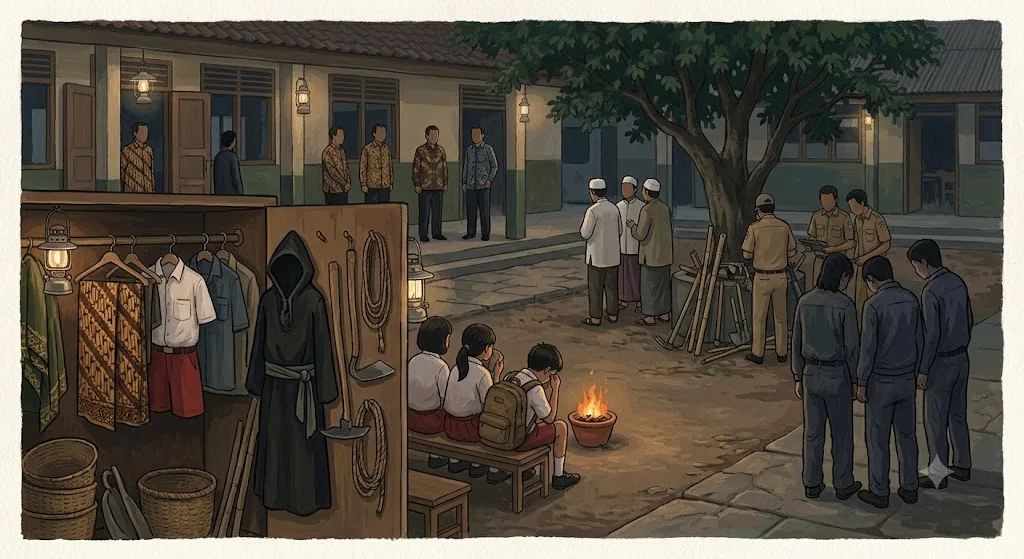
From the mid-2000s, Indonesian media repeatedly reported groups of pupils or factory employees screaming, collapsing, shaking, becoming rigid or apparently speaking under the control of spirits. A scholarly review traced a cluster of widely reported incidents from outbreaks among schoolgirls in Riau in 2005 through a series of events across Indonesia between 2006 and early 2008. Those affected were overwhelmingly girls and women, particularly pupils and industrial workers.[journal.ubaya.ac.id]journal.ubaya.ac.idUnderstanding the Mass Trance Phenomenon in IndonesiaMarch 8, 2013 — The outbreaks in- volved groups of school children and factory work…
A typical outbreak could begin with one person behaving unusually before spreading rapidly to others who could see or hear her. In February 2008, for example, Indonesian television showed pupils and teachers experiencing a shared trance at a school on Sumbawa. Contemporary reporting also described repeated outbreaks among women working in cigarette, garment and electronics factories. Local explanations often centred on disturbed spirits, haunted land or workers becoming vulnerable because they were physically and emotionally exhausted.[Reuters]reuters.comMass trance afflicts Indonesian women, factory workersMass trance afflicts Indonesian women, factory workersFebruary 27, 2008 — 26 Feb 2008 — Reports of schoolchildren, young women and…
These supernatural interpretations were neither random nor merely backward. Spirit possession already provided a familiar cultural language for distress. When a pupil said that a spirit had entered her, teachers and relatives could understand the event within established religious and local traditions. Prayer, recitation and ritual intervention therefore often formed part of the immediate response. In some communities, that explanation could be more socially acceptable than saying that a young woman was overwhelmed by pressure, conflict or fear.
Psychological and social explanations focus on the conditions in which the outbreaks occurred. Schools combine strict discipline, examinations, long ceremonies and close observation by peers. Factories may combine repetitive work, heat, production targets, insecure employment and limited opportunities for workers to protest. A trance outbreak can interrupt these routines and express distress without any individual consciously deciding to stage a protest. Indonesian researchers have consequently interpreted mass trance as a culturally shaped response to everyday social pressures rather than as evidence that participants were pretending.[journal.ubaya.ac.id]journal.ubaya.ac.idUnderstanding the Mass Trance Phenomenon in IndonesiaMarch 8, 2013 — The outbreaks in- volved groups of school children and factory work…
Gender is central to this interpretation. Girls and young women often occupied tightly supervised environments in which open anger or confrontation was discouraged. Shared trance could create a temporary space in which ordinary expectations no longer applied: work stopped, school discipline was suspended and adults were required to listen. That does not prove that every outbreak had the same cause, and environmental illness must always be excluded first. It does explain why the phenomenon repeatedly appeared in institutions where many young women were under similar constraints.
Media coverage could help an episode travel. Images of screaming pupils, descriptions of a haunted building and reports that another school had been affected supplied audiences with a recognisable script. Once people knew what a “mass possession” looked like, new events could be interpreted through the same pattern. Reporting was therefore not necessarily inventing the symptoms, but it could strengthen the expectation that distress would take a particular form.

The sorcerer killings and the “ninja” panic
Indonesia’s most lethal modern witch panic occurred in East Java during the political upheaval of 1998. In and around Banyuwangi, people accused of harmful sorcery were attacked and killed. Violence then became entangled with rumours that black-clad assassins, described as “ninjas”, were hunting religious teachers and community leaders. Villages organised night watches, strangers were treated as possible killers, and some people suspected of being ninjas were themselves beaten or murdered.[newmandala.org]newmandala.orghunting killing ninjas indonesiaNew MandalaHunting and killing ninjas in Indonesia3 May 2016 — The so-called 'ninja' case saw towns and villages of East Java, Indonesia…
The episode began before President Suharto’s resignation in May 1998 but intensified during the unstable transition that followed. Economic crisis, demonstrations, communal conflict and uncertainty about the security forces created an atmosphere in which almost any violent event could be interpreted as part of a hidden operation. Banyuwangi also had a history of allegations that particular people used occult power to cause illness, death or crop failure. Existing beliefs gave accusations a local vocabulary; national disorder made them more dangerous.
The first victims were commonly described as sorcerers, but that category was unstable. Those killed included traditional practitioners, healers, religious figures and ordinary residents caught in local disputes. An accusation could crystallise older resentments over land, family conflict, reputation or political allegiance. Once violence began, a person did not need to have practised magic to be at risk. Suspicion itself became evidence.
The later “ninja” rumour reversed the direction of fear. Communities came to believe that organised men in dark clothing were targeting Muslim teachers or eliminating people who knew too much about the killings. Newspapers reported alleged sightings, while neighbourhood patrols circulated warnings and watched roads after dark. Anthropologist Nicholas Herriman found that some supposed ninjas were probably travellers, homeless people, individuals with mental health problems or others unable to explain their presence convincingly to an armed crowd.[ResearchGate]researchgate.netOpen source on researchgate.net.
Death-toll figures vary because records were incomplete and the boundaries of the episode are disputed. Indonesia’s National Commission on Human Rights has cited 194 deaths in Banyuwangi, while some studies use lower totals or distinguish between alleged sorcerers, suspected ninjas and killings in neighbouring districts. The disagreement is itself revealing: the panic produced a confused landscape of clandestine attacks, mob killings, disappearances and politically charged claims about who was responsible.[The Jakarta Post]thejakartapost.com25 years after bloody witch hunts in east java cases remain unresolved25 years after bloody witch hunts in east java cases remain unresolved
Was the violence organised?
No single explanation has settled the question. Nahdlatul Ulama, Indonesia’s largest Muslim organisation, and some survivors have alleged that trained or state-connected actors exploited the sorcery issue to attack religious leaders or destabilise the political transition. The apparent discipline of some assailants, the targeting of prominent figures and the failure of security forces to stop the killings strengthened suspicions of an organised campaign.
Other researchers argue that much of the violence was locally generated. In this interpretation, villagers sincerely believed that certain people used destructive magic and felt the state was unwilling or unable to protect them. Killings then produced retaliation, rumours and imitation. Political actors may have manipulated the unrest, but manipulation does not require them to have planned every attack.[academia.edu]academia.eduOpen source on academia.edu.
The strongest evidence supports a mixed picture rather than a neat conspiracy or a purely spontaneous outburst. Local beliefs and conflicts made accusations credible; political breakdown reduced restraints on violence; rumours linked scattered incidents into a national story; and official inaction allowed armed groups to operate. Even where the identity of an attacker remains unknown, the social mechanism is clear: fear converted uncertainty into categories of enemies, first “sorcerers” and then “ninjas”.
The case also shows why calling the episode a witch hunt should not reduce it to folklore. People were tortured, displaced and killed, while families continued to live with the stigma attached to the accused. Decades later, campaigners and relatives have argued that the crimes remain insufficiently investigated and that state responsibility has not been resolved.[Rupkatha]rupkatha.comOpen source on rupkatha.com.
Miracle healing and the crowds around Ponari
Collective belief in Indonesia has not always centred on danger. In 2009, a child named Ponari became nationally famous after claims that a stone he possessed could heal illness. Visitors travelled to his village in East Java carrying water that they wanted him to touch with the stone. Queues stretched for hundreds of metres, while some people collected soil or water from around his family home in the hope that it retained healing power.[insideindonesia.org]insideindonesia.orgponari and the sorcerer s stonePonari and the sorcerer's stone19 Jul 2009 — Four people died, crushed by the crowds. For several months, every day the line would stretc…
The attraction was understandable in a country where medical treatment could be expensive, distant or disappointing. The story offered something that formal healthcare often could not: an accessible cure, a visible miracle and the hope that severe illness might be relieved without complicated treatment. Testimonies from people who felt better supplied persuasive evidence within the crowd, even though individual recovery does not establish that the stone caused it.
The gathering became dangerous. Four people were reported to have died in crowd crushes, and child-protection advocates warned that Ponari himself was being exploited. Religious authorities, local officials and campaigners disagreed over how to respond. Closing the site could appear to deny desperate families hope; leaving it open exposed visitors and the child to further harm.[insideindonesia.org]insideindonesia.orgponari and the sorcerer s stonePonari and the sorcerer's stone19 Jul 2009 — Four people died, crushed by the crowds. For several months, every day the line would stretc…
Ponari’s case is best understood as a miracle craze rather than a psychogenic illness. Belief spread through testimony, television and the spectacle of enormous queues. The crowd became part of the proof: people reasoned that so many others would not travel unless something extraordinary had happened. This is a familiar mechanism in miracle panics worldwide, but the Indonesian episode was shaped by local traditions of spiritual healing, unequal healthcare access and the rapid national circulation of an emotionally compelling story.
New prophets, “deviant sects” and religious panic
Indonesia has produced numerous new religious movements, prophetic claimants and communities that combine teachings from established religions. Their appearance is not unusual in a society with longstanding mystical traditions, intense religious debate and rapid social change. Yet public discussion often describes such groups using a single hostile category equivalent to “deviant sect”, even when their beliefs, organisation and conduct differ greatly.
Lia Eden and the Eden community
Lia Eden, formerly known as Lia Aminuddin, said that she received divine messages through the Archangel Gabriel and developed a community in Jakarta that drew elements from several religious traditions. She presented herself in prophetic and messianic terms, criticised established religious authority and attracted a relatively small but highly visible following, including educated urban participants. Scholars generally describe the group as a new religious movement rather than assuming that the word “cult” explains its character.[uinsyahada.ac.id]jurnal.uinsyahada.ac.idOpen source on uinsyahada.ac.id.
The Indonesian Council of Ulama declared her teachings deviant, and Lia Eden was prosecuted and imprisoned under blasphemy provisions. Her case illustrated a recurring pattern: theological disagreement was transformed into a public-order and criminal-law issue. Supporters of prosecution argued that prophetic claims insulted Islam and could disturb social harmony. Critics replied that “harmony” was being defined as conformity and that imprisonment gave majority religious organisations power over minority belief.
Lia Eden’s story also complicates stereotypes about followers of unconventional religions. Her community was not simply a refuge for isolated or uneducated people. Research has examined its appeal among urban Indonesians seeking alternative spirituality, religious pluralism and explanations for national crisis. The movement became more controversial partly because it challenged the authority to decide who may interpret revelation.[ResearchGate]researchgate.netResearch Gate Lia Eden Community and the New Religious MovementResearch Gate Lia Eden Community and the New Religious Movement
Gafatar and the fear of a hidden sect
The treatment of Gafatar shows how a religious scare can produce mass displacement. The movement combined religious teachings associated with Ahmad Mushaddeq with a programme of communal farming and social renewal. Members established settlements in West Kalimantan, where they hoped to build a self-sufficient way of life. Critics depicted the community as a heretical organisation misleading Muslims and separating families.
In January 2016, mobs attacked Gafatar settlements and burned homes. More than 7,000 members were eventually removed from the area, according to Human Rights Watch. Officials described their actions as evacuation or protection, but displaced members were detained in temporary centres, subjected to religious “guidance” and dispersed to their regions of origin. Amnesty International documented the forced removal of at least 1,500 people from districts in West Kalimantan during the initial attacks.[Human Rights Watch]hrw.orgGovernment agencies and security forces didHuman Rights WatchIndonesia: Persecution of Gafatar Religious Group29 Mar 2016 — More than 7000 members of the Gafatar religious communit…
Some families undoubtedly experienced serious internal conflict when relatives joined the movement or moved away. That concern, however, became merged with broader claims that the entire community threatened religion and national unity. The evidence of disagreement within families did not justify burning settlements, collective detention or compulsory renunciation of belief.
Academic accounts place Gafatar within the growth of post-1998 Indonesian new religious movements. Economic disappointment, political transition and competition over Islamic authority created space for leaders offering moral renewal and an alternative social order. Some teachings had millenarian features, promising radical transformation in response to a corrupt or failing present. Such beliefs can be studied critically without assuming that believers deserved persecution.[Indonesia at Melbourne]indonesiaatmelbourne.unimelb.edu.augafatar attack shows the limits of unity in diversitygafatar attack shows the limits of unity in diversity
How law can turn anxiety into persecution
Indonesia’s constitution protects religious freedom, but its legal and administrative system has historically favoured a limited set of officially recognised religions. The 1965 blasphemy law authorised action against interpretations judged to deviate from the central teachings of a religion and provided the basis for criminal prosecution under Article 156a of the Criminal Code. In 2010, the Constitutional Court upheld the law despite arguments that it violated freedom of religion and expression.[Human Rights Watch]hrw.orgHuman Rights Watch Indonesia: Court Ruling a Setback for Religious FreedomHuman Rights Watch Indonesia: Court Ruling a Setback for Religious Freedom
These rules make moral panic more consequential. A rumour that a group is insulting religion does not remain merely a rumour when councils, police and prosecutors can classify theological difference as a threat to public order. Religious rulings are not themselves criminal judgments, but they can shape public pressure and influence officials. Minority communities may therefore face a chain of escalation: denunciation, demonstrations, police intervention, prosecution and forced “rehabilitation”.
Human-rights research has documented prosecutions involving new prophets, minority Muslim communities and people accused of offensive speech. Critics argue that blasphemy provisions often reward intimidation because authorities can present prosecution as the easiest way to prevent unrest. In effect, those threatening disorder may gain greater influence than the peaceful minority being threatened.[or.id]leip.or.idOpen source on or.id.
This does not mean every public concern about a religious group is invented. Authorities may legitimately investigate fraud, abuse, confinement, violence or exploitation, regardless of the theology involved. The danger arises when unusual belief is treated as proof of harm. A rights-based response distinguishes conduct from doctrine: prosecute coercion or violence where evidence supports it, but do not punish people merely for following an unpopular revelation or rejecting an orthodox interpretation.
What makes these episodes spread?
Indonesia’s cases differ, but several recurring mechanisms connect them.
A familiar cultural script. Spirit possession, harmful magic, prophetic revelation and miraculous healing were already intelligible ideas. When an unexplained event occurred, people did not have to invent an interpretation from nothing.
Institutional pressure. Trance outbreaks often appeared among pupils and low-paid women workers whose opportunities to express exhaustion or conflict were limited. Shared symptoms temporarily disrupted an environment that individuals could not easily challenge.[journal.ubaya.ac.id]journal.ubaya.ac.idUnderstanding the Mass Trance Phenomenon in IndonesiaMarch 8, 2013 — The outbreaks in- volved groups of school children and factory work…
Political uncertainty. The 1998 sorcerer killings expanded when state authority was weakened and suspicions of covert operations were widespread. Rumours were persuasive because Indonesia had a real history of political violence, surveillance and unaccountable security forces.
Social proof. Long queues outside a healer’s home, repeated television footage of possession and constant reports of ninja sightings made belief appear publicly confirmed. People often judge an uncertain claim partly by observing how many others act as though it is true.
Authority competition. New religious movements became flashpoints because they challenged established institutions’ power to define acceptable belief. Accusations of heresy defended not only doctrine but also social status and political influence.
Fear of official failure. Villagers who believed police could not stop sorcery organised their own justice. Families who distrusted medical care turned to miracle healing. Officials who feared demonstrations prosecuted minority believers instead of confronting threatening crowds. In each case, a lack of confidence in ordinary institutions made extraordinary explanations or actions more attractive.
Myth, illness and responsibility
It would be misleading to describe Indonesia as unusually irrational. Comparable outbreaks of psychogenic illness, witch accusations, miracle crowds and sect panics have appeared across the world. Indonesia’s distinctiveness lies in the local forms these events took and in the way spiritual traditions, industrial modernisation, democratic transition and state regulation of religion interacted.
Mass trance should not be used to ridicule Indonesian spirituality or dismiss women’s suffering. The most plausible accounts recognise both the reality of participants’ symptoms and the cultural form through which distress was expressed. Sorcery belief likewise cannot excuse murder, but neither can the 1998 violence be understood without examining political fear, local conflict and the failure of law enforcement.
The language of “cult danger” deserves particular caution. Lia Eden’s community and Gafatar held unconventional and contested beliefs, but the most clearly documented large-scale harm in their cases came from prosecution, forced displacement and public hostility. Labelling them as cults can reproduce the original panic unless the term is tied to evidence of coercive practices rather than theological difference.
Indonesia’s history therefore offers a broader warning about collective belief. Panics become most dangerous not when people merely believe unusual things, but when uncertainty is converted into a licence to identify enemies. The decisive questions are always practical: who is claiming that a threat exists, what evidence supports it, whose interests the claim serves, and whether the response protects people or places them in greater danger.
Amazon book picks
Further Reading
Books and field guides related to When Fear and Belief Swept Indonesia. Use these as the next step if you want deeper reading beyond the article.
Extraordinary Popular Delusions and the Madness of Crowds
Rating: 4.0/5 from 5 Google Books ratings
Explores historical episodes of collective belief and crowd behaviour.

Imagined communities
Helps explain nationalism, identity and collective belief in Southeast Asia.

The Jakarta Method
Provides political context for fear, violence and social upheaval in modern Indonesia.

Interpretation of Cultures
Introduces cultural interpretation useful for understanding belief, ritual and social behaviour.
Endnotes
1.
Source: journal.ubaya.ac.id
Link:https://journal.ubaya.ac.id/index.php/jpa/article/download/4372/3311/
Source snippet
Understanding the Mass Trance Phenomenon in IndonesiaMarch 8, 2013 — The outbreaks in- volved groups of school children and factory work...
Published: March 8, 2013
2.
Source: insideindonesia.org
Title: ponari and the sorcerer s stone
Link:https://www.insideindonesia.org/archive/articles/ponari-and-the-sorcerer-s-stone
Source snippet
Ponari and the sorcerer's stone19 Jul 2009 — Four people died, crushed by the crowds. For several months, every day the line would stretc...
3.
Source: pmc.ncbi.nlm.nih.gov
Link:https://pmc.ncbi.nlm.nih.gov/articles/PMC4884863/
Source snippet
Mass Psychogenic Illness: Demography and Symptom Profile...by BK Tarafder · 2016 · Cited by 20 — This study was aimed at investigatin...
4.
Source: reuters.com
Title: Mass trance afflicts Indonesian women, factory workers
Link:https://www.reuters.com/article/lifestyle/mass-trance-afflicts-indonesian-women-factory-workers-idUSSP35858/
Source snippet
Mass trance afflicts Indonesian women, factory workersFebruary 27, 2008 — 26 Feb 2008 — Reports of schoolchildren, young women and...
Published: February 27, 2008
5.
Source: researchgate.net
Link:https://www.researchgate.net/publication/398363171_Understanding_the_Mass_Trance_Phenomenon_in_Indonesia_Between_Traditional_Beliefs_and_Community_Mental_Health
6.
Source: insideindonesia.org
Title: the banyuwangi murders
Link:https://www.insideindonesia.org/editions/edition-6245/the-banyuwangi-murders
7.
Source: researchgate.net
Link:https://www.researchgate.net/publication/232961257_Sorcerer_Killings_in_Banyuwangi_A_Re-Examination_of_State_Responsibility_for_Violence
8.
Source: academia.edu
Link:https://www.academia.edu/1968978/_Sorcerer_Killings_in_Banyuwangi_A_Re_Examination_of_State_Responsibility_for_Violence
9.
Source: rupkatha.com
Link:https://rupkatha.com/V13/n1/v13n123.pdf
10.
Source: jurnal.uinsyahada.ac.id
Link:https://jurnal.uinsyahada.ac.id/index.php/F/article/view/5126
11.
Source: link.springer.com
Title: Nature Link Challenging Islamic Orthodoxy
Link:https://link.springer.com/book/10.1007/978-3-319-38978-3
12.
Source: researchgate.net
Title: Research Gate Lia Eden Community and the New Religious Movement
Link:https://www.researchgate.net/publication/362797702_Lia_Eden_Community_and_the_New_Religious_Movement_Analysis_of_Social_Psychology_and_Rational_Choice_Theory
13.
Source: amnesty.org
Link:https://www.amnesty.org/es/wp-content/uploads/2021/05/ASA2133512016ENGLISH.pdf
14.
Source: academia.edu
Link:https://www.academia.edu/38887238/Returning_to_the_Religion_of_Abraham_Controversies_over_the_Gafatar_Movement_in_Contemporary_Indonesia
15.
Source: leip.or.id
Link:https://leip.or.id/wp-content/uploads/2018/10/LeIP-Interpretations-of-Article-156A-of-The-Indonesian-Criminal-Code-On-Blasphemy-and-Religious-Defamation-a-Legal-and-Human-Right-Analysis.pdf
16.
Source: amnesty.org
Link:https://www.amnesty.org/es/wp-content/uploads/2021/06/asa210182014en.pdf
17.
Source: researchgate.net
Link:https://www.researchgate.net/publication/359588405_Possession_Disorder_in_Makassar_Indonesia
18.
Source: researchgate.net
Link:https://www.researchgate.net/publication/240281012_Occupational_Mass_Psychogenic_Illness_A_Transcultural_Perspective
19.
Source: researchgate.net
Link:https://www.researchgate.net/publication/273288452_Deep_culture_in_action_resignification_synecdoche_and_metanarrative_in_the_moral_panic_of_the_Salem_Witch_Trials
20.
Source: researchgate.net
Link:https://www.researchgate.net/publication/350455114_Remembering_the_1998_Indonesian_Sorcerers_Massacre_Memory_of_Tragedy_and_Trauma_in_Intan_Andaru%27s_Perempuan_Bersampur_Merah_Woman_in_Red_Scarf
21.
Source: researchgate.net
Link:https://www.researchgate.net/publication/311970645_Challenging_Islamic_Orthodoxy_Accounts_of_Lia_Eden_and_Other_Prophets_in_Indonesia
22.
Source: academia.edu
Link:https://www.academia.edu/4593752/Of_Women_and_Witches_A_Case_Study_in_Moral_Panics
23.
Source: academia.edu
Link:https://www.academia.edu/143888167/_Deviant_Qur_anic_Interpretation_in_Indonesia_Reading_Lia_Eden_s_Defense_of_the_Claim_to_Prophethood
24.
Source: academia.edu
Link:https://www.academia.edu/86934429/The_Fatw%C4%81_of_the_Indonesian_Ulam%C4%81_Council_on_the_Gods_Kingdom_Eden_in_Indonesia
25.
Source: academia.edu
Link:https://www.academia.edu/40680158/WhatsApp_Vigilantes_An_exploration_of_citizen_reception_and_circulation_of_WhatsApp_misinformation_linked_to_mob_violence_in_India
26.
Source: state.gov
Title: 441219 INDONESIA 2022 INTERNATIONAL RELIGIOUS FREEDOM REPORT
Link:https://www.state.gov/wp-content/uploads/2023/05/441219-INDONESIA-2022-INTERNATIONAL-RELIGIOUS-FREEDOM-REPORT.pdf
27.
Source: hrw.org
Title: Government agencies and security forces did
Link:https://www.hrw.org/news/2016/03/29/indonesia-persecution-gafatar-religious-group
Source snippet
Human Rights WatchIndonesia: Persecution of Gafatar Religious Group29 Mar 2016 — More than 7000 members of the Gafatar religious communit...
28.
Source: newmandala.org
Title: hunting killing ninjas indonesia
Link:https://www.newmandala.org/hunting-killing-ninjas-indonesia/
Source snippet
New MandalaHunting and killing ninjas in Indonesia3 May 2016 — The so-called 'ninja' case saw towns and villages of East Java, Indonesia...
Published: May 2016
29.
Source: Wikipedia
Title: Mass psychogenic illness
Link:https://en.wikipedia.org/wiki/Mass_psychogenic_illness
30.
Source: thejakartapost.com
Title: 25 years after bloody witch hunts in east java cases remain unresolved
Link:https://www.thejakartapost.com/paper/2023/08/01/25-years-after-bloody-witch-hunts-in-east-java-cases-remain-unresolved
31.
Source: research-repository.uwa.edu.au
Link:https://research-repository.uwa.edu.au/files/3218035/Herriman_Nicholas%2520_2007.pdf
32.
Source: indonesiaatmelbourne.unimelb.edu.au
Title: gafatar attack shows the limits of unity in diversity
Link:https://indonesiaatmelbourne.unimelb.edu.au/gafatar-attack-shows-the-limits-of-unity-in-diversity/
33.
Source: hrw.org
Title: Human Rights Watch Indonesia: Court Ruling a Setback for Religious Freedom
Link:https://www.hrw.org/news/2010/04/19/indonesia-court-ruling-setback-religious-freedom
34.
Source: freedomhouse.org
Title: Policing Belief Indonesia
Link:https://freedomhouse.org/sites/default/files/PolicingBelief_Indonesia.pdf
35.
Source: Wikipedia
Title: Witch hunt
Link:https://en.wikipedia.org/wiki/Witch_hunt
36.
Source: sjweh.fi
Link:https://www.sjweh.fi/download.php?abstract_id=2294&file_nro=1
37.
Source: bircu-journal.com
Link:https://bircu-journal.com/index.php/birci/article/download/5695/pdf
38.
Source: intersections.anu.edu.au
Link:https://intersections.anu.edu.au/issue18/beazley.htm
39.
Source: irep.iium.edu.my
Link:https://irep.iium.edu.my/view/year/2025.html
40.
Source: pmc.ncbi.nlm.nih.gov
Link:https://pmc.ncbi.nlm.nih.gov/articles/PMC7720453/
41.
Source: penamas.kemenag.go.id
Link:https://penamas.kemenag.go.id/penamas/en/article/download/670/266/4454
42.
Source: facebook.com
Link:https://www.facebook.com/groups/898899773959040/posts/1925627207952953/
Additional References
43.
Source: youtube.com
Title: Khanzab: Dari Kisah Nyata, “Pembantaian Dukun Santet Banyuwangi”
Link:https://www.youtube.com/watch?v=WQ7YsTY2pA4
Source snippet
This discussion on the 1998 Banyuwangi killings is highly relevant because it explores how rumors and a breakdown of local authority fuel...
44.
Source: youtube.com
Link:https://www.youtube.com/watch?v=3d4BzvvqVD0
Source snippet
Khanzab: Dari Kisah Nyata, "Pembantaian Dukun Santet Banyuwangi" - IN-FRAME w/ Ernest Prakasa...
45.
Source: youtube.com
Title: The Ninja Case in Banyuwangi, Gus Dur: “Green Dragon Operation”
Link:https://www.youtube.com/watch?v=Ohsz1OtWTYs
Source snippet
Kemah Terlarang Kesurupan Massal Official Trailer | Kisah Nyata di Jogja 2016...
46.
Source: youtube.com
Link:https://www.youtube.com/watch?v=HtFKKpXJbEY
Source snippet
The Witch Doctor Massacre - Official Trailer...
47.
Source: youtube.com
Title: The Witch Doctor Massacre
Link:https://www.youtube.com/watch?v=W8FUcJbD270
Source snippet
The Ninja Case in Banyuwangi, Gus Dur: "Green Dragon Operation"...
48.
Source: facebook.com
Link:https://www.facebook.com/mountainbeacon2600/photos/bontoc-school-explains-student-incident-as-no-demons-just-distressby-frank-cimat/122252269916122796/
49.
Source: heiup.uni-heidelberg.de
Link:https://heiup.uni-heidelberg.de/catalog/view/531/812/89660
50.
Source: voi.id
Link:https://voi.id/en/memori/38670
51.
Source: nu.or.id
Link:https://www.nu.or.id/news/authorities-still-at-odds-over-ponari039s-039powers039-9yCLy
52.
Source: digilib.uin-suka.ac.id
Link:https://digilib.uin-suka.ac.id/34976/2/Returning%20to%20the%20Religion%20of%20Abraham%20Controversies%20over%20the%20Gafatar%20Movement%20in%20Contemporary%20Indonesia%20%281%29.pdf
Topic Tree
Follow this branch
Related pages 192
- Antigua and Barbuda
- Argentina Belief Scares
- Azerbaijan Belief
- Bahrain Beliefs
- North Korea
- +187 more in sidebar