Within Australia Unsettled
Can a Government Ban a Belief System?
Australia's fight with Scientology raised a lasting question: when should governments regulate harmful conduct without outlawing belief?
On this page
- The Anderson Inquiry and its allegations
- State bans, legal resistance and religious recognition
- Where regulation ends and persecution begins
Page outline Jump by section
Introduction
Australia’s conflict with Scientology became one of the clearest modern tests of a democratic society’s response to a controversial religious movement. During the 1960s, several Australian states attempted to suppress Scientology after official inquiries concluded that some of its practices were harmful. Yet, within two decades, Australia’s highest court recognised Scientology as a religion, not because it endorsed its teachings, but because it concluded that governments should be cautious about deciding which beliefs count as genuine religion. The Australian experience therefore shifted the debate away from banning beliefs and towards regulating harmful conduct. That distinction continues to influence discussions about high-control groups, religious freedom and state power.

The Anderson Inquiry and its allegations
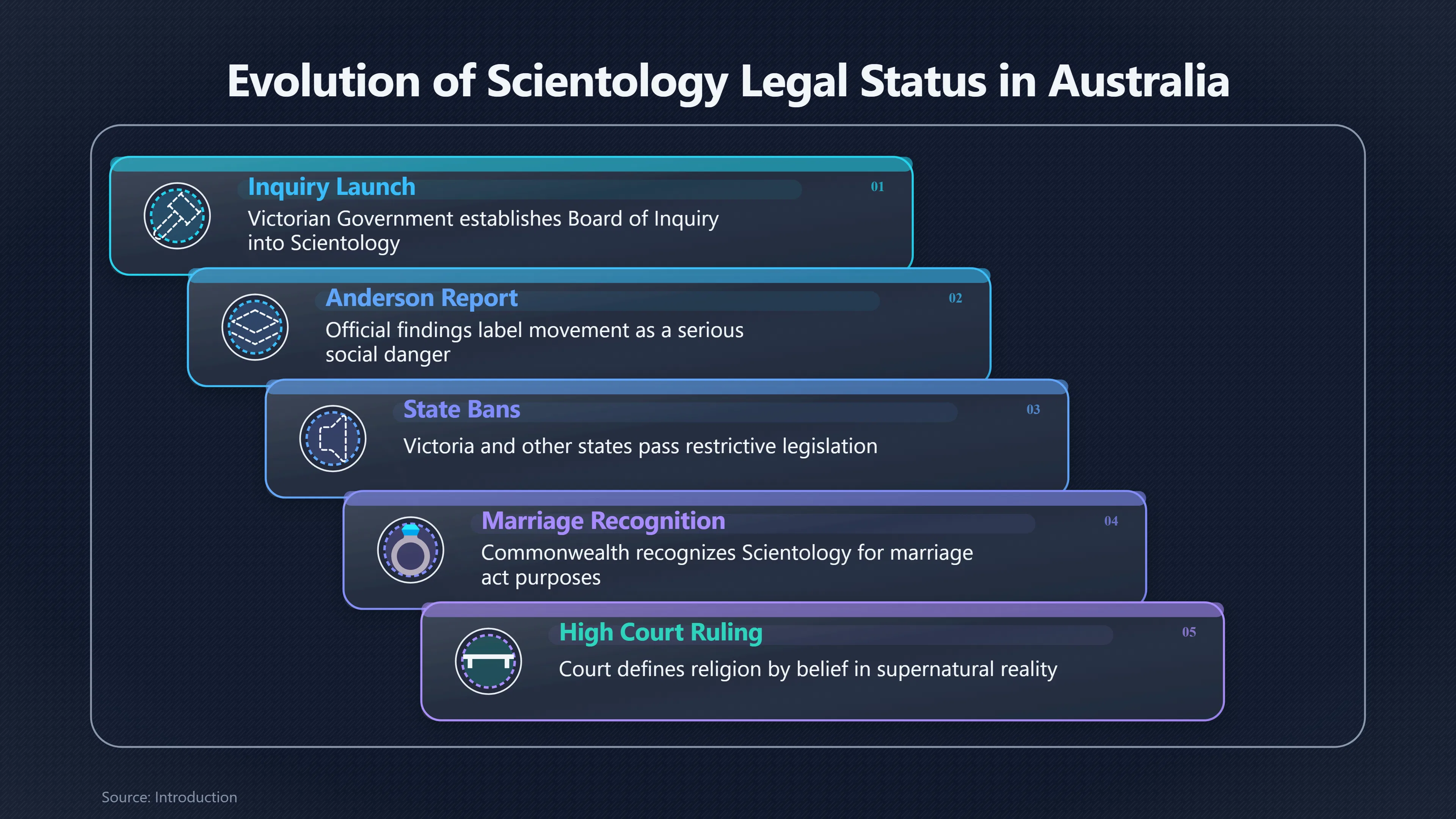
Australia became the first country to conduct a major public inquiry into Scientology when the Victorian Government established the Board of Inquiry into Scientology in 1963 under Queen’s Counsel Kevin Anderson. The inquiry heard evidence from more than 150 witnesses and examined thousands of documents before producing its report in 1965. Its terms of reference focused on Scientology’s methods, organisation and claimed therapeutic effects rather than its theology.[Research Data Australia]researchdata.edu.auResearch Data Australia Board of Inquiry into ScientologyResearch Data AustraliaBoard of Inquiry into ScientologyNovember 28, 1965…
The resulting Anderson Report was exceptionally hostile. It argued that Scientology’s techniques could produce psychological harm, foster dependency upon the organisation and give leaders excessive control over followers. It criticised the movement’s auditing practices, confidential records and medical claims, concluding that Scientology represented a serious social danger. Although the report discussed whether Scientology was a religion, Anderson stated that his inquiry was not intended to resolve theological questions but to investigate practices occurring in Victoria.[www5.austlii.edu.au]www5.austlii.edu.auREPORT OF THE BOARD OF INQUIRY INTO…
The report reflected wider anxieties of the period. During the 1960s, governments in many Western countries were becoming concerned about psychological manipulation, unconventional therapies and rapidly growing new religious movements. Scientology’s claims to improve mental health without recognised medical qualifications attracted particular scrutiny from psychiatrists and public officials.
Historians have also noted that the Anderson Inquiry became a model for later governmental investigations into controversial religious movements. Whether one agrees with its conclusions or not, it established an important precedent: governments could investigate alleged harmful conduct without directly judging the truth of religious beliefs.
State bans, legal resistance and religious recognition
The Anderson Report led Victoria to pass legislation in 1965 that severely restricted Scientology activities. Other states, including South Australia and Western Australia, introduced similar laws or restrictions during the late 1960s. Australia therefore became the first country where state governments attempted to suppress Scientology through legislation.[Wikipedia]WikipediaAnderson ReportAnderson Report
In practice, however, the bans proved difficult to enforce. Scientologists reorganised under different legal structures, including the name “Church of the New Faith”, and continued operating while challenging restrictions through the courts and political processes. Over time, changing public attitudes towards civil liberties also weakened support for outright prohibition.
By the early 1970s, governments increasingly distinguished between objectionable conduct and religious status. In 1973, the Commonwealth recognised Scientology for the purposes of the Marriage Act, allowing authorised ministers to conduct marriages. State prohibitions were gradually repealed during the following decade.[Daily Telegraph]dailytelegraph.com.auScientology was introduced in Australia in 1954 and quickly expanded with the establishment of its first church in Melbourne in 1955. How…
The decisive turning point came in 1983 when the High Court of Australia delivered its judgment in Church of the New Faith v Commissioner of Payroll Tax (Vic). The case concerned payroll tax exemptions rather than criminal law, but the judges used it to consider what legally constitutes a religion.
Rather than asking whether Scientology’s doctrines were true, reasonable or orthodox, the Court adopted a broader approach. It concluded that governments should avoid deciding theological truth and instead look for characteristics such as belief in a supernatural reality and accepted standards of conduct giving effect to those beliefs. Under that test, Scientology qualified as a religion.[acnc.gov.au]acnc.gov.au1. COM4 1983 High court decision Sientology articleCommissioner of Payroll Tax* (1983) is recognized as a landmark legal decision, establishing the standard for the definition of *religi…
The judgment became influential well beyond Scientology itself. It broadened legal protection for minority faiths and warned against allowing governments to favour established religions over unfamiliar ones.
Where regulation ends and persecution begins
The Australian experience raises a question that extends far beyond Scientology: when should governments regulate harmful behaviour without suppressing freedom of belief?
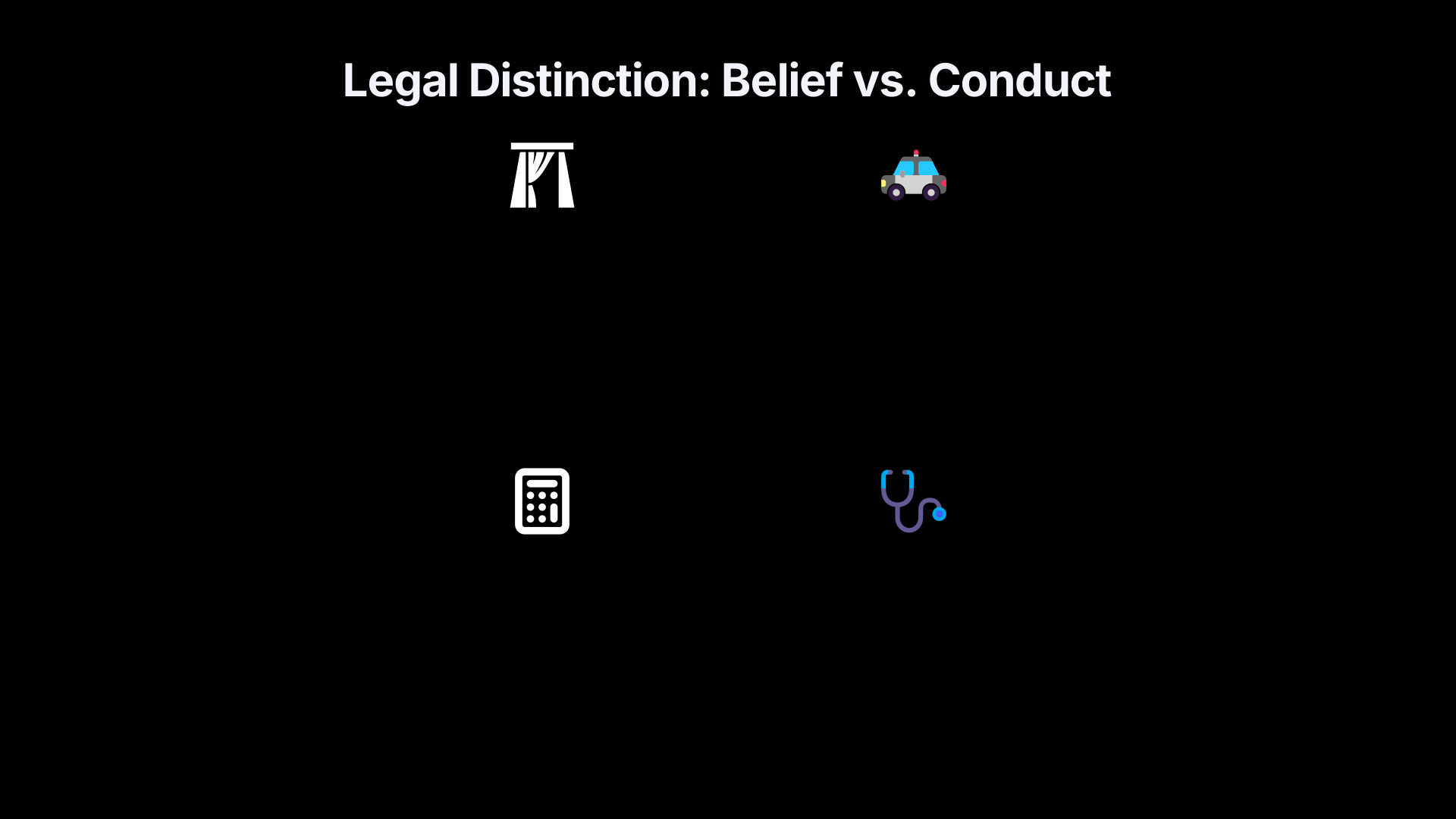
Modern liberal democracies generally distinguish between beliefs, which receive strong legal protection, and actions, which can be regulated when they cause demonstrable harm. This distinction helps explain why governments may legitimately intervene in areas such as:
- fraud or deceptive commercial practices;
- unlawful medical claims;
- child protection;
- coercion, abuse or unlawful imprisonment;
- workplace and financial offences; and
- other criminal conduct regardless of religious motivation.
By contrast, banning an organisation solely because its beliefs are unpopular creates a different set of risks. Once governments claim authority to decide which religions are genuine, minority faiths of many kinds may become vulnerable to political pressure or changing public opinion.
Australia’s legal evolution illustrates this balance. The Anderson Inquiry concentrated heavily on alleged harmful practices, yet the legislative response moved towards suppressing the organisation itself. The High Court later redirected the legal focus by emphasising religious neutrality while leaving ordinary criminal and civil law available to address misconduct.
A continuing influence on Australian debates
Scientology remains controversial in Australia. Former members have made allegations concerning psychological manipulation, family separation and other harmful practices, while the organisation has consistently rejected many of these claims and defended itself as a legitimate religion. More recent parliamentary discussions about coercive control and high-control groups have revisited many of the broader questions first raised during the 1960s, although they generally seek regulation aimed at harmful behaviour rather than prohibitions on particular belief systems.[News.com.au]news.com.auEducation was replaced by repeated mantras and auditing practices using the e-meter to probe "spiritual distress." After leaving the chur…
The legacy of the Scientology controversy therefore reaches beyond one movement. It shaped Australian thinking about the limits of state power, the protection of religious minorities and the importance of separating theological disagreement from evidence of actual harm. It also serves as a reminder that moral panic and genuine concern can coexist: allegations of abuse deserve careful investigation, but extraordinary legal powers to ban beliefs require equally careful justification.
Australia’s confrontation with Scientology ultimately transformed a dispute about one controversial movement into a lasting constitutional question. The country moved from attempting to prohibit an unpopular organisation towards a more durable principle: governments should punish unlawful conduct wherever it occurs, while remaining reluctant to decide which beliefs are worthy of legal protection.

Amazon book picks
Further Reading
Books and field guides related to Can a Government Ban a Belief System?. Use these as the next step if you want deeper reading beyond the article.
Cults in Our Midst
Provides broader context for evaluating high-control organizations.
Endnotes
1.
Source: researchdata.edu.au
Title: Research Data Australia Board of Inquiry into Scientology
Link:https://researchdata.edu.au/board-inquiry-scientology/490921
Source snippet
Research Data AustraliaBoard of Inquiry into ScientologyNovember 28, 1965...
Published: November 28, 1965
2.
Source: www5.austlii.edu.au
Link:https://www5.austlii.edu.au/au/other/vic/VicBCPubInq/1965/2.pdf
Source snippet
REPORT OF THE BOARD OF INQUIRY INTO...
3.
Source: Wikipedia
Title: Anderson Report
Link:https://en.wikipedia.org/wiki/Anderson_Report
4.
Source: acnc.gov.au
Title: 1. COM4 1983 High court decision Sientology article
Link:https://www.acnc.gov.au/sites/default/files/documents/2022-07/1.%20COM4_1983%20High%20court%20decision%20Sientology%20article.pdf
Source snippet
Commissioner of Payroll Tax* (1983) is recognized as a landmark legal decision, establishing *the standard* for the definition of *religi...
5.
Source: news.com.au
Link:https://www.news.com.au/lifestyle/real-life/true-stories/exscientology-member-recalls-dark-underbelly-of-church/news-story/cff746b6d7715a36b4dc5360ea177d97
Source snippet
Education was replaced by repeated mantras and auditing practices using the e-meter to probe "spiritual distress." After leaving the chur...
6.
Source: vgls.vic.gov.au
Link:https://www.vgls.vic.gov.au/client/en_AU/vgls/search/detailnonmodal?d=ent%3A%2F%2FSD_ILS%2F0%2FSD_ILS%3A343464~~0&h=8&ic=true&ps=300&qu=Anderson%2C+Victoria
7.
Source: vgls.vic.gov.au
Title: Report of the Board of Inquiry into Scientology / [Kevin Victor Anderson]
Link:https://www.vgls.vic.gov.au/client/en_AU/vgls/search/detailnonmodal.template.header_0.mainmenu.accessibilitymode?d=ent%3A%2F%2FSD_ILS%2F0%2FSD_ILS%3A343464~~0&h=8&ic=true&ps=300&qu=Anderson%2C+Victoria.&sdcsrf=3f03d4fe-e1b6-42e4-a871-e62000923996
8.
Source: scnfiles.com
Title: Anderson Report
Link:https://scnfiles.com/anderson-report/chapters-anderson/chapter28.html
Source snippet
Full Document | Victorian Government Inquiry into Scientology | SCNDBTHE ANDERSON REPORT Victorian Government Inquiry into the Practice a...
9.
Source: dailytelegraph.com.au
Link:https://www.dailytelegraph.com.au/news/nsw/revealed-history-of-the-church-of-scientology-in-australia/news-story/4d67f1a0cfbd6542844ec39f275b8691
Source snippet
Scientology was introduced in Australia in 1954 and quickly expanded with the establishment of its first church in Melbourne in 1955. How...
10.
Source: scnfiles.com
Title: Anderson Report
Link:https://scnfiles.com/anderson-report/chapters-anderson/chapter14.html
11.
Source: xenu.net
Title: The Anderson Report
Link:https://www.xenu.net/archive/audit/andrhome.html
12.
Source: scnfiles.com
Title: Anderson Report
Link:https://scnfiles.com/anderson-report/chapters-anderson/chapter31.html
Additional References
13.
Source: xenu.net
Title: GOVERNMENT REPORTS PARLIAMENTARY
Link:https://www.xenu.net/archive/audit/ofpapers.html
Source snippet
Official Papers on ScientologyJune 14, 1997 — A COLLECTION OF OFFICIAL reports and court judgements relating to Scientology THIS SITE HAS...
Published: June 14, 1997
14.
Source: youtube.com
Title: ‘Sorry mate’ neo-Nazi’s visa cancelled + Scientology’s Aussie rebrand
Link:https://www.youtube.com/watch?v=2QNwzsbfRj8
Source snippet
Dr. David Bennett AC, QC and former Solicitor General of Australia...
15.
Source: youtube.com
Title: Dr. David Bennett AC, QC and former Solicitor General of Australia
Link:https://www.youtube.com/watch?v=XVkzJxYGpjY
Source snippet
Better Believe It: Steve Cannane on Scientology in Australia...
16.
Source: xenu.net
Link:https://www.xenu.net/archive/audit/ar01.html
17.
Source: youtube.com
Title: Scientology: Fair Game?
Link:https://www.youtube.com/watch?v=jBmwZ_OmTdI
Source snippet
Why Scientology is dying in Australia | 60 Minutes Australia...
18.
Source: standleague.org
Title: 1983 australian high court decision re church scientology
Link:https://www.standleague.org/resources/decisions/1983-australian-high-court-decision-re-church-scientology.html
19.
Source: youtube.com
Title: Better Believe It: Steve Cannane on Scientology in Australia
Link:https://www.youtube.com/watch?v=91YWrejC71o
Source snippet
Scientology: Fair Game?...
20.
Source: reddit.com
Title: Australian inquiry into cults
Link:https://www.reddit.com/r/exmormon/comments/1p7pei9/australian_inquiry_into_cults/
Source snippet
Australian inquiry into cults...
21.
Source: dialogueireland.ie
Title: Dialogue Ireland Resources SCIENTOLOGY LITERATURE
Link:https://www.dialogueireland.ie/dicontent/resources/dciarchive/scn_literature.html
22.
Source: youtube.com
Title: Why Scientology is dying in Australia | 60 Minutes Australia
Link:https://www.youtube.com/watch?v=I9_XA8zAeJM
Topic Tree