Within Jordan Panics
Why Did Jordan's Vaccine Scare Spread?
More than 800 pupils sought medical help as anxiety-related symptoms turned a routine vaccination programme into a national alarm.
On this page
- From the first symptoms to hundreds of cases
- What investigators found about the vaccine
- Why genuine stress symptoms spread so quickly
Page outline Jump by section
Introduction
In late September 1998, a routine school vaccination campaign in Jordan became one of the world’s best-known examples of a mass vaccination scare. More than 800 pupils sought medical attention after receiving a combined tetanus-diphtheria (Td) vaccine, and 122 were admitted to hospital. The scale of the alarm led to fears that the vaccine had been contaminated or was otherwise unsafe. However, an extensive national investigation found no evidence that the vaccine itself had caused a widespread toxic reaction. Instead, investigators concluded that the overwhelming majority of cases were best explained by mass psychogenic illness—a phenomenon in which genuine physical symptoms spread through fear, expectation and social influence rather than through infection or poisoning.[PMC]pmc.ncbi.nlm.nih.govOctober 24, 2001…
The episode remains important because it demonstrates how a routine public health programme can become the focus of intense collective anxiety. It has since been widely cited by the World Health Organization (WHO) and vaccine-safety experts as a landmark case for understanding what is now more commonly described as an immunization stress-related response (ISRR).[World Health Organization]who.intWorld Health OrganizationImmunization stress-related response: a manual for program managers and health professionals to prevent, identif…
From the First Symptoms to Hundreds of Cases
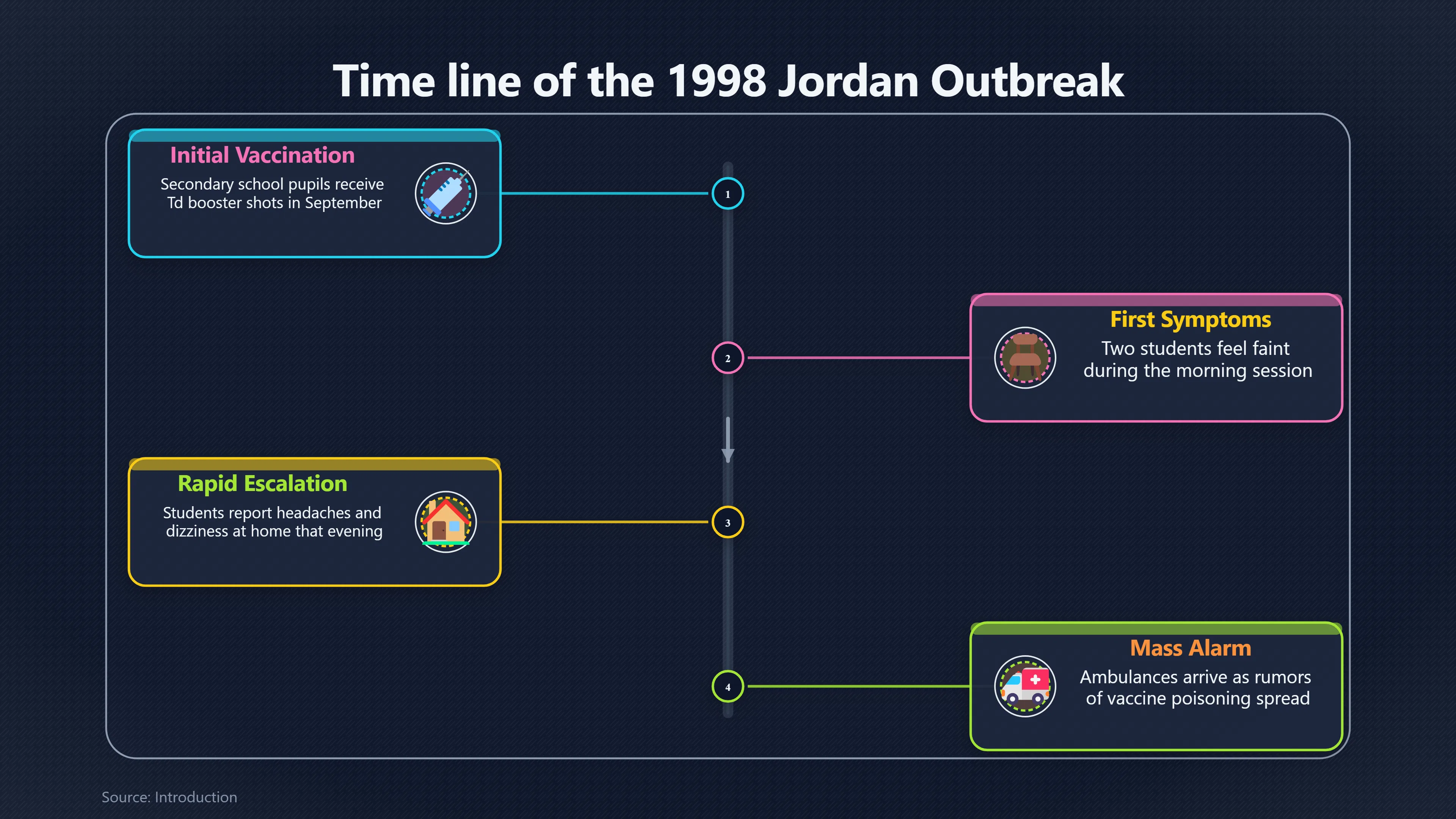
Jordan’s Ministry of Health began administering Td booster vaccinations to secondary school pupils during September 1998. At the school where the outbreak began, around 160 Year 10 boys were vaccinated during the morning. Two briefly felt faint during the vaccination session, recovered quickly and returned to class. Later that evening several students developed headaches and dizziness at home—symptoms that are recognised as possible short-term reactions after injections but are also common responses to stress and anxiety.[IRIS]iris.who.intIRISPolicy and PracticeOctober 4, 2025…
The following morning, one pupil who had felt unwell the previous evening stumbled while entering school and was taken to hospital. Soon afterwards other students began reporting similar complaints. As increasing numbers of pupils complained of feeling ill, ambulances arrived, parents rushed to schools and hospitals, and rumours spread rapidly that something was seriously wrong with the vaccine.[IRIS]iris.who.intIRISPolicy and PracticeOctober 4, 2025…
Within days the concern had spread far beyond the original school. Investigators eventually identified 806 students who sought medical attention after vaccination. Of these, 122 were admitted to hospital, although most remained only briefly and recovered without lasting effects. Cases appeared across several governorates despite different vaccine batches and different vaccination teams, suggesting that a single defective batch or administration error could not explain the pattern.[PMC]pmc.ncbi.nlm.nih.govOctober 24, 2001…
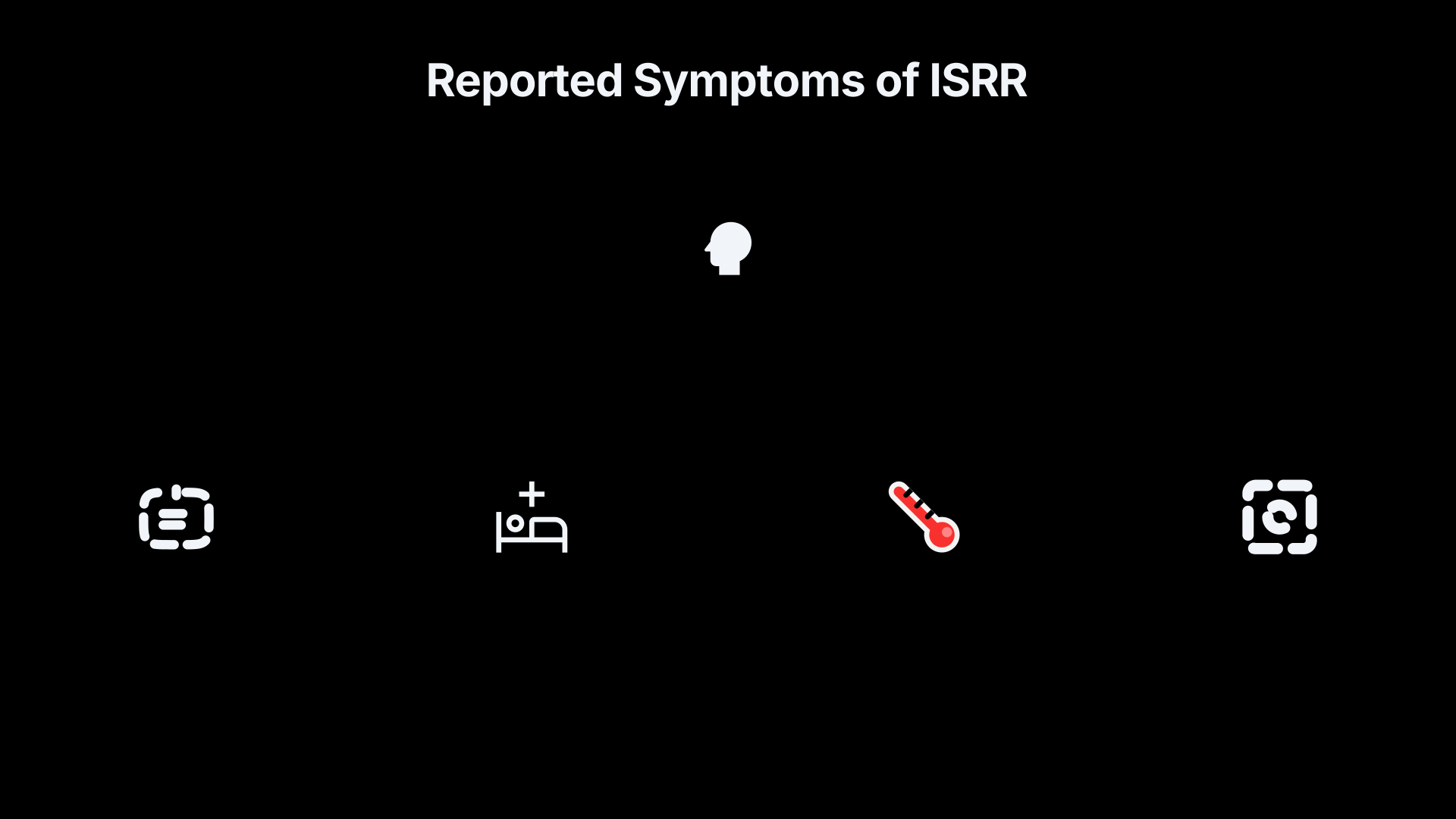
The most frequently reported symptoms included:
- headache
- dizziness
- weakness
- nausea
- abdominal discomfort
- faintness
- feverish feelings
- general malaise
These symptoms were real and distressing, even though investigators concluded they were generally not caused by vaccine toxicity.[PMC]pmc.ncbi.nlm.nih.govOctober 24, 2001…
What Investigators Found About the Vaccine
Because the illness involved schoolchildren and followed a government vaccination campaign, health authorities treated the incident as a potential public health emergency.
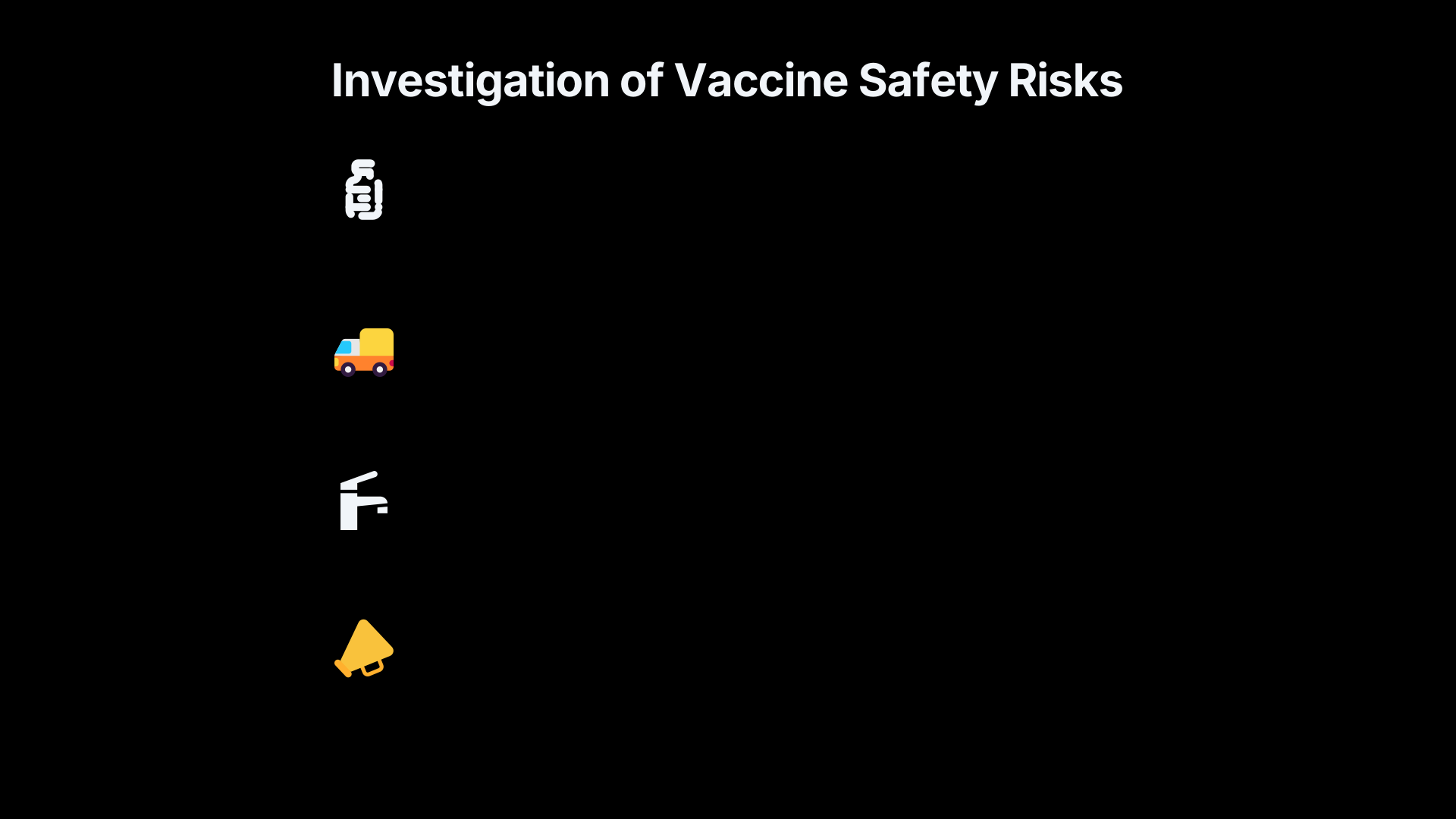
Investigators considered numerous possible explanations, including:
- contamination during vaccine manufacture;
- improper storage or transport;
- administration errors;
- food or water poisoning;
- environmental toxins;
- infectious disease.
These possibilities were examined through epidemiological surveys, hospital records and laboratory investigations. None provided evidence of a toxic exposure capable of explaining the nationwide pattern. Different vaccine lots had been used in different districts, and illness did not consistently follow any particular batch. Nor did investigators identify an infectious agent or environmental contaminant linking the affected schools.[PMC]pmc.ncbi.nlm.nih.govOctober 24, 2001…
Researchers concluded that a small number of pupils probably experienced ordinary reactions to vaccination, including temporary discomfort or faintness. The larger outbreak developed afterwards as anxiety and expectation spread through schools and communities rather than through a harmful property of the vaccine itself.[PMC]pmc.ncbi.nlm.nih.govOctober 24, 2001…
This distinction is crucial. The investigation did not conclude that students fabricated their symptoms. Rather, it concluded that psychological stress produced genuine physical symptoms which then spread socially within groups.[PMC]pmc.ncbi.nlm.nih.govOctober 24, 2001…
Why Genuine Stress Symptoms Spread So Quickly
Mass psychogenic illness is sometimes misunderstood as people “pretending” to be ill. Medical literature describes something quite different.
Strong anxiety can produce real bodily changes, including:
- rapid breathing (hyperventilation);
- dizziness;
- nausea;
- weakness;
- tingling sensations;
- fainting;
- headaches.
When these symptoms occur in a closely connected group—particularly where people can observe one another—others become highly alert to similar sensations in their own bodies. Ordinary feelings that would otherwise pass unnoticed can suddenly be interpreted as signs of serious illness.[PubMed]pubmed.ncbi.nlm.nih.govPub Med Mass psychogenic illness after vaccinationMass psychogenic illness after vaccination - PubMed…
School vaccination programmes contain several conditions that can amplify this process:
- large groups receiving injections together;
- fear of needles or side effects;
- pupils watching classmates become distressed;
- rapid communication between friends;
- worried parents receiving alarming reports;
- visible emergency responses such as ambulances and hospital admissions.
Each precaution taken by teachers, doctors and emergency services was medically appropriate, but those visible responses could also reinforce public belief that a dangerous poisoning had occurred.[PMC]pmc.ncbi.nlm.nih.govOctober 24, 2001…
The Jordan outbreak followed this pattern closely. Investigators later described how information travelled between pupils, parents, teachers, hospitals, emergency personnel and journalists much faster than any biological hazard could have spread.[PMC]pmc.ncbi.nlm.nih.govOctober 24, 2001…
The Role of the Media and Public Anxiety
Researchers paid particular attention to communication during the outbreak.
Television, newspapers and word of mouth rapidly expanded awareness of the incident beyond the original school. As more reports appeared, parents elsewhere became increasingly vigilant for possible vaccine reactions. Students who had already been vaccinated sometimes began noticing symptoms only after hearing about earlier cases.
The official investigation concluded that media coverage, parental concern and understandable caution within the healthcare system all contributed to escalating public alarm, even though each group was acting in good faith. This finding has become an important lesson in crisis communication: uncertainty itself can accelerate collective fear if authorities do not communicate quickly, transparently and consistently.[PMC]pmc.ncbi.nlm.nih.govOctober 24, 2001…
Why the 1998 Outbreak Became an International Case Study
The Jordan incident became one of the most frequently cited examples in vaccine safety literature because it was investigated thoroughly and documented in detail.
Its influence extends beyond Jordan. WHO and international vaccine-safety experts have repeatedly used the case to illustrate how clusters of anxiety-related reactions can threaten confidence in vaccination even when vaccines meet safety standards. Rather than dismissing affected people, modern guidance emphasises:
- recognising that symptoms are genuine;
- investigating possible medical causes thoroughly;
- communicating findings openly;
- avoiding language that suggests patients imagined their illness;
- preparing vaccination teams to recognise stress-related reactions early.
To reflect this broader understanding, WHO now prefers the term immunization stress-related response (ISRR) over older expressions such as “mass hysteria” or “immunization anxiety-related reaction”. The newer terminology recognises that biological, psychological and social factors interact during vaccination campaigns and that respectful communication is essential for maintaining public trust.[who.int]who.intWorld Health OrganizationImmunization stress-related response: a manual for program managers and health professionals to prevent, identif…
Why the Event Still Matters
The 1998 Jordan vaccination scare remains significant not because it exposed a dangerous vaccine, but because it revealed how quickly fear can become contagious in trusted public institutions.
The investigation showed that:
- the vaccine itself was not responsible for the nationwide outbreak;
- the reported symptoms were largely genuine physiological responses associated with stress rather than deliberate fabrication;
- rumours, observation and uncertainty can spread illness behaviour remarkably quickly;
- transparent investigation and communication are as important as laboratory testing during vaccine safety incidents.
For historians, psychologists and public health specialists, the Jordan outbreak stands as one of the clearest documented demonstrations of collective stress responses following immunization. It continues to shape international guidance on how vaccination programmes should prepare for, recognise and manage anxiety-related clusters while preserving both patient welfare and public confidence.[nih.gov]pmc.ncbi.nlm.nih.govOctober 24, 2001…
Amazon book picks
Further Reading
Books and field guides related to Why Did Jordan's Vaccine Scare Spread?. Use these as the next step if you want deeper reading beyond the article.
Extraordinary Popular Delusions and the Madness of Crowds
Rating: 4.0/5 from 5 Google Books ratings
Places vaccine scares within the wider history of collective belief.

The Psychology of Pandemics
Directly addresses fear-driven responses to vaccination and disease.


Endnotes
1.
Source: pmc.ncbi.nlm.nih.gov
Link:https://pmc.ncbi.nlm.nih.gov/articles/PMC2566491/
Source snippet
October 24, 2001...
Published: October 24, 2001
2.
Source: who.int
Link:https://www.who.int/publications-detail-redirect/978-92-4-151594-8
Source snippet
World Health OrganizationImmunization stress-related response: a manual for program managers and health professionals to prevent, identif...
3.
Source: iris.who.int
Title: IRISPolicy and Practice
Link:https://iris.who.int/bitstream/10665/268394/1/PMC2566491.pdf
Source snippet
October 4, 2025...
Published: October 4, 2025
4.
Source: pmc.ncbi.nlm.nih.gov
Title: PMCMass sociogenic illness
Link:https://pmc.ncbi.nlm.nih.gov/articles/PMC543940/
5.
Source: who.int
Title: World Health Organization Case studies review
Link:https://www.who.int/groups/global-advisory-committee-on-vaccine-safety/topics/vaccine-safety-information/case-studies-review
6.
Source: who.int
Link:https://www.who.int/publications/i/item/WHO-MVP-EMP-SAV-2019.08
7.
Source: wkc.who.int
Title: int Immunization stress related responses
Link:https://wkc.who.int/resources/publications/i/item/978-92-4-151594-8
8.
Source: who.int
Link:https://www.who.int/groups/global-advisory-committee-on-vaccine-safety/topics/aefi/isrs
9.
Source: pubmed.ncbi.nlm.nih.gov
Title: Pub Med Mass psychogenic illness after vaccination
Link:https://pubmed.ncbi.nlm.nih.gov/12814329/
Source snippet
Mass psychogenic illness after vaccination - PubMed...
10.
Source: pubmed.ncbi.nlm.nih.gov
Title: Pub Med Immunization stress-related response
Link:https://pubmed.ncbi.nlm.nih.gov/32131975/
Source snippet
Immunization stress-related response - Redefining immunization anxiety-related reaction as an adverse event following immunization...
11.
Source: pubmed.ncbi.nlm.nih.gov
Link:https://pubmed.ncbi.nlm.nih.gov/32673376/
Source snippet
2020 Jun 4;46(6):210-218. doi: 10.4745/ccdr.v46i06a10. MANAGING IMMUNIZATION STRESS-RELATED RESPONSE: A CONTRIBUTOR TO SUSTAINING TRUST I...
12.
Source: pubmed.ncbi.nlm.nih.gov
Link:https://pubmed.ncbi.nlm.nih.gov/30118381/
13.
Source: pmc.ncbi.nlm.nih.gov
Link:https://pmc.ncbi.nlm.nih.gov/articles/PMC6363158/
14.
Source: pmc.ncbi.nlm.nih.gov
Link:https://pmc.ncbi.nlm.nih.gov/articles/PMC10874769/
15.
Source: pubmed.ncbi.nlm.nih.gov
Link:https://pubmed.ncbi.nlm.nih.gov/29198916/
16.
Source: pubmed.ncbi.nlm.nih.gov
Link:https://pubmed.ncbi.nlm.nih.gov/15632400/
17.
Source: pubmed.ncbi.nlm.nih.gov
Link:https://pubmed.ncbi.nlm.nih.gov/9629291/
18.
Source: pubmed.ncbi.nlm.nih.gov
Link:https://pubmed.ncbi.nlm.nih.gov/11338694/
19.
Source: pubmed.ncbi.nlm.nih.gov
Link:https://pubmed.ncbi.nlm.nih.gov/9601200/
Additional References
20.
Source: youtube.com
Title: Why Mass Hysteria is Thriving in the 21st Century
Link:https://www.youtube.com/watch?v=vKZ9uJNEv80
Source snippet
The Razor-Thin Line Between Contagion and Connection | Dan Taberski | TED...
21.
Source: youtube.com
Title: The Razor-Thin Line Between Contagion and Connection | Dan Taberski | TED
Link:https://www.youtube.com/watch?v=u0fFIJapsRY
Source snippet
Episode 72. Mass Psychogenic Illness with Robert Baloh...
22.
Source: sciencedirect.com
Link:https://www.sciencedirect.com/science/article/pii/S0264410X20302589
Source snippet
ScienceDirect...
23.
Source: nejm.org
Link:https://www.nejm.org/doi/abs/10.1056/NEJM200001133420206
24.
Source: nejm.org
Link:https://www.nejm.org/doi/full/10.1056/NEJM200001133420206
25.
Source: researchgate.net
Link:https://www.researchgate.net/figure/Number-of-vaccinated-students-affected-by-district-and-vaccine-lot-29-September-5_tbl3_11801887
26.
Source: researchgate.net
Link:https://www.researchgate.net/publication/11801887_Mass_psychogenic_illness_following_tetanus-diphtheria_toxoid_vaccination_in_Jordan
27.
Source: youtube.com
Title: HPV and Psychogenic Reactions
Link:https://www.youtube.com/watch?v=PH9tJ23bAu4
Source snippet
Why Mass Hysteria is Thriving in the 21st Century - Robert Bartholomew...
28.
Source: doi.org
Title: The Influence of Psychological Stress on the Immune Response to Vaccinesa
Link:https://doi.org/10.1111/j.1749-6632.1998.tb09603.x
29.
Source: youtube.com
Title: Recognizing Anaphylaxis vs. Immunization Stress-Related Response
Link:https://www.youtube.com/watch?v=jfAbM4W2loY
Source snippet
HPV and Psychogenic Reactions...
Topic Tree