Within Georgia
Why Mkalavishvili Called Violence Religious Purification
Basili Mkalavishvili turned fears of foreign sects into a militant campaign framed as the cleansing of Orthodox Georgia.
On this page
- The excommunicated priest and his followers
- The language of contamination and cleansing
- Why the movement found wider tolerance
Page outline Jump by section
Introduction
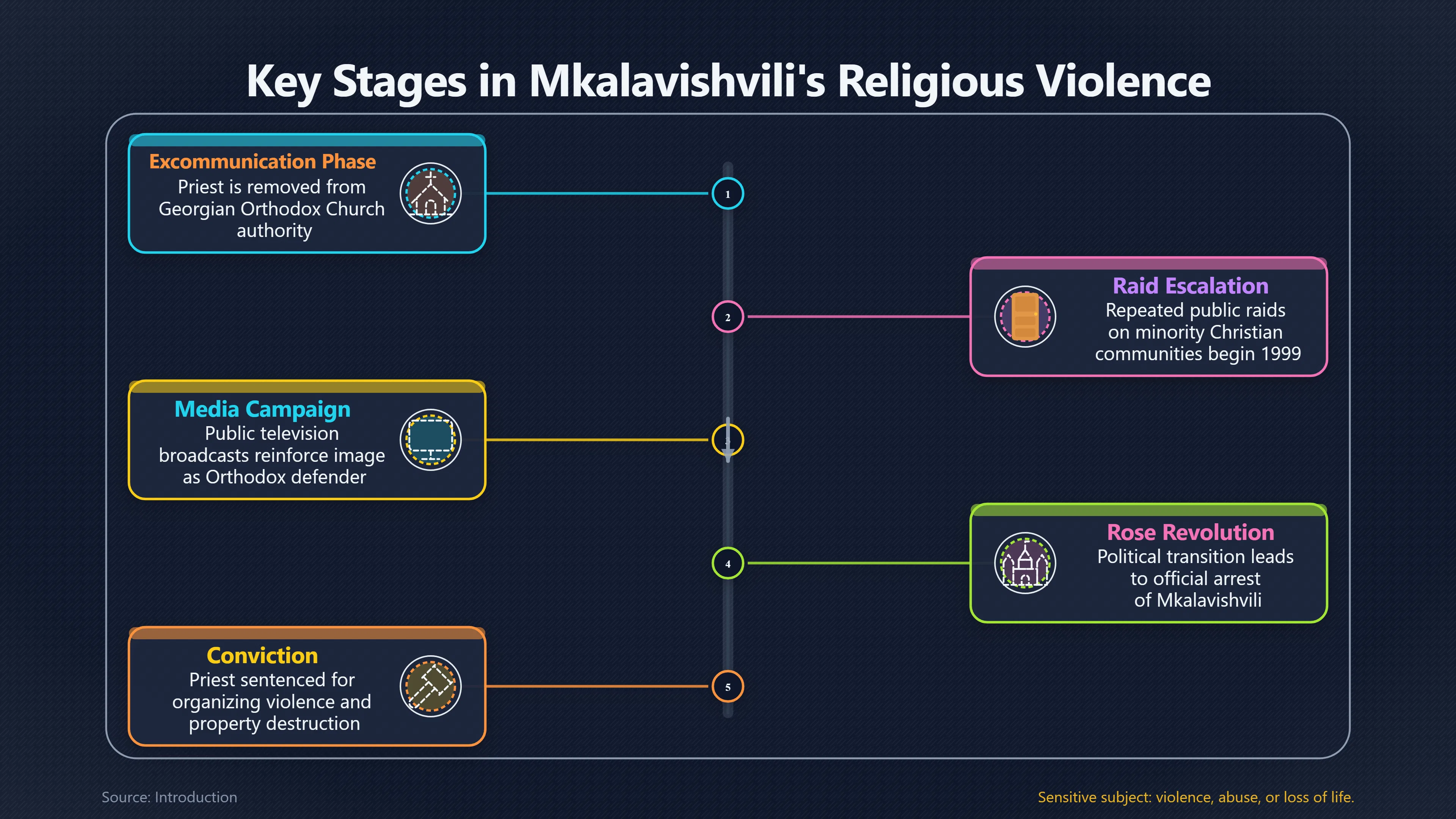
Basili Mkalavishvili became the best-known face of religiously motivated mob violence in post-Soviet Georgia because he presented attacks on religious minorities not as criminal acts but as a campaign to cleanse the country spiritually. An excommunicated Orthodox priest, he argued that Jehovah’s Witnesses, Pentecostals, Baptists and other minority Christian groups were dangerous foreign “sects” corrupting the nation. By framing violence as an act of religious purification rather than aggression, he gave supporters a moral vocabulary that justified intimidation, beatings and the destruction of religious literature. This rhetoric mattered because it transformed prejudice into organised action, especially at a time when state institutions were weak and many officials failed to intervene. Human rights investigators and later court proceedings concluded that the movement’s influence depended not only on Mkalavishvili’s leadership but also on a wider climate of tolerance for anti-minority violence.[Human Rights Watch]hrw.orgHuman Rights WatchMemorandum to the U.S. Government on Religious Violence in the Republic of Georgia | Human Rights WatchAugust 28, 2001…
The excommunicated priest and his followers
Mkalavishvili had been removed from the authority of the Georgian Orthodox Church, yet he continued to operate with a loyal following centred on what his supporters called the Gldani Orthodox Diocese. Although no longer recognised by the Church, he retained influence by presenting himself as a defender of authentic Orthodoxy against internal betrayal and foreign religious influence.[Human Rights Watch]hrw.orgHuman Rights WatchGeorgia Lets Attacks on Religious Believers Go Unpunished | Human Rights WatchSeptember 5, 2000…
His movement became notorious after repeated raids on meetings of Jehovah’s Witnesses and other minority Christian communities from 1999 onwards. These attacks were often highly public. Worshippers were beaten, religious services disrupted, literature confiscated and burned, and homes or meeting places vandalised. Human Rights Watch documented numerous incidents in which police either failed to intervene or were alleged to have assisted attackers by allowing them access to private gatherings.[Human Rights Watch]hrw.orgHuman Rights WatchMemorandum to the U.S. Government on Religious Violence in the Republic of Georgia | Human Rights WatchAugust 28, 2001…
Unlike a spontaneous crowd panic, the violence showed signs of organisation. Mkalavishvili frequently announced his intentions publicly, appeared on television, and encouraged supporters to continue attacks even when criminal investigations had begun. This combination of charismatic leadership, public messaging and repeated demonstrations gave the campaign a sense of legitimacy among sympathisers despite its violent methods.[Human Rights Watch]hrw.orgHuman Rights WatchMemorandum to the U.S. Government on Religious Violence in the Republic of Georgia | Human Rights WatchAugust 28, 2001…
The language of contamination and cleansing
The central mechanism of Mkalavishvili’s campaign was not theological debate but a rhetoric of contamination. Minority religions were portrayed as pollutants entering the Georgian national body rather than as fellow Christian denominations with different beliefs.
This language rested on several connected claims:
- Georgia was portrayed as an essentially Orthodox nation whose identity depended upon religious unity.
- Minority churches were described as foreign agents rather than ordinary religious communities.
- Their literature and missionary work were presented as infectious or corrupting influences.
- Violence against them was reframed as defensive “cleansing” rather than persecution.[Human Rights Watch]hrw.orgHuman Rights WatchHuman Rights Watch World Report 2002: Europe & Central Asia: Georgia…
Such rhetoric is well recognised by historians and scholars of collective violence. Describing opponents as sources of contamination lowers the perceived moral cost of attacking them because violence becomes associated with purification instead of punishment or revenge. In Georgia, this language was especially effective because Orthodoxy occupied an unusually important place in national identity after decades of Soviet repression of religion.[Human Rights Watch]hrw.orgHuman Rights WatchHuman Rights Watch World Report 2002: Europe & Central Asia: Georgia…
Mkalavishvili’s followers frequently destroyed Bibles and other religious publications belonging to minority groups in public burnings. These acts carried symbolic significance beyond simple vandalism. Destroying literature represented an attempt to eradicate ideas considered spiritually dangerous, reinforcing the narrative that Georgia needed protection from religious “infection”.[Human Rights Watch]hrw.orgHuman Rights WatchMemorandum to the U.S. Government on Religious Violence in the Republic of Georgia | Human Rights WatchAugust 28, 2001…
Why the movement found wider tolerance
Mkalavishvili’s influence cannot be explained simply by his own personality. His campaign developed during a period of political instability, weak policing and widespread anxiety over Georgia’s identity after the collapse of the Soviet Union.
Several conditions made his message resonate with some audiences:
- Orthodox Christianity had become closely identified with national recovery and independence.
- Many minority churches had international links, making it easier to portray them as foreign intrusions.
- Public understanding of newer religious movements was often limited, allowing hostile stereotypes about “sects” to spread.
- State authorities frequently failed to investigate attacks promptly, creating an impression that violence would not be punished.[Human Rights Watch]hrw.orgOpen source on hrw.org.
Importantly, historians and human rights organisations distinguish between genuine concern about unfamiliar religious groups and the organised moral panic promoted by militant activists. There was no evidence that Jehovah’s Witnesses or other targeted communities were engaged in conspiracies against the Georgian state. Instead, investigators found that rumours about hidden foreign control, psychological manipulation and national betrayal were repeatedly used to justify intimidation against legally operating religious communities.[Human Rights Watch]hrw.orgHuman Rights WatchMemorandum to the U.S. Government on Religious Violence in the Republic of Georgia | Human Rights WatchAugust 28, 2001…
The wider media environment also played a role. Some television stations broadcast footage supplied by Mkalavishvili’s supporters, giving attacks extensive publicity and inadvertently reinforcing his image as a defender of Orthodoxy rather than an organiser of criminal violence. Human Rights Watch argued that this visibility, combined with official inaction, helped spread similar attacks beyond Tbilisi into other parts of Georgia.[Human Rights Watch]hrw.orgHuman Rights WatchHuman Rights Watch World Report 2002: Europe & Central Asia: Georgia…
From tolerated violence to criminal prosecution
For several years, Mkalavishvili appeared able to organise attacks despite repeated complaints from victims and human rights organisations. Investigators documented dozens of assaults while prosecutions either stalled or failed to result in meaningful enforcement. This prolonged impunity strengthened the impression among supporters that their actions enjoyed unofficial approval.[Human Rights Watch]hrw.orgOpen source on hrw.org.
The situation changed after Georgia’s political transition following the Rose Revolution. Authorities eventually arrested Mkalavishvili, and in January 2005 he was convicted of organising violence against religious minorities and destroying property. Human Rights Watch described the conviction as an important step in ending the climate of impunity that had allowed attacks to continue for years, while noting that broader reforms were still necessary to protect freedom of religion.[Human Rights Watch]hrw.orgHuman Rights WatchGeorgia: Ex-Priest Jailed for Attacks Against Religious Minorities | Human Rights WatchJanuary 30, 2005…
Why this case remains important
Mkalavishvili’s movement illustrates how nationalist religious language can transform social prejudice into organised collective violence without relying on elaborate conspiracy theories or formal political power.
The case remains significant because it demonstrates several recurring mechanisms found in moral panics involving religion:
- defining minority groups as existential threats rather than neighbours;
- presenting social diversity as national contamination;
- portraying violence as moral purification;
- exploiting weak law enforcement to normalise intimidation;
- using repeated public spectacles to recruit supporters and spread fear.
Rather than representing a spontaneous outbreak of “mass hysteria”, the campaign is better understood as a sustained moral panic built around religious nationalism, charismatic leadership and official passivity. It has become one of the clearest modern examples in Georgia of how purification rhetoric can legitimise persecution while claiming to defend national and religious identity.[Human Rights Watch]hrw.orgHuman Rights WatchHuman Rights Watch World Report 2002: Europe & Central Asia: Georgia…
Amazon book picks
Further Reading
Books and field guides related to Why Mkalavishvili Called Violence Religious Purification. Use these as the next step if you want deeper reading beyond the article.


The Orthodox Church in the history of Russia
Offers regional Orthodox historical context.
Endnotes
1.
Source: hrw.org
Link:https://www.hrw.org/news/2001/08/28/memorandum-us-government-religious-violence-republic-georgia
Source snippet
Human Rights WatchMemorandum to the U.S. Government on Religious Violence in the Republic of Georgia | Human Rights WatchAugust 28, 2001...
Published: August 28, 2001
2.
Source: hrw.org
Link:https://www.hrw.org/legacy/wr2k2/europe9.html
Source snippet
Human Rights WatchHuman Rights Watch World Report 2002: Europe & Central Asia: Georgia...
3.
Source: hrw.org
Link:https://www.hrw.org/news/2000/09/05/georgia-lets-attacks-religious-believers-go-unpunished-0
Source snippet
Human Rights WatchGeorgia Lets Attacks on Religious Believers Go Unpunished | Human Rights WatchSeptember 5, 2000...
Published: September 5, 2000
4.
Source: hrw.org
Link:https://www.hrw.org/news/2001/11/08/georgia-shevardnadze-must-end-religious-violence
5.
Source: hrw.org
Link:https://www.hrw.org/news/2005/01/30/georgia-ex-priest-jailed-attacks-against-religious-minorities
Source snippet
Human Rights WatchGeorgia: Ex-Priest Jailed for Attacks Against Religious Minorities | Human Rights WatchJanuary 30, 2005...
Published: January 30, 2005
6.
Source: hrw.org
Title: Memorandum to the U.S
Link:https://www.hrw.org/legacy/backgrounder/eca/georgia/georgia_memo_full.htm
Source snippet
Government on Religious Violence in the Republic of Georgia (Human Rights Watch August 2001)August 29, 2001 — The evidence indicates that...
Published: August 29, 2001
7.
Source: hrw.org
Title: Georgia: Mobs Terrorize Non-Orthodox Christians | Human Rights Watch
Link:https://www.hrw.org/news/2001/08/28/georgia-mobs-terrorize-non-orthodox-christians
Source snippet
"People should be entitled to worship without fear," said Elizabeth Andersen, executive director...
8.
Source: hrw.org
Title: Georgia Lets Attacks on Religious Believers Go Unpunished | Human Rights Watch
Link:https://www.hrw.org/news/2000/09/05/georgia-lets-attacks-religious-believers-go-unpunished
Source snippet
September 5, 2000 — GEORGIA LETS ATTACKS ON RELIGIOUS BELIEVERS GO UNPUNISHED Print Donate Now September 5, 2000 8:00PM EDT | News Releas...
Published: September 5, 2000
Additional References
9.
Source: jw.org
Link:https://www.jw.org/en/library/magazines/g20020122/Religious-Persecution-in-Georgia-How-Much-Longer/
Source snippet
Religious Persecution in Georgia—How Much Longer?January 22, 2002 — Concerned observers in Europe and other parts of the world hope that...
Published: January 22, 2002
10.
Source: jw.org
Title: ECH R Accepts Georgia’s Admission of Human Rights Violations
Link:https://www.jw.org/en/news/region/georgia/human-rights-violations-case/
Source snippet
ECHR Accepts Georgia’s Admission of Human Rights ViolationsJune 22, 2015 — EUROPEAN COURT OF HUMAN RIGHTS ACCEPTS GEORGIA’S ADMISSION ABO...
Published: June 22, 2015
11.
Source: youtube.com
Title: Why Georgia’s Foreign Agents Law Undermines Democracy and Human Rights
Link:https://www.youtube.com/watch?v=-hipyeM7W0I
Source snippet
Foreign agents' legislation passed: Georgian parliament approves contentious bill...
12.
Source: youtube.com
Link:https://www.youtube.com/watch?v=Mr1W1NhAPFs
Source snippet
Tbilisi, Gldani District.Walking through in Tbilisi.Georgia...
13.
Source: youtube.com
Title: Lost in Transition? Malkhaz Songhulashvili // Малхаз Сонгулашвили
Link:https://www.youtube.com/watch?v=KxZAafP5xrs
Source snippet
Why Georgia's Foreign Agents Law Undermines Democracy and Human Rights...
14.
Source: youtube.com
Title: Jehovah’s Witness material destroyed by religious group
Link:https://www.youtube.com/watch?v=P-Z_z4doe1Q
Source snippet
Lost in Transition? Malkhaz Songhulashvili // Малхаз Сонгулашвили...
15.
Source: refworld.org
Link:https://www.refworld.org/reference/annualreport/usdos/2003/en/30865
Source snippet
Department of State Annual Report on International Religious Freedom for 2003 - Georgia | RefworldDecember 18, 2003 — Abuses of Religious...
Published: December 18, 2003
16.
Source: refworld.org
Link:https://www.refworld.org/reference/annualreport/usdos/2004/en/34563
Source snippet
Department of State Annual Report on International Religious Freedom for 2004 - Georgia | RefworldSeptember 15, 2004 — Since 1999, follow...
Published: September 15, 2004
17.
Source: youtube.com
Title: Tbilisi, Gldani District.Walking through in Tbilisi.Georgia
Link:https://www.youtube.com/watch?v=z7gpcPnLqnU
Topic Tree