Within Mauritius
Did Colonial Newspapers Invent a Witchcraft Panic?
Reports of sorcery-related deaths reveal both genuine fears of harm and a press eager to portray Mauritius as irrational.
On this page
- What nineteenth century reports claimed
- Healing, poisoning and accusations of sorcery
- How colonial storytelling distorted local belief
Page outline Jump by section
Introduction
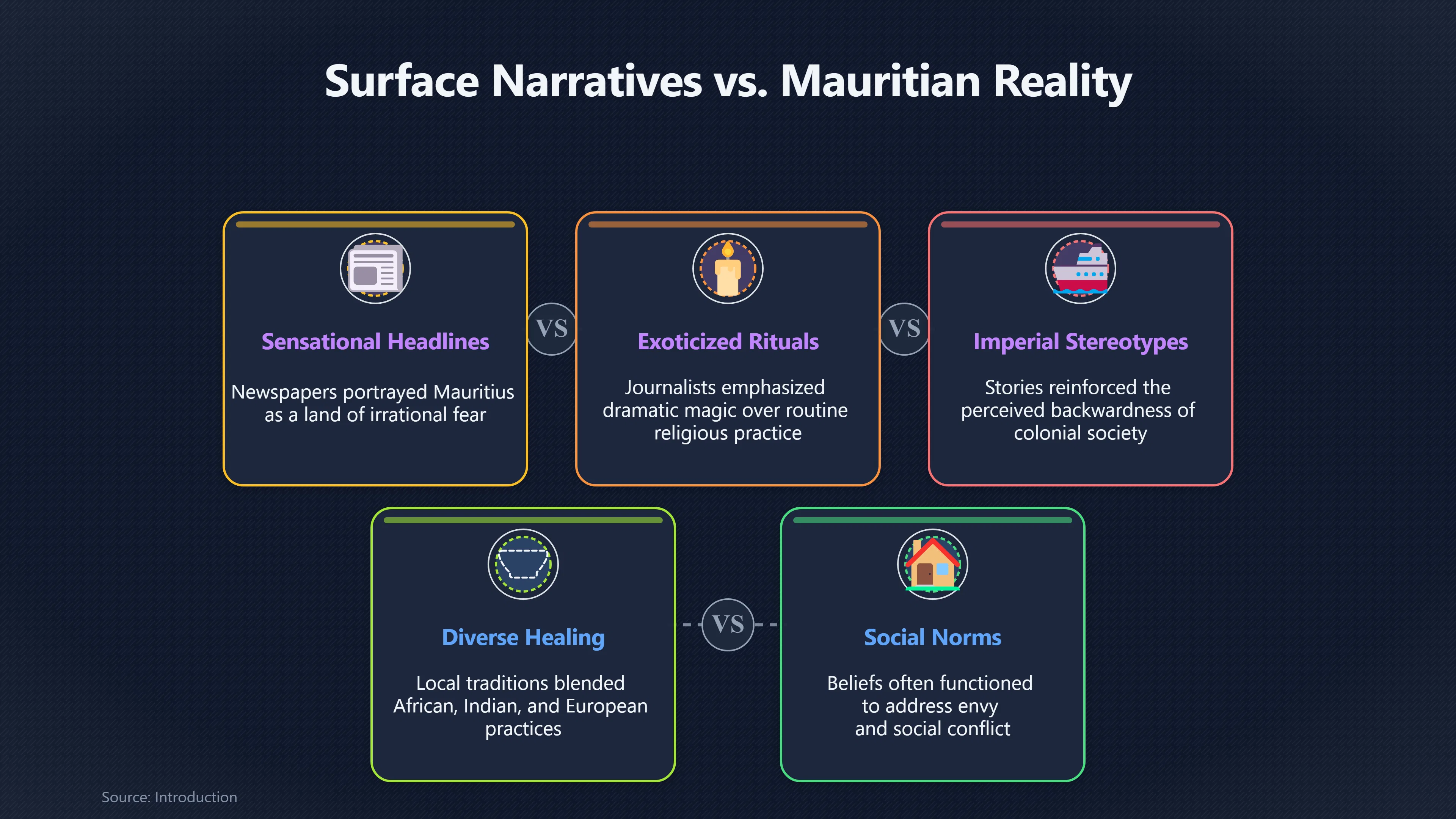
Nineteenth-century reports of witchcraft-related deaths in Mauritius are often cited as proof that the colony was gripped by irrational fear. A closer reading of the evidence suggests a more complicated story. Fatal crimes, unexplained illnesses and accusations of sorcery did occur, but many of the best-known accounts reached wider audiences through colonial newspapers that mixed genuine criminal reporting with highly dramatic descriptions of “native superstition”. As stories travelled through newspapers in Mauritius, Britain, Australia and New Zealand, they were frequently rewritten to emphasise the supposed backwardness of colonial society rather than to explain the local circumstances. The result was not a documented island-wide witchcraft panic but a series of sensational narratives in which real tragedies became evidence for imperial stereotypes.
What nineteenth-century reports claimed
Colonial newspapers repeatedly described Mauritius as a place where witch doctors, magical books and occult rituals supposedly influenced everyday life. Reports commonly asserted that sorcerers attracted clients from every social class, claimed that educated people secretly consulted magical practitioners, and suggested that belief in supernatural harm remained widespread despite schools, churches and modern administration. These articles often presented themselves as eyewitness correspondence from Port Louis before being reprinted throughout the British Empire.[Papers Past]paperspast.natlib.govt.nzPapers PastPapers Past | Newspapers | Star (Christchurch) | 5 February 1885 | MURDER AND WITCHCRAFT IN MAURITIUS.February 5, 1885…
One of the most widely circulated stories concerned a man identified as Picot, described as a sorcerer who was convicted after the murder of a young girl in the early 1880s. Newspaper accounts claimed that the victim’s body had been mutilated because human remains were believed to strengthen magical charms. They further reported that the condemned man insisted his supernatural powers would prevent his execution, a detail that reinforced the image of irrational belief confronting colonial justice. The reports spread far beyond Mauritius, appearing in newspapers in New Zealand and elsewhere with little independent verification beyond the original colonial correspondence.[Papers Past]paperspast.natlib.govt.nzPapers PastPapers Past | Newspapers | Star (Christchurch) | 5 February 1885 | MURDER AND WITCHCRAFT IN MAURITIUS.February 5, 1885…
Another widely reprinted story from the late 1880s described rumours that children were being abducted as sacrifices to defeat a supernatural sea spirit. The reports portrayed frightened parents, rumours of disappearances and public alarm, while simultaneously presenting Mauritian society as unusually vulnerable to superstition. Yet the articles themselves acknowledged that the panic began with rumour rather than documented ritual killings.[Papers Past]paperspast.natlib.govt.nzPapers PastPapers Past | Newspapers | Hawke's Bay Herald | 13 February 1888 | SUPERSTITION IN MAURITIUS…
Healing, poisoning and accusations of sorcery
The newspaper stories become easier to understand when placed alongside what is known about healing and magical belief in Mauritius rather than treating them as simple records of fact.
Mauritian society brought together traditions from Africa, Madagascar, India, Europe and China. Alongside religious institutions, many people consulted folk healers for illness, protection or suspected curses. Colonial newspapers rarely distinguished clearly between herbal practitioners, spiritual healers, fortune tellers and individuals accused of criminal fraud, often grouping them all together as “witch doctors”.[Taylor & Francis Online]tandfonline.comTaylor & Francis OnlineFull article: God, witchcraft, and beliefs about illness in MauritiusAugust 28, 2024…
This mattered because deaths attributed to witchcraft were frequently linked to ordinary crimes or medical uncertainty rather than demonstrable supernatural events. Newspaper reports regularly combined poisoning allegations, unexplained illness and interpersonal conflict with assumptions about sorcery. Where modern readers might distinguish homicide, accidental poisoning, fraud and supernatural belief, Victorian journalism often merged them into a single dramatic narrative about “witchcraft”.
Modern research suggests that belief in witchcraft in Mauritius has generally functioned less as an explanation for every misfortune than as one possible interpretation when illness seems unusually severe, mysterious or socially meaningful. People become more likely to suspect supernatural causes when normal explanations appear inadequate or when relationships involving envy, conflict or suspected wrongdoing already exist.[Taylor & Francis Online]tandfonline.comOpen source on tandfonline.com.
How colonial storytelling distorted local belief
The strongest pattern in the surviving newspaper record is not evidence of a sustained witchcraft panic but evidence of selective storytelling.
Colonial correspondents wrote for readers in Britain and other parts of the Empire who expected exotic and morally instructive stories from overseas possessions. Accounts therefore tended to emphasise:
- extraordinary crimes rather than ordinary everyday life;
- dramatic magical rituals instead of routine religious practice;
- apparent conflict between “civilisation” and “superstition”;
- lurid details that encouraged republication across imperial newspapers.
The repeated reference to the French magical text Petit Albert illustrates this process. Journalists portrayed the book as the secret manual behind widespread sorcery, despite admitting that many alleged practitioners had never seen or read it themselves. The reference gave readers a familiar European point of comparison while reinforcing the impression of a hidden occult network operating across the colony.[Papers Past]paperspast.natlib.govt.nzPapers PastPapers Past | Newspapers | Star (Christchurch) | 5 February 1885 | MURDER AND WITCHCRAFT IN MAURITIUS.February 5, 1885…
The resulting picture exaggerated coherence. The articles implied an organised culture of witchcraft where the evidence often points instead to diverse healing traditions, local rumours and occasional criminal cases interpreted through existing supernatural beliefs.
What modern research suggests
Recent anthropological and psychological research paints a far more nuanced picture than nineteenth-century journalism.
Studies conducted in Mauritius show that witchcraft beliefs remain culturally recognisable but are embedded within a society that also relies heavily on biomedical healthcare and mainstream religious traditions. Magical practitioners continue to exist, yet accusations are relatively uncommon compared with parts of mainland Africa where witchcraft allegations have produced large-scale violence or formal witch hunts. Researchers instead describe gossip, reputational damage and occasional neighbourhood disputes as the more typical social consequences.[Taylor & Francis Online]tandfonline.comTaylor & Francis OnlineFull article: God, witchcraft, and beliefs about illness in MauritiusAugust 28, 2024…
Experimental studies further suggest that accusations often reflect concerns about envy and damaged social relationships rather than indiscriminate fear. Participants are more likely to infer witchcraft when someone appears motivated by jealousy or selfishness, indicating that supernatural explanations can reinforce local social norms rather than simply expressing irrational terror.[Springer Nature Link]link.springer.comSpringer Nature LinkWitchcraft, Envy, and Norm Enforcement in Mauritius | Human Nature | Springer Nature Link…
These findings help explain why nineteenth-century newspapers could report both widespread belief and relatively few verified witchcraft killings. Belief in harmful magic existed, but it did not automatically produce organised persecution or sustained public panic.

Why these reports still matter
The colonial newspaper stories remain historically important because they reveal as much about imperial journalism as about Mauritius itself.
They documented genuine crimes, rumours and anxieties, but they also transformed isolated events into evidence that an entire colony remained trapped in superstition. Modern historians therefore treat many of these articles cautiously, reading them alongside court records, later scholarship and research on Mauritian religious life rather than accepting them at face value.
Seen in this broader context, the reports illustrate the interaction between real fear, local healing traditions and the commercial logic of colonial news. Deaths linked to accusations of sorcery were exceptional enough to become headlines, while the newspapers’ dramatic framing helped create an enduring image of Mauritius that was often more sensational than representative.

Endnotes
1.
Source: paperspast.natlib.govt.nz
Link:https://paperspast.natlib.govt.nz/newspapers/TS18850205.2.35
Source snippet
Papers PastPapers Past | Newspapers | Star (Christchurch) | 5 February 1885 | MURDER AND WITCHCRAFT IN MAURITIUS.February 5, 1885...
Published: February 5, 1885
2.
Source: paperspast.natlib.govt.nz
Link:https://paperspast.natlib.govt.nz/newspapers/HBH18880213.2.18
Source snippet
Papers PastPapers Past | Newspapers | Hawke's Bay Herald | 13 February 1888 | SUPERSTITION IN MAURITIUS...
Published: February 1888
3.
Source: tandfonline.com
Link:https://www.tandfonline.com/doi/full/10.1080/2153599X.2024.2363748
Source snippet
Taylor & Francis OnlineFull article: God, witchcraft, and beliefs about illness in MauritiusAugust 28, 2024...
Published: August 28, 2024
4.
Source: tandfonline.com
Link:https://www.tandfonline.com/doi/abs/10.1080/2153599X.2024.2363748
5.
Source: link.springer.com
Link:https://link.springer.com/article/10.1007/s12110-024-09484-4
Source snippet
Springer Nature LinkWitchcraft, Envy, and Norm Enforcement in Mauritius | Human Nature | Springer Nature Link...
6.
Source: tandfonline.com
Link:https://www.tandfonline.com/doi/abs/10.1080/2153599X.2021.2006286
7.
Source: vintagemauritius.org
Title: Port Louis
Link:https://vintagemauritius.org/port-louis/port-louis-the-devastating-cyclone-of-1892-mauritius/
Additional References
8.
Source: pmc.ncbi.nlm.nih.gov
Title: PMCWitchcraft, Envy, and Norm Enforcement in Mauritius
Link:https://pmc.ncbi.nlm.nih.gov/articles/PMC11836218/
Source snippet
2025 Jan 22;35(4):347–381. doi: 10.1007/s12110-024-09484-4 WITCHCRAFT, ENVY, AND NORM ENFORCEMENT IN MAURITIUS Aiyana K Willard AIYANA K...
9.
Source: researchgate.net
Title: (PDF) Witchcraft, Envy, and Norm Enforcement in Mauritius
Link:https://www.researchgate.net/publication/388275087_Witchcraft_Envy_and_Norm_Enforcement_in_Mauritius
Source snippet
January 22, 2025 — Article PDF Available WITCHCRAFT, ENVY, AND NORM ENFORCEMENT IN MAURITIUS * January 2025 * Human Nature 35(4):347-381...
Published: January 22, 2025
10.
Source: youtube.com
Link:https://www.youtube.com/watch?v=O62jWdJYa1k
Source snippet
Stanley Cohen: Folk Devils and Moral Panics...
11.
Source: youtube.com
Title: History of Media Literacy, Part 1: Crash Course Media Literacy #2
Link:https://www.youtube.com/watch?v=oXf0F4GYzWQ
Source snippet
The Disturbing Reality of the Salem Witch Trials...
12.
Source: youtube.com
Title: Stanley Cohen: Folk Devils and Moral Panics
Link:https://www.youtube.com/watch?v=AKhLAzdiCfQ
Source snippet
History of Media Literacy, Part 1: Crash Course Media Literacy #2...
13.
Source: muni.cz
Link:https://www.muni.cz/en/research/publications/2471663
14.
Source: ukessays.com
Link:https://www.ukessays.com/essays/media/the-press-in-mauritius-media-essay.php
15.
Source: wellcomecollection.org
Link:https://wellcomecollection.org/works/a2kgnftu
16.
Source: muni.cz
Link:https://www.muni.cz/vyzkum/publikace/2471663
17.
Source: blog.britishnewspaperarchive.co.uk
Link:https://blog.britishnewspaperarchive.co.uk/2017/10/28/halloween-in-history/
Topic Tree