Who Defined Truth and Danger in Bulgaria?
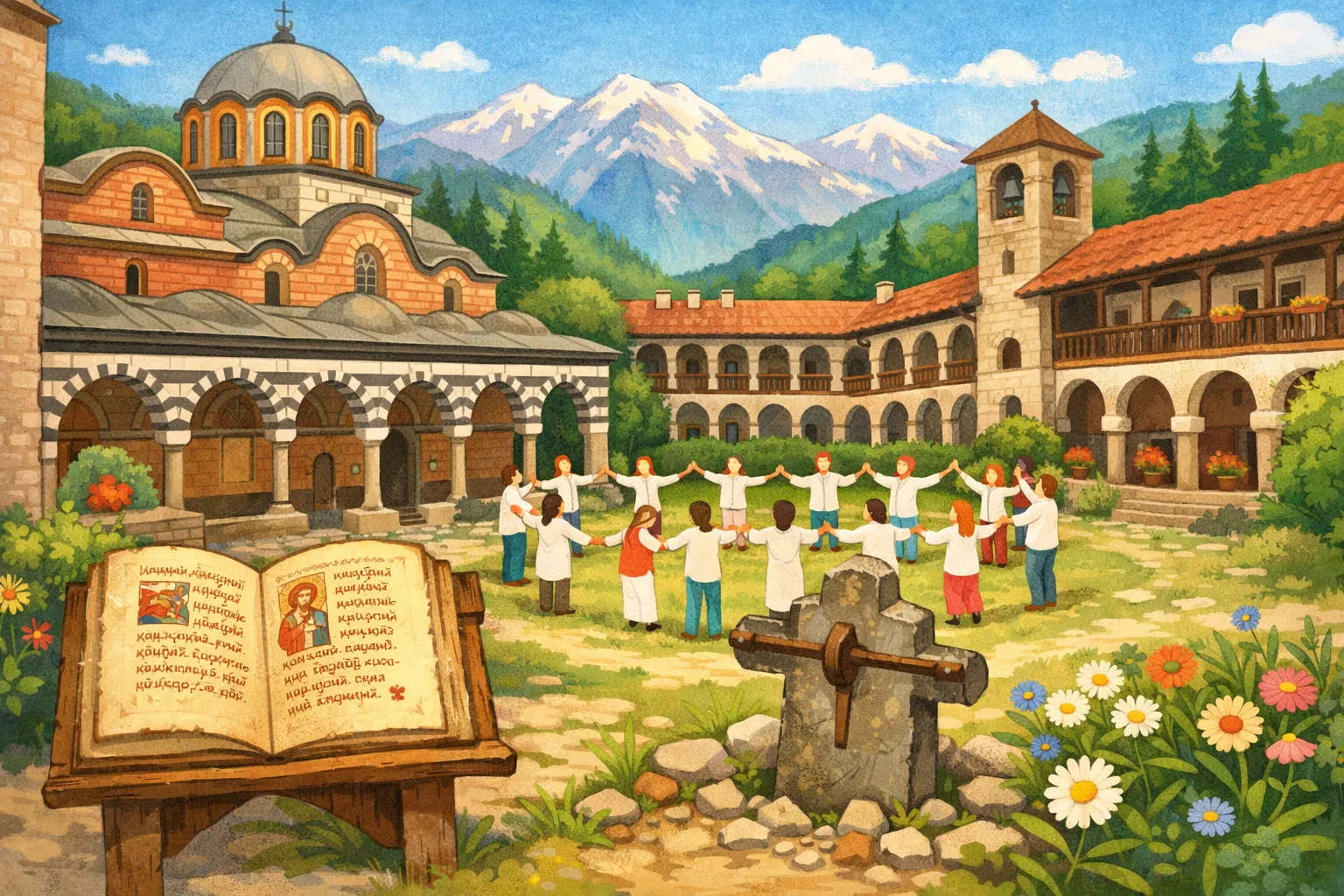
Bulgaria’s history of contagious belief is not dominated by one famous outbreak of “mass hysteria”. Instead, it reveals a recurring struggle over who may define religious truth, credible knowledge and social danger. Medieval rulers and clergy portrayed the Bogomils as a subversive heresy.
Page outline Jump by section
Introduction
These episodes should not be treated as equivalent. Some involved organised religious movements; others were folklore, political persecution, media-driven moral panics or digitally amplified rumours. Bulgaria’s most revealing pattern is therefore not collective madness, but repeated uncertainty about authority: whether to trust the established Church, the state, scientific institutions, charismatic spiritual figures or stories circulating through personal networks.
The Bogomils: heretics, dissidents or a movement reconstructed by its enemies?
Bogomilism emerged in the Bulgarian Empire during the tenth century and became one of medieval Europe’s most influential dissident Christian traditions. It is commonly associated with a priest called Bogomil, although historians possess little reliable information about him. The movement’s followers appear to have rejected the authority and wealth of the established Church, questioned conventional ritual and taught a form of dualism in which the material world was associated with evil or a rebellious spiritual power. Their ideas later circulated through Byzantine and Balkan territories and were connected, sometimes too confidently, with dissident movements farther west.[Cambridge University Press & Assessment]cambridge.orgUniversity Press & Assessment Bogomils (Chapter 14Cambridge University Press & AssessmentBogomils (Chapter 14) - The Cambridge Companion to…17 Jul 2025 — This chapter bases its analysi…
What the Bogomils themselves believed is difficult to reconstruct because much of the surviving evidence was written by opponents. A particularly important source is the denunciation composed by the tenth-century cleric Cosmas, who accused them not only of theological error but of insulting priests, refusing established worship and encouraging resistance to secular authority. Modern scholars therefore have to separate observations about actual practices from polemical claims designed to make the movement appear socially dangerous. The scarcity of independent evidence is not a minor inconvenience: it means that the standard image of a tightly organised, uniformly dualist sect may partly reflect the categories imposed by hostile churchmen.[Cambridge University Press & Assessment]cambridge.orgUniversity Press & Assessment Bogomils (Chapter 14Cambridge University Press & AssessmentBogomils (Chapter 14) - The Cambridge Companion to…17 Jul 2025 — This chapter bases its analysi…
Bogomilism matters to a history of panics because the official response joined religious fear to political anxiety. A movement that challenged church property, clerical mediation and visible religious ceremony could be presented as a threat to the whole social order. Accusations of heresy allowed rulers and clergy to turn disagreement into deviance: a believer was not merely wrong but potentially corrupting neighbours, weakening obedience and spreading error through hidden networks.
This was persecution rather than mass psychogenic illness, and it should not be described as a “cult panic” without qualification. Some Bogomil communities were real, persistent and organised. Yet the evidence also shows how authorities construct threatening outsiders. The category of “Bogomil” could function both as the name of a movement and as a label applied to troublesome doctrines that officials wished to suppress. Later generations added further layers of myth, portraying the Bogomils variously as early Protestants, democratic revolutionaries, pure spiritual seekers or direct ancestors of the Cathars. Each version often says as much about modern politics and identity as it does about medieval Bulgaria.
Why did Bulgarians fear that some dead people might return?
Archaeological discoveries have made Bulgaria prominent in modern stories about “vampire graves”. At sites including Sozopol and Perperikon, excavators found burials in which iron objects had been driven into or placed across the torso, while other bodies had been restrained, disturbed or treated differently from ordinary Christian burials. Bulgarian archaeologists have connected these practices with beliefs that certain dead people might rise, trouble the living or spread misfortune. Comparable protective burials are known elsewhere in eastern and central Europe.[archaeology.org]archaeology.orgMagazine Digs & DiscoveriesArchaeology MagazineDigs & Discoveries - Vampire-Proofing Your VillageBulgaria has some 100 other known “ Bulgaria has some 100 other kno…
The dramatic modern label can be misleading. Archaeology does not prove that the buried people drank blood, nor does it establish precisely what every community believed. “Vampire” is often used as convenient shorthand for a wider family of ideas about restless or dangerous dead. Protective burial practices could be directed at people who died unusually, were considered socially suspect or were believed vulnerable to posthumous transformation. Christian rites and older protective customs could coexist rather than belonging to two neatly separate belief systems.[archaeology.org]archaeology.orgMagazine Digs & DiscoveriesArchaeology MagazineDigs & Discoveries - Vampire-Proofing Your VillageBulgaria has some 100 other known “ Bulgaria has some 100 other kno…
These graves nevertheless record real fear with real consequences. Someone decided that an ordinary burial was insufficient and physically altered a corpse to protect the community. The practice transformed an invisible danger into an action that could be performed: pin the body, weigh it down, remove or reposition a limb, or place a sharp object in the grave. Such rituals provided a sense of control when death was sudden, disease was poorly understood and misfortune demanded an explanation.
The modern response created a second cycle of contagious belief. International headlines turned individual discoveries into stories of medieval “vampire slayers”, while tourism and popular culture encouraged Bulgaria’s identification with Balkan undead folklore. Archaeologists themselves sometimes welcomed public interest but warned that press coverage could become more explosive than the evidence justified. The result is a useful example of later mythmaking: an old protective rite becomes a modern entertainment story, and the sensational retelling can obscure the ostracism or anxiety that produced the burial.[Archaeology Magazine]archaeology.orgMagazine Digs & DiscoveriesArchaeology MagazineDigs & Discoveries - Vampire-Proofing Your VillageBulgaria has some 100 other known “ Bulgaria has some 100 other kno…
Peter Deunov and the White Brotherhood
Peter Deunov, who lived from 1864 to 1944, developed a Bulgarian esoteric Christian movement usually known as the White Brotherhood. His teaching drew together Christianity, mysticism, ideas of spiritual evolution, vegetarianism, music, breathing exercises and communal discipline. In 1922 he opened an esoteric school in Sofia, and a community later developed at Izgrev on the city’s outskirts. His followers became especially associated with paneurhythmy, a system of rhythmic group movement most visibly performed outdoors in the Rila Mountains.[edu.pl]journals.ispan.edu.plISS PAS Journals The issue of the Bulgarian nation andISS PAS Journals The issue of the Bulgarian nation and
Deunov taught that humanity was entering a higher stage of spiritual development and gave Bulgaria a special place within a larger providential history. Scholars have described this as a form of Slavic or Bulgarian messianism: the nation was imagined not simply as a political community but as a bearer of a spiritual mission. Such ideas were not unique to Bulgaria. They belonged to a wider European landscape of Theosophy, occult Christianity, spiritualism, alternative health and movements seeking a “new human” who would transcend the failures of modern civilisation.[ISS PAS Journals]journals.ispan.edu.plISS PAS Journals The issue of the Bulgarian nation andISS PAS Journals The issue of the Bulgarian nation and
The Bulgarian Orthodox Church regarded Deunov’s doctrine as heretical, and the relationship between his followers and established religious authority was often tense. Under communist rule, when independent religious life was tightly controlled, the movement faced additional restrictions. Yet it survived, and its annual gatherings continue to attract participants from Bulgaria and abroad. Contemporary coverage alternates between sympathetic depictions of meditation and harmony, curiosity about unusual ritual and criticism of racial or evolutionary language found in parts of Deunov’s writings.[RadioFreeEurope/RadioLiberty]rferl.orgOpen source on rferl.org.
Calling the White Brotherhood a “cult” settles none of the important questions. The label has been used by critics and appears in some official or popular classifications, but scholars more neutrally describe it as a new religious or esoteric movement. There is a significant difference between examining a group’s hierarchy, teachings and treatment of members and assuming that unconventional beliefs are evidence of manipulation. Deunov’s movement demonstrates why that distinction matters: it has apocalyptic and millenarian elements, but it is also a durable Bulgarian religious tradition rather than a brief outbreak of collective delusion.
How the post-communist “sect” scare developed
Communist Bulgaria officially promoted atheism and placed religious organisations under state control. When the political system changed after 1989, the country experienced both a revival of public religion and the arrival or greater visibility of evangelical churches, Jehovah’s Witnesses, eastern spiritual movements and other groups. This sudden pluralism was unfamiliar. Established religious institutions, sections of the press and some officials frequently described minority communities as “sects”, a term that implied secrecy, foreign control, psychological manipulation or danger to children. Broader studies of post-communist Europe identify this combination of religious revival and suspicion of unfamiliar movements across much of the former Soviet bloc.[Cambridge University Press & Assessment]resolve.cambridge.orgOpen source on cambridge.org.
Concern was not invented from nothing. The international tragedies associated with a small number of destructive religious movements during the 1970s–1990s made questions about coercion, financial exploitation and abuse legitimate. The moral-panic element appeared when the danger was generalised from particular misconduct to minority religion itself. Groups with very different beliefs and organisational structures could be placed in one threatening category, while claims about “brainwashing” were repeated without clear evidence about what individual Bulgarian communities were actually doing.
Jehovah’s Witnesses became a prominent test case. They encountered registration disputes, official restrictions and hostility linked partly to their positions on military service and blood transfusions. Complaints eventually reached the European human-rights system. In a 1998 settlement, Bulgaria recognised the community’s legal personality after an earlier period in which its registration had been refused. Later litigation concerned violent disruption of its worship and whether authorities had adequately protected members.[HUDOC]hudoc.echr.coe.intHUDOCLOTTER v. BULGARIAHUDOCLOTTER v. BULGARIA
These cases show the concrete harm that “sect” narratives can produce. Public suspicion may lead to harassment, obstruction of meetings and unequal treatment even where a community has committed no crime. Religious-freedom monitoring has continued to record social hostility towards some minority groups, alongside constitutional protections for freedom of conscience and the privileged cultural status of Eastern Orthodoxy as Bulgaria’s traditional religion.[U.S. Department of State]2021-2025.state.govOpen source on state.gov.
The lesson is not that every warning about religious abuse is a panic. It is that evidence should attach to conduct rather than identity. Fraud, violence, coercive control and child abuse can be investigated under ordinary legal standards. A religious group should not be treated as dangerous merely because its theology is foreign, unpopular or outside the Orthodox mainstream.
Baba Vanga and the manufacture of prophecy
Baba Vanga, a blind Bulgarian woman who died in 1996, became famous as a healer, clairvoyant and source of personal advice. Visitors travelled to consult her, and stories about apparently accurate insights spread through testimony, books and television. Her public image occupied an ambiguous space between folk religion, spiritual healing, state-era fascination with parapsychology and private efforts to find certainty during illness, bereavement or political instability.
Her global afterlife is more important to the history of contagious belief than any single prediction. Research by historian Mary Neuburger traces how Vanga’s authority moved through word of mouth, newspapers, books, television and the internet, particularly across Bulgarian-Russian cultural networks. Her reputation was repeatedly presented as compatible with both science and spirituality, allowing believers to treat scepticism as narrow-minded while also avoiding dependence on conventional religion.[ResearchGate]researchgate.netResearch Gate(PDF) Mediums, Media, and Mediated “Post”-Truth: BabaResearch Gate(PDF) Mediums, Media, and Mediated “Post”-Truth: Baba
Many of the spectacular predictions now attributed to Vanga cannot be securely traced to statements recorded before the events concerned. She left no organised written collection of prophecies, and later claims often rest on recollection, translation, paraphrase or unattributed internet lists. This makes retrospective fitting easy: vague words can be attached to a war, disaster or political event after it occurs, while failed predictions disappear and apparent successes are repeated. Recent investigations have shown how supposed forecasts about terrorist attacks, pandemics, Syria, Russia or a third world war are continually recycled despite weak documentary foundations.[cambridge.org]cambridge.orgOpen source on cambridge.org.
This does not mean that everyone who visited Vanga was foolish or dishonest. Personal consultations can have emotional value independent of supernatural accuracy, and memories of comfort or striking coincidence may be sincere. The problem begins when an intimate reputation is converted into an industrial supply of geopolitical prophecy. Tabloids gain dramatic annual predictions; online creators gain attention; political propagandists gain an apparently mystical witness who cannot correct the record.
Vanga’s name now functions as a flexible authority token. A headline need only claim that “Baba Vanga predicted” an event to make an unsupported story feel culturally rooted and pre-validated. The mechanism resembles older prophetic traditions, but digital media accelerates it: copies become detached from origins, repeated versions create false familiarity, and each new crisis supplies another opportunity to reinterpret the archive.

From prophecy to pandemic conspiracy
The COVID-19 crisis exposed a more consequential form of contagious belief. Bulgaria recorded exceptionally high vaccine hesitancy, shaped by several overlapping factors: distrust of government, concerns about safety, political conflict, contradictory communication and exposure to conspiracy narratives. Comparative European research found that mistrust, health literacy and beliefs about vaccine risks were important predictors of reluctance, while Bulgarian studies reported links between conspiracy beliefs and vaccination attitudes.[nih.gov]pmc.ncbi.nlm.nih.govPMCCOVID-19 vaccine hesitancy in eight European countriesPMCCOVID-19 vaccine hesitancy in eight European countries
Surveys during the pandemic found substantial acceptance of claims that diseases were deliberately created for profit or control. Such findings should be handled carefully: agreement with one suspicious proposition does not mean that most Bulgarians share a single conspiratorial worldview. Nor can low vaccination be explained entirely by misinformation. Practical access, inconsistent policy, dissatisfaction with institutions and reasonable questions about rapidly developed medical products also mattered. Nevertheless, conspiracy stories offered emotionally powerful explanations for uncertainty by identifying intentional villains and converting a complex emergency into a secret plan.[Euractiv]euractiv.comOpen source on euractiv.com.
The health consequences distinguish this episode from harmless supernatural folklore. Misleading claims could discourage protective behaviour, deepen hostility towards doctors and make official corrections appear to confirm a cover-up. Conventional fact sheets were often insufficient because the dispute concerned trust as much as information. When people believed that political leaders, pharmaceutical companies and mainstream media were acting together, evidence supplied by those institutions could be rejected before it was considered.
Bulgaria’s media environment has made such cycles harder to contain. Studies and monitoring organisations have described political influence, fragile public trust, extensive exposure to false reporting and pressure on independent journalism. In that setting, sensational claims can circulate between partisan outlets, television discussion, Facebook groups and foreign information networks. Repetition gives a rumour social proof even when no new evidence has appeared.[disinfo.eu]disinfo.euOpen source on disinfo.eu.
What Bulgaria’s cases reveal
Bulgaria’s record does not support a simple national story of unusual superstition. Similar conflicts over heresy, dangerous minorities, prophecy, undead folklore and medical conspiracy occur across Europe and beyond. What is distinctive is how Bulgarian examples connect several historical systems of authority: medieval Orthodox monarchy, village custom, communist administration, post-communist religious competition and today’s fragmented digital media.
Across these settings, collective fear tends to spread when three conditions meet. First, a danger is difficult to observe directly: spiritual corruption, a returning corpse, psychological manipulation, hidden vaccine harm or an approaching catastrophe. Second, trusted institutions are divided or weak. Third, a persuasive story identifies both a cause and an action, whether that means suppressing heresy, restraining a corpse, banning a “sect”, consulting a prophet or rejecting an official health message.
The most important distinction is between belief and harm. Unusual theology, spiritual exercises and private faith are not themselves evidence of coercion or pathology. Folklore may preserve valuable cultural memory even when its supernatural claims are not factual. Conversely, a panic can cause serious damage despite being based on exaggeration: bodies may be desecrated, minorities harassed, medical advice rejected or political mistrust intensified.
Bulgaria’s history therefore cautions against two equal mistakes. One is to romanticise every dissident movement or popular belief as harmless resistance. The other is to accept every official or media label of “heresy”, “sect”, “prophecy” or “public danger” at face value. The sounder approach asks who made the claim, what contemporary evidence survives, how the story travelled, whose interests it served and what happened to the people caught inside it.
Amazon book picks
Further Reading
Books and field guides related to Who Defined Truth and Danger in Bulgaria?. Use these as the next step if you want deeper reading beyond the article.
Extraordinary Popular Delusions and the Madness of Crowds
Rating: 4.0/5 from 5 Google Books ratings
Useful for broader themes of belief and social fear.
The Balkans
Provides broad historical context for Bulgarian religious and political conflicts.
Endnotes
1.
Source: cambridge.org
Title: University Press & Assessment Bogomils (Chapter 14)
Link:https://www.cambridge.org/core/books/cambridge-companion-to-christian-heresy/bogomils/7CE28C6F475CCF7D0E3F7CDF29DDFADB
Source snippet
Cambridge University Press & AssessmentBogomils (Chapter 14) - The Cambridge Companion to...17 Jul 2025 — This chapter bases its analysi...
2.
Source: archaeology.org
Title: Magazine Digs & Discoveries
Link:https://archaeology.org/issues/september-october-2012/digs-discoveries/vampire-proofing-your-village/
Source snippet
Archaeology MagazineDigs & Discoveries - Vampire-Proofing Your VillageBulgaria has some 100 other known “ Bulgaria has some 100 other kno...
3.
Source: world-archaeology.com
Title: World Archaeology Vampires, Slayers, And False Accusations
Link:https://www.world-archaeology.com/world/europe/bulgaria/vampires-slayers-and-false-accusations/
Source snippet
World ArchaeologyVampires, Slayers, And False Accusations - World Archaeology21 Sept 2012 — Vampires, Slayers, And False Accusations · 'V...
4.
Source: resolve.cambridge.org
Link:https://resolve.cambridge.org/core/services/aop-cambridge-core/content/view/A19B3F2376539AA0BBBA0BA74C5ADB48/9780511993039c6_p140-180_CBO.pdf/the-former-soviet-bloc.pdf
5.
Source: 2021-2025.state.gov
Link:https://2021-2025.state.gov/reports/2020-report-on-international-religious-freedom/bulgaria/
6.
Source: state.gov
Link:https://www.state.gov/reports/2022-report-on-international-religious-freedom/bulgaria
7.
Source: 2021-2025.state.gov
Link:https://2021-2025.state.gov/reports/2021-report-on-international-religious-freedom/bulgaria/
8.
Source: researchgate.net
Title: Research Gate(PDF) Mediums, Media, and Mediated “Post”-Truth: Baba
Link:https://www.researchgate.net/publication/385267473_Mediums_Media_and_Mediated_Post-Truth_Baba_Vanga_in_the_Russian_Imagination
9.
Source: cambridge.org
Link:https://www.cambridge.org/core/journals/comparative-studies-in-society-and-history/article/mediums-media-and-mediated-posttruth-baba-vanga-in-the-russian-imagination/7EFE9311CFB5908A0C1FBF6CFCA60B9A
10.
Source: novinite.com
Link:https://www.novinite.com/articles/237503/Baba%2BVanga%3A%2BBulgaria%27s%2BBlind%2BMystic%2BWho%2BBecame%2Ba%2BGlobal%2BMyth
11.
Source: researchgate.net
Link:https://www.researchgate.net/publication/371378565_Rumours_conspiracy_beliefs_and_COVID-19_vaccination_attitudes_in_Bulgaria_A_cross-sectional_study
12.
Source: euractiv.com
Link:https://www.euractiv.com/news/survey-finds-70-of-bulgarians-believe-in-conspiracies/
13.
Source: ipi.media
Link:https://ipi.media/wp-content/uploads/2025/10/Bulgaria-Report-2025.pdf
14.
Source: state.gov
Link:https://www.state.gov/report/custom/dde60cc5f5/
15.
Source: 2021-2025.state.gov
Link:https://2021-2025.state.gov/reports/2019-report-on-international-religious-freedom/bulgaria/
16.
Source: 2009-2017.state.gov
Link:https://2009-2017.state.gov/j/drl/rls/irf/2003/24348.htm
17.
Source: 2009-2017.state.gov
Link:https://2009-2017.state.gov/documents/organization/171687.pdf
18.
Source: 2021-2025.state.gov
Link:https://2021-2025.state.gov/report/custom/da12f44eae/
19.
Source: 2009-2017.state.gov
Link:https://2009-2017.state.gov/j/drl/rls/irf/2005/51545.htm
20.
Source: 2021-2025.state.gov
Link:https://2021-2025.state.gov/reports/2020-report-on-international-religious-freedom/kyrgyzstan/
21.
Source: 2009-2017.state.gov
Link:https://2009-2017.state.gov/j/drl/rls/irf/2006/71373.htm
22.
Source: resolve.cambridge.org
Title: revolutions in eastern europe and the beginnings of the postcommunist era
Link:https://resolve.cambridge.org/core/services/aop-cambridge-core/content/view/1F835F041E11335243049878E2CF2A24/9781139054850c19_p348-365_CBO.pdf/revolutions_in_eastern_europe_and_the_beginnings_of_the_postcommunist_era.pdf
23.
Source: researchgate.net
Link:https://www.researchgate.net/publication/290199763_New_Religious_Movements_Countermovements_Moral_Panics_and_the_Media
24.
Source: researchgate.net
Link:https://www.researchgate.net/publication/292475371_Falun_Gong_The_end_of_days
25.
Source: researchgate.net
Link:https://www.researchgate.net/publication/268803750_Apotropaic_Practices_and_the_Undead_A_Biogeochemical_Assessment_of_Deviant_Burials_in_Post-Medieval_Poland
26.
Source: researchgate.net
Title: 335118712 Autoproscoptae Bogomils and Messalians in the 14th Century Bulgaria
Link:https://www.researchgate.net/publication/335118712_Autoproscoptae_Bogomils_and_Messalians_in_the_14th_Century_Bulgaria
27.
Source: facebook.com
Link:https://www.facebook.com/groups/281886105961506/posts/1191737251643049/
28.
Source: facebook.com
Link:https://www.facebook.com/100087085099776/posts/claims-surrounding-bulgarian-mystic-baba-vanga-are-once-again-going-viral-with-s/878052785107550/
29.
Source: facebook.com
Link:https://www.facebook.com/TheBalkans/posts/the-bogomils-were-a-medieval-sect-that-emerged-in-bulgaria-in-the-10th-century-t/835966438700985/
30.
Source: youtube.com
Title: Who Were the Bogomils? A Deep Dive into a Medieval Christian Revolution
Link:https://www.youtube.com/watch?v=YNntphVhcm4
Source snippet
The White Brotherhood...
31.
Source: youtube.com
Title: The White Brotherhood
Link:https://www.youtube.com/watch?v=iJ6qoL2zuUY
Source snippet
Baba Vanga Documentary to Fall Asleep To...
32.
Source: iupress.istanbul.edu.tr
Link:https://iupress.istanbul.edu.tr/en/journal/jses/article/ortacag-bulgaristaninda-sapkin-bir-hareket-bogomilizm
Source snippet
CrossMark. Murat Serdar... Angelovska-Panova, Maja, “Turning Towards Heresy: Bogomils and Self...Read more...
33.
Source: Wikipedia
Link:https://en.wikipedia.org/wiki/Bogomilism
34.
Source: oxbowbooks.com
Title: the archaeology of vampires
Link:https://www.oxbowbooks.com/blog/2016/10/31/the-archaeology-of-vampires/
Source snippet
Oxbow BooksThe Archaeology Of Vampires31 Oct 2016 — The Archaeology Of Vampires... Fear of the undead has been around for a very long ti...
35.
Source: journals.ispan.edu.pl
Title: ISS PAS Journals The issue of the Bulgarian nation and “
Link:https://journals.ispan.edu.pl/index.php/adeptus/article/download/a.2016.001/2548/6524
36.
Source: rferl.org
Link:https://www.rferl.org/a/bulgaria-white-brotherhood-ceremony-rila-paneurhythmy/32562654.html
37.
Source: journal.equinoxpub.com
Link:https://journal.equinoxpub.com/IJSNR/article/view/12194
38.
Source: hudoc.echr.coe.int
Title: HUDOCLOTTER v. BULGARIA
Link:https://hudoc.echr.coe.int/eng?i=001-23050
39.
Source: hudoc.echr.coe.int
Link:https://hudoc.echr.coe.int/app/conversion/pdf/?filename=001-3808.pdf&id=001-3808&library=ECHR
40.
Source: hudoc.echr.coe.int
Title: HUDOCTHE RELIGIOUS DENOMINATION OF JEHOVAH’S
Link:https://hudoc.echr.coe.int/eng?i=001-205217
41.
Source: pmc.ncbi.nlm.nih.gov
Title: PMCCOVID-19 vaccine hesitancy in eight European countries
Link:https://pmc.ncbi.nlm.nih.gov/articles/PMC9045608/
42.
Source: disinfo.eu
Link:https://www.disinfo.eu/publications/disinformation-landscape-in-bulgaria/
43.
Source: hudoc.echr.coe.int
Link:https://hudoc.echr.coe.int/eng?i=001-216366
44.
Source: hudoc.echr.coe.int
Link:https://hudoc.echr.coe.int/fre?i=001-88022
45.
Source: hudoc.echr.coe.int
Link:https://hudoc.echr.coe.int/eng?i=001-209327
46.
Source: hudoc.echr.coe.int
Title: int PAKETOV A AND OTHERS v. BULGARIA
Link:https://hudoc.echr.coe.int/fre?i=001-219776
47.
Source: ks.echr.coe.int
Title: int Article 1 Protocol 1
Link:https://ks.echr.coe.int/web/echr-ks/article-1-protocol-1-all-updates
48.
Source: hudoc.echr.coe.int
Link:https://hudoc.echr.coe.int/fre?i=001-220041
49.
Source: echr.coe.int
Title: fs freedom religion eng
Link:https://www.echr.coe.int/documents/d/echr/fs_freedom_religion_eng
50.
Source: Wikipedia
Title: Mass psychogenic illness
Link:https://en.wikipedia.org/wiki/Mass_psychogenic_illness
51.
Source: Wikipedia
Title: Baba Vanga
Link:https://en.wikipedia.org/wiki/Baba_Vanga
52.
Source: en.wikisource.org
Link:https://en.wikisource.org/wiki/1911_Encyclop%C3%A6dia_Britannica/Bogomils
53.
Source: pmc.ncbi.nlm.nih.gov
Link:https://pmc.ncbi.nlm.nih.gov/articles/PMC7396040/
54.
Source: pubmed.ncbi.nlm.nih.gov
Link:https://pubmed.ncbi.nlm.nih.gov/2276268/
55.
Source: pmc.ncbi.nlm.nih.gov
Link:https://pmc.ncbi.nlm.nih.gov/articles/PMC3536509/
56.
Source: cejsh.icm.edu.pl
Title: a.2016.001 2548
Link:https://cejsh.icm.edu.pl/cejsh/element/bwmeta1.element.ojs-doi-10_11649_a_2016_001/c/a.2016.001-2548.pdf
57.
Source: balkanjournal.org
Link:https://www.balkanjournal.org/jbs/article/download/91/63
58.
Source: sajp.org.za
Link:https://sajp.org.za/index.php/sajp/article/view/1671/2648
59.
Source: chesterrep.openrepository.com
Link:https://chesterrep.openrepository.com/bitstreams/3c12ea08-187b-49e8-8857-3fd348cb17d3/download
Additional References
60.
Source: theguardian.com
Link:https://www.theguardian.com/world/2026/mar/07/baba-vanga-mystic-prophecies-fuel-online-propaganda-conspiracy-theories
Source snippet
Experts, including members of the Baba Vanga Foundation, stress that she rarely commented on geopolitical events and that many of the so...
61.
Source: smithsonianmag.com
Title: vampire grave bulgaria holds skeleton stake through its heart 180953004
Link:https://www.smithsonianmag.com/smart-news/vampire-grave-bulgaria-holds-skeleton-stake-through-its-heart-180953004/
Source snippet
Smithsonian Magazine"Vampire Grave" in Bulgaria Holds a Skeleton With a Stake...13 Oct 2014 — Archeologists in Bulgaria haved uncovered...
62.
Source: youtube.com
Title: The Most Mysterious Place in Bulgaria: Rupite, Baba Vanga’s Home
Link:https://www.youtube.com/watch?v=s2hCqgTdIGw
Source snippet
Bulgarian pastors challenge government's disinformation campaign against Christians...
63.
Source: youtube.com
Link:https://www.youtube.com/watch?v=UzagzdIqmIY
Source snippet
The Most Mysterious Place in Bulgaria: Rupite, Baba Vanga's Home...
64.
Source: brill.com
Link:https://brill.com/display/book/9789004210394/Bej.9789004192379.i-643_003.pdf?srsltid=AfmBOopn5ex4hwbo2qcjrUiZs50OPwj6Q_SK-p56cfxNefUMR73gJDi4
65.
Source: academia.edu
Link:https://www.academia.edu/12938867/Bogomilism
66.
Source: bird.bg
Link:https://bird.bg/en/allatra-bulgaria/
67.
Source: geni.com
Link:https://www.geni.com/projects/Bogomils/28113
68.
Source: edmo.eu
Link:https://edmo.eu/publications/covid-19-vaccination-in-bulgaria-and-romania-too-easy-to-blame-it-on-fake-news/
69.
Source: study.com
Link:https://study.com/learn/lesson/mass-hysteria-moral-panic.html
Topic Tree
Follow this branch
Related pages 192
- Antigua and Barbuda
- Argentina Belief Scares
- Azerbaijan Belief
- Bahrain Beliefs
- North Korea
- +187 more in sidebar