Within Bosnia and Herzegovina
Why the Bosnian Pyramid Claim Refuses to Die
Visoko shows how tourism, national pride and scientific-sounding claims can keep a rejected archaeological theory alive.
On this page
- How the Visoko pyramid theory began
- What geologists and archaeologists found
- Tourism, identity and alternative history belief
Page outline Jump by section
Introduction
The so-called Bosnian pyramids near the town of Visoko are one of the best-known examples of modern pseudoarchaeology in Europe. Since 2005, supporters have claimed that several hills are vast prehistoric pyramids built by an advanced civilisation, making them older and larger than the pyramids of Egypt. Those claims have attracted hundreds of thousands of visitors, generated documentaries, volunteer excavations and a thriving tourist industry. At the same time, they have been overwhelmingly rejected by professional archaeologists, geologists and heritage specialists, who argue that the hills are natural geological formations and that the excavations have threatened genuine archaeological remains. The Visoko story matters not because it reveals a lost civilisation, but because it shows how national pride, economic hope, media attention and scientific-sounding language can sustain an extraordinary claim long after specialists have found no convincing evidence for it.[Archaeology Magazine]archive.archaeology.orgMagazine Bosnian "Pyramids" UpdateArchaeology MagazineBosnian "Pyramids" Update - Archaeology Magazine ArchiveJune 27, 2006…
How the Visoko pyramid theory began
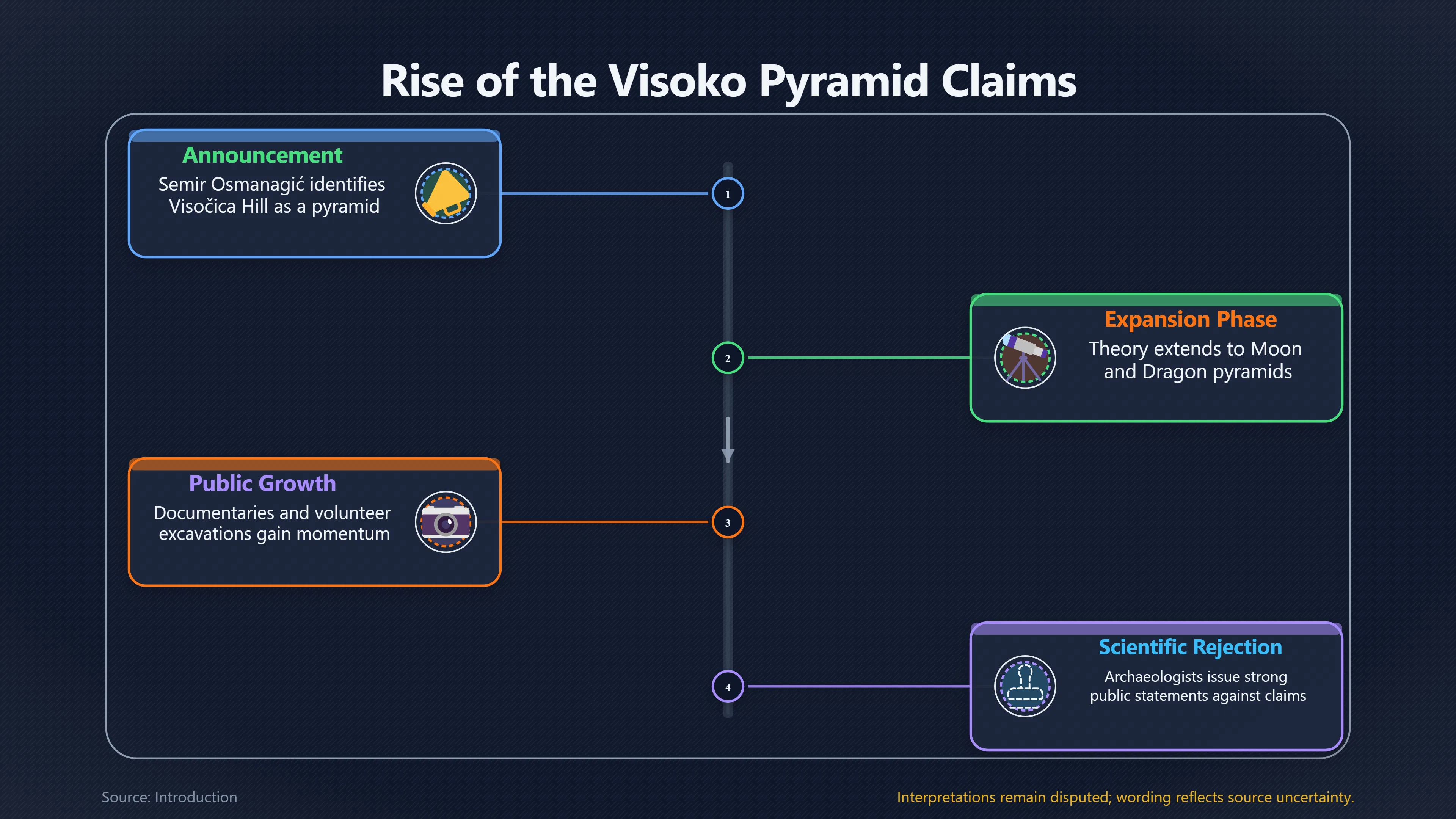
The movement began in 2005 when Bosnian-American businessman and alternative-history author Semir Osmanagić announced that Visočica Hill concealed an enormous ancient pyramid, which he called the “Pyramid of the Sun”. He soon expanded the idea to include several neighbouring hills, assigning them names such as the Pyramid of the Moon and Pyramid of the Dragon. According to his claims, the complex was built thousands of years before known ancient civilisations and represented the greatest archaeological discovery in history.[Wikipedia]WikipediaBosnian pyramid claimsBosnian pyramid claims
The proposal arrived at a moment when Bosnia and Herzegovina was still recovering from the economic and psychological effects of the 1992–95 war. An internationally famous archaeological discovery promised tourism, investment and a positive national story. Volunteers joined excavation campaigns, international media covered the claims, and supporters argued that established academics were refusing to accept revolutionary evidence. That narrative of misunderstood discovery became almost as important as the alleged pyramids themselves.[Archaeology Magazine]archive.archaeology.orgMagazine Bosnian "Pyramids" UpdateArchaeology MagazineBosnian "Pyramids" Update - Archaeology Magazine ArchiveJune 27, 2006…
Unlike conventional archaeological projects, the pyramid campaign developed largely outside established academic institutions. Public lectures, documentaries, guided tours and internet communities helped spread the idea far beyond Bosnia, making the site a recurring feature in alternative-history media.
What geologists and archaeologists found
Professional geologists quickly concluded that the hills around Visoko are natural landforms known as flatirons. These develop when layers of sedimentary rock are tilted by tectonic forces and then shaped by erosion, producing steep triangular slopes that can resemble artificial pyramids when viewed from particular angles. The apparent symmetry therefore reflects normal geological processes rather than human engineering.[Wikipedia]WikipediaBosnian pyramid claimsBosnian pyramid claims
Excavated stone slabs promoted as ancient concrete were likewise identified as naturally occurring sedimentary rocks. Claims about precise astronomical alignments, vast underground construction and extreme antiquity have not been supported by peer-reviewed archaeological evidence. No convincing traces of the enormous workforce, settlements, tools or cultural remains that would accompany construction on such a scale have been found.[Wikipedia]WikipediaBosnian pyramid claimsBosnian pyramid claims
One of the strongest criticisms has concerned archaeological method rather than simply the conclusions. Archaeology depends on careful recording of soil layers, artefacts and context. Critics argued that excavations at Visoko prioritised confirming the pyramid hypothesis instead of testing it, making the work incompatible with accepted scientific standards.[Archaeology Magazine]archive.archaeology.orgMagazine Bosnian "Pyramids" UpdateArchaeology MagazineBosnian "Pyramids" Update - Archaeology Magazine ArchiveJune 27, 2006…
Why experts called it pseudoarchaeology
Pseudoarchaeology does not simply mean “an unusual archaeological idea”. It refers to claims presented as archaeology while rejecting the methods that allow archaeological conclusions to be tested and revised.
The Visoko project displays several features commonly identified with pseudoarchaeology:
- beginning with a dramatic conclusion before evidence is evaluated;
- treating naturally occurring shapes as proof of deliberate construction;
- presenting criticism as evidence of an academic conspiracy;
- relying heavily on selective observations while ignoring contradictory geological evidence;
- using scientific terminology without following scientific standards of testing or peer review.
These characteristics explain why the European Association of Archaeologists issued an unusually strong public statement in 2006 describing the project as a “cruel hoax”. The association warned that the excavations risked damaging genuine cultural heritage while misleading the public about the nature of archaeological research.[Wikipedia]WikipediaBosnian pyramid claimsBosnian pyramid claims
The real heritage at risk
Ironically, the Visoko hills are historically important even without prehistoric pyramids.
Visočica contains the remains of the medieval royal town of Visoki, associated with the medieval Bosnian kingdom. The surrounding area also preserves authentic archaeological evidence from different historical periods, including medieval settlements and other cultural remains. Professional archaeologists warned that poorly controlled excavations in search of pyramids could destroy valuable evidence that cannot be replaced once disturbed.[The Archaeologist]thearchaeologist.orgOpen source on thearchaeologist.org.
This concern shifted the debate beyond whether the pyramid theory was correct. Heritage specialists argued that promoting an unsupported narrative could divert attention, funding and conservation effort away from Bosnia and Herzegovina’s genuine archaeological record.
Tourism, identity and alternative-history belief
Despite scientific rejection, the Bosnian pyramid movement has proved remarkably durable.[Wikipedia]WikipediaBosnian pyramid claimsBosnian pyramid claims
One reason is that it offers benefits independent of whether the central claim is true. Visoko has become a popular tourist destination. Visitors explore tunnels, attend guided tours, participate in wellness activities and buy books and souvenirs connected with the pyramid story. For local businesses, the economic gains are tangible regardless of academic opinion.[Bosnia Spirit]bosnia-spirit.comBosnia SpiritBosnian Pyramids Visoko guide: the honest truth about the controversyMay 26, 2026…
The theory also appeals to questions of identity. For some supporters, the pyramids symbolise an overlooked European civilisation and challenge the idea that historical achievements belong only to famous centres such as Egypt or Mesopotamia. In a country marked by war, political division and contested histories, an inspiring alternative national narrative can carry emotional weight that purely scientific arguments struggle to overcome.
Modern media reinforce this process. Television documentaries, social media videos and alternative-history websites frequently present the claims alongside mysteries such as Atlantis or ancient advanced civilisations. Repetition creates familiarity, while dramatic visuals of pyramid-shaped hills encourage viewers to believe that appearances alone constitute evidence.
Why the claim refuses to die
The persistence of the Bosnian pyramid story illustrates several well-understood features of human belief.
First, people naturally recognise meaningful patterns, even in landscapes shaped entirely by geology. Pyramid-like outlines can appear striking, especially when photographed from favourable viewpoints.
Second, extraordinary claims often become resistant to correction once they are linked to identity or community. Visitors who report powerful personal experiences, enthusiasm for the site or pride in Bosnia’s supposed ancient past may see criticism as an attack on something emotionally significant rather than a discussion about geological evidence.
Third, the movement demonstrates how economic incentives can reinforce belief. Tourism, books, lectures and organised visits create institutions that continue to promote the narrative long after specialists have rejected it. The debate therefore becomes self-sustaining: scientific criticism generates publicity, publicity attracts visitors, and visitor interest encourages further promotion.

What the Bosnian pyramids reveal about collective belief
The Bosnian pyramid controversy is less a mystery of ancient engineering than a revealing case study in how pseudoarchaeology develops. A visually impressive landscape, a charismatic promoter, post-war hopes for international recognition, media amplification and the commercial rewards of tourism combined to create one of Europe’s most successful alternative-history movements.
Its cultural importance lies not in demonstrating that Bosnia contains prehistoric pyramids, but in showing how unsupported historical claims can acquire lasting social value. The episode also reminds readers that rejecting a pseudoarchaeological explanation does not diminish Bosnia and Herzegovina’s genuine past. On the contrary, the medieval heritage around Visoko remains historically significant precisely because it can be studied through evidence rather than speculation.
Amazon book picks
Further Reading
Books and field guides related to Why the Bosnian Pyramid Claim Refuses to Die. Use these as the next step if you want deeper reading beyond the article.
Frauds, myths, and mysteries
Explains pseudoarchaeology like the Bosnian pyramid claims.


Archaeological Theory: An Introduction
Shows how archaeologists evaluate extraordinary claims.
Endnotes
1.
Source: archive.archaeology.org
Title: Magazine Bosnian “Pyramids” Update
Link:https://archive.archaeology.org/online/features/osmanagic/update.html
Source snippet
Archaeology MagazineBosnian "Pyramids" Update - Archaeology Magazine ArchiveJune 27, 2006...
Published: June 27, 2006
2.
Source: Wikipedia
Title: Bosnian pyramid claims
Link:https://en.wikipedia.org/wiki/Bosnian_pyramid_claims
3.
Source: archive.archaeology.org
Link:https://archive.archaeology.org/online/features/osmanagic/UNESCO.pdf
Source snippet
Archaeology Magazine12 June 2006...
Published: June 2006
4.
Source: bosnia-spirit.com
Link:https://www.bosnia-spirit.com/guides/bosnian-pyramids-visoko-guide/
Source snippet
Bosnia SpiritBosnian Pyramids Visoko guide: the honest truth about the controversyMay 26, 2026...
Published: May 26, 2026
5.
Source: archive.archaeology.org
Link:https://archive.archaeology.org/online/features/osmanagic/
6.
Source: archive.archaeology.org
Link:https://archive.archaeology.org/0607/abstracts/bosnia.html
7.
Source: thearchaeologist.org
Link:https://www.thearchaeologist.org/blog/bosnian-pyramids-visokos-controversial-12000-year-structures
Additional References
8.
Source: theoriesofanything.com
Link:https://www.theoriesofanything.com/research/bosnian-pyramids-claims-excavations-scientific-response
Source snippet
March 7, 2026 — THEORIES OF ANYTHING WHERE ALL FIELDS CONNECT M_2_07 M_2_07 — BOSNIAN PYRAMIDS — CLAIMS, EXCAVATIONS & SCIENTIFIC RESPONS...
Published: March 7, 2026
9.
Source: jelsciences.com
Title: Key archaeological institutions, such as th
Link:https://www.jelsciences.com/articles/jbres2106.php
Source snippet
Multidisciplinary Evaluation of the Pyramid-Shaped Formation near Visoko, Bosnia-Herzegovina: A Case for Anthropogenic ConstructionMay 19...
10.
Source: portal.findresearcher.sdu.dk
Title: dk The Bosnian Pyramid Phenomenon
Link:https://portal.findresearcher.sdu.dk/en/publications/the-bosnian-pyramid-phenomenon/
Source snippet
Bosnian Pyramid Phenomenon - University of Southern DenmarkMay 1, 2020 — THE BOSNIAN PYRAMID PHENOMENON * Olav Hammer *, Karen Swartz *...
Published: May 1, 2020
11.
Source: youtube.com
Title: Worlds Largest Oldest Pyramid
Link:https://www.youtube.com/watch?v=xD2wV5Llylk
Source snippet
Bosnian 'energy pyramids' boosted by Djokovic visits | AFP...
12.
Source: youtube.com
Title: Bosnian ‘energy pyramids’ boosted by Djokovic visits | AFP
Link:https://www.youtube.com/watch?v=inyFah_hqK0
Source snippet
Explorer claims evidence of pyramid found in Bosnia...
13.
Source: youtube.com
Title: Are There Ancient Pyramids in Visoko, Bosnia?
Link:https://www.youtube.com/watch?v=rR2o1CvEfRY
Source snippet
Worlds Largest Oldest Pyramid - Full Tour Movie - Visoko Bosnia - ECTV...
14.
Source: docslib.org
Link:https://docslib.org/doc/2163989/bosnian-pyramids-a-pseudoarchaeological-myth-and-a-threat-to-the-existing-cultural-and-historical-heritage-of-bosnia-herzegovina
15.
Source: history.co.uk
Link:https://www.history.co.uk/articles/the-bosnian-pyramids-fact-or-fiction
16.
Source: youtube.com
Title: Bosnian Pyramids: Real Ancient Power or Modern Myth?
Link:https://www.youtube.com/watch?v=aS1zvTqlnBs
Source snippet
Are There Ancient Pyramids in Visoko, Bosnia?...
17.
Source: livescience.com
Title: Bosnian Pyramids: Great Discovery or Colossal Hoax? | Live Science
Link:https://www.livescience.com/736-bosnian-pyramids-great-discovery-colossal-hoax.html
Topic Tree