When Belief, Fear and Power Collided in Fiji
Fiji’s history of collective belief and social fear is not dominated by a single famous witch hunt or school “mass hysteria” outbreak.
Page outline Jump by section
Introduction
These episodes should not be treated as versions of the same phenomenon. The Tuka movement was principally an indigenous response to conquest and colonial rule. Village conflicts over spirits reflect changing religious authority rather than simple irrational panic. Grace Road, by contrast, involved a documented end-times migration, a powerful business network and court-established abuse. Together, they show how labels such as “cult”, “witchcraft” and “superstition” can describe real dangers, but can also become political weapons that conceal struggles over land, leadership, culture and state power.[dukeupress.edu]read.dukeupress.eduDuke University PressNeither Cargo nor Cult: Ritual Politics and the Colonial…In the 1880s an oracle priest, Navosavakadua, mobilized…
The Tuka movement: prophecy after conquest
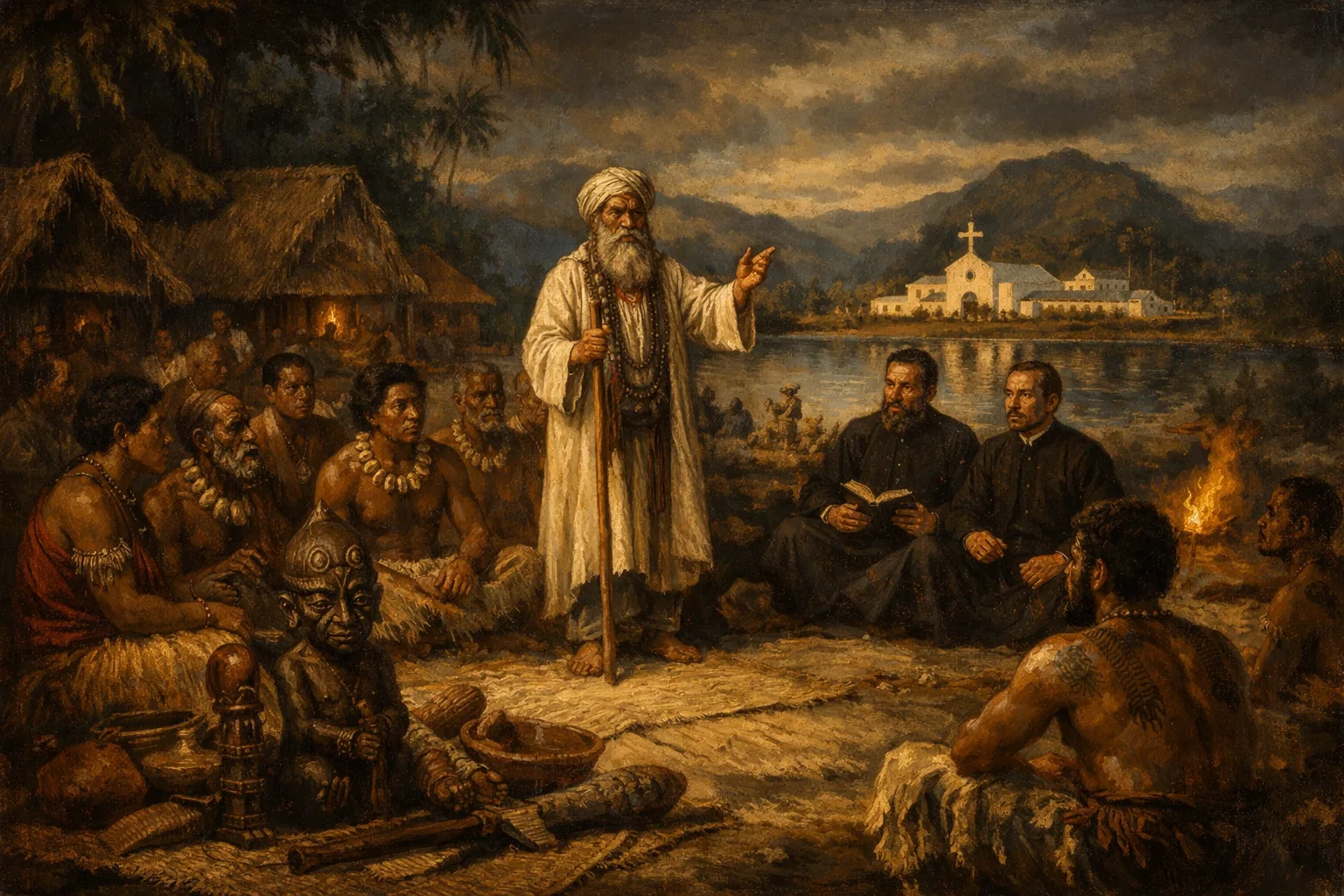
The most important early case is the Tuka movement associated with Navosavakadua, an indigenous religious leader from the interior of Viti Levu. It emerged in successive phases from the late 1870s into the early 1890s, during the first generation of British colonial government. Fiji had been ceded to Britain in 1874, while the violent suppression of resistance in the highlands, new taxation, missionary pressure and the authority granted to selected chiefs were transforming everyday life. Scholars therefore place Tuka within the transition from armed resistance to religious and symbolic opposition.[De Gruyter Brill]degruyterbrill.comDe Gruyter Brill Chapter TwoNavosavakadua and the Tuka MovementThe Tuka Movement rose in three successive waves during the late 1870s, the mid-1880s, and early 1890s…
Navosavakadua was described as an oracle priest and prophet. His teachings promised a reversal of the new political order: indigenous sources of power would return, the authority of colonial officials and compliant chiefs would be overturned, and people who had been marginalised would regain control of their land and destiny. Religious expectation, political protest and historical memory were inseparable. What officials heard as fantastic prophecy could also express practical grievances about tribute, labour, land and imposed leadership.[dukeupress.edu]read.dukeupress.eduDuke University PressNeither Cargo nor Cult: Ritual Politics and the Colonial…In the 1880s an oracle priest, Navosavakadua, mobilized…
Colonial authorities treated the movement as infectious disaffection. Navosavakadua was repeatedly arrested or exiled, and officials searched for “ringleaders”, watched villages and tried to prevent his influence from spreading. The language used in official records often resembled the language of epidemic control: belief was imagined as something that passed dangerously from person to person and threatened orderly government. Yet the state’s alarm was not wholly imaginary. Tuka did challenge the political and religious arrangements on which British indirect rule depended. The distortion lay in reducing a complex anti-colonial movement to credulity, deception or primitive fanaticism.[Think Pacific]thinkpacific.comThink Pacific British Colonial Constructions of the Tuka MovementThink Pacific British Colonial Constructions of the Tuka Movement
Why “cargo cult” is misleading
Tuka was later presented in some anthropological writing as an early “cargo cult”: a movement supposedly expecting material abundance or European goods through ritual means. That interpretation made the episode fit a wider theory about colonised Pacific peoples misunderstanding Western wealth and technology. Martha Kaplan’s historical and anthropological work strongly challenged this picture. Her central argument is captured by the title Neither Cargo nor Cult: Tuka did not begin as a crude attempt to obtain imported goods, and the apparently self-contained “cult” described by officials was partly produced by colonial classification.[bibliovault.org]bibliovault.orgOpen source on bibliovault.org.
This does not mean that followers held no extraordinary expectations. Prophecy, divine intervention and the reversal of power were central. The point is that these beliefs made sense within a history of warfare, chiefly rivalry, ancestral authority and sudden colonial dispossession. Calling the movement a cargo cult strips away that history and encourages readers to see delusion where participants may have seen restoration, justice and political survival.[jstor.org]jstor.orgNavosavakadua and the "Tuka" Movement in Fijiby M Kaplan · 1990 · Cited by 73 — Navosavakadua's history raises questions about cultu…
The episode is culturally important because it demonstrates how a “cult scare” can be created from above. Colonial officials did not invent Tuka or its opposition to their rule, but they decided which religious practices counted as acceptable tradition and which counted as dangerous disorder. Christianity endorsed by the state and recognised chiefs became signs of respectable Fijian identity; independent prophecy became evidence of subversion.[Think Pacific]thinkpacific.comThink Pacific British Colonial Constructions of the Tuka MovementThink Pacific British Colonial Constructions of the Tuka Movement

When spirits became “witchcraft”
Belief in spirits, ancestral power, healing and harmful magic has a long history in Fiji, but it is misleading to place every such belief under the European category of witchcraft. The modern language of witchcraft has often been sharpened by Christian competition. Anthropologist Lynda Newland’s village research found that some Pentecostal churches reinterpreted a range of older spirit relationships as evidence of evil occult power. Practices once understood through kinship, place or ancestral obligation could be redescribed as demonic forces requiring conversion and spiritual warfare.[jstor.org]jstor.orgTurning the Spirits into Witchcraft: Pentecostalism in Fijian…by L Newland · 2004 · Cited by 68 — Many of these objects were asso…
This change matters because naming an object, illness or family tradition as witchcraft can create a social threat where there was previously a more negotiable relationship with spirits. Pentecostal preachers may present deliverance, destruction of ritual objects or rejection of ancestral customs as protection from danger. For followers, these actions can feel like release from fear. For other villagers, they may look like an attack on communal history and established authority.[JSTOR]jstor.orgTurning the Spirits into Witchcraft: Pentecostalism in Fijian…by L Newland · 2004 · Cited by 68 — Many of these objects were asso…
Newland described serious conflict linked to these campaigns, including village division on Beqa and violence in a community in Naitasiri. Such cases do not amount to a national witch panic comparable with early modern European trials. They are better understood as local struggles over who has the authority to diagnose misfortune and decide which forms of religious power are legitimate. The fear can nevertheless become contagious: illness, crop failure, family conflict or unusual behaviour may be fitted into a shared story of hidden spiritual attack, after which suspicion reinforces further suspicion.[ResearchGate]researchgate.netOpen source on researchgate.net.
The law treats supernatural harm as a public danger
Fiji’s law has also preserved the category of witchcraft rather than dismissing it solely as folklore. Section 263 of the Crimes Act 2009 is headed “Witchcraft and sorcery” and sits among offences endangering life and health. Its existence reflects a practical legal problem found across a number of societies: authorities may not endorse supernatural claims, but intimidation, fraudulent healing, poisoning, assault or conduct presented as magical harm can still produce real victims.[laws.gov.fj]laws.gov.fjView SectionView Section
Historical discussion of Fiji’s legislation has also raised difficult boundary questions. A 1969 Pacific Islands Monthly article asked whether celebrated practices such as Beqa firewalking or Hindu firewalking might be caught by the language of witchcraft. The question exposes the risk of overbroad laws: a statute intended to prevent harmful exploitation can stigmatise religious ceremony, healing traditions or culturally valued performance when officials impose an external definition of the supernatural.[digitalpasifik.org]digitalpasifik.orgOpen source on digitalpasifik.org.
The safest distinction is therefore not between “rational” people and “superstitious” people. It is between belief itself and conduct that causes demonstrable harm. A person may believe in spirits without threatening anyone. A preacher may condemn witchcraft without creating a panic. The danger increases when accusations identify supposed human agents of evil, when frightened communities impose punishments, or when claims of supernatural power are used to control medical decisions, money or personal freedom.
Grace Road and the promised refuge in Fiji
Fiji’s clearest modern case of an apocalyptic movement with documented coercive harm is the Grace Road Church. Founded by South Korean pastor Shin Ok-ju, the church taught that global famine, war or disaster was approaching and that Fiji had been divinely selected as a place of safety. Around 400 followers relocated there from South Korea in 2014. Fiji was not incidental to the doctrine: it was presented as a promised refuge and a base from which the movement could prepare for the coming crisis.[ABC News]abc.net.auABC News Fiji deports South Korean doomsday 'cult' members asABC News Fiji deports South Korean doomsday 'cult' members as
Former members and investigators described a tightly controlled community in which passports were confiscated, families were separated and followers worked in farms, restaurants, construction, hairdressing and other businesses. A South Korean court found that followers had been made to work without pay and that many were prevented from leaving. It also found that ritualised beating sessions were used to punish mistakes or criticism and supposedly drive out evil spirits.[ABC News]abc.net.auABC News Former Grace Road Church member speaks out about lifeABC News Former Grace Road Church member speaks out about life
Shin was convicted in South Korea of offences including assault, confinement and child abuse. Her sentence was increased to seven years and upheld by South Korea’s Supreme Court in 2020. These legal findings are crucial because they separate Grace Road from a mere moral panic about an unconventional religion. Although “cult” remains a disputed and often hostile label, the central concerns were not simply strange doctrine or separation from mainstream churches. They included court-established violence, confinement and exploitation.[ABC News]abc.net.ausouth korean cult leader jailed over ritual beatings child abuseABC NewsSouth Korean cult leader sentenced to prison for detaining…1 Aug 2019 — The leader of a South Korean doomsday cult who detaine…
A former member also alleged that her mother was discouraged from receiving cancer treatment because doctors were believed to implant electronic chips in patients. Another legal case concerned an attempt to treat a man with schizophrenia through prayer while withholding medication; his condition deteriorated and his leg was amputated. These accounts show how apocalyptic and conspiratorial ideas can become physically dangerous when religious authority replaces informed medical care and members lose the practical freedom to refuse.[ABC News]abc.net.auABC News Former Grace Road Church member speaks out about lifeABC News Former Grace Road Church member speaks out about life
How the movement became economically powerful
Grace Road did not remain an isolated religious settlement. It built a highly visible corporate network that included farms, restaurants, supermarkets, petrol stations, construction work and other businesses. Its enterprises won public praise, awards and government contracts, while the group promoted agricultural self-sufficiency and contributed to reconstruction after Cyclone Winston. These activities helped it appear not as a marginal sect but as a successful development partner.[ABC News]abc.net.auABC News Calls for inquiry into Fiji government's ties to South Korea'sABC News Calls for inquiry into Fiji government's ties to South Korea's
An investigation by the Organized Crime and Corruption Reporting Project reported that Grace Road companies had received millions of Fijian dollars in loans from the state-backed Fiji Development Bank and had developed unusually warm relationships with senior political figures. The investigation did not establish government corruption, but it raised questions about why allegations concerning forced labour and abuse did not prevent official support or rapid commercial expansion.[ABC News]abc.net.auABC News Calls for inquiry into Fiji government's ties to South Korea'sABC News Calls for inquiry into Fiji government's ties to South Korea's
This created a distinctive public dilemma. Boycotting the group’s businesses could be framed as protection of alleged victims, yet those businesses employed local workers, supplied popular services and had become woven into Fiji’s economy. Mainstream churches and opposition politicians repeatedly called for stronger investigation, while Grace Road denied abuse allegations and rejected the description of itself as a cult.[ABC News]abc.net.auABC News'It's a cult': Fijian churches want Grace RoadABC News'It's a cult': Fijian churches want Grace Road
Arrests, deportations and continuing scrutiny
Fijian authorities took more visible action after a change of government. In September 2023, several senior Grace Road figures were detained as prohibited immigrants because of South Korean arrest warrants and Interpol notices. Two were removed to South Korea, while others challenged deportation proceedings in court. The episode marked a sharper official stance than under the previous government, although it did not dismantle the wider business network or resolve the position of hundreds of followers living in Fiji.[abc.net.au]abc.net.auABC News Fiji deports South Korean doomsday 'cult' members asABC News Fiji deports South Korean doomsday 'cult' members as
Further controversy followed in 2024 when Fiji opened an investigation into allegations that children connected with Grace Road had received passports without proper authorisation. Reporting alleged that such documents had been used to take children out of Fiji without their mother’s consent. The claims joined a wider set of unresolved questions about immigration decisions, family separation and the ability of members to approach authorities freely.[OCCRP]occrp.orgfiji investigating unauthorized passports given to doomsday cult membersfiji investigating unauthorized passports given to doomsday cult members
By late 2025 and early 2026, the case had become an international human-trafficking concern. OCCRP reported that the United States had warned that aid relations could be affected unless Fiji acted more decisively, while two American women who had left the group said they were prepared to return to Fiji to give evidence. Those reports concerned allegations still requiring investigation in Fiji and should not be treated as completed criminal findings. They nevertheless show that Grace Road remained an active legal and political issue more than a decade after the migration began.[OCCRP]occrp.orgus threatens to cut fiji aid over impunity for doomsday cultus threatens to cut fiji aid over impunity for doomsday cult
Cult, panic or genuine abuse?
Grace Road illustrates why the word “cult” must be used carefully but not avoided when evidence of coercion is strong. Mainstream churches used the label before the South Korean convictions, and political critics sometimes employed it while attacking the Fijian government. The group argues that the word is prejudicial and that its businesses and members have been misrepresented. Religious difference alone would not justify the label.[ABC News]abc.net.auABC News Fiji deports South Korean doomsday 'cult' members asABC News Fiji deports South Korean doomsday 'cult' members as
The case against treating the controversy as a mere scare rests on several forms of evidence:
- South Korean court findings concerning confinement, assault, child abuse and unpaid labour.
- Testimony from former members describing confiscated passports, family separation and violent discipline.
- Broadcast footage showing ritual assaults.
- Immigration action based on foreign arrest warrants and Interpol notices.
- Continuing investigations into passports, trafficking allegations and the treatment of children.[abc.net.au]abc.net.ausouth korean cult leader jailed over ritual beatings child abuseABC NewsSouth Korean cult leader sentenced to prison for detaining…1 Aug 2019 — The leader of a South Korean doomsday cult who detaine…
At the same time, not every allegation has been proved in a Fijian court, and criticism of the movement can become entangled with political rivalry, competition between churches or suspicion of outsiders. Responsible reporting therefore distinguishes confirmed convictions from testimony, ongoing investigations and political claims. It also avoids assuming that every Grace Road member is simply brainwashed. People may remain because of sincere faith, family ties, financial dependence, fear, social isolation or a belief that accusations are persecution.
The more useful question is not whether a group seems strange. It is whether members can leave, retain their documents, obtain healthcare, communicate privately, control their earnings, keep contact with relatives and refuse punishment without retaliation. These practical tests reveal coercion more reliably than sensational descriptions of doctrine.
Why Fiji’s record is often misunderstood
Fiji is sometimes fitted into broad lists of Pacific “cargo cults”, witchcraft societies or exotic religious practices. That framing can reproduce the same colonial habits visible in the history of Tuka: unfamiliar belief is isolated from its political circumstances and presented as evidence of a uniquely credulous culture. The strongest scholarship instead asks who applied the label, what power that person held and what social conflict the label concealed.[jstor.org]jstor.orgNavosavakadua and the "Tuka" Movement in Fijiby M Kaplan · 1990 · Cited by 73 — Navosavakadua's history raises questions about cultu…
The available record also does not support presenting Fiji as a major centre of classic mass psychogenic illness, such as contagious fainting or unexplained symptoms spreading through a school. Better-documented themes are prophetic resistance, religious reinterpretation of spirits, institutional fear of dissident belief and a modern apocalyptic organisation accused of systematic coercion. Calling all of these “mass hysteria” would obscure rather than explain them.
Three distinctions keep the history clear:
Religious resistance is not automatically delusion. Tuka used prophecy and ritual, but it also articulated grievances created by conquest, taxation, chiefly authority and cultural disruption.
Belief in supernatural harm is not the same as a witch panic. Panic begins when suspicion escalates into collective accusation, punishment or violent cleansing. Local Christian campaigns in Fiji sometimes approached this threshold, but the evidence does not justify inventing a nationwide witch-hunt tradition.
A cult scare is not the same as documented coercion. Grace Road attracted hostile labelling, yet the South Korean convictions and extensive testimony mean that its abuse controversy cannot be dismissed as prejudice against a minority religion.

What these episodes reveal
Fiji’s most significant stories of contagious belief are also stories about authority. British officials feared Tuka because independent prophecy challenged their preferred chiefs and missionary order. Pentecostal campaigns against witchcraft can transfer authority from ancestors, elders and healers to pastors who claim exclusive power over evil. Grace Road’s apocalyptic message helped move followers across borders into a community where religious leadership, work, family life and business were closely connected.[thinkpacific.com]thinkpacific.comThink Pacific British Colonial Constructions of the Tuka MovementThink Pacific British Colonial Constructions of the Tuka Movement
Social pressure helped each episode spread, but in different ways. Tuka drew strength from dispossession and shared hopes of political reversal. Witchcraft narratives can organise confusing misfortune into a morally certain explanation. Grace Road combined fear of catastrophe with obedience, isolation, economic dependence and the promise of collective survival. None requires the assumption that participants lacked intelligence. People adopt extraordinary beliefs when those beliefs answer immediate questions about danger, suffering, injustice and belonging.
The enduring lesson is that collective fear should be investigated without ridicule and collective belief without romanticisation. Authorities can manufacture a “cult” to delegitimise resistance, as the colonial treatment of Tuka demonstrates. Religious movements can also use persecution narratives to hide genuine abuse, as the Grace Road convictions demonstrate. Fiji’s history is most revealing precisely because it contains both possibilities.

Endnotes
1.
Source: jstor.org
Link:https://www.jstor.org/stable/645249
Source snippet
Navosavakadua and the "Tuka" Movement in Fijiby M Kaplan · 1990 · Cited by 73 — Navosavakadua's history raises questions about cultu...
2.
Source: jstor.org
Link:https://www.jstor.org/stable/40331952
Source snippet
Turning the Spirits into Witchcraft: Pentecostalism in Fijian...by L Newland · 2004 · Cited by 68 — Many of these objects were asso...
3.
Source: pages.vassar.edu
Link:https://pages.vassar.edu/marthakaplan/files/2012/03/Kaplan-Website-NCNC-2-chapters-OCR.pdf
Source snippet
Vassar CollegeNEITHER CARGO NOR CULTby M Kaplan · Cited by 317 — This narrative therefore moves chronologically to tell a story of a Fiji...
4.
Source: bibliovault.org
Link:https://www.bibliovault.org/BV.titles.epl?tquery=Navosavakadua
5.
Source: researchgate.net
Link:https://www.researchgate.net/publication/261891857_Turning_the_Spirits_into_Witchcraft_Pentecostalism_in_Fijian_Villages
6.
Source: laws.gov.fj
Title: View Section
Link:https://laws.gov.fj/Acts/ViewSection/97058?query=%E8%AF%BA%E4%B8%81%E6%B1%89%E6%80%8E%E4%B9%88%E6%89%BE%E5%B0%8F%E5%A7%90%E5%85%A8%E5%A5%97%E5%8F%AB%E5%8C%85%E5%A4%9C%E6%9C%8D%E5%8A%A1%28%E5%A8%81%E4%BF%A1%E2%96%B71429262%E7%9C%9F%E5%AE%9E%E4%B8%8A%E9%97%A8%E6%9C%8D%E5%8A%A1%29%E8%AF%BA%E4%B8%81%E6%B1%89%E6%89%BE%E5%B0%8F%E5%A7%90%E5%AD%A6%E7%94%9F%E5%A6%B9%E8%BF%87%E5%A4%9C%E4%B8%8A%E9%97%A8%E7%89%B9%E6%AE%8A%E6%8C%89%E6%91%A9%E6%9C%8D%E5%8A%A1-%E8%AF%BA%E4%B8%81%E6%B1%89%E6%89%BE%E5%B0%8F%E5%A7%90%E7%9C%9F%E5%AE%9E%E5%A4%A7%E4%BF%9D%E5%81%A5-%E6%89%BE%E5%B0%8F%E5%A7%90%E5%8F%AB%E5%B0%8F%E5%A6%B9%E8%BF%87%E5%A4%9C%E4%B8%8A%E9%97%A8%E6%8C%89%E6%91%A9%E6%9C%8D%E5%8A%A1.fear
7.
Source: digitalpasifik.org
Link:https://digitalpasifik.org/items/150886
8.
Source: occrp.org
Link:https://www.occrp.org/en/news/fiji-detains-local-leader-of-korean-doomsday-sect
9.
Source: occrp.org
Title: fiji investigating unauthorized passports given to doomsday cult members
Link:https://www.occrp.org/en/news/fiji-investigating-unauthorized-passports-given-to-doomsday-cult-members
10.
Source: occrp.org
Title: unauthorized fiji passports were used to take cult children out of the country
Link:https://www.occrp.org/en/news/unauthorized-fiji-passports-were-used-to-take-cult-children-out-of-the-country
11.
Source: occrp.org
Title: us threatens to cut fiji aid over impunity for doomsday cult
Link:https://www.occrp.org/en/scoop/us-threatens-to-cut-fiji-aid-over-impunity-for-doomsday-cult
12.
Source: occrp.org
Title: american women who fled fijis grace road cult ready to return to give evidence
Link:https://www.occrp.org/en/news/american-women-who-fled-fijis-grace-road-cult-ready-to-return-to-give-evidence
13.
Source: occrp.org
Title: fiji police probe senior officers over alleged links to drug traffickers
Link:https://www.occrp.org/en/news/fiji-police-probe-senior-officers-over-alleged-links-to-drug-traffickers
14.
Source: occrp.org
Title: fiji considers investigating link between drug dealer and minister
Link:https://www.occrp.org/en/news/fiji-considers-investigating-link-between-drug-dealer-and-minister
15.
Source: occrp.org
Title: son of palau senate leader caught up in fiji drug sweep
Link:https://www.occrp.org/en/news/son-of-palau-senate-leader-caught-up-in-fiji-drug-sweep
16.
Source: occrp.org
Link:https://www.occrp.org/en/regions/pacific/fiji/page/1
17.
Source: occrp.org
Title: impact fiji opposition calls for scrutiny of grace roads operations
Link:https://www.occrp.org/en/news/impact-fiji-opposition-calls-for-scrutiny-of-grace-roads-operations
18.
Source: fiji.travel
Link:https://www.fiji.travel/
19.
Source: researchgate.net
Link:https://www.researchgate.net/publication/344387826_The_representation_of_cults_new_religious_movements_in_the_media
20.
Source: researchgate.net
Link:https://www.researchgate.net/publication/310498711_Navosavakadua_and_the_Tuka_Movement_Resistance_in_Early_Colonial_Fiji
21.
Source: researchgate.net
Link:https://www.researchgate.net/publication/264658668_Neither_Cargo_Nor_Cult_Ritual_Politics_and_the_Colonial_Imagination_In_FIJI
22.
Source: dfat.gov.au
Link:https://www.dfat.gov.au/geo/fiji/fiji-country-brief
23.
Source: read.dukeupress.edu
Link:https://read.dukeupress.edu/books/book/593/Neither-Cargo-nor-CultRitual-Politics-and-the
Source snippet
Duke University PressNeither Cargo nor Cult: Ritual Politics and the Colonial...In the 1880s an oracle priest, Navosavakadua, mobilized...
24.
Source: abc.net.au
Title: south korean cult leader jailed over ritual beatings child abuse
Link:https://www.abc.net.au/news/2019-08-01/south-korean-cult-leader-jailed-over-ritual-beatings-child-abuse/11369586
Source snippet
ABC NewsSouth Korean cult leader sentenced to prison for detaining...1 Aug 2019 — The leader of a South Korean doomsday cult who detaine...
25.
Source: degruyterbrill.com
Title: De Gruyter Brill Chapter Two
Link:https://www.degruyterbrill.com/document/doi/10.1515/9780824860981-004/html?srsltid=AfmBOorDld8eG1ovRNG-VSbb_vywxsT5-yZREllApSREGH5jg800jFE8
Source snippet
Navosavakadua and the Tuka MovementThe Tuka Movement rose in three successive waves during the late 1870s, the mid-1880s, and early 1890s...
26.
Source: dx.doi.org
Link:https://dx.doi.org/10.21313/hawaii/9780824832919.003.0002
Source snippet
It accounts for the transition from warfare to...Read more...
27.
Source: thinkpacific.com
Title: Think Pacific British Colonial Constructions of the Tuka Movement
Link:https://thinkpacific.com/app/uploads/2020/06/The-Tuka-movement.pdf
28.
Source: research-portal.st-andrews.ac.uk
Title: turning the spirits into witchcraft pentecostalism in fijian vill
Link:https://research-portal.st-andrews.ac.uk/en/publications/turning-the-spirits-into-witchcraft-pentecostalism-in-fijian-vill/
29.
Source: abc.net.au
Title: ABC News Fiji deports South Korean doomsday ‘cult’ members as
Link:https://www.abc.net.au/news/2023-09-08/fiji-arrests-grace-road-south-korea-cult-leaders/102826328
30.
Source: apnews.com
Link:https://apnews.com/article/47595f35c114ffd36a5eae679feb65f8
31.
Source: abc.net.au
Title: ABC News Former Grace Road Church member speaks out about life
Link:https://www.abc.net.au/news/2018-09-10/former-grace-road-church-member-speaks-out-at-abuse-from-leader/10219266
32.
Source: abc.net.au
Title: south korean pastor arrested allegedly detaining followers fiji
Link:https://www.abc.net.au/news/2018-08-03/south-korean-pastor-arrested-allegedly-detaining-followers-fiji/10067964
33.
Source: abc.net.au
Title: ABC News Calls for inquiry into Fiji government’s ties to South Korea’s
Link:https://www.abc.net.au/news/2022-07-28/fiji-grace-road-church-abuse-allegations-south-korea-cult/101267924
34.
Source: abc.net.au
Title: fiji gov accused of turning blind eye on grace roads
Link:https://www.abc.net.au/pacific/programs/pacificbeat/fiji-gov-accused-of-turning-blind-eye-on-grace-roads/11376728
35.
Source: abc.net.au
Title: ABC News’It’s a cult’: Fijian churches want Grace Road
Link:https://www.abc.net.au/listen/programs/am/fijian-churches-want-grace-road-church-investigated/10754876
36.
Source: abc.net.au
Title: calls in fiji to boycott controversial grace road church
Link:https://www.abc.net.au/pacific/programs/pacificbeat/calls-in-fiji-to-boycott-controversial-grace-road-church/11716702
37.
Source: abc.net.au
Title: nesia daily afternoon edition
Link:https://www.abc.net.au/pacific/programs/nesia-daily-afternoon-edition/nesia-daily-afternoon-edition/106529046
38.
Source: Wikipedia
Link:https://en.wikipedia.org/wiki/Fiji
39.
Source: Wikipedia
Title: Grace Road Church
Link:https://en.wikipedia.org/wiki/Grace_Road_Church
40.
Source: abc.net.au
Title: png communities more likely to intervene in sorcery cases
Link:https://www.abc.net.au/pacific/programs/pacificbeat/png-communities-more-likely-to-intervene-in-sorcery-cases/11549226
41.
Source: abc.net.au
Title: spotlight on fiji as grace road church leader is jailed
Link:https://www.abc.net.au/pacific/programs/pacificbeat/spotlight-on-fiji-as-grace-road-church-leader-is-jailed/11368958
42.
Source: abc.net.au
Title: American women survive Fiji’s Grace Road cult
Link:https://www.abc.net.au/pacific/programs/nesia-daily-afternoon-edition/nesia-daily-afternoon-edition/106349546
43.
Source: dukeupress.edu
Link:https://www.dukeupress.edu/neither-cargo-nor-cult
Additional References
44.
Source: youtube.com
Link:https://www.youtube.com/watch?v=O0sU_cMjtgQ
Source snippet
Fiji crackdown on South Korean cult Grace Road Church members continues | The World...
45.
Source: youtube.com
Link:https://www.youtube.com/watch?v=9kzlydaSkHw
Source snippet
Grace Road President refutes claim by Minister of him being on the run...
46.
Source: youtube.com
Title: Grace Road President refutes claim by Minister of him being on the run
Link:https://www.youtube.com/watch?v=aIs4QACLqhg
Source snippet
Grace Road Group - Building the Centre of the World (2023)...
47.
Source: youtube.com
Title: Escaping Korea’s Pacific Cult | 101 East
Link:https://www.youtube.com/watch?v=Bn9nJ4mthKA
Source snippet
Doomsday: Is this the end of the Grace Road church in Fiji? | The Pacific | ABC News...
48.
Source: policehumanrightsresources.org
Link:https://policehumanrightsresources.org/content/uploads/2016/07/The-Witchcraft-Act.pdf?x36399=
49.
Source: colab.ws
Link:https://colab.ws/articles/10.1525%2Fae.1990.17.1.02a00010
50.
Source: aljazeera.com
Link:https://www.aljazeera.com/video/101-east/2019/11/14/escaping-koreas-pacific-cult
51.
Source: facebook.com
Link:https://www.facebook.com/groups/Pacificnewsroom/posts/1963096497610510/
52.
Source: travelonline.com
Link:https://www.travelonline.com/fiji
53.
Source: islandsbusiness.com
Link:https://islandsbusiness.com/news-break/fiji-says-local-grace-road-investigations-continuing/
Topic Tree
Follow this branch
Related pages 192
- Antigua and Barbuda
- Argentina Belief Scares
- Azerbaijan Belief
- Bahrain Beliefs
- North Korea
- +187 more in sidebar