When Belief and Fear Gripped Romania
Romania’s history of collective belief and fear is not a simple catalogue of “mass hysteria”. It includes several different phenomena: early modern witch prosecutions, miracle pilgrimages, vampire rituals, apocalyptic and alternative spiritual movements, media-driven religious scandals, and lethal rumour during political collapse.
Page outline Jump by section
Introduction
The most revealing examples are the 1935 pilgrimage to Maglavit after a shepherd reported seeing God; the phantom “terrorists” whose supposed presence intensified the bloodshed of the 1989 Revolution; the fatal 2005 exorcism at Tanacu; and a 2004 grave-opening carried out to stop a suspected returning spirit. Together, they show how extraordinary beliefs become socially powerful when they fit existing anxieties, pass through trusted institutions and appear to explain suffering that has no clear cause. They also show why belief itself is rarely the whole explanation: poverty, political uncertainty, illness, media competition and institutional failure usually shape what happens next.
Witchcraft without a single Romanian witch craze
Witchcraft accusations occurred in territories that now form Romania, especially in Transylvania between the sixteenth and eighteenth centuries. It is misleading, however, to imagine one unified “Romanian witch hunt”. Modern Romania did not yet exist, and Transylvania, Wallachia and Moldavia operated under different political, religious and legal systems.
Research into Transylvanian court records shows accusations arising among Romanian, Hungarian, German-speaking and other communities. Romanians could appear as defendants, accusers, witnesses or people consulted for magical expertise. Legal attitudes varied: some jurisdictions treated harmful magic harshly, while others gave defendants considerable room to challenge testimony. Local conflicts, illnesses, family quarrels and damaged reputations often mattered as much as theological doctrine.[ResearchGate]researchgate.net369052726 Witch Trials in Seventeenth Century Targu MuresResearchGate(PDF) Witch Trials in Seventeenth-Century Târgu MureşDecember 30, 2022 — 19 May 2026 — women accused of witchcraft were able…
Cluj and other Transylvanian towns did conduct executions and repeated waves of prosecution. Yet the surviving evidence points towards numerous local disputes rather than a Romanian equivalent of the concentrated panics seen in parts of the Holy Roman Empire. A recent scholarly synthesis of witchcraft in Romania stresses the need to examine Transylvania separately from Moldavia and Wallachia, while also considering folklore, healing practices and apocalyptic writing alongside formal trials.[springer.com]link.springer.comPublish with us. Policies and ethics. Back to top. Access this…Read more…
This distinction matters because the word “witch” can hide several social roles. An accused neighbour supposedly causing illness was not necessarily the same kind of person as a healer, fortune-teller or ritual specialist who openly offered services. Witch trials were judicial persecutions; popular magic could also be an accepted, feared or commercially useful part of everyday life.
That ambiguity persists in modern Romania. In 2011, press coverage turned a change in the taxation of self-employed fortune-tellers and practitioners of witchcraft into an international story about witches cursing the government. The dispute was real, but the playful Gothic framing encouraged readers abroad to treat Romania as a land of supernatural survivals rather than a modern society debating regulation, income and informal labour.[The Guardian]theguardian.comThe Guardian Romanian witches to cast anti-government spell | RomaniaThe GuardianRomanian witches to cast anti-government spell | RomaniaJanuary 6, 2011 — 6 Jan 2011 — Witches in Romania are planning to cas…
Maglavit: how a shepherd’s vision became a national event
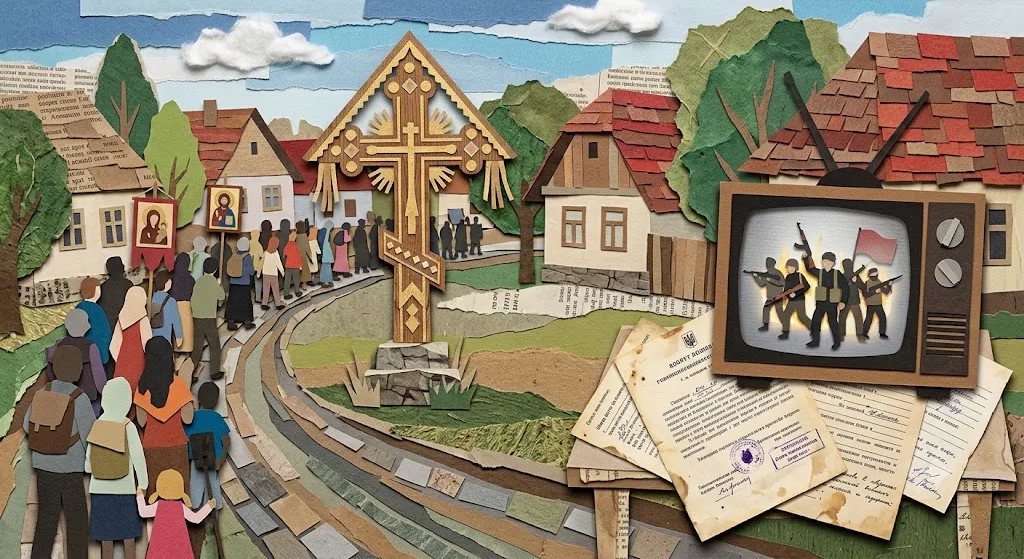
In 1935, Petrache Lupu, a shepherd from the village of Maglavit in south-western Romania, said that he had encountered a divine figure who instructed people to repent, observe religious duties and abandon sinful behaviour. A cross was erected at the reported site, water nearby acquired a reputation for healing, and enormous crowds began arriving.
Maglavit was not merely a village curiosity. It became one of interwar Romania’s most discussed religious events. Pilgrims reported cures, newspapers published testimonies, pamphlets circulated and public figures debated whether Lupu’s experience was revelation, fraud, suggestion or mental disturbance. Police files show that publications promoting the phenomenon were monitored and in some cases confiscated, demonstrating that the state regarded the movement as more than harmless devotional enthusiasm.[researchgate.net]researchgate.net364362731 The miracle of Maglavit 1935 and the Romanian psychology of religion364362731 The miracle of Maglavit 1935 and the Romanian psychology of religion
The central question was not simply whether Lupu had “really” seen God. Doctors, clergy and intellectuals were also asking what the crowds revealed about Romanian society. The country was experiencing economic insecurity, political extremism and intense arguments over national identity. A humble shepherd preaching repentance could be presented as a pure voice of the people, untouched by urban corruption or party politics.
The reported cures strengthened the movement because they transformed private testimony into apparently public evidence. Sick people travelled to the site, slept outdoors and returned with stories of improvement. Some recoveries may have been spontaneous, temporary or inaccurately reported; others were preserved mainly in devotional accounts rather than clinical records. The evidence therefore supports the existence of a major pilgrimage and widespread healing claims, but not a reliable total of medically verified miracles.[wikipedia.org]WikipediaPetrache LupuPetrache Lupu
Maglavit is better understood as a miracle movement than as mass psychogenic illness. The pilgrims did not all develop the same unexplained symptoms. Instead, hope, religious expectation and repeated testimony produced a shared conviction that a sacred intervention might be occurring. Newspapers, transport networks and cheap print allowed the conviction to spread far beyond the original village.
The phenomenon also illustrates the uneasy relationship between spontaneous religion and established authority. Religious institutions could not dismiss a movement that inspired repentance and pilgrimage, but neither could they allow an unverified visionary to define doctrine independently. Political authorities faced a similar problem: suppression risked angering believers, while encouragement could turn a charismatic religious event into an unpredictable popular force.

The invisible “terrorists” of December 1989
Romania’s most destructive episode of contagious fear occurred during the Revolution of December 1989. The uprising began with resistance to the attempted removal of Protestant pastor László Tőkés in Timișoara and grew into a nationwide revolt against Nicolae Ceaușescu’s dictatorship. Security forces genuinely fired on demonstrators before Ceaușescu fled Bucharest on 22 December. The later panic was therefore not born from nothing: people had already witnessed state violence and had good reason to expect further repression.[enrs.eu]enrs.euthe romanian revolutionthe romanian revolution
After the regime collapsed, television broadcasts and military communications warned repeatedly of hidden “terrorists” loyal to Ceaușescu. Reports described snipers, poisoned water, attacks on strategic buildings, disguised enemies and armed convoys. Soldiers, civilian guards and revolutionary groups were deployed with poor coordination, uncertain chains of command and little ability to distinguish allies from attackers.
The consequences were catastrophic. Most of the Revolution’s deaths occurred after Ceaușescu had lost power. Military prosecutors later alleged that false or unverified information about a terrorist threat helped produce contradictory orders, chaotic shooting and fire between forces that were nominally on the same side. Former president Ion Iliescu and other officials were charged in relation to the alleged creation of this climate of fear, although the long-running legal process has remained contested and incomplete.[Al Jazeera]aljazeera.comromanias ex leader iliescu charged over 1989 uprisingromanias ex leader iliescu charged over 1989 uprising
The “terrorist” question remains politically sensitive because several interpretations compete. One holds that organised loyalist units deliberately attacked the revolution. Another argues that most post-22 December violence resulted from confusion, misinformation, accidental exchanges of fire and deliberate psychological manipulation. Some researchers and witnesses maintain that unidentified armed actors did exist, even if the scale and command structure attributed to them were exaggerated.[fcdo.gov.uk]blogs.fcdo.gov.ukDennis Revisiting the 1989 Revolution.docDennis Revisiting the 1989 Revolution.doc
It would be wrong to call the entire Revolution a delusion. The dictatorship was real, protesters were killed and weapons were being fired. The collective-fear element concerns the rapid conversion of uncertainty into a seemingly coherent story: invisible specialists were everywhere, attacking from roofs and tunnels according to a secret plan.
Several conditions made that story persuasive:
- A legacy of secrecy: decades of dictatorship had taught Romanians that the security services operated through concealed networks.
- Recent trauma: demonstrators had already been shot, making renewed attack entirely plausible.
- Live broadcasting: television delivered urgent claims before they could be checked and gave national authority to rumours.
- Armed confusion: soldiers, civilians and irregular groups occupied the same spaces without reliable identification.
- Political usefulness: the image of a formidable hidden enemy helped the new leadership present itself as the defender of the Revolution.
The episode demonstrates how a rumour can become materially true in its effects. Belief in snipers caused people to shoot; the resulting gunfire then seemed to confirm the presence of snipers. Each reaction generated new “evidence” for the original fear.
Tanacu and the danger of turning illness into possession
In June 2005, Maricica Irina Cornici, a young woman living at the Holy Trinity monastery in Tanacu, died after being restrained during an attempted exorcism conducted by priest Daniel Corogeanu and four nuns. Cornici had experienced serious psychological distress and had received psychiatric treatment. At the monastery, her behaviour was interpreted by those involved as evidence of demonic influence.
During the ritual she was bound to an improvised wooden structure, gagged and kept under restraint. Corogeanu and the nuns were subsequently convicted of offences connected with her confinement and death. The precise medical sequence became disputed in public discussion, but the core facts of coercive restraint, an attempted exorcism and a preventable death were established through the criminal proceedings.[religiondispatches.org]religiondispatches.orgReligion Dispatches Romanian Exorcist Released from Prison, Becomes NewReligion Dispatches Romanian Exorcist Released from Prison, Becomes New
Tanacu became a national media event because it concentrated several Romanian anxieties into one case: the authority of the Orthodox Church, inadequate mental-health care, poverty, isolated religious communities and the uncertain boundary between accepted ritual and dangerous abuse.
The incident should not be described as a nationwide possession panic. There was no epidemic of people displaying identical symptoms. Its wider importance lies in the struggle over interpretation after the death. Supporters of Corogeanu treated Cornici’s behaviour as spiritual affliction and portrayed the prosecution as hostility towards faith. Critics saw religious fanaticism, institutional negligence and the abandonment of a vulnerable woman.
Scholars studying the coverage found that newspapers, television, doctors, clergy, politicians and secular commentators competed to define the event. The scandal became a stage on which broader arguments about post-communist Romania were performed: whether religious revival had escaped proper oversight, whether secular elites despised ordinary believers, and whether medical institutions had failed before the monastery did.[Academia]academia.eduExorcism, Media and the Romanian OrthodoxyExorcism, Media and the Romanian Orthodoxy
The Orthodox hierarchy distanced itself from the ritual and Corogeanu’s monastery, but this did not end the dispute. For some believers, institutional condemnation could itself be interpreted as cowardice or betrayal. That response illustrates a common feature of closed belief systems: evidence against an authority figure may be absorbed as proof that hostile institutions are persecuting the truth.
Tanacu also shows why language matters. Calling Cornici “possessed” converted symptoms requiring care into signs of a supernatural enemy. Calling the episode merely “medieval superstition”, however, can obscure the modern conditions that made it possible: fragmented healthcare, social isolation, charismatic authority and public uncertainty about mental illness.
A modern vampire ritual in Marotinu de Sus
In 2004, relatives of a dead man in the village of Marotinu de Sus opened his grave because they believed he had returned as a harmful spirit and was making a living family member ill. They removed and burned the heart, mixed the ashes with water and gave the resulting preparation to the sick relative. Police investigated after the dead man’s daughter complained about the desecration.[independent.co.uk]independent.co.ukThe Independent The real vampire slayersThe Independent The real vampire slayers
International coverage often presented the affair as proof that Dracula’s country still believed in vampires. That description is catchy but misleading. The villagers were not reenacting Bram Stoker’s novel, and the ritual belonged to local ideas about dangerous returning dead rather than the aristocratic, cape-wearing vampire of popular entertainment.
Such beliefs provided a framework for explaining illness that appeared after a death. Bereavement, fear, physical symptoms and family memories could be connected through a familiar narrative: the dead person had not settled properly and was drawing strength from surviving relatives. Opening the grave then offered a direct action against an otherwise invisible cause.
The ritual was illegal and violated the dignity of the dead, but it was not evidence that an entire region had entered a vampire panic. Reports from the village suggested that similar interventions were remembered as an older local practice, while the 2004 case became exceptional precisely because it attracted police and global media attention.[Michael Bird Writer & Journalist]michaelbirdjournalist.comOpen source on michaelbirdjournalist.com.
The difference between local belief and mass panic is crucial. A small group acted on a shared explanation within a family and village network. The later “panic” was largely a media phenomenon: foreign audiences encountered a sensational story stripped of its social context, while Romania was again cast as Europe’s supernatural borderland.
MISA and the problem with the word “cult”
Romania’s best-known alternative spiritual organisation is the Movement for Spiritual Integration into the Absolute, usually known by the initials MISA. Gregorian Bivolaru founded it after the fall of communism, drawing together yoga, esoteric teaching, sexuality, apocalyptic ideas and conspiracy narratives.
MISA’s history requires unusually careful language. The movement and Bivolaru have faced serious allegations and criminal cases, including accusations involving sexual exploitation, coercion and trafficking. Bivolaru was convicted in Romania in 2013 of a sexual offence involving a minor. He was arrested in France in November 2023 during an investigation into alleged rape, trafficking, kidnapping and abuse of vulnerability. French authorities found dozens of women living at properties associated with the movement; several former members have accused Bivolaru of using spiritual initiation to obtain sexual access. Bivolaru and MISA deny coercion and describe the investigations and media coverage as persecution. The newer French allegations remain matters for the courts rather than settled historical fact.[Le Monde.fr]lemonde.frOpen source on lemonde.fr.
At the same time, Romanian authorities have themselves been found to have violated Bivolaru’s rights in some proceedings, and several earlier cases against MISA members ended without convictions. Under communism, Bivolaru had also been imprisoned and subjected to compulsory psychiatric treatment partly because the state regarded independent yoga teaching with suspicion. These facts do not disprove later allegations, but they explain why members can interpret every investigation through a longstanding narrative of political and religious persecution.[The Romania Journal]romaniajournal.roex misa leader gregorian bivolaru wins case against romania to echrex misa leader gregorian bivolaru wins case against romania to echr
The movement therefore sits at the intersection of two genuine dangers. One is the danger of coercive charismatic authority, particularly when spiritual advancement is tied to obedience, secrecy or sexual access. The other is the danger of “cult panic”, in which unusual beliefs are treated as sufficient proof of criminality and allegations are repeated without distinguishing convictions, dismissed cases and unresolved charges.
A responsible assessment focuses on conduct rather than strangeness. Belief in cosmic energies, extraterrestrials or sexual spirituality may appear eccentric, but eccentricity is not abuse. The relevant questions are whether adults could give meaningful consent, leave freely, retain documents and money, challenge leaders and report misconduct without intimidation.
MISA’s conspiracy teachings may also strengthen organisational loyalty. Bivolaru has portrayed hostile governments, Freemasons and other hidden forces as participants in a vast struggle against the movement. Such ideas can make adverse reporting self-confirming: criticism becomes evidence that the conspiracy is real. Yet the same pattern can operate outside the movement when journalists assume that every allegation must be true because the group has already been labelled a cult.
Why Romanian scares take these forms
Romania’s episodes of contagious belief differ greatly, but several recurring conditions help explain their spread.
Institutional uncertainty creates room for supernatural or conspiratorial explanations. At Maglavit, competing religious, medical and political authorities could not produce a single accepted interpretation. At Tanacu, care moved uneasily between psychiatric and religious settings. In December 1989, the collapse of command structures made almost any report of hidden attackers plausible.
Personal testimony can outweigh distant expertise. A neighbour who says she recovered at a shrine, a soldier who reports seeing a sniper or a relative who improves after a grave ritual may be more persuasive than an official denial. Such testimony is vivid, socially trusted and difficult to disprove.
Media do not merely report panics; they shape their form. Interwar pamphlets helped transform Maglavit into a national pilgrimage. Live television gave authority to the terrorist narrative in 1989. Competitive reporting turned Tanacu into a symbolic struggle between faith and modernity. International coverage converted a local grave ritual into a “real Dracula” story.
Earlier repression affects later trust. Communist Romania censored religion, alternative spirituality and political information. After 1989, official claims could therefore be rejected as another form of manipulation. This distrust made space both for genuine religious freedom and for leaders who framed scrutiny as renewed persecution.
Beliefs spread most easily when they offer action. Pilgrims could travel to Maglavit, revolutionaries could guard buildings, villagers could neutralise a returning spirit and Tanacu’s religious community could attempt an exorcism. An explanation becomes more compelling when it tells frightened people what to do.

What should and should not be called mass hysteria
“Mass hysteria” is an imprecise and often insulting label. It has historically been used to dismiss women, religious minorities, crowds and people with medically unexplained symptoms. Modern specialists usually prefer narrower concepts.
- Mass psychogenic illness refers to real symptoms spreading through a group without an identified toxic or infectious cause, commonly under conditions of stress.
- Moral panic describes disproportionate public fear that a group or behaviour threatens society.
- Rumour panic occurs when unverified warnings guide collective action during uncertainty.
- Persecution involves accusations and punishment directed at alleged offenders, as in witch trials.
- Collective religious enthusiasm describes shared pilgrimage, revival or miracle belief without assuming illness.
- Charismatic or high-control movements should be assessed through leadership, consent and conduct rather than automatically being called cults.
Under those distinctions, Maglavit was principally a miracle pilgrimage; the Transylvanian witch trials were episodes of accusation and legal persecution; Marotinu de Sus involved local ritual belief; Tanacu was a fatal abuse case followed by a national religious controversy; and the post-Ceaușescu terrorist scare was a rumour-driven security panic embedded within a real revolution.
Romania’s history is therefore valuable precisely because it resists a single diagnosis. Extraordinary events did not spread because Romanians were uniquely superstitious or irrational. They spread through recognisable human processes: fear seeking an explanation, hope seeking confirmation, institutions defending authority and stories becoming more believable each time people acted upon them.


Endnotes
1.
Source: researchgate.net
Title: 369052726 Witch Trials in Seventeenth Century Targu Mures
Link:https://www.researchgate.net/publication/369052726_Witch_Trials_in_Seventeenth-Century_Targu_Mures
Source snippet
ResearchGate(PDF) Witch Trials in Seventeenth-Century Târgu MureşDecember 30, 2022 — 19 May 2026 — women accused of witchcraft were able...
Published: December 30, 2022
2.
Source: researchgate.net
Link:https://www.researchgate.net/publication/293070534_Social_Representations_Fears_and_Conflict_Regulations_The_Romanians_in_the_Witch_Hunts_of_Transylvania_16th-18th_centuries
Source snippet
The Romanians in the Witch Hunts of Transylvania (16th...This paper aims at showing the complexity of the Romanians' implica...
3.
Source: link.springer.com
Link:https://link.springer.com/book/10.1007/978-3-031-15222-1
Source snippet
Publish with us. Policies and ethics. Back to top. Access this...Read more...
4.
Source: doi.org
Title: Project MUSE
Link:https://doi.org/10.1353/mrw.2023.a930897
Source snippet
Project MUSE - Witchcraft in Romania by Ioan Pop-Curşeu...30 Jun 2024 — Chapter 1—“Who are the Romanians and how to study witchcraft...
5.
Source: researchgate.net
Link:https://www.researchgate.net/publication/354318664_Magic_and_its_Tools_in_Cluj_in_the_16th-18th_Centuries
Source snippet
ResearchGate(PDF) Magic and its Tools in Cluj in the 16th–18th CenturiesGyörgy Igyártó, a prosecutor with a major role in several witch t...
6.
Source: researchgate.net
Title: 364362731 The miracle of Maglavit 1935 and the Romanian psychology of religion
Link:https://www.researchgate.net/publication/364362731_The_miracle_of_Maglavit_1935_and_the_Romanian_psychology_of_religion
7.
Source: Wikipedia
Title: Petrache Lupu
Link:https://en.wikipedia.org/wiki/Petrache_Lupu
8.
Source: enrs.eu
Title: the romanian revolution
Link:https://enrs.eu/article/the-romanian-revolution
9.
Source: blogs.fcdo.gov.uk
Title: Dennis Revisiting the 1989 Revolution.doc
Link:https://blogs.fcdo.gov.uk/wp-content/uploads/Dennis-Revisiting-the-1989-Revolution.doc
10.
Source: balkaninsight.com
Link:https://balkaninsight.com/2019/12/19/new-book-clears-mystery-about-romanias-blood-soaked-revolution/bi/
11.
Source: Wikipedia
Title: Romanian revolution
Link:https://en.wikipedia.org/wiki/Romanian_revolution
12.
Source: Wikipedia
Title: Tanacu exorcism
Link:https://en.wikipedia.org/wiki/Tanacu_exorcism
13.
Source: academia.edu
Title: Exorcism, Media and the Romanian Orthodoxy
Link:https://www.academia.edu/78533006/Exorcism_Media_and_the_Romanian_Orthodoxy_Chasing_the_Devil_Coping_with_Uncertainty
14.
Source: Wikipedia
Title: Gregorian Bivolaru
Link:https://en.wikipedia.org/wiki/Gregorian_Bivolaru
15.
Source: Wikipedia
Title: Satanic panic
Link:https://en.wikipedia.org/wiki/Satanic_panic
16.
Source: Wikipedia
Title: Witch trials in the early modern period
Link:https://en.wikipedia.org/wiki/Witch_trials_in_the_early_modern_period
17.
Source: Wikipedia
Title: List of mass panic cases
Link:https://en.wikipedia.org/wiki/List_of_mass_panic_cases
18.
Source: Wikipedia
Title: Moral panic
Link:https://en.wikipedia.org/wiki/Moral_panic
19.
Source: Wikipedia
Title: List of Marian apparitions
Link:https://en.wikipedia.org/wiki/List_of_Marian_apparitions
20.
Source: Wikipedia
Title: Mass psychogenic illness
Link:https://en.wikipedia.org/wiki/Mass_psychogenic_illness
21.
Source: researchgate.net
Link:https://www.researchgate.net/publication/372510216_A_Systematic_Review_of_Research_Developments_in_Mass_Psychogenic_Illness
22.
Source: researchgate.net
Link:https://www.researchgate.net/publication/240708991_Nordic_Satanism_and_Satanism_Scares_The_Dark_Side_of_the_Secular_Welfare_State
23.
Source: researchgate.net
Title: 379814362 STATE OF HATE Far right Extremism in Europe
Link:https://www.researchgate.net/publication/379814362_STATE_OF_HATE_Far-right_Extremism_in_Europe
24.
Source: researchgate.net
Link:https://www.researchgate.net/publication/292145151_Deconstructing_a_Modern_Witch_Hunt_Satanic_Cults_Ritual_Abuse_and_Moral_Panic
25.
Source: academia.edu
Title: Fenomenul Maglavit 1935 Ecouri de la Locul Minunilor
Link:https://www.academia.edu/45106339/Fenomenul_Maglavit_1935Ecouri_de_la_Locul_Minunilor
26.
Source: academia.edu
Link:https://www.academia.edu/114260192/_Es_war_einmal_eine_alte_Hexe_The_Witch_between_Stereotype_and_Historical_Reality
27.
Source: folklore.ee
Link:https://www.folklore.ee/FOAFtale/ftn37.htm
28.
Source: balkaninsight.com
Link:https://balkaninsight.com/2022/08/04/romania-ex-president-faces-fresh-trial-for-1989-revolution-crimes/bi/
29.
Source: history.com
Title: what was satanic panic 1980s
Link:https://www.history.com/articles/what-was-satanic-panic-1980s
30.
Source: nationalarchives.gov.uk
Link:https://www.nationalarchives.gov.uk/education/resources/early-modern-witch-trials/
31.
Source: theguardian.com
Title: The Guardian Romanian witches to cast anti-government spell | Romania
Link:https://www.theguardian.com/world/2011/jan/06/romanian-witches-cast-antigovernment-spell
Source snippet
The GuardianRomanian witches to cast anti-government spell | RomaniaJanuary 6, 2011 — 6 Jan 2011 — Witches in Romania are planning to cas...
Published: January 6, 2011
32.
Source: revistateologica.ro
Title: Radu Petre Mureșan The Maglavit Phenomenon 1935
Link:https://www.revistateologica.ro/wp-content/uploads/Radu-Petre-Mure%C8%99an-The-Maglavit-Phenomenon-1935.pdf
33.
Source: footstepsinthedeep.wordpress.com
Title: petrache lupu the shepherd who saw god
Link:https://footstepsinthedeep.wordpress.com/2015/08/04/petrache-lupu-the-shepherd-who-saw-god/
34.
Source: theguardian.com
Title: The Guardian The fall of communism in Romania
Link:https://www.theguardian.com/world/2024/dec/11/the-fall-of-communism-in-romania-archive-december-1989
35.
Source: aljazeera.com
Title: romanias ex leader iliescu charged over 1989 uprising
Link:https://www.aljazeera.com/news/2019/4/8/romanias-ex-leader-iliescu-charged-over-1989-uprising
36.
Source: religiondispatches.org
Title: Religion Dispatches Romanian Exorcist Released from Prison, Becomes New
Link:https://religiondispatches.org/2014/07/20/romanian-exorcist-released-prison-becomes-new-folk-devil
37.
Source: independent.co.uk
Title: The Independent The real vampire slayers
Link:https://www.independent.co.uk/news/world/europe/the-real-vampire-slayers-397874.html
38.
Source: theguardian.com
Link:https://www.theguardian.com/world/2005/jun/19/theobserver
39.
Source: michaelbirdjournalist.com
Link:https://michaelbirdjournalist.com/2017/12/20/i-dug-out-his-heart-with-a-pitchfork/comment-page-1/
40.
Source: lemonde.fr
Link:https://www.lemonde.fr/en/france/article/2024/03/24/the-downfall-of-a-yogi-guru-accused-of-rape-and-human-trafficking-in-france_6649819_7.html
41.
Source: romaniajournal.ro
Title: ex misa leader gregorian bivolaru wins case against romania to echr
Link:https://www.romaniajournal.ro/society-people/ex-misa-leader-gregorian-bivolaru-wins-case-against-romania-to-echr/
42.
Source: theguardian.com
Title: was ripon school gripped by mass psychogenic illness
Link:https://www.theguardian.com/science/2015/nov/14/was-ripon-school-gripped-by-mass-psychogenic-illness
43.
Source: theguardian.com
Link:https://www.theguardian.com/world/2005/sep/08/2
44.
Source: theguardian.com
Title: the disturbing case of a tantric yoga guru and his followers
Link:https://www.theguardian.com/lifeandstyle/2025/mar/09/the-disturbing-case-of-a-tantric-yoga-guru-and-his-followers
45.
Source: ebsco.com
Link:https://www.ebsco.com/research-starters/social-sciences-and-humanities/mass-hysteria
46.
Source: uk.practicallaw.thomsonreuters.com
Link:https://uk.practicallaw.thomsonreuters.com/Browse/Home/PracticalLawGlobal/Countries/Romania?contextData=%28sc.Default%29&transitionType=Default
47.
Source: books.google.com
Title: Witchcraft in Romania
Link:https://books.google.com/books/about/Witchcraft_in_Romania.html?id=7wafEAAAQBAJ
Additional References
48.
Source: youtube.com
Title: The Shepherd of Maglavit: Lived Religion in Modern Romania
Link:https://www.youtube.com/watch?v=mBH9OgEC0qg
Source snippet
Petrache Lupu, Ciobanul Din Maglavit Care A Vorbit Cu Dumnezeu - Umbrele României Ep2...
49.
Source: govinfo.gov
Link:https://www.govinfo.gov/content/pkg/CPRT-108JPRT20429/html/CPRT-108JPRT20429.htm
50.
Source: youtube.com
Title: Petrache Lupu, Ciobanul Din Maglavit Care A Vorbit Cu Dumnezeu
Link:https://www.youtube.com/watch?v=N86GMHYa3jc
Source snippet
The Tanacu Exorcism – Scared To Death...
51.
Source: youtube.com
Title: Woman Tortured and Killed by Nuns
Link:https://www.youtube.com/watch?v=xw8DLdwe5KQ
Source snippet
Before Dracula: Europe's Real Vampire Panic. Why Villages Opened the Graves...
52.
Source: dynamiccatholic.com
Link:https://www.dynamiccatholic.com/rosary/marian-apparitions.html?srsltid=AfmBOoqj27R9LSO7cU0h4MDE9dnAiMVM9TdXCuy1GU6ocfajLKrBOLrG
53.
Source: facebook.com
Link:https://www.facebook.com/CBCPodcasts/posts/all-7-episodes-of-uncover-satanic-panic-are-now-outlearn-how-fears-of-satanic-cu/1536646486484322/
54.
Source: scribd.com
Link:https://www.scribd.com/document/892698817/Places-where-the-Virgin-Mary-has-appeared-in-Romania
55.
Source: reddit.com
Link:https://www.reddit.com/r/AskHistorians/comments/12jvlg0/did_people_actually_worry_about_the_occult_during/
56.
Source: cambridge.org
Link:https://www.cambridge.org/core/books/encyclopedia-of-transitional-justice/entries-on-transitional-justice-institutions-and-organizations/4794AE82B741436DB8228D1732FBB747
57.
Source: facebook.com
Link:https://www.facebook.com/johanegerkranspublic/posts/finally-getting-to-the-original-gangstas-of-the-vampire-world-heres-my-first-tak/1585523988236218/
Topic Tree
Follow this branch
Related pages 192
- Antigua and Barbuda
- Argentina Belief Scares
- Azerbaijan Belief
- Bahrain Beliefs
- North Korea
- +187 more in sidebar