Within Somalia
Were Possession Ceremonies Healing or Mass Hysteria?
Somali possession ceremonies gave distress a recognised spiritual meaning and a structured setting for care, expression and social support.
On this page
- How saar and mingis traditions explained distress
- Music, trance and the structure of communal healing
- Why ritual participation differs from spontaneous panic
Page outline Jump by section
Introduction
Across parts of Somalia, spirit possession ceremonies have long provided a recognised way of understanding and responding to suffering that might otherwise have seemed confusing or isolating. Rather than treating unexplained distress as a purely individual problem, these ceremonies place it within a shared cultural framework in which family members, neighbours and ritual specialists participate in care. Anthropologists generally describe these practices as organised systems of healing and social support rather than examples of spontaneous collective panic. While beliefs about spirits differ between communities and have often been criticised by religious reformers, the ceremonies remain important for understanding how some Somalis have interpreted illness, emotional distress and recovery.[ecoi.net]ecoi.netOpen source on ecoi.net.
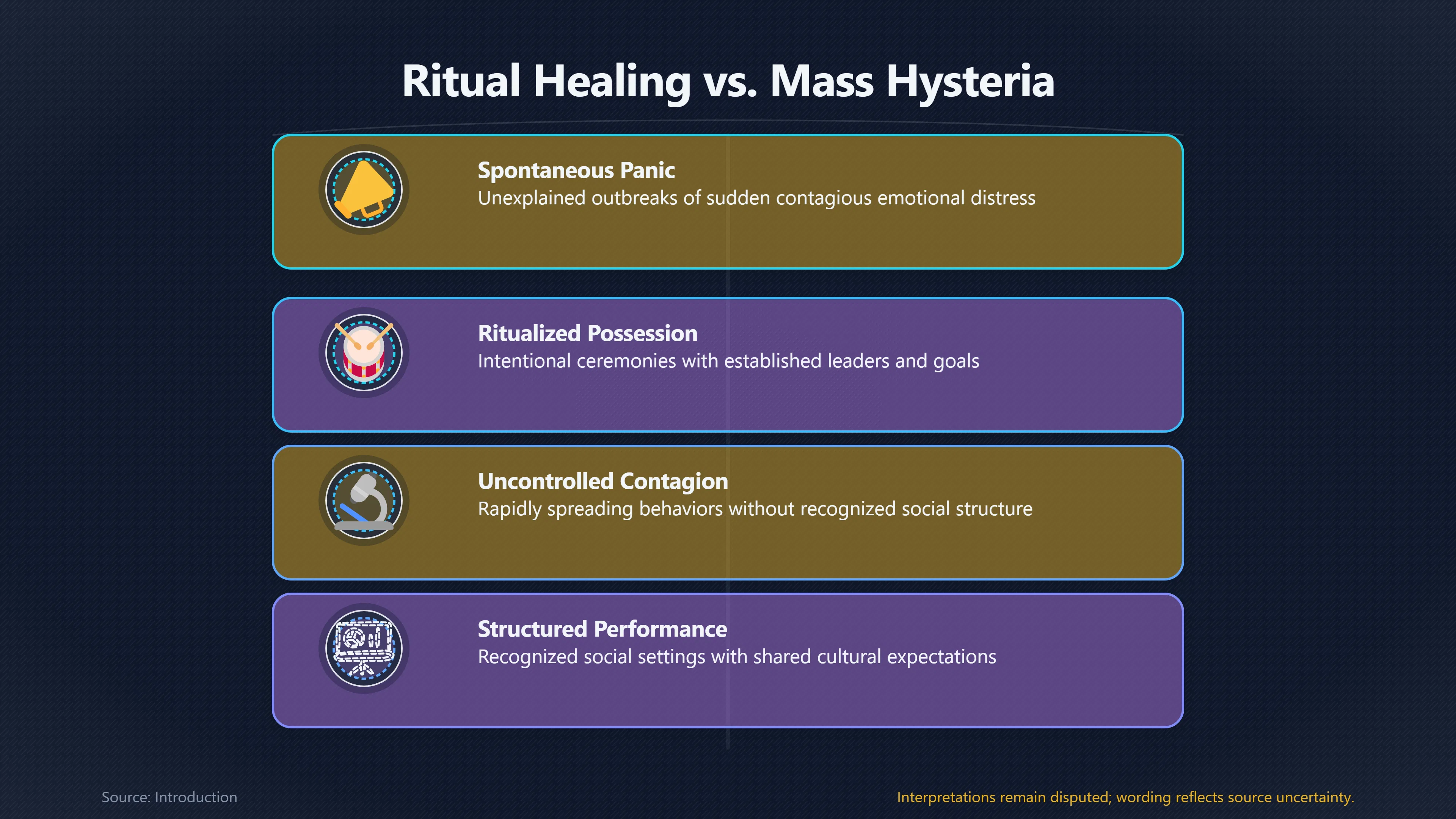
A key point is that ritualised possession should not automatically be confused with “mass hysteria”. The behaviours seen during ceremonies—trance, rhythmic movement, singing and emotional expression—occur within a recognised social setting with established expectations, leaders and goals. Participants know why they have gathered and what the ceremony is intended to achieve, making it fundamentally different from a sudden, contagious panic or unexplained outbreak of illness.[ecoi.net]ecoi.netOpen source on ecoi.net.
How possession traditions explained distress
In Somalia, anthropologists have documented spirit-possession traditions commonly referred to as saar, with regional variations including mingis. These traditions describe certain forms of illness or persistent suffering as the work of particular spirits whose identities, preferences and histories are understood within local communities. Rather than viewing possession simply as a supernatural attack, many ceremonies aim to establish a stable relationship with the spirit so that the afflicted person can regain health and social balance.[ecoi.net]ecoi.netOpen source on ecoi.net.
The symptoms attributed to possession vary widely. They may include headaches, exhaustion, insomnia, fainting, bodily pain, anxiety, disturbed behaviour or emotional distress that has resisted ordinary remedies. Instead of treating these symptoms as unrelated complaints, the possession framework gathers them into a single meaningful explanation that patients, relatives and healers can discuss together.[ResearchGate]researchgate.netResearchGate(PDF) From Mogadishu to Dixon: The Somali Diaspora in a Global Context.January 1, 2007…
Researchers have also argued that possession beliefs provide a culturally recognised way of expressing psychological and social difficulties. Marital conflict, grief, infertility, displacement, chronic stress or emotional burdens may become understandable through the language of possession without requiring the sufferer to describe these experiences in modern psychiatric terms. This does not prove that every case reflects psychological distress, nor does it validate or invalidate beliefs about spirits; rather, it shows how cultural interpretations shape experiences of illness and recovery.[ecoi.net]ecoi.netOpen source on ecoi.net.
Music, trance and the structure of communal healing
Possession ceremonies are highly structured rather than chaotic. They commonly involve rhythmic singing, drumming or clapping, dancing, incense, distinctive clothing and offerings appropriate to the spirit believed to be present. Experienced ritual leaders guide the event, identify the spirit through dialogue and observation, and direct participants through recognised stages of the ceremony.[miembrosadepac.org]miembrosadepac.orgSpirit Possession and TranceApril 19, 2026…
Music is central because it helps create the ritual environment in which trance becomes possible. Participants often know which rhythms or songs are associated with particular spirits, and ceremonies follow familiar patterns rather than unpredictable emotional outbursts. Anthropological accounts describe possession states as socially recognised performances embedded within shared expectations rather than random episodes of collective confusion.[miembrosadepac.org]miembrosadepac.orgSpirit Possession and TranceApril 19, 2026…
Equally important is the communal nature of the event. Family members, neighbours and other participants witness the person’s suffering, acknowledge it publicly and assist in the ritual. This shared participation can reduce isolation, legitimise the person’s distress and reaffirm their place within the community. Healing therefore involves restoring social relationships as well as addressing physical or emotional symptoms.[miembrosadepac.org]miembrosadepac.orgSpirit Possession and TranceApril 19, 2026…
Many ethnographic studies note that women have often been particularly associated with saar and mingis traditions, especially married women, although men may also participate. Scholars have suggested that these ceremonies sometimes provided one of the few socially acceptable spaces in which women could express frustration, negotiate family tensions or receive collective attention without directly challenging established social norms. This interpretation remains an anthropological explanation rather than a universal rule for every ceremony or participant.[ecoi.net]ecoi.netOpen source on ecoi.net.

Why ritual participation differs from spontaneous panic
From an outsider’s perspective, a room full of people singing, dancing and entering trance may appear to resemble emotional contagion. The resemblance is superficial. Collective panic is generally unexpected, rapidly spreading and unwanted, whereas possession ceremonies are intentional events with recognised purposes, experienced leaders and culturally understood outcomes.[PMC]pmc.ncbi.nlm.nih.govOpen source on nih.gov.
Several features distinguish ritual healing from mass psychogenic illness:
- Expected setting: participants deliberately attend a recognised ceremony.
- Shared interpretation: unusual behaviour is interpreted within an established religious or cultural framework.
- Guided leadership: ritual specialists manage the ceremony rather than losing control of events.
- Therapeutic goal: the objective is healing, reconciliation or relief rather than escape from an imagined external threat.
- Repeated tradition: ceremonies follow inherited practices that may continue over generations instead of appearing suddenly during a crisis.[ecoi.net]ecoi.netOpen source on ecoi.net.
For these reasons, most anthropologists caution against retrospectively diagnosing possession ceremonies as episodes of “mass hysteria”. Although altered states of consciousness and strong emotional expression are present, they occur within a recognised institution rather than through uncontrolled social contagion.[PMC]pmc.ncbi.nlm.nih.govOpen source on nih.gov.
Healing traditions alongside modern mental health care
Contemporary Somalia presents a more complex picture than historical descriptions alone suggest. Mental health services remain limited in many areas, while religious and traditional healing continue to be the first source of help for many families. Modern reviews report that psychosocial distress is often understood through concepts including spirit possession, evil eye or witchcraft, and that people frequently seek assistance from religious or traditional healers before approaching clinical services.[PMC]pmc.ncbi.nlm.nih.govPMCMental health crisis in Somalia: a review and a way forwardPMCMental health crisis in Somalia: a review and a way forward
Health researchers increasingly argue that understanding these cultural frameworks is essential for effective mental health care. Clinicians who ignore locally meaningful explanations may struggle to build trust, while uncritical acceptance of every traditional practice is also inappropriate because some forms of institutional spiritual healing have been associated with coercive practices, including reports of physical restraint and abuse in certain facilities. Respecting cultural beliefs therefore needs to be balanced with protection of patients’ rights and access to evidence-based treatment where needed.[PMC]pmc.ncbi.nlm.nih.govPMCMental health crisis in Somalia: a review and a way forwardPMCMental health crisis in Somalia: a review and a way forward
Why these ceremonies remain culturally important
Spirit possession ceremonies remain significant because they illustrate how communities can transform private suffering into a shared social experience. They provide recognised explanations for distress, create structured opportunities for emotional expression and mobilise networks of support at moments of vulnerability.
For historians and anthropologists, they also demonstrate why ritual healing should not be confused with mass hysteria. The ceremonies are organised cultural institutions with established meanings, not spontaneous outbreaks of irrational behaviour. Understanding that distinction is essential for interpreting Somalia’s history of collective belief fairly and avoiding the tendency to classify unfamiliar religious or healing practices as psychological epidemics.[ecoi.net]ecoi.netOpen source on ecoi.net.
Amazon book picks
Further Reading
Books and field guides related to Were Possession Ceremonies Healing or Mass Hysteria?. Use these as the next step if you want deeper reading beyond the article.

The Spirit Catches You and You Fall Down
First published 1997. Subjects: Asian Americans, Attitude, Attitude of Health Personnel, Child, Communication.

The anthropology of religion, magic, and witchcraft
First published 2007. Subjects: Anthropology of religion, Religion, Religion and culture, Anthropology.

A modern history of Somalia
First published 1980. Subjects: History, Somalia, history.
Understanding Somalia and Somaliland
First published 2008. Subjects: History, Somalia, history, Djibouti.
Endnotes
1.
Source: ecoi.net
Link:https://www.ecoi.net/en/document/2029113.html
2.
Source: pmc.ncbi.nlm.nih.gov
Title: PMCMurug, Waali, and Gini: Expressions of Distress in Refugees From Somalia
Link:https://pmc.ncbi.nlm.nih.gov/articles/PMC474735/
3.
Source: pmc.ncbi.nlm.nih.gov
Link:https://pmc.ncbi.nlm.nih.gov/articles/PMC12355663/
4.
Source: pmc.ncbi.nlm.nih.gov
Link:https://pmc.ncbi.nlm.nih.gov/articles/PMC6889563/
5.
Source: researchgate.net
Link:https://www.researchgate.net/publication/305429935_From_Mogadishu_to_Dixon_The_Somali_Diaspora_in_a_Global_Context
Source snippet
ResearchGate(PDF) From Mogadishu to Dixon: The Somali Diaspora in a Global Context.January 1, 2007...
Published: January 1, 2007
6.
Source: pmc.ncbi.nlm.nih.gov
Title: PMCMental health crisis in Somalia: a review and a way forward
Link:https://pmc.ncbi.nlm.nih.gov/articles/PMC8827242/
7.
Source: miembrosadepac.org
Title: Spirit Possession and Trance
Link:https://www.miembrosadepac.org/wp-content/uploads/2013Copia/10/Schmidt-Spirit-Possession-and-Trance.pdf
Source snippet
April 19, 2026...
Published: April 19, 2026
8.
Source: researchgate.net
Link:https://www.researchgate.net/publication/400682126_A_Literature_Review_of_Mental_Health_Perceptions_and_Help-seeking_Behavior_in_Somali_Communities_in_Western_Europe
9.
Source: researchgate.net
Title: (PDF) The curious case of the disappearing Zar cult
Link:https://www.researchgate.net/publication/376891968_The_curious_case_of_the_disappearing_Zar_cult
10.
Source: researchgate.net
Link:https://www.researchgate.net/publication/370211807_Religiosity_and_spirituality_in_mental_health_contexts_Perceptions_of_psychologists_and_chaplains
11.
Source: ecoi.net
Link:https://www.ecoi.net/en/document/2050497.html
12.
Source: researchgate.net
Title: (PDF) Mental Health Problems and Healing among Somalis in Sweden*
Link:https://www.researchgate.net/publication/264461874_Mental_Health_Problems_and_Healing_among_Somalis_in_Sweden
13.
Source: pubmed.ncbi.nlm.nih.gov
Link:https://pubmed.ncbi.nlm.nih.gov/21291343/
Additional References
14.
Source: africabib.org
Link:https://www.africabib.org/rec.php?RID=104706341
Source snippet
AfricaBib | Due riti di possessione a confronto: il culto di Sheekh Xussen e il Mingis...
15.
Source: youtube.com
Title: The Spirit Healers of Africa: Secrets of the Dibia, Sangoma, and Nganga
Link:https://www.youtube.com/watch?v=Rt2dl82-Dyw
Source snippet
"Ancient Somali Medicine: Powerful, Practical, or Dangerous?[https://www.youtube.com/watch?v=NZkc3JbiAKw..."](https://www.youtube.com/watch?v=NZkc3JbiAKw...")...
16.
Source: openresearch.ocadu.ca
Title: ca From Haunted to Healed
Link:https://openresearch.ocadu.ca/id/eprint/5090/
Source snippet
Masters thesis, OCAD University. * Information * Documents Item Type: | Thesis Creators: | sabeel, shahinaz Abstract: | Thr...
17.
Source: doi.org
Link:https://doi.org/10.1186%2Fs13033-022-00525-y
18.
Source: sciencedirect.com
Link:https://www.sciencedirect.com/science/article/pii/S2666560325000143
19.
Source: repositorio.iscte-iul.pt
Link:https://repositorio.iscte-iul.pt/handle/10071/7534
20.
Source: persee.fr
Title: Pelizzari (Elisa). Possession et thérapie dans la corne de l’Afrique
Link:https://www.persee.fr/doc/assr_0335-5985_1999_num_106_1_1212_t1
21.
Source: sciencedirect.com
Title: Community and healing among the Zaramo in Tanzania
Link:https://www.sciencedirect.com/science/article/pii/0160798779900310
22.
Source: country-studies.com
Title: Folk Islam and Indigenous Ritual (Somalia)SOMALIA
Link:https://country-studies.com/somalia/folk-islam-and-indigenous-ritual.html
23.
Source: ethnomed.org
Title: Somali Refugee Mental Health Cultural Profile
Link:https://ethnomed.org/resource/somali-refugee-mental-health-cultural-profile/
Topic Tree