Within Albania
When Albania Tried to Abolish Religion
The communist state tried to eliminate religion through closures, propaganda and punishment while demanding unquestioning faith in the party.
On this page
- The 1967 attack on organised worship
- How propaganda created internal enemies
- The paradox of compulsory state belief
Page outline Jump by section
Introduction
Under the rule of Enver Hoxha, Albania carried out one of the most sweeping campaigns against religion in modern European history. Between the late 1940s and the end of the communist era, the state progressively dismantled religious institutions, imprisoned or executed clergy, confiscated religious property and portrayed religious belief as a dangerous form of backwardness. The campaign reached its peak in 1967, when the regime closed every church, mosque, monastery and shrine that remained open and declared Albania the world’s first atheist state. Rather than simply promoting secular government, the communist leadership sought to replace religious loyalty with complete ideological loyalty to the Party and the state. This makes the campaign an important case study in how governments can create official narratives about “superstition”, identify internal enemies and attempt to reshape everyday belief through propaganda, education and coercion.[countrystudies.us]countrystudies.usCountry Studies AlbaniaCountry StudiesAlbania - Hoxha's Antireligious Campaign…
The 1967 attack on organised worship
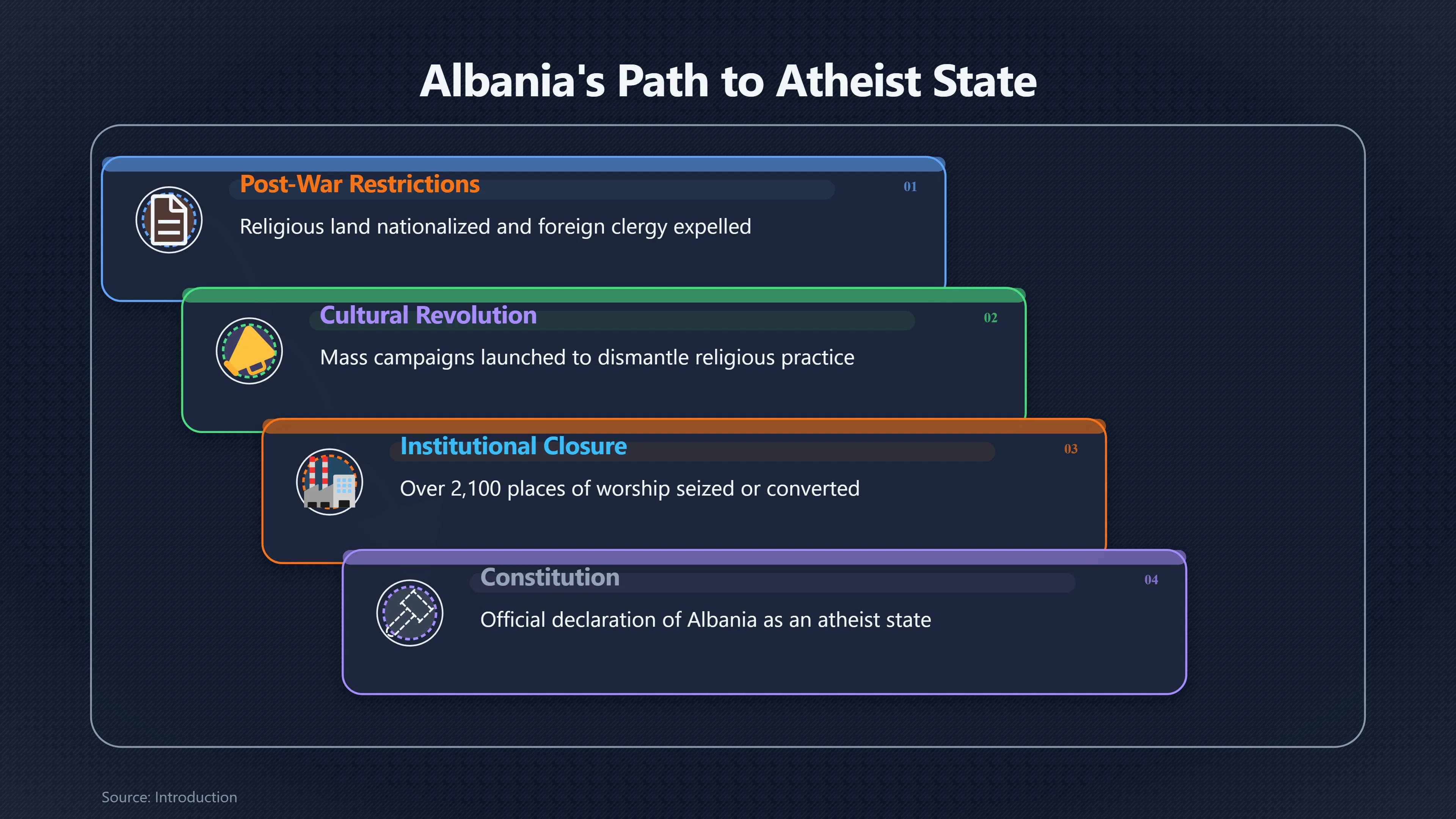
Communist Albania had already restricted religious organisations soon after the Second World War. Religious land was nationalised, foreign clergy were expelled, and churches and Islamic institutions were placed under strict state supervision. Catholic clergy, whom the regime regarded as especially suspect because of their ties to the Vatican, faced particularly harsh persecution, although Muslim and Orthodox leaders were also arrested and imprisoned.[Country Studies]countrystudies.usCountry Studies AlbaniaCountry StudiesAlbania - Hoxha's Antireligious Campaign…
The decisive break came in 1967 during what Hoxha called an ideological and cultural revolution. Influenced in part by developments in Maoist China, the Albanian leadership encouraged students and youth organisations to campaign publicly against religious practice. Local activists visited villages, demanded the closure of places of worship and organised rallies denouncing religion as superstition and an obstacle to socialism. Although official propaganda often presented these actions as spontaneous initiatives from below, historians generally view them as carefully directed by the Party leadership.[countrystudies.us]countrystudies.usCountry Studies AlbaniaCountry StudiesAlbania - Hoxha's Antireligious Campaign…
Within months, every recognised place of worship had been closed or converted to other uses. Contemporary government figures referred to more than 2,100 churches, mosques, monasteries and shrines being seized. Many became warehouses, sports halls, cinemas or cultural centres, while others were demolished entirely. Religious organisations ceased to exist as legal institutions, and public worship effectively disappeared.[Country Studies]countrystudies.usCountry Studies AlbaniaCountry StudiesAlbania - Hoxha's Antireligious Campaign…
The campaign was later reinforced through law. Albania’s 1976 constitution declared the country an atheist state and prohibited religious activity, while subsequent legislation criminalised religious propaganda and the distribution of religious literature. Public expressions of faith could lead to imprisonment.[Country Studies]countrystudies.usCountry Studies AlbaniaCountry StudiesAlbania - Hoxha's Antireligious Campaign…
How propaganda created internal enemies
The campaign was not aimed only at institutions. It also sought to redefine religious believers as obstacles to national progress.
Communist propaganda consistently described religion as a relic of feudalism, foreign domination and ignorance. Clergy were portrayed as collaborators with past occupiers, exploiters of ordinary people or agents of hostile foreign powers. This language allowed the regime to frame repression not as persecution but as liberation from irrational beliefs.[Country Studies]countrystudies.usCountry Studies AlbaniaCountry StudiesAlbania - Hoxha's Antireligious Campaign…
The term “superstition” became especially important. Rather than referring only to miracles or folk magic, it expanded to include a wide range of ordinary religious customs, including:
- attending religious services;
- observing holy days;
- baptisms, Islamic circumcisions and religious marriages;
- displaying religious symbols;
- maintaining shrines or family devotional practices.
Traditional customs associated with weddings, funerals and seasonal festivals were also scrutinised if they carried religious meaning. Schools, workplaces and neighbourhood organisations were expected to promote scientific atheism and encourage citizens to reject inherited beliefs.[Country Studies]countrystudies.usCountry Studies AlbaniaCountry StudiesAlbania - Hoxha's Antireligious Campaign…
Young people played a central symbolic role. The regime encouraged students to challenge older generations, presenting youthful rejection of religion as evidence that socialism was creating a new, rational citizen. This deliberately weakened the transmission of belief within families, where religious traditions had normally been preserved.[Country Studies]countrystudies.usCountry Studies AlbaniaCountry StudiesAlbania - Hoxha's Antireligious Campaign…

The paradox of compulsory state belief
Although the government denounced religion as irrational, historians frequently note a striking paradox: the campaign demanded an alternative form of unquestioning ideological commitment.
Marxist-Leninist doctrine became more than a political programme. Portraits of Hoxha dominated public life, Party texts were treated as authoritative guides, and ideological education reached schools, workplaces and cultural institutions. Citizens were expected to demonstrate loyalty not merely through obedience but through public enthusiasm for socialism and atheism. Failure to participate could attract suspicion.[digitalcommons.georgefox.edu]digitalcommons.georgefox.eduState-Sponsored Atheism: The Case of Albania during the Enver Hoxha EraState-Sponsored Atheism: The Case of Albania during the Enver Hoxha Era
This does not mean historians literally classify Albanian communism as a religion. Rather, many scholars observe that the regime attempted to replace religious authority with political authority, creating new rituals, symbols and ceremonies while condemning older ones. Loyalty shifted from churches, mosques and religious communities to the Party itself.[Routledge]routledge.comCommunism, Atheism and the Orthodox Church of Albania: Cooperation, SuCommunism, Atheism and the Orthodox Church of Albania: Cooperation, Su…
The result illustrates an important distinction in the study of collective belief. The campaign was not simply a rejection of faith. It was an effort to monopolise belief by eliminating competing sources of moral authority.
Fear, conformity and everyday life
The success of the campaign cannot be explained solely through police repression.
For many Albanians, practising religion became dangerous because neighbours, colleagues and even relatives might report signs of religious activity. Public conformity therefore became a practical survival strategy. Families often continued traditions privately or transmitted fragments of religious knowledge in secret, while avoiding any visible challenge to the authorities.[digitalcommons.georgefox.edu]digitalcommons.georgefox.eduState-Sponsored Atheism: The Case of Albania during the Enver Hoxha EraState-Sponsored Atheism: The Case of Albania during the Enver Hoxha Era
The experience varied across communities. Roman Catholic clergy in northern Albania suffered especially severe imprisonment and executions, but Sunni Muslim, Bektashi and Orthodox leaders were likewise arrested, sent to labour camps or prevented from carrying out religious duties. Religious education disappeared almost completely from public life, producing a generation that grew up with little formal knowledge of organised religion.[countrystudies.us]countrystudies.usCountry Studies AlbaniaCountry StudiesAlbania - Hoxha's Antireligious Campaign…
Because many traditional customs had religious roots, the campaign also altered everyday culture. Naming practices, ceremonies and festivals were increasingly reshaped to reflect socialist ideals rather than religious calendars. Some religious buildings survived only because they were preserved as historical monuments rather than functioning places of worship.[Country Studies]countrystudies.usCountry Studies AlbaniaCountry StudiesAlbania - Hoxha's Antireligious Campaign…
Why this matters in the history of collective belief
Hoxha’s campaign differs from classic episodes of mass hysteria or moral panic, yet it belongs in the wider history of collective belief because it shows how states can manufacture official fears and enforce ideological conformity.
The central claim promoted by the regime was that religion itself represented a dangerous social threat. Through education, propaganda, surveillance and punishment, the government encouraged citizens to view believers as people standing in the way of national progress. Fear therefore flowed less from spontaneous public panic than from state-directed campaigns that identified supposed internal enemies and rewarded ideological conformity.[Country Studies]countrystudies.usCountry Studies AlbaniaCountry StudiesAlbania - Hoxha's Antireligious Campaign…
The campaign also demonstrates the limits of coercion. When communist rule collapsed in 1990–91, religious practice reappeared remarkably quickly despite more than two decades of official prohibition. Churches and mosques reopened, religious communities reorganised and Albania adopted constitutional protections for freedom of religion. The rapid revival suggested that although public expressions of belief had been suppressed, many personal identities and traditions had survived beneath the surface.[Kisha Autoqefale e Shqipërisë]orthodoxalbania.orgoverviewKisha Autoqefale e ShqipërisëOverview 1991-2020 - Orthodox Autocephalous Church of AlbaniaMarch 9, 2018…
Today, historians generally interpret Hoxha’s anti-religious campaign not as evidence that belief can simply be abolished by decree, but as an example of how authoritarian governments can redefine ordinary cultural practices as dangerous “superstition”, mobilise mass participation through propaganda and attempt to replace one system of belief with another enforced by the power of the state.[routledge.com]routledge.comCommunism, Atheism and the Orthodox Church of Albania: Cooperation, SuCommunism, Atheism and the Orthodox Church of Albania: Cooperation, Su…
Amazon book picks
Further Reading
Books and field guides related to When Albania Tried to Abolish Religion. Use these as the next step if you want deeper reading beyond the article.
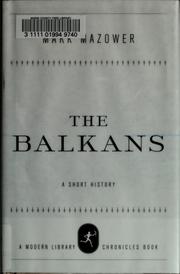
The Balkans: Nationalism, War and the Great Powers,
Explains Albania's political development.



Free: Coming of Age at the End of History
Describes the legacy of communist Albania and ideological control.
Endnotes
1.
Source: routledge.com
Title: Communism, Atheism and the Orthodox Church of Albania: Cooperation, Su
Link:https://www.routledge.com/Communism-Atheism-and-the-Orthodox-Church-of-Albania-Cooperation-Survival-and-Suppression-1945-1967/Hoxha/p/book/9781032075693
Source snippet
Communism, Atheism and the Orthodox Church of Albania: Cooperation, Su...
2.
Source: digitalcommons.georgefox.edu
Title: State-Sponsored Atheism: The Case of Albania during the Enver Hoxha Era
Link:https://digitalcommons.georgefox.edu/ree/vol40/iss6/8/
3.
Source: 2017-2021.state.gov
Title: Department Albania
Link:https://2017-2021.state.gov/reports/2017-report-on-international-religious-freedom/albania/
Source snippet
State DepartmentAlbania - United States Department of State...
4.
Source: 2021-2025.state.gov
Link:https://2021-2025.state.gov/reports/2021-report-on-international-religious-freedom/albania/
5.
Source: ih-revista.edu.al
Link:https://ih-revista.edu.al/index.php/ih-revista/article/view/556
6.
Source: ih-revista.edu.al
Link:https://ih-revista.edu.al/index.php/ih-revista/article/view/614
7.
Source: countrystudies.us
Title: Country Studies Albania
Link:https://countrystudies.us/albania/56.htm
Source snippet
Country StudiesAlbania - Hoxha's Antireligious Campaign...
8.
Source: orthodoxalbania.org
Title: overview 1991 2012
Link:https://orthodoxalbania.org/2020/en/2018/03/09/overview-1991-2012/
Source snippet
Kisha Autoqefale e ShqipërisëOverview 1991-2020 - Orthodox Autocephalous Church of AlbaniaMarch 9, 2018...
Published: March 9, 2018
9.
Source: anglisticum.org.mk
Link:https://www.anglisticum.org.mk/index.php/IJLLIS/article/view/1490
Additional References
10.
Source: dergipark.org.tr
Link:https://dergipark.org.tr/tr/pub/hakisderg/article/836916
Source snippet
ARNAVUTLUK’TA ENVER HOCA VE KOMÜNİZMİN DİNE KARŞI SAVAŞI VE GÜNÜMÜZE YANSIMALARI - Hak İş Uluslararası Emek ve Toplum DergisiDecember 31...
11.
Source: cambridge.org
Title: A. Smith Show author details * * * S. A. Smith Affiliation: University of Oxford
Link:https://www.cambridge.org/core/books/supernatural-politics/propaganda-against-religion-and-superstition/D82F9D4E8D96CBDBF5BE495E56BFBC05
Source snippet
Propaganda against Religion and Superstition (Chapter 8) - Supernatural PoliticsMay 15, 2026 — 8 - PROPAGANDA AGAINST RELIGION AND SUPERS...
Published: May 15, 2026
12.
Source: mdpi.com
Title: Importing Religion into Post-Communist Albania: Between Rights and Obligations
Link:https://www.mdpi.com/2077-1444/14/5/658
Source snippet
May 15, 2023 — Review Reports Versions Notes ABSTRACT After the communist regime seized power in Albania in 1944, the vilification, humil...
Published: May 15, 2023
13.
Source: researchgate.net
Link:https://www.researchgate.net/publication/301758018_From_the_communist_point_of_view_Cultural_hegemony_and_folkloric_manipulation_in_Albanian_studies_under_socialism
14.
Source: perlego.com
Link:https://www.perlego.com/book/3495787/communism-atheism-and-the-orthodox-church-of-albania-cooperation-survival-and-suppression-19451967-pdf
15.
Source: explorer.cuni.cz
Link:https://explorer.cuni.cz/publication/146798
16.
Source: ecoi.net
Link:https://www.ecoi.net/en/document/1090750.html
Source snippet
USDOS – US Department of State (Author): “Country Report on Human Rights Practices for 1987”, Document #1090750 - ecoi.net...
17.
Source: gutenberg.org
Link:https://www.gutenberg.org/files/32129/32129-h/32129-h.htm
18.
Source: researchgate.net
Title: (PDF) State-Sponsored Atheism: The Case of Albania during the Enver Hoxha Era
Link:https://www.researchgate.net/publication/343627292_State-Sponsored_Atheism_The_Case_of_Albania_during_the_Enver_Hoxha_Era
19.
Source: youtube.com
Link:https://www.youtube.com/watch?v=3hHpVvE6WC8
Topic Tree