Within Japan Panics
When Television Made Fear Spread Faster
The toilet-paper rush and the Pokemon illness episode show how television can amplify both rational caution and contagious symptoms.
On this page
- The 1973 toilet paper buying spiral
- The Pokemon broadcast and genuine seizure risk
- How news coverage turns local events into national scares
Page outline Jump by section
Introduction
Modern Japan has experienced several striking episodes in which television and other mass media did more than report public anxiety—they became part of the mechanism by which it spread. Two of the best-known examples are the 1973 rush to buy toilet paper during the oil crisis and the 1997 Pokémon television incident. They are very different events: one involved consumer behaviour, the other a genuine medical emergency. Yet both reveal a common pattern. Initial uncertainty was amplified by highly visible media coverage, causing many people to react not simply to the original problem but to the behaviour they saw unfolding around them. These episodes have become classic case studies in how modern media can transform local events into nationwide scares without requiring widespread irrationality.
The 1973 toilet-paper buying spiral
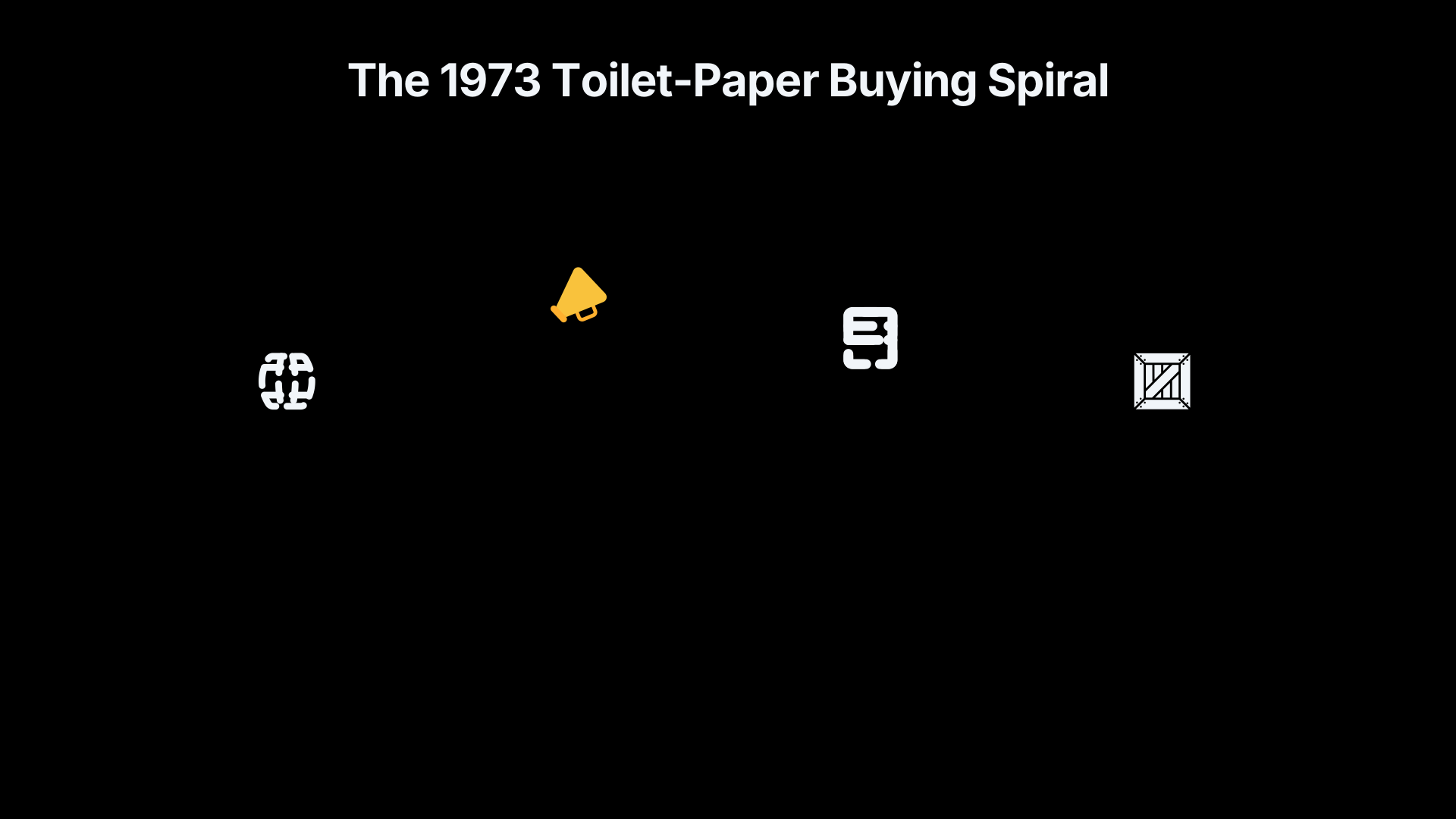
The toilet-paper panic of late 1973 unfolded during Japan’s first oil shock, when the Arab oil embargo created genuine concerns about energy supplies and inflation. Prices for many goods were rising rapidly, and consumers had already witnessed shortages of essential products. Against this backdrop, rumours spread that toilet paper—made from paper, not petroleum—would soon become unavailable.
The rumour itself was false, but it flourished because it matched the public mood. Long queues outside supermarkets and increasingly empty shelves became powerful visual evidence that reinforced the belief that supplies were running out. Once television news showed shoppers rushing to buy toilet paper, many viewers concluded that they too needed to act before stocks disappeared.
Historians have argued that describing the episode simply as irrational “panic” misses its social logic. Many shoppers did not necessarily believe the rumour about production shortages. Instead, they feared that other people believed it. If everyone else was buying in bulk, failing to join in risked being left without an everyday necessity. The shortage therefore became self-fulfilling: visible buying created genuine scarcity in shops even though production capacity remained largely intact.[OUP Academic]academic.oup.comOUP Academic“Toilet Paper Panic”: Uncertainty and Insecurity in Early 1970s Japan | The American Historical Review | Oxford AcademicJuly…
The episode remains influential because it demonstrates that consumer scares often spread through observation rather than belief. Seeing empty shelves can outweigh official reassurances, especially when television repeatedly broadcasts images of scarcity.
The Pokémon broadcast and genuine seizure risk
On 16 December 1997, a very different media event occurred when an episode of the animated television series Pokémon featured rapidly flashing red and blue lights during an explosion sequence. Soon after the broadcast, hundreds of children experienced symptoms including seizures, dizziness, nausea and visual disturbances. Ambulances transported hundreds of viewers to hospital, prompting an immediate nationwide health response.[Ministry of Health, Labour and Welfare]mhlw.go.jpMinistry of Health, Labour and Welfare厚生科学特別研究光感受性発作に関する臨床研究(速報版)についてMinistry of Health, Labour and Welfare厚生科学特別研究光感受性発作に関する臨床研究(速報版)について
Unlike many media scares, this incident began with a genuine physical hazard. The flashing sequence contained visual effects capable of triggering photosensitive epileptic seizures in susceptible viewers. Government investigations and later medical studies confirmed that some children experienced authentic neurological reactions linked to the broadcast.[Ministry of Health, Labour and Welfare]mhlw.go.jpMinistry of Health, Labour and Welfare厚生科学特別研究光感受性発作に関する臨床研究(速報版)についてMinistry of Health, Labour and Welfare厚生科学特別研究光感受性発作に関する臨床研究(速報版)について
However, the story did not end there. Extensive news coverage repeatedly replayed the flashing images and reported dramatic accounts of children becoming ill. Within the following days, thousands more children reported symptoms, many of whom had not experienced epileptic seizures. Researchers comparing clinical records with the timing of reported illnesses concluded that while the initial wave included genuine seizure cases, a much larger second wave was consistent with mass psychogenic illness, sometimes called mass sociogenic illness. Anxiety, expectation and discussion among classmates appeared to spread symptoms such as headaches, dizziness and nausea beyond those directly affected by photosensitive epilepsy.[wikipedia.org]WikipediaMass psychogenic illnessMass psychogenic illness
The Pokémon episode is therefore one of the clearest documented examples of a real medical event and a socially contagious illness occurring together. It demonstrates that recognising psychogenic symptoms does not mean dismissing the original danger. Both processes can operate simultaneously.
The incident also led to lasting reforms. Japanese broadcasters introduced stricter guidelines limiting flashing images, reducing the intensity and duration of rapid colour changes, and encouraging safer viewing conditions. These standards influenced animation production well beyond Japan.[Ministry of Health, Labour and Welfare]mhlw.go.jpMinistry of Health, Labour and Welfare厚生科学特別研究光感受性発作に関する臨床研究(速報版)についてMinistry of Health, Labour and Welfare厚生科学特別研究光感受性発作に関する臨床研究(速報版)について
How news coverage turns local events into national scares
These two cases illustrate a recurring mechanism rather than a uniquely Japanese characteristic.
In both episodes, television altered how people judged risk through several reinforcing processes:
- Visibility became evidence. Empty shelves or ambulance footage convinced viewers that an unusual threat was already widespread.
- People reacted to other people’s behaviour. Individuals often acted because they expected others to continue doing so, not because they independently accepted the underlying rumour.
- Official reassurance struggled against visible reality. Statements that supplies were adequate or risks were limited carried less weight when television showed queues outside shops or large numbers of hospital admissions.
- Feedback loops intensified the event. Media coverage generated more public reactions, which created more newsworthy images, encouraging further coverage.
Later research into Japan’s COVID-19 toilet-paper buying surge in 2020 reached remarkably similar conclusions. Studies by researchers at NHK’s Broadcasting Culture Research Institute found that many shoppers did not believe rumours that toilet paper would disappear. Instead, television reports showing empty shelves persuaded them that widespread stockpiling was already occurring, making participation appear rational despite doubting the rumour itself. Researchers explicitly noted that memories of the 1973 oil-shock panic continued to shape public expectations decades later.[J-STAGE]jstage.jst.go.jpOpen source on go.jp.
Why these episodes still matter
Japan’s media-driven shortages and illness scares are often cited because they challenge the simple idea that collective fear results from irrational crowds. The toilet-paper panic was rooted in reasonable concern about future access to essential goods during economic disruption. The Pokémon incident began with a genuine medical hazard before social contagion magnified its apparent scale.
Together, they show that modern mass communication does not merely transmit information. It also allows people to observe one another’s reactions in real time. Those reactions can become new evidence, encouraging further behavioural change. In this way, visible public responses—queues, empty shelves, ambulances or dramatic news reports—can become as influential as the original event itself.
For historians, psychologists and media researchers, these Japanese episodes remain important because they demonstrate that collective scares often arise from an interaction between real uncertainty, social observation and repeated media exposure, rather than from simple gullibility or fabricated danger alone.


Endnotes
1.
Source: academic.oup.com
Link:https://academic.oup.com/ahr/article-abstract/126/2/530/6316740
Source snippet
OUP Academic“Toilet Paper Panic”: Uncertainty and Insecurity in Early 1970s Japan | The American Historical Review | Oxford AcademicJuly...
2.
Source: sciencedirect.com
Link:https://www.sciencedirect.com/science/article/pii/S0887899402004484
Source snippet
A comparison survey of seizures and other symptoms of Pokemon phenomenon - ScienceDirect...
3.
Source: Wikipedia
Title: Mass psychogenic illness
Link:https://en.wikipedia.org/wiki/Mass_psychogenic_illness
4.
Source: sciencedirect.com
Title: Analysis of photo-pattern sensitivity in patients with Pokemon-related symptoms
Link:https://www.sciencedirect.com/science/article/pii/S0887899402004630
5.
Source: sciencedirect.com
Title: A comparison survey of seizures and other symptoms of Pokemon phenomenon
Link:https://www.sciencedirect.com/science/article/abs/pii/S0887899402004484
6.
Source: jstage.jst.go.jp
Link:https://www.jstage.jst.go.jp/article/bunken/70/7/70_2/_article/-char/ja/
7.
Source: mhlw.go.jp
Title: Ministry of Health, Labour and Welfare厚生科学特別研究光感受性発作に関する臨床研究(速報版)について
Link:https://www.mhlw.go.jp/www1/houdou/1004/h0414-2.html
8.
Source: jstage.jst.go.jp
Title: jst.go.jp A tentative model of consumer’s decision making in the hoarding panic
Link:https://www.jstage.jst.go.jp/article/jssp/1/1/1_KJ00003724590/_article/-char/en
9.
Source: jstage.jst.go.jp
Link:https://www.jstage.jst.go.jp/article/jssp/1/1/1_KJ00003724590/_article/-char/ja
11.
Source: jstage.jst.go.jp
Link:https://www.jstage.jst.go.jp/article/jssp/1/1/1_KJ00003724590/_article
Additional References
12.
Source: theguardian.com
Title: Photograph: AP View image in fullscreen Pokémon Shock … The epi
Link:https://www.theguardian.com/tv-and-radio/2022/dec/16/pokemon-explosion-tv-japan-children-hospital
Source snippet
‘There was an explosion, and I had to close my eyes’: how TV left 12,000 children needing a doctor | Television | The GuardianDecember 16...
13.
Source: japanpolicyforum.jp
Title: RECONSIDERIN G NIHON NO JISATSU (JAPAN’S SUICIDE)
Link:https://www.japanpolicyforum.jp/politics/pt2012052916291736.html
Source snippet
RECONSIDERING NIHON NO JISATSU (JAPAN'S SUICIDE)May 29, 2012 — The truth behind the incident was that the students went into a state of p...
Published: May 29, 2012
14.
Source: youtube.com
Title: Was Electric Soldier Porygon Dubbed?
Link:https://www.youtube.com/watch?v=ExeVy9sh-Dk
Source snippet
Johnny Carson Jokes About The Recent Toilet Paper Shortage - 12/19/1973...
15.
Source: youtube.com
Title: Johnny Carson Jokes About The Recent Toilet Paper Shortage
Link:https://www.youtube.com/watch?v=5K9-Lz0SbrA
Source snippet
Porygon Seizure Episode Full Story (Banned Pokemon Episode)...
16.
Source: youtube.com
Title: Electric Soldier Porygon: The UNTOLD Stories
Link:https://www.youtube.com/watch?v=Ry2YkTympL4
Source snippet
Was Electric Soldier Porygon Dubbed? - The History of Pokemon Shock...
17.
Source: youtube.com
Title: The Pokémon Episode That Sent 700 Kids to the Hospital?!
Link:https://www.youtube.com/watch?v=tiwvYMHwBmg
Source snippet
Electric Soldier Porygon: The UNTOLD Stories...
18.
Source: researchgate.net
Link:https://www.researchgate.net/publication/370875641_A_History_of_Mentalities_in_Modern_Japan_Premonitions_of_Anxiety_in_Economic_Prosperity_in_the_Early_1970s
19.
Source: nejm.org
Link:https://www.nejm.org/doi/abs/10.1056/NEJM200407223510424
20.
Source: scq.ubc.ca
Link:https://www.scq.ubc.ca/journal-club-find-watching-pokemon-is-hazardoud-to-your-health/
21.
Source: cir.nii.ac.jp
Link:https://cir.nii.ac.jp/crid/1390287706351240576
Topic Tree