Within Luxembourg Panics
How Did One Witch Accusation Create Another?
Courts transformed quarrels and misfortune into conspiracy cases by forcing confessions and demanding the names of supposed accomplices.
On this page
- Neighbour disputes, illness and everyday suspicion
- Torture, leading questions and forced confessions
- Why legal procedure amplified false conspiracy claims
Page outline Jump by section
Introduction
The largest witch persecutions in the Duchy of Luxembourg did not grow because villagers steadily uncovered a real underground organisation. They expanded because the legal process itself encouraged accusations to multiply. Once someone had been arrested on suspicion of witchcraft, interrogators often demanded not only a confession but also the names of supposed accomplices. Under torture or the threat of renewed torture, many prisoners named neighbours, relatives or local rivals. Those newly accused people were then questioned in the same way, creating chains of accusations that could spread through entire communities. Historians regard this judicial mechanism as one of the main reasons why local suspicions developed into claims of vast witch conspiracies rather than remaining isolated disputes.[uni.lu]publications.uni.luversity of Luxembourg PublicationsHexenprozesse im Herzogtum Luxemburg: Echternach 1679/1680 - Kmec Sonja…
How everyday suspicion became criminal investigation
Most witchcraft cases began with ordinary conflicts rather than dramatic discoveries. A sick child, dead livestock, spoiled butter, a failed harvest or a long-running argument between neighbours could all become grounds for suspicion if no better explanation seemed available.
On their own, these accusations did not necessarily produce mass persecution. Many communities experienced quarrels without generating large witch hunts. The turning point came when magistrates accepted the possibility that misfortunes were connected through a hidden conspiracy. Instead of asking whether one neighbour had caused harm, courts increasingly asked whether the accused belonged to a wider network serving the Devil. That change transformed individual allegations into investigations searching for an entire organisation.[University of Luxembourg Publications]publications.uni.luversity of Luxembourg PublicationsHexenprozesse im Herzogtum Luxemburg: Echternach 1679/1680 - Kmec Sonja…
This approach reflected early modern demonological beliefs. Authorities increasingly assumed that witches acted collectively, attended secret gatherings and recruited others. Once investigators accepted that premise, every suspect became a potential witness against many more people.
Torture and the demand for more names
Why confessions rarely ended a case
In many criminal courts of the period, confession was considered the strongest form of proof. In witchcraft prosecutions, however, a confession often marked the beginning rather than the end of an investigation.
Interrogators typically wanted answers to a familiar sequence of questions:
- How did the accused become a witch?
- Who introduced them?
- Who attended secret meetings?
- Who else practised harmful magic?
- Which neighbours had made similar agreements?
These were leading questions. They assumed that a conspiracy already existed and required prisoners to supply names that fitted the investigators’ expectations.[Lund University]lunduniversity.lu.send University Häxprocesserna i Europa | Lund Universitynd UniversityHäxprocesserna i Europa | Lund University…
Why torture created false networks
Modern research on interrogation shows that people under extreme pain or fear often say what they believe questioners want to hear rather than what is true. Early modern judges did not understand false confession in the modern psychological sense. Instead, many believed that torture could reveal hidden truth if applied correctly.
In Luxembourg’s witch trials, as elsewhere in heavily affected parts of the Holy Roman Empire, torture frequently became a machine for producing ever larger lists of suspects. Prisoners who named no one risked further questioning and additional suffering. Naming others could appear to offer at least a chance that the interrogation would stop. The resulting accusations therefore reflected the pressures of the courtroom as much as genuine village suspicions.[uni.lu]publications.uni.luversity of Luxembourg PublicationsHexenprozesse im Herzogtum Luxemburg: Echternach 1679/1680 - Kmec Sonja…
Why accusation chains spread so quickly
The process resembled a branching network rather than a series of independent cases.
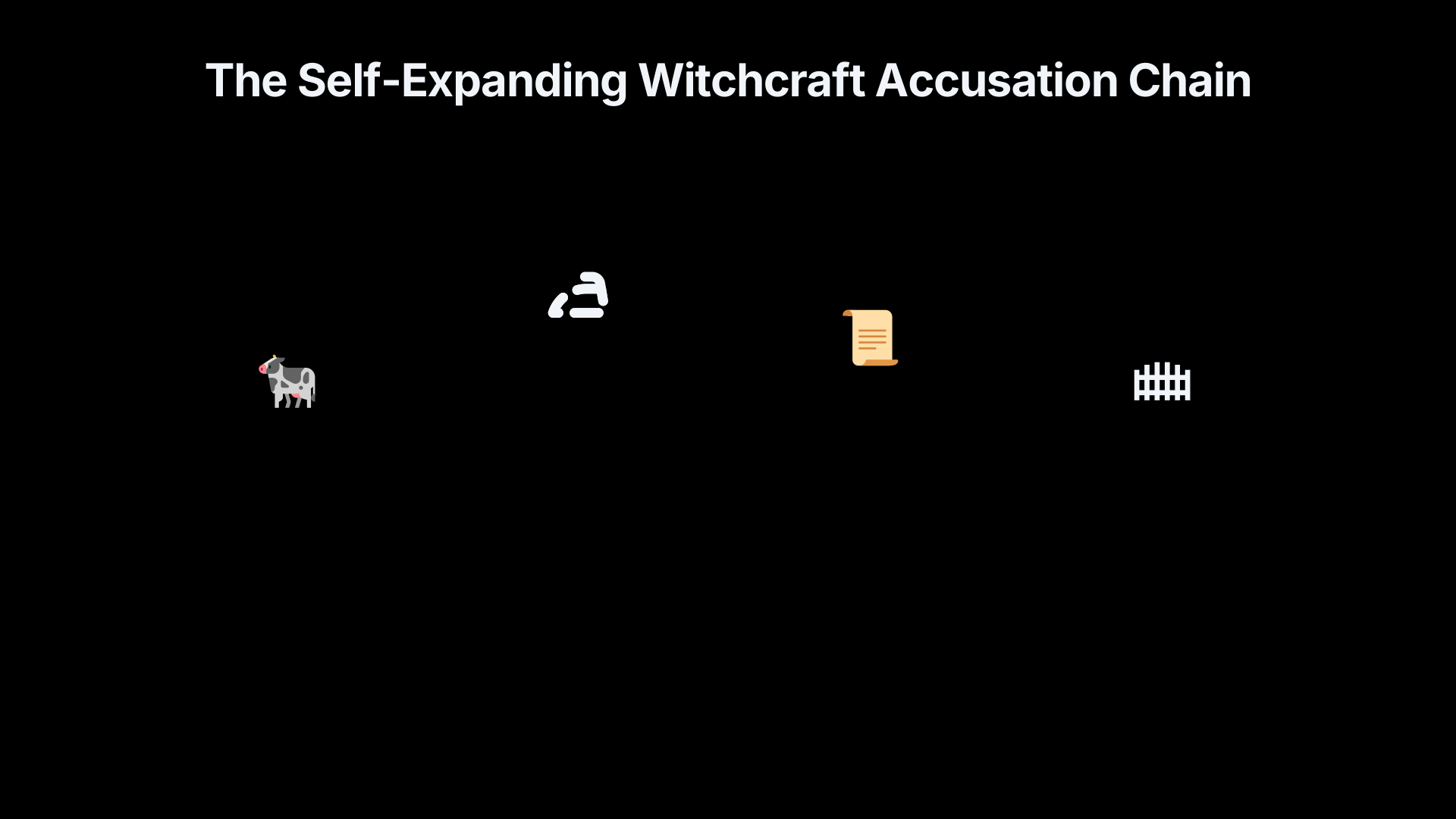
A typical pattern was:
- One person was accused after local misfortune or conflict.
- Under interrogation, the suspect confessed after coercion or torture.
- Officials demanded the names of accomplices.
- Newly named people were arrested.
- Those prisoners faced the same questioning and produced further names.
Each stage generated fresh investigations. Because every confession was treated as evidence supporting the next arrest, courts effectively reinforced their own assumptions. The legal process became self-expanding.
This helps explain why some districts experienced sudden waves of prosecutions rather than a steady trickle of isolated cases. Once several people had confessed under coercion, authorities believed they had uncovered proof of a widespread conspiracy, even though the evidence largely consisted of previous coerced testimony.[uni.lu]publications.uni.luversity of Luxembourg PublicationsHexenprozesse im Herzogtum Luxemburg: Echternach 1679/1680 - Kmec Sonja…
The Echternach prosecutions as an example
The prosecutions around Echternach in 1679–80 illustrate this mechanism particularly clearly. Research by historian Sonja Kmec shows that investigators were concerned not simply with individual acts of alleged witchcraft but with identifying wider circles of supposed participants. Confessions, accusations and repeated interrogations linked defendants together into networks that appeared convincing within the legal framework of the time.[University of Luxembourg Publications]publications.uni.luversity of Luxembourg PublicationsHexenprozesse im Herzogtum Luxemburg: Echternach 1679/1680 - Kmec Sonja…
From a modern perspective, these “networks” were largely products of judicial procedure rather than discoveries of genuine criminal organisations. They reflected repeated rounds of interrogation, expectations about what witches were supposed to confess, and the willingness of courts to accept statements extracted under coercion.
Why courts believed the growing conspiracy
To modern readers, it may seem obvious that accusations produced under torture were unreliable. Early modern judges often interpreted them differently.
Several ideas reinforced one another:
- Confession was treated as powerful evidence, even when obtained under severe pressure.
- Consistency between different confessions appeared convincing, although prisoners were often asked similar leading questions.
- Existing belief in organised witchcraft made overlapping stories seem to confirm one another.
- Repeated accusations from different prisoners were interpreted as independent confirmation rather than recognising that all had emerged from the same coercive process.
This created a powerful feedback loop. Every new confession seemed to validate previous ones, while every new arrest appeared to confirm that investigators were uncovering an increasingly extensive conspiracy.[Lund University]lunduniversity.lu.send University Häxprocesserna i Europa | Lund Universitynd UniversityHäxprocesserna i Europa | Lund University…
Why historians see legal procedure as the key mechanism
Modern historians generally argue that popular belief alone cannot explain the scale of Luxembourg’s witch persecutions. Fear of harmful magic existed across much of Europe, yet only some regions experienced devastating waves of executions.
The crucial difference lay in legal institutions. Courts willing to authorise torture, rely heavily on confessions and pursue named accomplices converted local suspicion into expanding prosecution networks. Without those judicial practices, neighbourly quarrels would often have remained isolated accusations instead of developing into large-scale hunts. Studies of Luxembourg’s surviving trial records fit this broader European pattern, showing that the growth of persecution depended as much on courtroom procedure as on popular belief itself.[uni.lu]publications.uni.luversity of Luxembourg PublicationsHexenprozesse im Herzogtum Luxemburg: Echternach 1679/1680 - Kmec Sonja…
The eventual decline of witch trials across Europe likewise followed legal change. As higher courts and legal scholars became increasingly sceptical of torture, demanded stronger evidence and questioned the reliability of confession-based prosecutions, the accusation chains that had sustained major witch hunts became far harder to maintain.[Reddit]reddit.comHow were witch trials finally refuted?How were witch trials finally refuted?…
Amazon book picks
Further Reading
Books and field guides related to How Did One Witch Accusation Create Another?. Use these as the next step if you want deeper reading beyond the article.
The witch-hunt in early modern Europe
First published 1987. Subjects: Witchcraft, History, Hexenglaube, Geschichte (1450-1750), Heksenvervolgingen.
Europe's inner demons
First published 1975. Subjects: Witchcraft, History, Demonology, Church history, Witchcraft, europe.
Thinking with Demons
First published 1997. Subjects: Religion, Witchcraft, History, Witchcraft, europe, Europe, religion.
Witch craze
First published 2004. Subjects: Trials (Witchcraft), Witchcraft, History, Witchcraft, europe, Heksenvervolgingen.
Endnotes
1.
Source: publications.uni.lu
Link:https://publications.uni.lu/handle/10993/6322
Source snippet
versity of Luxembourg PublicationsHexenprozesse im Herzogtum Luxemburg: Echternach 1679/1680 - Kmec Sonja...
2.
Source: lunduniversity.lu.se
Title: nd University Häxprocesserna i Europa | Lund University
Link:https://www.lunduniversity.lu.se/publication/3799799
Source snippet
nd UniversityHäxprocesserna i Europa | Lund University...
3.
Source: reddit.com
Title: How were witch trials finally refuted?
Link:https://www.reddit.com/r/AskHistorians/comments/17dm9q5
Source snippet
How were witch trials finally refuted?...
4.
Source: orbilu.uni.lu
Link:https://orbilu.uni.lu/handle/10993/6322?locale=en
Source snippet
Hexenprozesse im Herzogtum Luxemburg: Echternach 1679/1680 - 2002...
5.
Source: orbilu.uni.lu
Link:https://orbilu.uni.lu/handle/10993/6322
6.
Source: orbilu.uni.lu
Link:https://orbilu.uni.lu/handle/10993/6322?locale=fr
Additional References
7.
Source: chariotjournal.wordpress.com
Link:https://chariotjournal.wordpress.com/2023/08/16/torture-in-early-modern-europe-how-torture-propelled-witch-hunts-through-their-peak-and-end/
Source snippet
in Early Modern Europe: How torture propelled witch-hunts through their peak and end – Chariot JournalAugust 16, 2023 — Torture was undou...
Published: August 16, 2023
8.
Source: today.rtl.lu
Title: lu Knowledge Bites: Double, double toil and trouble: Witchcraft in Luxembourg
Link:https://today.rtl.lu/luxembourg-insider/history/double-double-toil-and-trouble-witchcraft-in-luxembourg-1997152
Source snippet
Bites: Double, double toil and trouble: Witchcraft in Luxembourg - RTL TodayFebruary 18, 2025 — KNOWLEDGE BITES DOUBLE, DOUBLE TOIL AND T...
Published: February 18, 2025
9.
Source: en.wikisource.org
Title: The Manner of Procedure of a Judge in a Case of Witchcraft
Link:https://en.wikisource.org/wiki/An_Examen_of_Witches/The_Manner_of_Procedure_of_a_Judge_in_a_Case_of_Witchcraft
Source snippet
Examen of Witches/The Manner of Procedure of a Judge in a Case of Witchcraft - Wikisource, the free online libraryFebruary 2, 2025 — AN E...
Published: February 2, 2025
10.
Source: cambridge.org
Title: Confessions and tales of horror (Chapter 8)
Link:https://www.cambridge.org/core/books/abs/speak-of-the-devil/confessions-and-tales-of-horror/2F3412CDA773F1B709741950D2907AF0
Source snippet
Speak of the DevilJune 5, 2012 — 8 - CONFESSIONS AND TALES OF HORROR Published online by Cambridge University Press: 05 June 2012 Jean La...
Published: June 5, 2012
11.
Source: youtube.com
Title: The Witch-Hunt in Early Modern Europe: A Discussion with Brian Levack
Link:https://www.youtube.com/watch?v=eSvFMkcO2d4
Source snippet
3 WITCH TRIALS: Beliefs, Persecution, Heresy, Inquisition, Torture, Harry Potter w/ Alison Rowlands...
12.
Source: youtube.com
Link:https://www.youtube.com/watch?v=ql_QzJmXFcs
Source snippet
4 The Horrors of the German Witch Hunts | Human Voiced, No Ads...
13.
Source: youtube.com
Title: The Horrors of the German Witch Hunts | Human Voiced, No Ads
Link:https://www.youtube.com/watch?v=NvEzvu_uYEI
Source snippet
5 Revealing the Truths of the Witch Trials | Witches: Truth Behind the Trials | National Geographic UK...
14.
Source: visitluxembourg.com
Title: Visit Luxembourg Bourscheid Hougeriicht – High justice
Link:https://www.visitluxembourg.com/place/bourscheid-hougeriicht-high-justice
Source snippet
Visit LuxembourgBourscheid Hougeriicht – High justice - Visit Luxembourg...
15.
Source: youtube.com
Title: The Secret History of Witches | Witch Trials and Fear in History
Link:https://www.youtube.com/watch?v=HvNHzeM3EjU
Source snippet
2 The Witch-Hunt in Early Modern Europe: A Discussion with Brian Levack...
16.
Source: ksf.lu
Link:https://www.ksf.lu/index.php/de/greiweschlass/archive/divers
Topic Tree