Within Austria's Collective Fears
How Rumour Destroyed Jewish Vienna
The destruction of medieval Vienna's Jewish community shows how unsupported ritual accusations became organised state violence.
On this page
- The accusations behind the Vienna Gesera
- How rulers turned belief into policy
- Confiscation, expulsion and historical memory
Page outline Jump by section
Introduction
The Vienna Gesera of 1420–21 was one of the most destructive outbreaks of antisemitic persecution in medieval Austria. It demonstrates how unsupported rumours could become official policy when political power, religious prejudice and economic opportunity reinforced one another. Duke Albert V accused Jews of crimes including desecrating the Christian Eucharist, conspiring with the Hussites and threatening Christian society. None of these accusations was supported by credible evidence, yet they were used to justify arrests, torture, executions, confiscation of property and the destruction of Vienna’s Jewish community. Historians now regard the Vienna Gesera not as a spontaneous popular panic but as an example of rulers transforming long-established antisemitic myths into organised state violence.[Deutsch]wien.gv.atDeutsch Jews in medieval ViennaDeutschJews in medieval Vienna - City of Vienna…
The accusations behind the Vienna Gesera
The rumours that fuelled the Vienna Gesera were not invented overnight. They belonged to a wider medieval tradition of false accusations directed at Jewish communities across Europe. Among the most influential were claims that Jews desecrated consecrated communion wafers, murdered Christian children for religious purposes or secretly worked against Christian society. These stories circulated through sermons, local legends and legal proceedings despite the absence of reliable evidence.
By 1420, Austria was experiencing political uncertainty. The Hussite Wars had destabilised neighbouring Bohemia, and fears of religious dissent were widespread. Duke Albert V portrayed Vienna’s Jews not simply as religious outsiders but as potential collaborators with the Hussites. This transformed inherited prejudice into an alleged security threat. Rather than investigating individual acts, authorities treated the Jewish community collectively as guilty.[Deutsch]wien.gv.atDeutsch Jews in medieval ViennaDeutschJews in medieval Vienna - City of Vienna…
Modern historians emphasise that these accusations reflected Christian fears and inherited stereotypes rather than Jewish religious practice. Judaism explicitly forbids the consumption of blood, making ritual-murder stories fundamentally incompatible with Jewish law. Likewise, host-desecration stories depended upon Christian beliefs about the Eucharist that Jews did not share. The accusations therefore reveal far more about medieval Christian anxieties than about Jewish life itself.[Deutsch]wien.gv.atDeutsch Jews in medieval ViennaDeutschJews in medieval Vienna - City of Vienna…
How rulers turned belief into policy
Although rumours spread among the wider population, the destruction of Vienna’s Jewish community required decisions by political authorities. The Vienna Gesera illustrates how collective belief becomes especially dangerous when rulers adopt and legitimise unsupported accusations.
Instead of treating rumours with scepticism, Duke Albert V used them as justification for sweeping action. Jews were arrested, interrogated and tortured. Their property was confiscated, outstanding debts owed to Jewish lenders were often cancelled, and communities throughout Lower Austria faced expulsion or destruction. Those who survived imprisonment were largely forced into exile, while many others died during the persecution. Contemporary and later sources differ on exact numbers, but the episode ended the medieval Jewish community in Vienna.[Deutsch]wien.gv.atDeutsch Jews in medieval ViennaDeutschJews in medieval Vienna - City of Vienna…
Economic motives reinforced religious rhetoric. Jewish communities occupied legally restricted economic roles, particularly in lending money because many other occupations were closed to them. Confiscating Jewish wealth benefited the ducal treasury and relieved many debtors of their obligations. Historians therefore see the Gesera as combining religious hostility with financial and political advantage rather than as the product of irrational rumour alone.[Deutsch]wien.gv.atDeutsch Jews in medieval ViennaDeutschJews in medieval Vienna - City of Vienna…
This distinction matters. The episode is sometimes described as an outbreak of popular hatred, but the surviving evidence shows that official power gave rumours their destructive force. Without state endorsement, longstanding myths might have remained prejudice; with state endorsement, they became legal justification for persecution.
Why the rumours proved so persuasive
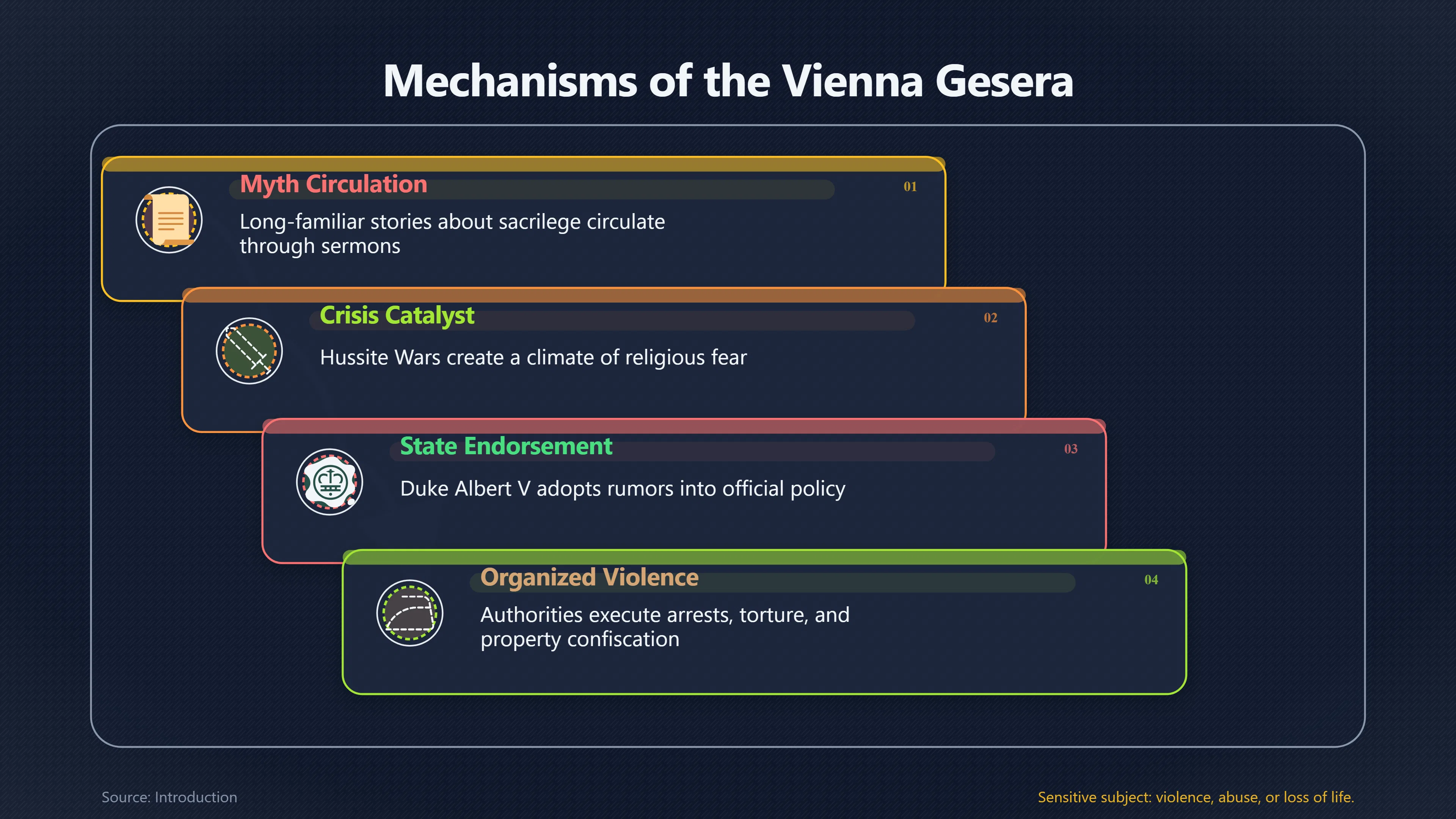
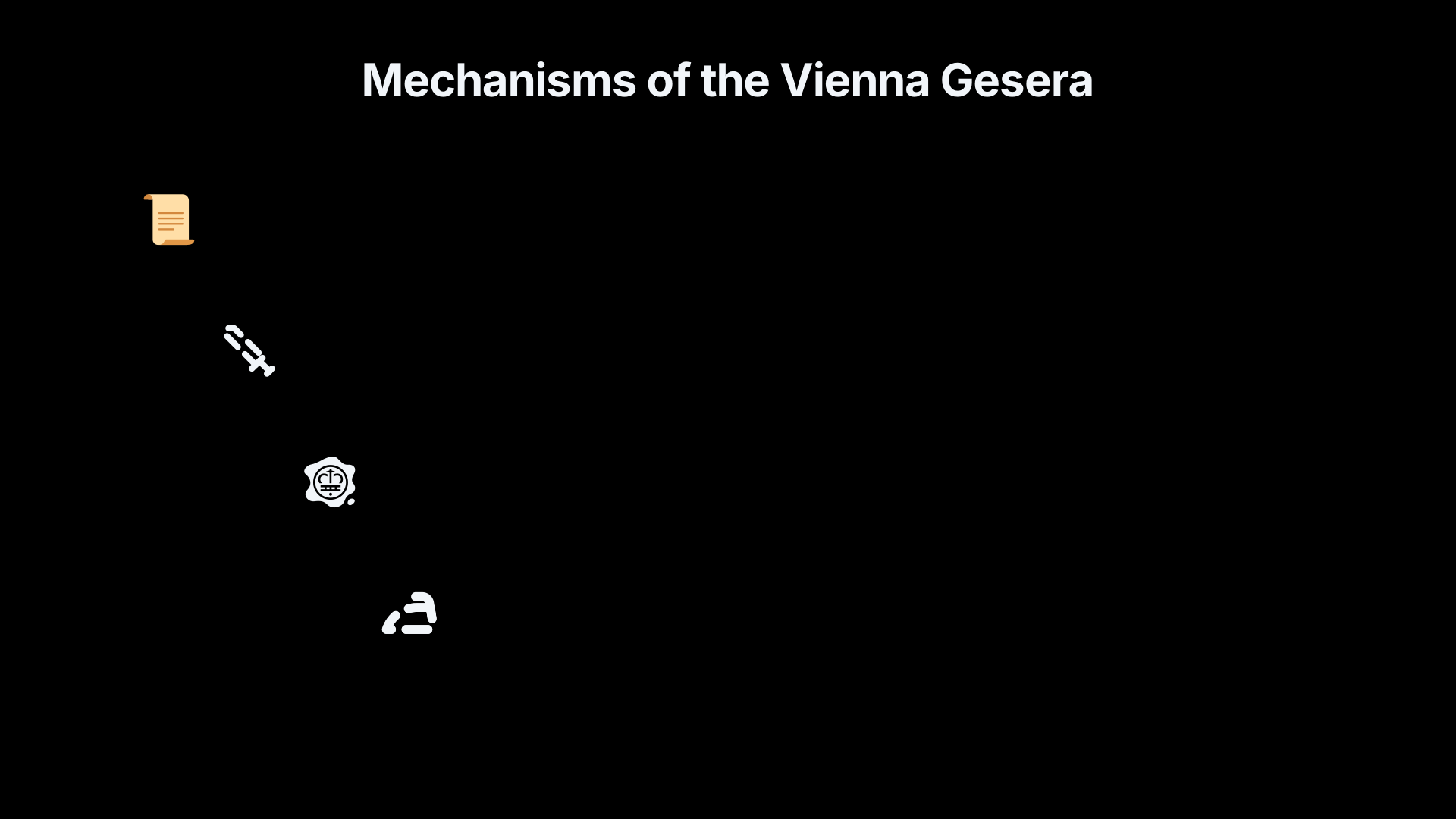
The Vienna Gesera illustrates several mechanisms that recur in many episodes of collective fear.
Long-familiar myths appeared credible. Repeated stories about alleged Jewish sacrilege had circulated for generations. Familiarity made extraordinary claims seem plausible to many contemporaries.
Political crises encouraged conspiracy thinking. The Hussite conflict heightened fears of hidden enemies and religious subversion, allowing authorities to connect unrelated anxieties into a single narrative.
Religious symbolism amplified emotion. Claims involving the Eucharist touched one of medieval Christianity’s most sacred beliefs. Alleged attacks on the host were therefore perceived as attacks on the entire Christian community rather than ordinary crimes.
Material incentives reduced resistance. Confiscated property, cancelled debts and the redistribution of wealth created practical beneficiaries of persecution, making official action attractive beyond purely religious motives.
These factors help explain why unsupported rumours could develop into coordinated violence without requiring convincing evidence.
Confiscation, expulsion and the destruction of Jewish Vienna
The consequences extended far beyond the immediate loss of life. The medieval Jewish quarter centred on today’s Judenplatz ceased to function as the heart of Jewish Vienna. The synagogue was destroyed, homes and property changed hands, and a community that had contributed to Vienna’s commercial and intellectual life for centuries disappeared.
Archaeological excavations beneath Judenplatz have uncovered the remains of the medieval synagogue destroyed during the Gesera. Today these remains form part of Museum Judenplatz, allowing visitors to see physical evidence of the community that persecution erased. Rather than preserving only written records of violence, the site demonstrates the scale of the community that once existed before organised persecution ended its presence in medieval Vienna.[vienna.info]wien.infovienna.info Museum Judenplatz ViennaJudenplatz Vienna - vienna.info…
The physical disappearance of Jewish institutions also had a lasting effect on public memory. Later generations encountered an altered cityscape in which the absence of Jewish life itself became normalised, obscuring the scale of what had been lost.

Historical memory and modern interpretation
Modern scholarship rejects the medieval accusations as baseless antisemitic myths. The Vienna Gesera is studied not as evidence of genuine conspiracy but as an example of how prejudice, rumour and political authority can reinforce one another.
The preservation of Judenplatz has become central to this reassessment. The museum’s exhibitions place the destruction of 1420–21 within the longer history of Jewish Vienna, emphasising both the richness of medieval Jewish life and the mechanisms through which persecution became possible. Excavated synagogue foundations and historical interpretation encourage visitors to understand the Gesera as a deliberate act of exclusion rather than an inevitable consequence of religious conflict.[vienna.info]wien.infovienna.info Museum Judenplatz ViennaJudenplatz Vienna - vienna.info…
Historians also distinguish the Vienna Gesera from modern ideas of “mass hysteria”. The rumours themselves spread socially, but the decisive factor was governmental action. Authorities investigated accusations through coercion rather than evidence, converted inherited prejudice into legal policy and organised the destruction of an entire community. This makes the episode a powerful example of how collective belief becomes most dangerous when backed by institutions capable of enforcing it.
Why the Vienna Gesera still matters
The Vienna Gesera remains one of Austria’s clearest historical examples of the destructive power of antisemitic rumour. It demonstrates that unsupported accusations rarely operate in isolation. They gain exceptional force when political leaders adopt them, courts abandon standards of evidence and economic interests align with prejudice.
For that reason, the episode is remembered not simply as a medieval tragedy but as a warning about the relationship between rumour and power. False stories alone did not destroy Jewish Vienna. They became catastrophic because they were accepted as justification for official policy, allowing fear, discrimination and political calculation to reshape an entire community with lasting consequences for Austrian history.
Amazon book picks
Further Reading
Books and field guides related to How Rumour Destroyed Jewish Vienna. Use these as the next step if you want deeper reading beyond the article.
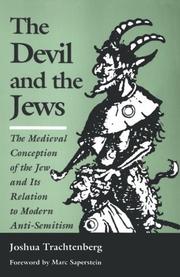
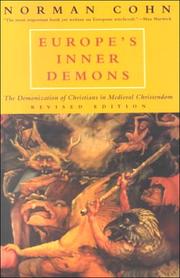
The devil and the Jews
Directly explains the false accusations behind the Vienna Gesera.

Endnotes
1.
Source: wien.gv.at
Title: Deutsch Jews in medieval Vienna
Link:https://www.wien.gv.at/en/living-together/jewish-vienna-history-medieval
Source snippet
DeutschJews in medieval Vienna - City of Vienna...
2.
Source: wien.info
Title: vienna.info Museum Judenplatz Vienna
Link:https://www.wien.info/en/see-do/discover-vienna/jewish-vienna/museum-judenplatz-352772
Source snippet
Judenplatz Vienna - vienna.info...
3.
Source: wien.gv.at
Title: Abgeschlossene Grabung 1., Judenplatz
Link:https://www.wien.gv.at/archaeologie/projekte/judenplatz.html
4.
Source: encyclopedia.com
Title: Vienna | Encyclopedia.com
Link:https://www.encyclopedia.com/places/germany-scandinavia-and-central-europe/austria-political-geography/vienna
5.
Source: wien.info
Title: Jewish Museum
Link:https://www.wien.info/en/see-do/discover-vienna/jewish-vienna/jewish-museum-349300
6.
Source: wien.info
Title: Jewish Vienna
Link:https://www.wien.info/en/see-do/discover-vienna/jewish-vienna/jewish-vienna-349336
7.
Source: wien.info
Title: Museum Judenplatz
Link:https://www.wien.info/de/sehen-erleben/wien-entdecken/juedisches-wien/judenplatz-349458
8.
Source: encyclopedia.ushmm.org
Link:https://encyclopedia.ushmm.org/content/en/article/vienna
Additional References
9.
Source: cambridge.org
Link:https://www.cambridge.org/core/journals/antiquity/article/archaeology-and-sensory-regimes-in-medieval-and-early-modern-europe/EDB6BB572411A12ADAAF8D46FEFB6245
Source snippet
February 10, 2026 — SENSORY EXCLUSION: JEWISH QUARTERS IN THE LATER MIDDLE AGES The case studies discussed so far refer mostly to the pos...
Published: February 10, 2026
10.
Source: geschichte.univie.ac.at
Title: univie.ac.at Anti-Semitism at the University of Vienna | 650 plus
Link:https://geschichte.univie.ac.at/en/topics/anti-semitism-university-vienna
Source snippet
univie.ac.atAnti-Semitism at the University of Vienna | 650 plusAugust 11, 2024 — ANTI-SEMITISM AT THE UNIVERSITY OF VIENNA 1421–2006 Ant...
Published: August 11, 2024
11.
Source: geschichte.univie.ac.at
Title: univie.ac.at Antisemitismus an der Universität Wien | 650 plus
Link:https://geschichte.univie.ac.at/de/node/108
Source snippet
an der Universität Wien | 650 plusNovember 8, 2024 — ANTISEMITISMUS AN DER UNIVERSITÄT WIEN 1421–2006 An der Universität Wien war antisem...
Published: November 8, 2024
12.
Source: viennatourism.org
Title: Jewish Vienna: History, Heritage Sites & Memorials Guide
Link:https://www.viennatourism.org/jewish-vienna-history/
Source snippet
June 26, 2026 — JEWISH VIENNA: HISTORY, HERITAGE SITES & MEMORIALS GUIDE June 26, 2026 Vienna’s Jewish history is among the oldest, riche...
Published: June 26, 2026
13.
Source: cambridge.org
Link:https://www.cambridge.org/core/journals/austrian-history-yearbook/article/abs/reviled-repressed-resurrected-vienna-1900-in-the-nazi-imaginary/77B01B90D74BA39CDAA70D12A8AD7939
Source snippet
Reviled, Repressed, Resurrected: Vienna 1900 in the Nazi Imaginary | Austrian History Yearbook | Cambridge CoreMay 5, 2022 — REVILED, REP...
Published: May 5, 2022
14.
Source: youtube.com
Title: Medieval Antisemitism (Essential Lectures in Jewish History) Dr. Henry Abramson
Link:https://www.youtube.com/watch?v=H-yEMdrOAS0
Source snippet
3 Medieval Antisemitism: An Introduction | Dr. Lackner...
15.
Source: youtube.com
Title: Vienna: A Jewish story of resilience and rupture
Link:https://www.youtube.com/watch?v=QCNZpXaksc8
Source snippet
2 Medieval Antisemitism (Essential Lectures in Jewish History) Dr. Henry Abramson...
16.
Source: youtube.com
Link:https://www.youtube.com/watch?v=icAMWP8hjAA
Source snippet
4 Episode 2 Vienna's Judenplatz - www.jewishinvienna.com...
17.
Source: youtube.com
Title: Episode 2 Vienna’s Judenplatz
Link:https://www.youtube.com/watch?v=2bwyjw3zCT8
Source snippet
5 Past as Prologue: Rethinking Antisemitism Today...
18.
Source: jmw.at
Link:https://www.jmw.at/en
Source snippet
Jewish Museum Vienna | Jüdisches Museum WienJune 12, 2026 — Museum Dorotheergasse Dorotheergasse 11 1010 Vienna closed Museum Judenplatz...
Published: June 12, 2026
Topic Tree