Within Dutch Panics
How Dutch Courts Turned Witch Fear Lethal
Dutch witch accusations became lethal when courts used torture, conspiracy theories and coerced names to turn suspicion into further arrests.
On this page
- Why local accusations became criminal cases
- Roermond and the self replicating prosecution
- Oudewater, legal restraint and modern remembrance
Page outline Jump by section
Introduction
Dutch witch trials were never a single, nationwide campaign. They varied dramatically from one town and province to another because local courts controlled how accusations were investigated, what counted as evidence, whether torture could be used, and how easily suspects could clear their names. This helps explain why some communities experienced only isolated accusations while others descended into lethal chains of prosecution. The most infamous example was the Roermond trials of 1613–1614, where judicial methods transformed individual suspicions into one of the largest witch persecutions within the borders of the present-day Netherlands. By contrast, the town of Oudewater became known for offering accused people an official route to prove their innocence, demonstrating that legal institutions could also restrain fear rather than amplify it.[archiefroermond.nl]archiefroermond.nl‘Heksen’ op de brandstapelGemeentearchief Roermond – Ontdek het verleden van de stad…
Why local accusations became criminal cases
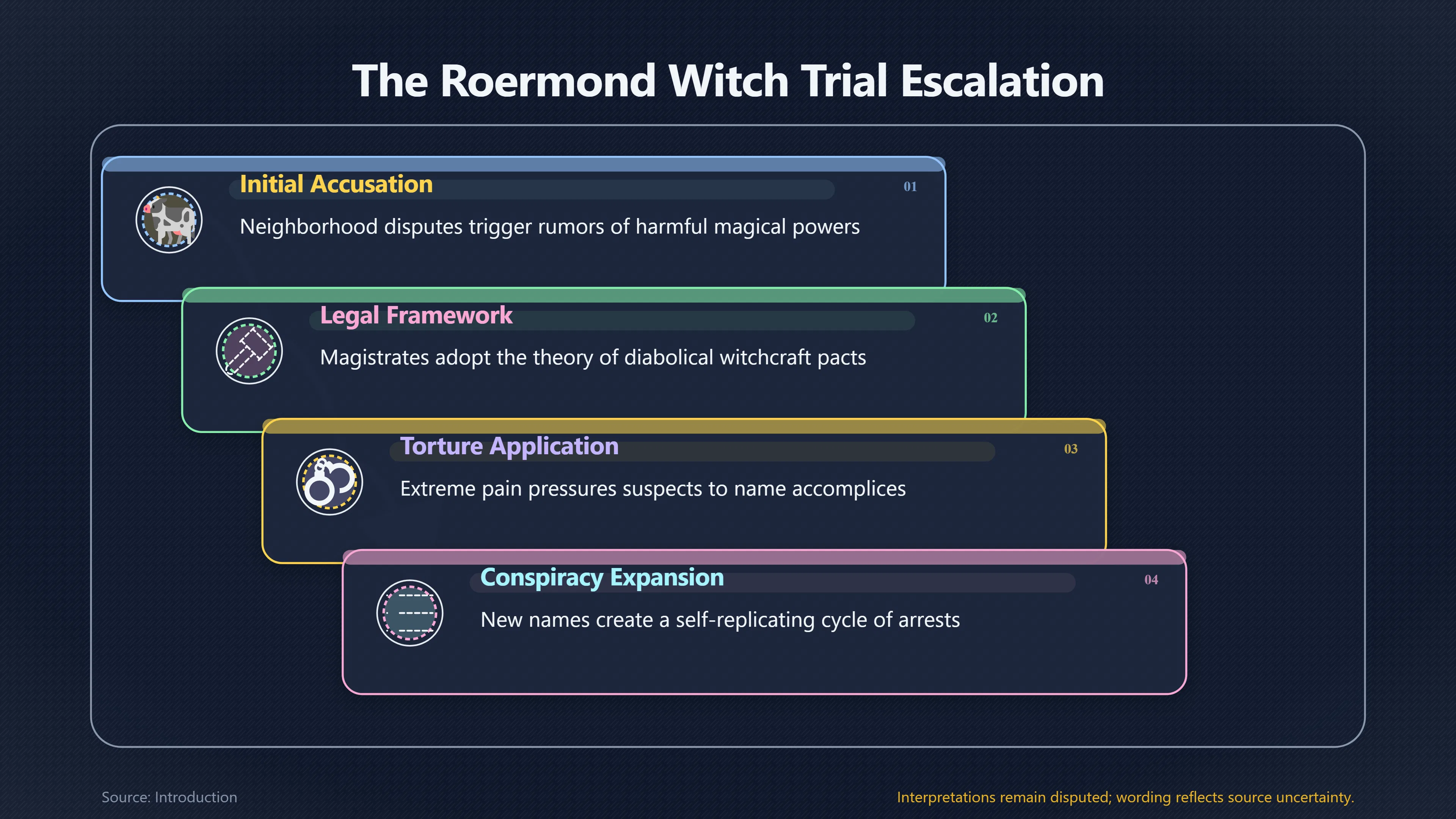
Most accusations of witchcraft began with familiar neighbourhood disputes. A child’s unexplained illness, livestock dying, repeated crop failures or longstanding personal quarrels could lead to rumours that someone possessed harmful magical powers. On their own, such suspicions did not necessarily result in executions.
The decisive step occurred when magistrates accepted the broader theory of diabolical witchcraft. Under this legal and theological model, a suspect was no longer simply blamed for causing misfortune but was believed to have entered a pact with the Devil, attended secret gatherings and participated in an organised conspiracy against Christian society. Courts therefore searched not merely for evidence of a single harmful act but for proof of membership in an imagined criminal network.
This changed the character of prosecutions. Instead of resolving one dispute, courts tried to uncover an entire conspiracy. Every confession became a source of fresh suspects, making investigations expand rather than conclude. Historians therefore emphasise that judicial procedure—not simply popular belief—often determined whether witch fears remained local gossip or became mass persecution.[archiefroermond.nl]archiefroermond.nl‘Heksen’ op de brandstapelGemeentearchief Roermond – Ontdek het verleden van de stad…
How torture made prosecutions self-replicating
The legal procedures available to individual courts were crucial.
Where torture was authorised, suspects were pressured to confess and, critically, to identify supposed accomplices. A confession extracted under extreme pain was treated as persuasive evidence rather than a sign of coercion. If the accused denied guilt, that refusal could itself justify further interrogation.
This created a self-reinforcing cycle:
- A suspect confessed after torture.
- The confession named neighbours, relatives or acquaintances.
- Those people were arrested.
- New interrogations produced additional names.
- The expanding list appeared to confirm the existence of a vast conspiracy.
The process rewarded accusations rather than scepticism. Courts increasingly interpreted overlapping confessions as independent confirmation, even though they had been produced by identical coercive methods. Modern historians regard this as one of the central mechanisms by which European witch hunts escalated, including those in parts of the Low Countries.[archiefroermond.nl]archiefroermond.nl‘Heksen’ op de brandstapelGemeentearchief Roermond – Ontdek het verleden van de stad…
Roermond and the self-replicating prosecution
The Roermond trials of 1613–1614 remain the clearest Dutch example of this judicial escalation.
At the time, Roermond lay within the Spanish-controlled Upper Quarter of Guelders rather than the independent Dutch Republic. Contemporary evidence and later scholarship indicate that at least seventy witch trials were conducted during this period, making it the largest known concentration of witch prosecutions within today’s Netherlands. Most convicted suspects were strangled before their bodies were burned, the standard execution method used there.[archiefroermond.nl]archiefroermond.nl‘Heksen’ op de brandstapelGemeentearchief Roermond – Ontdek het verleden van de stad…
The original court records have not survived intact, meaning historians reconstruct the events from contemporary printed accounts, municipal evidence and later historical analysis. As a result, exact totals vary between publications. While the precise number of executions cannot be established with complete certainty, there is broad agreement that the persecution was exceptionally large by Dutch standards.[archiefroermond.nl]archiefroermond.nl‘Heksen’ op de brandstapelGemeentearchief Roermond – Ontdek het verleden van de stad…
What distinguishes Roermond is not merely its scale but the way prosecutions multiplied. Rather than ending with the punishment of individual suspects, interrogations repeatedly generated new accusations. The courts’ acceptance of coerced confessions transformed scattered fears into an expanding legal campaign.
The episode illustrates that witch hunts were administrative processes as much as popular panics. Local officials decided how aggressively to investigate, whether torture would continue and how readily accusations could spread through judicial authority.

Why Dutch jurisdictions reached different outcomes
One reason there was no single “Dutch witch hunt” is that justice remained highly local.
Different jurisdictions exercised considerable discretion over criminal procedure. Magistrates differed in their willingness to:
- permit torture;
- accept supernatural evidence;
- treat confessions as reliable;
- prosecute alleged conspiracies rather than isolated accusations; and
- dismiss doubtful cases.
These legal differences produced strikingly different patterns of prosecution across the Low Countries. Areas with more cautious evidential standards generally experienced fewer executions, while places where courts actively pursued diabolical conspiracies could experience rapid escalation.
For historians, this variation provides strong evidence against the idea that witch hunts were simply outbreaks of irrational public emotion. The same underlying beliefs existed across much of Europe, yet judicial practice determined whether those beliefs became mass executions or faded without lasting consequences.[ResearchGate]researchgate.netOpen source on researchgate.net.
Oudewater, legal restraint and modern remembrance
Oudewater became famous for taking an unusually different approach.
The town’s official weigh house issued certificates stating that an accused person’s weight matched normal bodily proportions. The test itself rested on the mistaken belief that witches were unnaturally light because they could fly, so it did not reject belief in witchcraft altogether. Nevertheless, its practical effect was remarkably protective.
The weighing followed an official civic procedure involving municipal officers, public oversight and written certification. Individuals who received a certificate could present it elsewhere as evidence against accusations, giving them an institutional defence rather than exposing them to torture. Historical records identify numerous people who travelled considerable distances—including from German territories—to obtain such certificates.[geschiedkundigeverenigingoudewater.nl]geschiedkundigeverenigingoudewater.nlGeschiedkundige Vereniging Oudewater HeksenjachtGeschiedkundige Vereniging OudewaterHeksenjacht - Geschiedkundige vereniging OudewaterDecember 9, 2020…
Modern scholarship has also challenged later national myths surrounding Oudewater. During the twentieth century, the town was sometimes portrayed as proof that the Dutch had uniquely rejected witch hunting. Researchers argue that this overstates the case. Oudewater was exceptional precisely because other jurisdictions often behaved very differently. Its importance lies less in demonstrating universal Dutch tolerance than in showing that alternative legal responses were possible within the same broader culture of witch belief.[ResearchGate]researchgate.netOpen source on researchgate.net.
Today, the historic weigh house functions as a museum exploring both the history of witch persecution and the wider problem of exclusion, illustrating how official institutions can either legitimise fear or protect vulnerable people.[Museum De Heksenwaag Oudewater]heksenwaag.nlMuseum De Heksenwaag Oudewater HomeMuseum De Heksenwaag OudewaterHome - Museum De Heksenwaag Oudewater | The weigh house…
What the Dutch experience reveals about panic and justice
The Dutch witch trials demonstrate that collective fear alone did not determine outcomes. Similar beliefs about harmful magic existed across many communities, but only some courts transformed those fears into sustained criminal prosecutions.
Roermond shows how torture, conspiracy thinking and coerced naming of accomplices allowed prosecutions to expand almost automatically once they had begun. Oudewater shows the opposite possibility: even within a society that accepted many supernatural assumptions, legal procedures could interrupt escalation by providing recognised routes to acquittal.
For historians of mass persecution, this contrast is one of the most important lessons from the Netherlands. Witch hunts were not inevitable products of popular superstition. They became lethal when judicial systems converted suspicion into legally sanctioned certainty, and they subsided where courts imposed greater restraint on the production and evaluation of evidence.[archiefroermond.nl]archiefroermond.nl‘Heksen’ op de brandstapelGemeentearchief Roermond – Ontdek het verleden van de stad…


Endnotes
1.
Source: archiefroermond.nl
Title: ‘Heksen’ op de brandstapel
Link:https://www.archiefroermond.nl/verleden/verhalen/een-andere-geschiedenis/zwarte-bladzijden/heksen-op-de-brandstapel
Source snippet
Gemeentearchief Roermond – Ontdek het verleden van de stad...
2.
Source: heksenwaag.nl
Title: Museum De Heksenwaag Oudewater Home
Link:https://heksenwaag.nl/en/
Source snippet
Museum De Heksenwaag OudewaterHome - Museum De Heksenwaag Oudewater | The weigh house...
3.
Source: researchgate.net
Link:https://www.researchgate.net/publication/320307713_Unravelling_the_Myth_and_Histories_of_the_Weighing_Test_at_Oudewater_The_Case_of_Leentje_Willems
4.
Source: heksenwaag.nl
Title: They stand on the scales
Link:https://heksenwaag.nl/en/about-the-weigh-house/
Source snippet
About the weigh house - Museum De Heksenwaag OudewaterFebruary 23, 2021 — ABOUT THE WEIGH HOUSE THE HISTORY OF A REMARKABLE BUILDING For...
Published: February 23, 2021
5.
Source: archiefroermond.nl
Link:https://www.archiefroermond.nl/onderzoek/regesten
6.
Source: youtube.com
Title: Echoes of Injustice – The Dark Heritage of Witch Trials in Dutch Memory
Link:https://www.youtube.com/watch?v=XZQe0uLQZjA
Source snippet
DUTCH WITCH TRIALS | Laura's Legends | 02 Utrecht...
7.
Source: youtube.com
Title: DUTCH WITCH TRIALS | Laura’s Legends | 02 Utrecht
Link:https://www.youtube.com/watch?v=Ilq8dEePvr0
Source snippet
The History of Witch Trials - The Netherlands...
8.
Source: geschiedkundigeverenigingoudewater.nl
Title: Geschiedkundige Vereniging Oudewater Heksenjacht
Link:https://geschiedkundigeverenigingoudewater.nl/geschiedenis-van-oudewater/heksenjacht/
Source snippet
Geschiedkundige Vereniging OudewaterHeksenjacht - Geschiedkundige vereniging OudewaterDecember 9, 2020...
Published: December 9, 2020
9.
Source: nationalarchives.gov.uk
Link:https://www.nationalarchives.gov.uk/explore-the-collection/explore-by-time-period/early-modern/witchcraft/
Additional References
10.
Source: theguardian.com
Link:https://www.theguardian.com/world/2024/oct/04/dutch-feminists-campaign-for-national-monument-to-witches
Source snippet
“To this day a witch is still a comic figure. In the Netherlands, every year at the carnaval, people b...
11.
Source: youtube.com
Title: Why This Dutch Town Blew Up Its Own Castle: Valkenburg, Netherlands
Link:https://www.youtube.com/watch?v=jtj3LJO4TTI
Source snippet
You can watch The History of Witch Trials in the Netherlands to learn about the specific courts, legal mechanisms, and sentences used dur...
12.
Source: visitingthedutchcountryside.com
Title: The History of the Witches Weighing House in Oudewater
Link:https://www.visitingthedutchcountryside.com/history/witches-weighing-house-oudewater/
Source snippet
We have to thank emperor Charles the fifth, who was the ruler of The Netherlands in the beginning of the 16th century, for tha...
13.
Source: dutchnews.nl
Title: Photo: Ben Bender via Wikimedia Commons See
Link:https://www.dutchnews.nl/2020/10/halloween-hocus-pocus-find-out-if-you-are-a-witch-in-oudewaters-weigh-house/
Source snippet
Halloween hocus pocus: find out if you are a witch in Oudewater’s weigh house - DutchNews.nlOctober 28, 2020 — HALLOWEEN HOCUS POCUS: FIN...
Published: October 28, 2020
14.
Source: museumofwitchcraftandmagic.co.uk
Title: Museum of Witchcraft and Magic R/5/748
Link:https://museumofwitchcraftandmagic.co.uk/richel/r5748-print-of-oudewater-and-city-seal-and-notes-on-the-weighing-of-witches/
Source snippet
Museum of Witchcraft and MagicR/5/748 - print of Oudewater and city seal; and notes on the weighing of witches - Museum of Witchcraft and...
15.
Source: youtube.com
Title: The Weigh House In The 16th Century [Witch Weighing Court]
Link:https://www.youtube.com/watch?v=S2Vlb7mycYU
Source snippet
Why This Dutch Town Blew Up Its Own Castle: Valkenburg, Netherlands...
16.
Source: youtube.com
Title: The History of Witch Trials
Link:https://www.youtube.com/watch?v=LpQgpxF05H8
Source snippet
The Weigh House In The 16th Century [Witch Weighing Court]...
17.
Source: hotspotholland.nl
Link:https://hotspotholland.nl/en/the-Witches-weighhouse
18.
Source: dbnl.org
Link:https://www.dbnl.org/tekst/dres005verb01_01/dres005verb01_01_0017.php
19.
Source: amusingplanet.com
Title: The Witches’ Weigh House in Oudewater | Amusing Planet
Link:https://www.amusingplanet.com/2016/12/the-witches-weigh-house-in-oudewater.html
Topic Tree