Within Canada's Strange Beliefs
Why New France Never Had a Salem
New France saw supernatural accusations and court cases, but never developed a Canadian equivalent of the Salem witch panic.
On this page
- What surviving witchcraft cases reveal
- Anne Lamarque, Jean Campagna and the courts
- Colonial prejudice, folklore and later mythmaking
Page outline Jump by section
Introduction
New France inherited European beliefs about harmful magic, demonic influence and supernatural misfortune, yet it never experienced a witch panic comparable to the famous Salem trials of 1692 or the large-scale persecutions that swept parts of continental Europe. Colonists sometimes blamed illness, infertility, bad luck or unexplained events on sorcery, and accusations did reach colonial courts. However, the surviving record suggests that prosecutions remained uncommon, investigations were relatively cautious, and no documented witchcraft trial in New France ended with an execution for the crime itself.[Éducaloi]educaloi.qc.caÉducaloi Witch Trials in New France | Believe it or Not | ÉducaloiÉducaloiWitch Trials in New France | Believe it or Not | ÉducaloiOctober 30, 2025…

That contrast makes New France historically significant. Rather than illustrating a society free of supernatural beliefs, it shows how widespread belief in witchcraft could exist without developing into a self-sustaining judicial panic. The surviving cases reveal a colony where rumours, personal disputes and fears of occult harm were real, but where changing French legal practice, higher standards of proof and increasing official scepticism limited the scale of persecution.[Éducaloi]educaloi.qc.caÉducaloi Witch Trials in New France | Believe it or Not | ÉducaloiÉducaloiWitch Trials in New France | Believe it or Not | ÉducaloiOctober 30, 2025…
Why New France Never Had a Salem
The most striking feature of witchcraft accusations in New France is not that they occurred, but that they remained limited.
Historians estimate that only around twenty formal accusations or proceedings for witchcraft survive from the French colonial period. This is a remarkably small number compared with many European regions or neighbouring New England. An equally unusual feature is that most of those accused were men rather than women, reversing the gender pattern commonly associated with European witch hunts.[Éducaloi]educaloi.qc.caÉducaloi Witch Trials in New France | Believe it or Not | ÉducaloiÉducaloiWitch Trials in New France | Believe it or Not | ÉducaloiOctober 30, 2025…
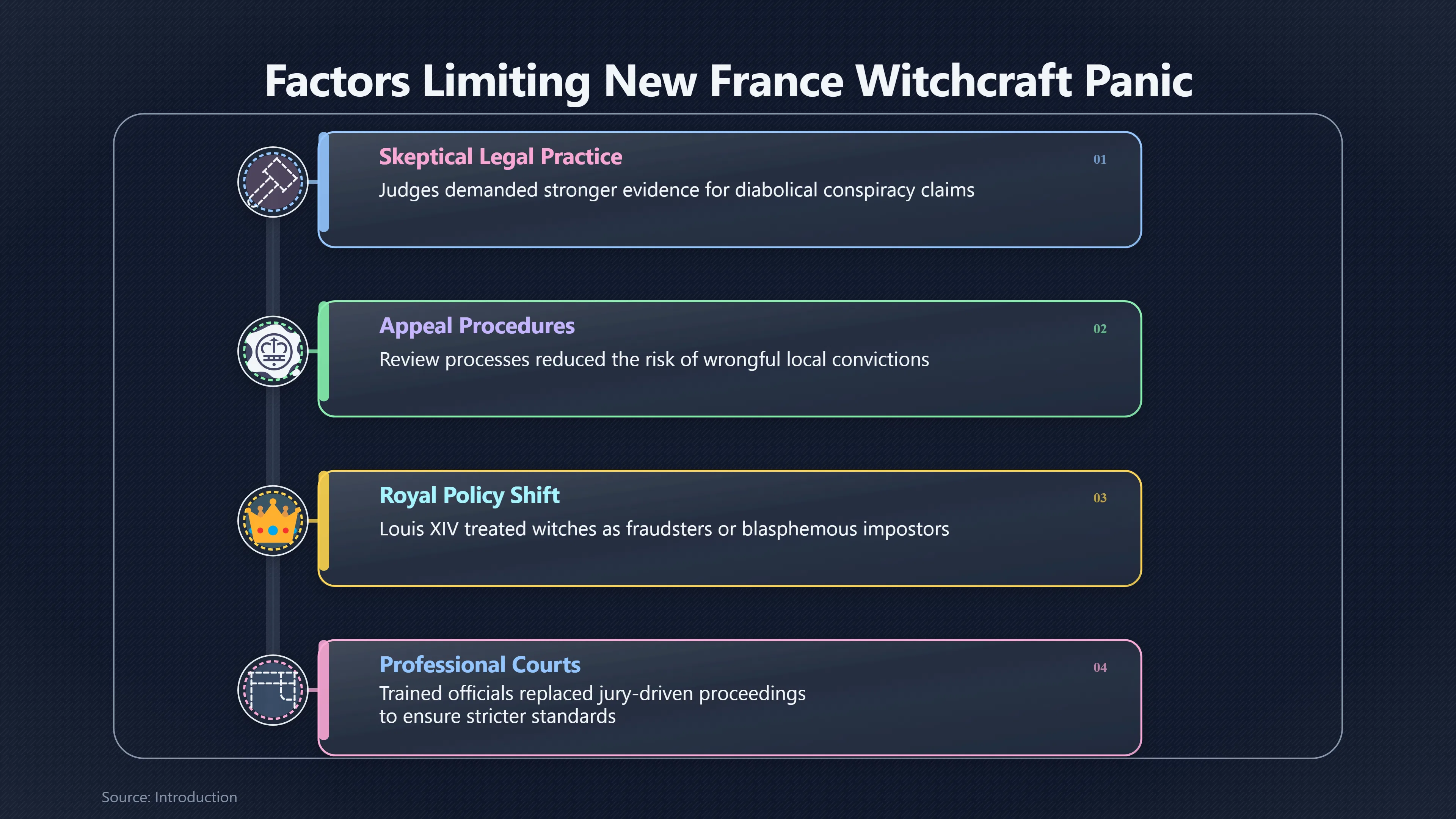
Several factors help explain why the colony avoided a major panic:
- French legal practice had become more sceptical. By the seventeenth century, judges in France increasingly demanded stronger evidence and were less willing to accept claims of diabolical conspiracy at face value.
- Appeal procedures reduced wrongful convictions. Convictions for witchcraft could be reviewed, making irreversible local miscarriages of justice less likely.
- Royal policy changed. In 1682, Louis XIV effectively decriminalised traditional witchcraft by treating supposed witches more as fraudsters, blasphemers or impostors than as servants of the Devil with genuine supernatural powers.
- Colonial courts were relatively professional. Unlike the jury-driven proceedings that helped fuel Salem, New France relied on trained judicial officials who generally applied stricter evidentiary standards.[Éducaloi]educaloi.qc.caÉducaloi Witch Trials in New France | Believe it or Not | ÉducaloiÉducaloiWitch Trials in New France | Believe it or Not | ÉducaloiOctober 30, 2025…
None of this meant that colonists rejected supernatural explanations. Rather, official institutions increasingly distinguished between popular belief and legally provable crime.
What Surviving Witchcraft Cases Reveal
The surviving cases are valuable because they expose everyday anxieties more than organised persecution.
Many accusations arose from neighbourhood conflict, damaged reputations, failed relationships or unexplained misfortune. People genuinely believed that harmful magic might cause illness, infertility or economic hardship. Courts therefore investigated allegations seriously enough to question witnesses and examine evidence, even if convictions were uncommon.[Éducaloi]educaloi.qc.caÉducaloi Witch Trials in New France | Believe it or Not | ÉducaloiÉducaloiWitch Trials in New France | Believe it or Not | ÉducaloiOctober 30, 2025…
Unlike later legends, the historical record shows no expanding conspiracy theories about hidden covens or widespread satanic networks. Instead, accusations usually centred on individuals whose behaviour, social standing or personal conflicts made them vulnerable to suspicion.
The rarity of prosecutions also reminds historians that surviving records represent only a fraction of everyday belief. Informal accusations, rumours and gossip almost certainly circulated more widely than formal court cases.
Anne Lamarque, Jean Campagna and the Courts
Anne Lamarque
The best-known documented accusation involved Montreal innkeeper Anne Lamarque in 1682.
Witnesses alleged that she possessed a book containing magical spells. Lamarque insisted that the volume was simply a work on herbs and medicine rather than sorcery. Although the accusation was taken seriously enough to reach court, she was acquitted and escaped what may have been a sentence of banishment. Modern historians argue that the case reflected broader concerns about her reputation and perceived moral conduct as much as fears of supernatural power.[canadashistory.ca]canadashistory.caCanada's HistoryCanada's History
The Lamarque affair illustrates an important pattern. Allegations of witchcraft often overlapped with disputes about sexuality, respectability and community standing rather than standing alone as purely religious accusations.

Jean Campagna
Another recorded case concerned Jean Campagna of Beaubassin in 1685. Although less well documented than Lamarque’s prosecution, his case demonstrates that accusations continued to appear across different settlements within New France rather than being confined to Montreal or Quebec City. Like other proceedings, it failed to trigger wider waves of accusation or escalating judicial panic.[Canada's History]canadashistory.caCanada's History
Other revealing examples
Other surviving investigations broaden the picture of what colonists feared.
One notable episode involved René Besnard, who was accused of causing a couple’s infertility through magical means by using a traditional European curse known as the “knotting of the cord”. Authorities questioned the allegation, and the affair ultimately resulted in banishment rather than execution. The case demonstrates how European folk beliefs travelled across the Atlantic with settlers and became woven into colonial life.[Éducaloi]educaloi.qc.caÉducaloi Witch Trials in New France | Believe it or Not | ÉducaloiÉducaloiWitch Trials in New France | Believe it or Not | ÉducaloiOctober 30, 2025…
The complicated case of Daniel Vuil is sometimes mistakenly described as New France’s only execution for witchcraft. Historians now generally regard that interpretation as doubtful. Although Vuil became associated with alleged demonic possession, surviving evidence suggests his execution in 1661 was more likely connected to political, religious or commercial offences than to a straightforward conviction for witchcraft. The lack of complete trial records means the precise reason remains debated.[Éducaloi]educaloi.qc.caÉducaloi Witch Trials in New France | Believe it or Not | ÉducaloiÉducaloiWitch Trials in New France | Believe it or Not | ÉducaloiOctober 30, 2025…
Colonial Prejudice, Folklore and Later Mythmaking
It would be misleading to describe New France as especially tolerant simply because it avoided a Salem-style catastrophe.
Belief in demons, curses and supernatural intervention remained widespread among settlers, clergy and officials. Religious culture accepted that evil spiritual forces existed, and reports of possession, miraculous events and demonic temptation circulated throughout the colony. Stories surrounding figures such as Catherine de Saint-Augustin demonstrate how deeply supernatural explanations remained embedded within everyday religious life.[Canada's History]canadashistory.caCanada's History
At the same time, later folklore sometimes blurred the boundary between documented history and legend. Popular tales about devils, enchanted canoes and magical encounters became central features of French Canadian storytelling, but these should not be confused with evidence for organised witch persecutions. Many famous legends emerged from oral tradition rather than court records.
Modern historians therefore distinguish carefully between three different phenomena:
- documented legal accusations preserved in colonial archives;
- widespread popular belief in harmful magic;
- later folklore that expanded supernatural themes for religious or literary purposes.
Keeping these categories separate helps explain why New France could produce enduring stories about magic without experiencing sustained judicial terror.

Why These Cases Still Matter
The history of witchcraft accusations in New France challenges a common assumption that belief in witchcraft automatically produced mass persecution.
Colonists clearly feared occult harm, sought supernatural explanations for misfortune and occasionally brought accusations before the courts. Yet institutional restraint, changing legal standards and evolving attitudes within France prevented isolated cases from growing into the kind of self-reinforcing panic seen elsewhere.
For Canada’s wider history of collective fears, these cases are an early reminder that rumours and supernatural beliefs can shape real legal proceedings without necessarily producing mass hysteria. They also demonstrate how judicial culture matters: societies with similar beliefs may respond very differently depending on evidentiary standards, legal institutions and the willingness of authorities to resist escalating accusations.[Éducaloi]educaloi.qc.caÉducaloi Witch Trials in New France | Believe it or Not | ÉducaloiÉducaloiWitch Trials in New France | Believe it or Not | ÉducaloiOctober 30, 2025…
Amazon book picks
Further Reading
Books and field guides related to Why New France Never Had a Salem. Use these as the next step if you want deeper reading beyond the article.
The witch-hunt in early modern Europe
Provides the best comparative background for New France.


Endnotes
1.
Source: educaloi.qc.ca
Title: Éducaloi Witch Trials in New France | Believe it or Not | Éducaloi
Link:https://educaloi.qc.ca/en/believe-it-or-not/witch-trials-in-new-france/
Source snippet
ÉducaloiWitch Trials in New France | Believe it or Not | ÉducaloiOctober 30, 2025...
Published: October 30, 2025
2.
Source: canadashistory.ca
Title: Canada’s History
Link:https://www.canadashistory.ca/explore/french-canada/sorcery-in-new-france
3.
Source: septentrion.qc.ca
Link:https://www.septentrion.qc.ca/catalogue/revue-d-histoire-de-la-nouvelle-france-no-2
4.
Source: educaloi.qc.ca
Link:https://educaloi.qc.ca/curiosites/les-proces-pour-sorcellerie-a-lepoque-de-la-nouvelle-france/
Source snippet
October 30, 2025 — Les procès pour sorcellerie à l’époque de la Nouvelle-France 30 octobre 2025 Curiosités LES PROCÈS POUR SORCELLERIE À...
Published: October 30, 2025
Additional References
5.
Source: cambridge.org
Link:https://www.cambridge.org/core/journals/canadian-journal-of-law-and-society-la-revue-canadienne-droit-et-societe/article/bad-religion-and-bad-business-the-history-of-the-canadian-witchcraft-provision/A6BDF56A3DDF40E21F986705458F5A06
Source snippet
ne Droit et Société | Cambridge CoreMay 2, 2024 — BAD RELIGION AND BAD BUSINESS: THE HISTORY OF THE CANADIAN WITCHCRAFT PROVISION Publish...
Published: May 2, 2024
6.
Source: activehistory.ca
Title: The Halloween Special – Witchcraft in Canada – Active History
Link:https://activehistory.ca/blog/2026/04/01/the-halloween-special-witchcraft-in-canada/
Source snippet
An expert dyke builder from Aunis, he was accused of causing the death of his employer by blowing a mysterious substance...
7.
Source: guides.loc.gov
Title: witch trials witchcraft
Link:https://guides.loc.gov/feminism-french-women-history/witch-trials-witchcraft
Source snippet
1887. Library of Congress Prints and Photographs Division. Before the Scientific Revolution took hold, people looked to the Church to exp...
8.
Source: journaldequebec.com
Title: Des accusations de sorcellerie e
Link:https://www.journaldequebec.com/2023/04/09/saviez-vous-que-la-nouvelle-france-na-pas-ete-epargnee-par-la-chasse-aux-sorcieres
Source snippet
Saviez-vous que la Nouvelle-France n’a pas été épargnée par la chasse aux sorcières?April 9, 2023 — Il faudra attendre le mois de mai 169...
Published: April 9, 2023
9.
Source: youtube.com
Title: Were there witches in New France?
Link:https://www.youtube.com/watch?v=r1EDZWhnhM4
Source snippet
Demonic Possession in History Booktube Clickbait...
10.
Source: africabib.org
Link:https://www.africabib.org/rec.php?DB=p&RID=279943741
11.
Source: youtube.com
Link:https://www.youtube.com/watch?v=kzsplorjbEg
Source snippet
Lecture Me! October 4, 2022...
Published: October 4, 2022
12.
Source: youtube.com
Title: Lecture Me!
Link:https://www.youtube.com/watch?v=T3dphhyNK8Q
Source snippet
The Bad Luck of Barbe Hallay: First Case of Possession in Quebec...
Published: October 4, 2022
13.
Source: unbscholar.lib.unb.ca
Title: ca Prosecuting the sacred and secular in Seventeenth-Century Ville-Marie
Link:https://unbscholar.lib.unb.ca/items/8b9d7da4-17d7-4050-bb27-e1b3201807b1
14.
Source: hist498finalproject.opened.ca
Title: ca The Hardships and Headlines in New France – HIST498 Final Project
Link:https://hist498finalproject.opened.ca/2022/04/15/the-hardships-and-headlines-in-new-france/
Topic Tree