Within Malawi
Why Did Mchape Draw Such Enormous Crowds?
From colonial anti-witchcraft campaigns to Mchape '95, mass healing promised protection when disease, political change and weak services bred uncertainty.
On this page
- The anti witchcraft movements of the 1930 s
- Billy Chisupe and Mchape '95
- Healing, media and contagious hope
Page outline Jump by section
Introduction
Mchape is one of the most revealing examples of how healing movements can grow during periods of national crisis in Malawi. The name refers both to influential anti-witchcraft campaigns that spread through colonial Nyasaland during the 1930s and to the remarkable “Mchape ‘95” healing movement led by Billy Goodson Chisupe during the HIV/AIDS epidemic after Malawi’s transition to multiparty democracy. Although separated by six decades, the two episodes shared an important pattern: at moments when disease, political uncertainty and social disruption undermined confidence in existing authorities, large numbers of people sought protection through mass healing rituals that promised to restore order and hope. Rather than treating these events simply as examples of “mass hysteria”, historians and anthropologists argue that they reveal how ordinary people responded to genuine insecurity using religious and cultural ideas that made sense within their own experience.[Cambridge University Press & Assessment]cambridge.orgCambridge University Press & AssessmentMchape '95, or, the sudden fame of Billy Goodson Chisupe: healing, social memory and the enigma of…
The anti-witchcraft movements of the 1930s
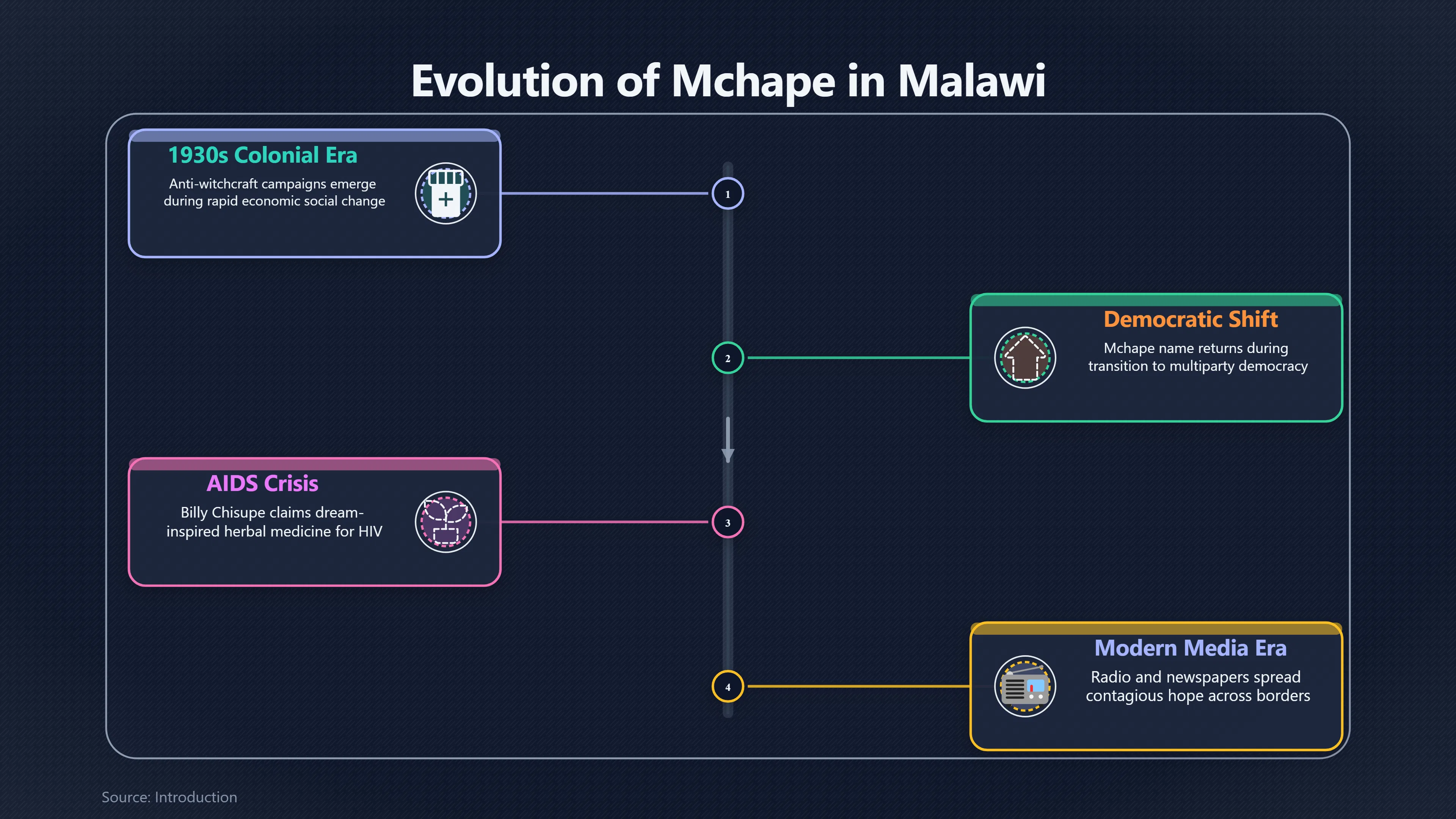
The first movements known as Mchape emerged during the colonial period, when Nyasaland was experiencing rapid economic and social change. Labour migration, taxation, missionary expansion and changing systems of authority disrupted village life while leaving many people feeling vulnerable to illness, death and accusations of witchcraft.
Travelling anti-witchcraft specialists moved from community to community offering medicines and purification rituals that supposedly exposed witches, neutralised harmful magic and protected households. These ceremonies were highly public. Entire villages might participate, creating a shared experience of cleansing rather than a private act of healing.
Colonial officials viewed the movements with suspicion. Administrators worried that anti-witchcraft campaigns challenged state authority and could provoke disorder or false accusations. Yet researchers have shown that participants were often trying to reduce fear rather than create it. By ritually identifying and removing hidden dangers, Mchape offered a way to restore trust within communities where unexplained deaths or misfortune had become socially divisive.[Cambridge University Press & Assessment]cambridge.orgCambridge University Press & AssessmentMchape '95, or, the sudden fame of Billy Goodson Chisupe: healing, social memory and the enigma of…
Anthropologists have also noted that these movements blended older religious practices with features associated with colonial modernity. Organised meetings, public sermons and medicines presented in bottles rather than traditional containers gave Mchape an appearance of both indigenous legitimacy and modern efficiency, making it attractive to communities navigating profound social change.[Taylor & Francis Online]tandfonline.comOpen source on tandfonline.com.
Billy Chisupe and Mchape ‘95
The name Mchape returned dramatically in 1995, only a year after Malawi ended three decades of one-party rule under Hastings Banda. The country was simultaneously adjusting to political liberalisation while confronting one of Africa’s most severe HIV/AIDS epidemics.
Billy Goodson Chisupe, a healer from southern Malawi, claimed that he had received instructions in a dream to prepare a herbal medicine capable of curing AIDS. People travelled from across Malawi and neighbouring countries to receive the treatment, which was distributed without charge. Estimates of attendance vary considerably. Peter Probst’s influential study estimates that roughly 300,000 people attended between February and June 1995, while later research notes that some contemporary estimates reached nearly one million visitors. The uncertainty itself reflects the extraordinary scale and rapid growth of the movement.[Cambridge University Press & Assessment]cambridge.orgCambridge University Press & AssessmentMchape '95, or, the sudden fame of Billy Goodson Chisupe: healing, social memory and the enigma of…
The movement quickly became a national event rather than a local healing practice. Roads became crowded with visitors, transport services organised special journeys, and temporary markets appeared around Chisupe’s village. For many participants, the journey resembled a pilgrimage as much as a medical visit.
Government health officials and medical professionals expressed scepticism because no scientific evidence demonstrated that the herbal preparation cured HIV infection. At the same time, officials faced a difficult dilemma. Simply dismissing the movement risked appearing indifferent to widespread suffering at a time when effective antiretroviral treatment was largely unavailable to ordinary Malawians.[Cambridge University Press & Assessment]cambridge.orgCambridge University Press & AssessmentMchape '95, or, the sudden fame of Billy Goodson Chisupe: healing, social memory and the enigma of…
Why did Mchape draw such enormous crowds?
The popularity of Mchape cannot be understood by looking only at religious belief. Researchers identify several overlapping pressures that made the movement unusually persuasive.
First, the AIDS epidemic created genuine desperation. During the mid-1990s, HIV infection carried an extremely high risk of death, while effective treatment remained inaccessible for most Malawians. Families watched relatives become ill with few realistic medical options available. In that setting, trying an unproven remedy involved relatively little additional risk compared with doing nothing.[Taylor & Francis Online]tandfonline.comOpen source on tandfonline.com.
Second, political transition created new forms of public discussion. Under the Banda government, political speech had been tightly controlled. After democratisation, people could more openly debate inequality, government performance and the handling of AIDS. According to Marissa Doran, Mchape became a vehicle through which broader frustrations about health, politics and social justice could be expressed alongside hopes for healing.[Taylor & Francis Online]tandfonline.comOpen source on tandfonline.com.
Third, the movement drew strength from historical memory. The name “Mchape” already carried associations with earlier anti-witchcraft campaigns that had promised protection against hidden threats. Even though the 1995 movement focused on AIDS rather than witchcraft, the familiar name connected contemporary hopes with remembered traditions of communal cleansing and renewal. Peter Probst argues that this historical continuity helped explain why the movement acquired national significance so quickly.[Cambridge University Press & Assessment]cambridge.orgCambridge University Press & AssessmentMchape '95, or, the sudden fame of Billy Goodson Chisupe: healing, social memory and the enigma of…

Healing, media and contagious hope
Modern media played a crucial role in transforming a local healer into a national figure.
Radio broadcasts introduced Chisupe to audiences across Malawi, while newspapers reported dramatic stories of apparent recoveries. International broadcasters also carried reports, spreading awareness beyond Malawi’s borders. As accounts of improvement circulated, they encouraged additional people to make the journey, creating a feedback loop in which growing attendance itself became evidence, for many observers, that something remarkable was happening.[Taylor & Francis Online]tandfonline.comOpen source on tandfonline.com.
This process illustrates what scholars sometimes describe as “contagious hope”. Unlike contagious fear, which spreads alarming rumours, contagious hope spreads expectations that relief may finally be available. As more people joined the movement, participation itself became socially meaningful. Travelling to Chisupe demonstrated that one had not abandoned a relative to illness and that every possible avenue for healing had been explored.
Researchers caution against reducing this dynamic to irrationality. Many participants understood that success was uncertain, yet judged that the potential benefit outweighed the cost in circumstances where conventional medicine offered little reassurance.[Taylor & Francis Online]tandfonline.comOpen source on tandfonline.com.

Was Mchape a cult or a case of mass hysteria?
Scholars generally discourage describing Mchape simply as either a “cult” or an episode of “mass hysteria”.
The label “cult” has often been applied by outsiders but obscures the movement’s complexity. Mchape lacked many features associated with highly controlled religious organisations, such as permanent membership, systematic isolation or long-term institutional structures. Instead, it functioned primarily as a temporary mass healing campaign centred on a particular crisis.[Cambridge University Press & Assessment]cambridge.orgCambridge University Press & AssessmentMchape '95, or, the sudden fame of Billy Goodson Chisupe: healing, social memory and the enigma of…
Likewise, describing the movement as mass hysteria risks overlooking the rational calculations facing participants. Doran argues that fear of AIDS, the absence of effective treatment, and dissatisfaction with existing institutions made attendance an understandable response to extraordinary circumstances. People were not merely swept along by emotion; many consciously weighed the possibility, however small, that Chisupe’s medicine might succeed where conventional medicine could not.[Taylor & Francis Online]tandfonline.comOpen source on tandfonline.com.
Probst offers a complementary interpretation. He suggests that Mchape should be understood through social memory and the politics of healing: the movement revived older patterns of collective purification while helping Malawians negotiate questions about suffering, authority and the meaning of national change after the end of Banda’s rule.[Cambridge University Press & Assessment]cambridge.orgCambridge University Press & AssessmentMchape '95, or, the sudden fame of Billy Goodson Chisupe: healing, social memory and the enigma of…
Why Mchape remains historically important
The two Mchape movements show that periods of national crisis often revive familiar cultural responses rather than producing entirely new beliefs. The anti-witchcraft campaigns of the 1930s and the AIDS healing movement of 1995 both emerged when existing institutions seemed unable to provide security against invisible threats.
For historians of Malawi, Mchape therefore illuminates more than an unusual healing movement. It demonstrates how collective memories can survive across generations, how epidemics reshape religious life, and how public trust influences responses to disease. It also reminds modern readers that large healing movements often reflect genuine social suffering rather than simple credulity. Understanding why hundreds of thousands of people found Mchape persuasive offers valuable insight into the relationship between health crises, political transformation and collective belief in Malawi.[cambridge.org]cambridge.orgCambridge University Press & AssessmentMchape '95, or, the sudden fame of Billy Goodson Chisupe: healing, social memory and the enigma of…
Amazon book picks
Further Reading
Books and field guides related to Why Did Mchape Draw Such Enormous Crowds?. Use these as the next step if you want deeper reading beyond the article.

The Immortal Life of Henrietta Lacks
Provides wider context on medicine, trust and public belief.

The Spirit Catches You and You Fall Down
Examines encounters between healing traditions and modern medicine.
African religions and philosophy
Places healing movements within African religious traditions.
Endnotes
1.
Source: cambridge.org
Link:https://www.cambridge.org/core/journals/africa/article/abs/mchape-95-or-the-sudden-fame-of-billy-goodson-chisupe-healing-social-memory-and-the-enigma-of-the-public-sphere-in-postbanda-malawi/4D81F62435E551B9522379A63DCB58CA
Source snippet
Cambridge University Press & AssessmentMchape '95, or, the sudden fame of Billy Goodson Chisupe: healing, social memory and the enigma of...
2.
Source: cambridge.org
Link:https://www.cambridge.org/core/journals/africa/article/abs/another-modern-antiwitchcraft-movement-in-east-central-africa1/D8A8ABBCB0D346A3249F4F6F17736713
Source snippet
Another Modern Anti-Witchcraft Movement in East Central Africa1 | Africa | Cambridge CoreAugust 21, 2012 — ANOTHER MODERN ANTI-WITCHCRAFT...
Published: August 21, 2012
3.
Source: cambridge.org
Link:https://www.cambridge.org/core/journals/africa/article/abs/kamcape-an-antisorcery-movement-in-southwest-tanzania/1B23D8ED514EC83845BF7EA4D79B9B86
Source snippet
Witchcraft Suppression Practices and Movements: Public Politics and the Logic of Purification. Comparative Studies in Society and History...
4.
Source: cambridge.org
Title: Africa: Volume 69
Link:https://www.cambridge.org/core/journals/africa/volume/DA07D030FD1249ECE8D80DABC4AE7AF2?pageNum=1
Source snippet
Cambridge CoreOctober 1, 1999 — SUFFERING AND THE SELD IN SOUTHERN MALAWI [Input] * ### Mchape '95, or, the sudden fame of Billy Goodso...
Published: October 1, 1999
5.
Source: cambridge.org
Title: Africa: Volume 69
Link:https://www.cambridge.org/core/journals/africa/issue/375DF3FE747669189EA816F53682BA8D
6.
Source: tandfonline.com
Link:https://www.tandfonline.com/doi/full/10.1080/17531050701625573
7.
Source: tandfonline.com
Link:https://www.tandfonline.com/doi/abs/10.1080/17531050701625573
8.
Source: si.edu
Link:https://www.si.edu/object/siris_sil_915209
9.
Source: eurekamag.com
Link:https://eurekamag.com/research/051/006/051006020.php
Additional References
10.
Source: africabib.org
Link:https://www.africabib.org/rec.php?RID=182967816
Source snippet
AfricaBib | Mchape '95, or, the Sudden Fame of Billy Goodson Chisupe: Healing, Social Memory and the Enigma of the Public Sphere...
11.
Source: researchgate.net
Title: Reconstructing Mchape ‘95: AIDS, Billy Chisupe, and the Politics of Persuasion
Link:https://www.researchgate.net/publication/233358137Reconstructing_Mchape%2795_AIDS_Billy_Chisupe_and_the_Politics_of_Persuasion
Source snippet
November 1, 2007 — Article RECONSTRUCTING MCHAPE '95: AIDS, BILLY CHISUPE, AND THE POLITICS OF PERSUASION * November 2007 * Journal of Ea...
Published: November 1, 2007
12.
Source: africafiles.org
Title: Africa Files | Malawians turn to traditional medicine
Link:https://www.africafiles.org/article_ID-133.html
Source snippet
Malawians turn to traditional medicineSeptember 1, 2001 — Malawians turn to traditional medicine Author: Brian Ligomeka Dat...
Published: September 1, 2001
13.
Source: youtube.com
Link:https://www.youtube.com/watch?v=cPbumaTqTKk
Source snippet
Witchcraft Act Was Used to Suppress Traditional Healers | Gogo Dineo Explains...
14.
Source: youtube.com
Title: Malawi scrambles to stop spate of witchcraft mob attacks
Link:https://www.youtube.com/watch?v=EEXamAr9e8U
Source snippet
Vigilante ‘Vampire-Hunters’ Kill 5 People In Malawi, Rumors Of Witchcraft Continue To Spread | TIME...
15.
Source: youtube.com
Title: Witchcraft Belief in Malawi | Wonderful Mkhutche | TEDx Bwaila
Link:https://www.youtube.com/watch?v=ssTIOhg2YBk
Source snippet
Wonderful Mkhutche on Witch-Hunting in Malawi...
16.
Source: africabib.org
Link:https://www.africabib.org/rec.php?RID=30758092X
17.
Source: mendeley.com
Link:https://www.mendeley.com/catalogue/43d56e07-d2d5-3fc7-8886-bc03c7d1725d/
18.
Source: jstor.org
Link:https://www.jstor.org/stable/jj.13168046
19.
Source: jstor.org
Link:https://www.jstor.org/stable/j.ctt155jgrj
Topic Tree