Within Iraq
How Did Emo Style Become a Threat?
Rumours about clothes, music and sexuality helped turn visibly different Iraqi teenagers into targets of fear and intimidation.
On this page
- How youth fashion became linked with Satanism
- The roles of rumours, media and officials
- Violence, intimidation and the limits of the evidence
Page outline Jump by section
Introduction
In 2012, Iraq experienced a striking moral panic centred on young people associated with the global “emo” fashion and music scene. What began as suspicion of black clothing, unusual hairstyles and alternative music quickly became something far more dangerous. Rumours spread that “emos” were Satanists, sexually immoral or part of a foreign conspiracy to corrupt Iraqi society. In an atmosphere already shaped by years of conflict, sectarian violence and political instability, these claims helped turn visibly different teenagers and young adults into targets for intimidation, assault and, in some reported cases, murder. Rather than representing a genuine security threat, the episode is now widely understood by human rights organisations and many scholars as a classic example of a moral panic: a social fear in which a small youth subculture was portrayed as a major danger far beyond the available evidence.[Human Rights Watch]hrw.orgHuman Rights Watch Iraq: Investigate ‘Emo’ Attacks | Human Rights WatchHuman Rights WatchIraq: Investigate ‘Emo’ Attacks | Human Rights WatchMarch 16, 2012…
How did emo style become a threat?
The Iraqi “emo scare” did not arise because the emo subculture itself had any organised presence or political agenda. Like similar youth cultures elsewhere, emo was largely associated with alternative rock music, dark clothing, long hairstyles, body piercings and expressive fashion. In Iraq, however, many adults had little familiarity with the movement beyond sensational media reports.
As the style became more visible in Baghdad and other cities, rumours increasingly linked it with Satanism, devil worship, drug use, homosexuality and moral decline. Different forms of non-conformity were merged together. Young men with long hair, heavy metal fans, skateboarders, tattooed youths and people perceived to be gay or gender non-conforming were often treated as belonging to the same supposedly dangerous group. Human rights organisations later noted that “emo” became a broad label applied to almost anyone whose appearance challenged conservative social expectations.[Human Rights Watch]hrw.orgHuman Rights Watch Iraq: Investigate ‘Emo’ Attacks | Human Rights WatchHuman Rights WatchIraq: Investigate ‘Emo’ Attacks | Human Rights WatchMarch 16, 2012…
This reflected a familiar feature of moral panics: outward appearance became interpreted as evidence of hidden beliefs or criminal intent. Wearing black clothes or listening to Western music was transformed from a personal preference into an alleged sign of participation in an anti-religious movement.
How rumours, media and officials reinforced the panic
The panic spread through several overlapping channels rather than from a single source.
Official language
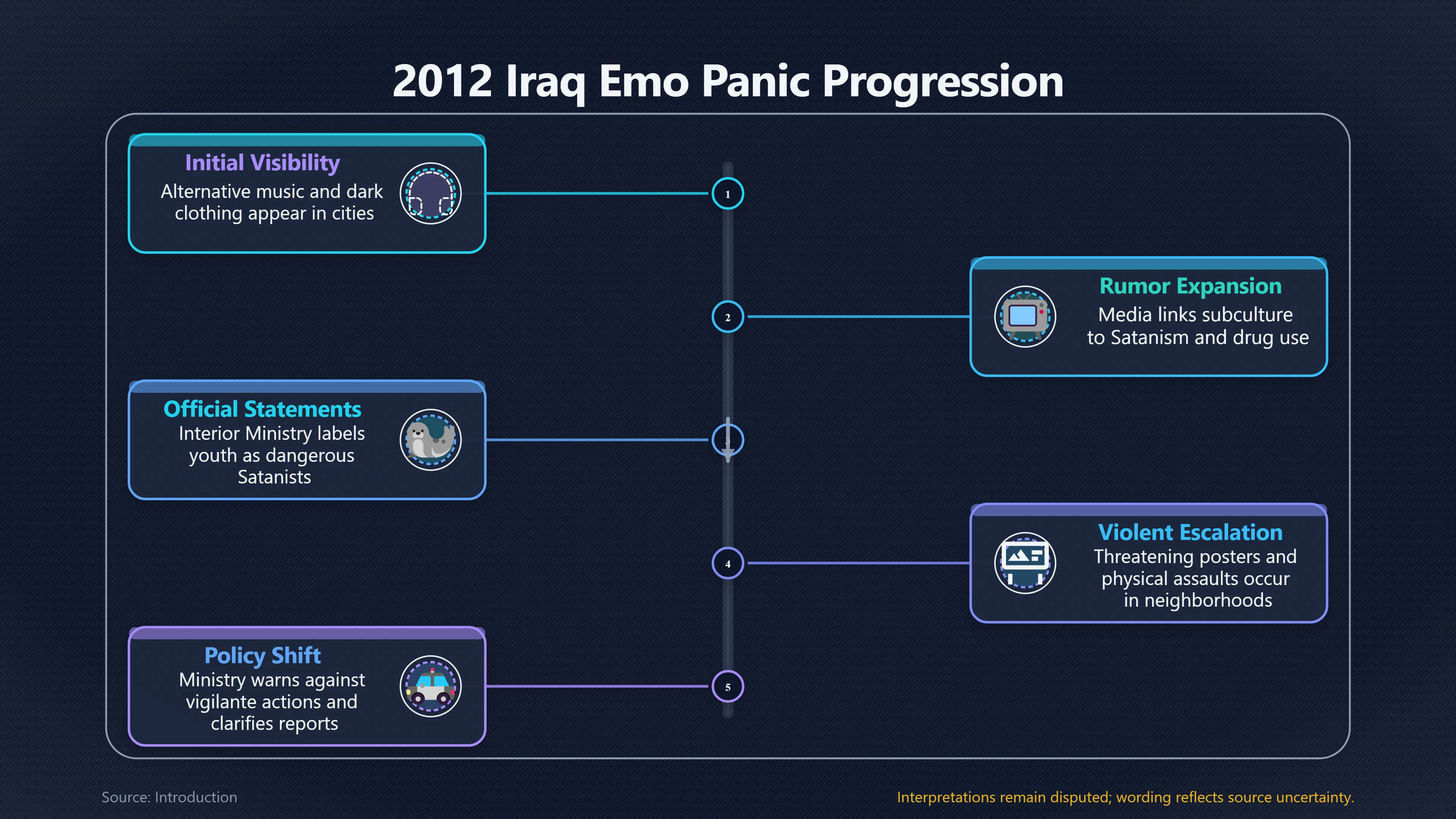
One of the most controversial developments came from Iraq’s Interior Ministry. In February 2012 it issued statements describing emos as “Satanists” and discussed campaigns against what it portrayed as a dangerous social phenomenon. Officials also referred to plans involving schools and police action against emo culture, giving rumours an appearance of official legitimacy.[Human Rights Watch]hrw.orgHuman Rights Watch Iraq: Investigate ‘Emo’ Attacks | Human Rights WatchHuman Rights WatchIraq: Investigate ‘Emo’ Attacks | Human Rights WatchMarch 16, 2012…
Following growing international criticism and reports of attacks, the ministry later altered its public tone. It warned against extremist groups taking the law into their own hands and denied reports that emo youths had been systematically killed, calling many reports exaggerated or fabricated. This change, however, did not erase the impact of the earlier statements.[Human Rights Watch]hrw.orgHuman Rights Watch Iraq: Investigate ‘Emo’ Attacks | Human Rights WatchHuman Rights WatchIraq: Investigate ‘Emo’ Attacks | Human Rights WatchMarch 16, 2012…
Media coverage
Some Iraqi television channels and newspapers amplified fears by describing an “emo phenomenon” as if it were a coordinated movement threatening religion and public morality. Reports sometimes associated emos with vampires, Satanism or Western cultural invasion despite providing little evidence.
The result was a feedback loop. Media stories encouraged rumours, rumours generated further coverage, and official comments appeared to confirm that the supposed threat was real.[Amnesty International]amnesty.orgInternational Iraq: Investigate ‘Emo’ AttacksAmnesty InternationalIraq: Investigate ‘Emo’ Attacks - Amnesty International…
Social pressure
The panic also reflected wider anxieties about cultural change after years of war. Iraq’s younger generation had greater access to satellite television, the internet and international fashion than earlier generations. Alternative clothing and music became symbolic battlegrounds in debates about religion, masculinity and national identity.
Rather than focusing on actual behaviour, many accusations rested almost entirely on appearance.
Violence, intimidation and the limits of the evidence
The most disturbing aspect of the panic was the violence directed at people labelled as emos.
Human rights organisations documented threatening posters in Baghdad neighbourhoods listing names of alleged emos and warning them to abandon “satanic” clothing, cut their hair and conform to accepted standards of masculinity. Victims reported anonymous death threats, assaults and intimidation. Some individuals went into hiding or radically changed their appearance to avoid attention.[Human Rights Watch]hrw.orgHuman Rights Watch Iraq: Investigate ‘Emo’ Attacks | Human Rights WatchHuman Rights WatchIraq: Investigate ‘Emo’ Attacks | Human Rights WatchMarch 16, 2012…
Reports of killings quickly circulated in Iraqi and international media. Some newspapers suggested that dozens of young people had been murdered. However, establishing the true scale proved difficult.
Evidence remains uneven for several reasons:
- Different organisations counted different incidents.
- Many attacks occurred in insecure areas where independent investigation was difficult.
- Families sometimes avoided publicity because of stigma or fear of retaliation.
- Various violent actors may have been involved rather than a single organised campaign.
Human Rights Watch, Amnesty International and the International Gay and Lesbian Human Rights Commission concluded that credible evidence showed a campaign of threats and violence against perceived emos and other non-conforming youths. At the same time, they were careful not to endorse the highest casualty estimates reported in some media, noting that they could not independently confirm claims of several dozen coordinated killings.[hrw.org]hrw.orgHuman Rights Watch Iraq: Investigate ‘Emo’ Attacks | Human Rights WatchHuman Rights WatchIraq: Investigate ‘Emo’ Attacks | Human Rights WatchMarch 16, 2012…
This distinction is important. The existence of uncertainty over exact numbers does not undermine the broader conclusion that genuine intimidation and lethal violence occurred. It illustrates the difficulty of documenting abuses during periods of political instability.
Why were so many different people targeted?
The panic was never solely about music.
Human rights investigators found that victims included:[hrw.org]hrw.orgالعراق: يجب التحقيق في الاعتداءات على الإيمو | Human Rights WatchMarch 16, 2012 — العراق: يجب التحقيق في الاعتداءات على الإيمو Print تبرعوا الآن 16 مارس/آذار 2012 5:32AM EDT | بيان صحفي متوفر بـ * Engli…
- young people with alternative hairstyles or clothing;
- heavy metal fans;
- people with tattoos or body piercings;
- individuals perceived to be gay, lesbian or transgender;
- men considered insufficiently masculine by local standards.
In practice, “emo” became an umbrella accusation covering many forms of visible difference. Existing prejudice against LGBT people and gender non-conforming individuals merged with fears about Western culture, creating a broader campaign against anyone seen as challenging accepted social norms.[Human Rights Watch]hrw.orgHuman Rights Watch Iraq: Investigate ‘Emo’ Attacks | Human Rights WatchHuman Rights WatchIraq: Investigate ‘Emo’ Attacks | Human Rights WatchMarch 16, 2012…
This explains why many people who had never identified with emo music nevertheless became targets.
Responses inside Iraq
The reaction within Iraq was more varied than is sometimes remembered.
Several parliamentarians publicly condemned the killings and called for police investigations. The Speaker of Parliament described vigilante killings carried out in the name of protecting society as criminal acts that encouraged violence rather than morality. Senior religious authorities also rejected extrajudicial killings. Representatives of Grand Ayatollah Ali al-Sistani described the attacks as terrorist acts rather than legitimate moral enforcement.[Human Rights Watch]hrw.orgHuman Rights Watch Iraq: Investigate ‘Emo’ Attacks | Human Rights WatchHuman Rights WatchIraq: Investigate ‘Emo’ Attacks | Human Rights WatchMarch 16, 2012…
These responses demonstrated that the panic was contested. Not all political or religious leaders accepted the narrative that emo youths represented a threat, and some explicitly argued that differences in appearance could not justify violence.
Why historians and social scientists see it as a moral panic
The 2012 emo scare closely matches the characteristics of a moral panic described in sociology.
A relatively small and poorly understood group became portrayed as representing a major danger to society. Rumours replaced evidence, visible style became treated as proof of hidden beliefs, and fear spread more rapidly than verified information. Existing social tensions—including insecurity after years of conflict, anxiety about Western influence, debates over gender roles and distrust of unfamiliar youth culture—made the rumours more persuasive.
The episode also shows how moral panics can produce real harm even when the underlying claims are unsupported. Whether or not an organised “emo movement” existed was largely beside the point. Once the label became associated with Satanism and immorality, ordinary young people could be threatened simply because of how they looked.
Why the emo scare remains important
The Iraqi emo scare is remembered less as a story about a musical genre than as a warning about the consequences of rumour-driven politics and social fear.
It illustrates how official rhetoric, sensational media coverage and community gossip can reinforce one another until ordinary differences in dress or appearance become interpreted as evidence of dangerous hidden identities. It also demonstrates the importance of distinguishing verified violence from exaggerated casualty claims while recognising that uncertainty over numbers should not obscure documented patterns of intimidation.
Within Iraq’s broader history of collective fears, the 2012 panic stands as one of the clearest modern examples of a youth subculture becoming a symbolic target for anxieties about religion, identity, sexuality and social change.[hrw.org]hrw.orgHuman Rights Watch Iraq: Investigate ‘Emo’ Attacks | Human Rights WatchHuman Rights WatchIraq: Investigate ‘Emo’ Attacks | Human Rights WatchMarch 16, 2012…
Amazon book picks
Further Reading
Books and field guides related to How Did Emo Style Become a Threat?. Use these as the next step if you want deeper reading beyond the article.

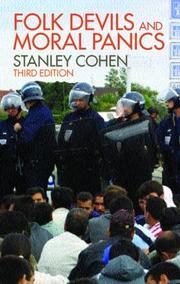
Folk devils and moral panics
Directly explains the concept behind the Iraqi emo scare.
Endnotes
1.
Source: amnesty.org
Title: International Iraq: Investigate ‘Emo’ Attacks
Link:https://www.amnesty.org/en/latest/press-release/2012/03/iraq-investigate-emo-attacks/
Source snippet
Amnesty InternationalIraq: Investigate ‘Emo’ Attacks - Amnesty International...
2.
Source: amnesty.org
Title: Irak: Deben investigarse los ataques contra “emos”
Link:https://www.amnesty.org/es/documents/pre01/141/2012/es/
3.
Source: amnesty.org
Title: Iraq: Investigate ‘Emo’ Attacks
Link:https://www.amnesty.org/en/documents/pre01/141/2012/en/
4.
Source: hrw.org
Title: Human Rights Watch Iraq: Investigate ‘Emo’ Attacks | Human Rights Watch
Link:https://www.hrw.org/news/2012/03/16/iraq-investigate-emo-attacks
Source snippet
Human Rights WatchIraq: Investigate ‘Emo’ Attacks | Human Rights WatchMarch 16, 2012...
Published: March 16, 2012
5.
Source: hrw.org
Link:https://www.hrw.org/world-report/2013/country-chapters/iraq
Source snippet
Human Rights WatchWorld Report 2013: World Report 2013: Iraq | Human Rights Watch...
6.
Source: amnesty.org.uk
Link:https://www.amnesty.org.uk/knowledge-hub/all-resources/iraqi-authorities-should-unequivocally-condemn-emo-attacks/
Source snippet
Iraqi authorities should 'unequivocally condemn' emo attacks | Amnesty International UKMarch 16, 2012 — IRAQI AUTHORITIES SHOULD 'UNEQUIV...
Published: March 16, 2012
7.
Source: hrw.org
Title: العراق: يجب التحقيق في الاعتداءات على الإيمو | Human Rights Watch
Link:https://www.hrw.org/ar/news/2012/03/16/245613
Source snippet
March 16, 2012 — العراق: يجب التحقيق في الاعتداءات على الإيمو Print تبرعوا الآن 16 مارس/آذار 2012 5:32AM EDT | بيان صحفي متوفر بـ * Engli...
Published: March 16, 2012
8.
Source: hrw.org
Title: Iraq: Intensifying Crackdown on Free Speech, Protests | Human Rights Watch
Link:https://www.hrw.org/news/2012/01/22/iraq-intensifying-crackdown-free-speech-protests
9.
Source: hrw.org
Link:https://www.hrw.org/world-report/2012/country-chapters/iraq
Additional References
10.
Source: rte.ie
Title: Human rights groups urge Iraq to probe ‘emo’ killings
Link:https://www.rte.ie/news/special-reports/2012/0316/314799-iraq_emo/
Source snippet
March 16, 2012 — HUMAN RIGHTS GROUPS URGE IRAQ TO PROBE 'EMO' KILLINGS Updated / Friday, 16 Mar 2012 14:59 Image: The term emo refers onl...
Published: March 16, 2012
11.
Source: youtube.com
Title: Heavy Metal in Baghdad Trailer
Link:https://www.youtube.com/watch?v=hdE-JIOpHHc
Source snippet
Iraqi Kurdis LGBT rights activist Zhiar Ali says local authorities do nothing to discourage killings...
12.
Source: refworld.org
Link:https://www.refworld.org/reference/annualreport/uscirf/2012/en/85615
Source snippet
USCIRF Annual Report 2012 - Countries of Particular Concern: Iraq | RefworldMarch 20, 2012 — In a positive development, the KRG region en...
Published: March 20, 2012
13.
Source: youtube.com
Title: ‘Emo’ youth targeted in Iraq | The Stream
Link:https://www.youtube.com/watch?v=vPxrvCTXY0Q
Source snippet
Iraq heavy metal group rocks on, for peace...
14.
Source: youtube.com
Link:https://www.youtube.com/watch?v=hVYUq_u5RQE
15.
Source: commondreams.org
Title: Iraq: Investigate ‘Emo’ Attacks | Common Dreams
Link:https://www.commondreams.org/newswire/2012/03/16/iraq-investigate-emo-attacks
16.
Source: youtube.com
Title: Iraq heavy metal group rocks on, for peace
Link:https://www.youtube.com/watch?v=eJcgpdwuzL0
Source snippet
Iraqi youth: the fight for freedom...
17.
Source: youtube.com
Title: Iraqi youth: the fight for freedom
Link:https://www.youtube.com/watch?v=o9YBphFE3zg
Source snippet
Heavy Metal in Baghdad Trailer...
Topic Tree