Within Equatorial Guinea
Did Sudden Wealth Hide an Invisible Human Cost?
Ekong stories imagined that wealth could come from secretly enslaving the dead, turning inequality into a fear of concealed human sacrifice.
On this page
- What the Ekong belief claimed
- Invisible labour, death and stolen prosperity
- Why economic inequality fed supernatural suspicion
Page outline Jump by section
Introduction
Across the Fang-speaking regions of Equatorial Guinea, southern Cameroon and northern Gabon, stories about Ekong expressed a striking fear: that extraordinary wealth might have an invisible human cost. Rather than imagining witches simply causing illness or death, Ekong beliefs claimed that powerful people secretly transformed victims into unseen labourers who generated riches for their masters. The stories offered a moral explanation for sudden prosperity, expensive imported goods and widening inequality in societies undergoing rapid economic and social change. Anthropologists regard Ekong not as evidence that invisible plantations literally existed, but as an important cultural language for discussing exploitation, colonial labour, bereavement and the unsettling appearance of new forms of wealth.[wiley.com]onlinelibrary.wiley.comWiley Online LibraryGlobalization and the Power of Indeterminate Meaning: Witchcraft and Spirit Cults in Africa and East Asia - Geschiere…
What the Ekong belief claimed
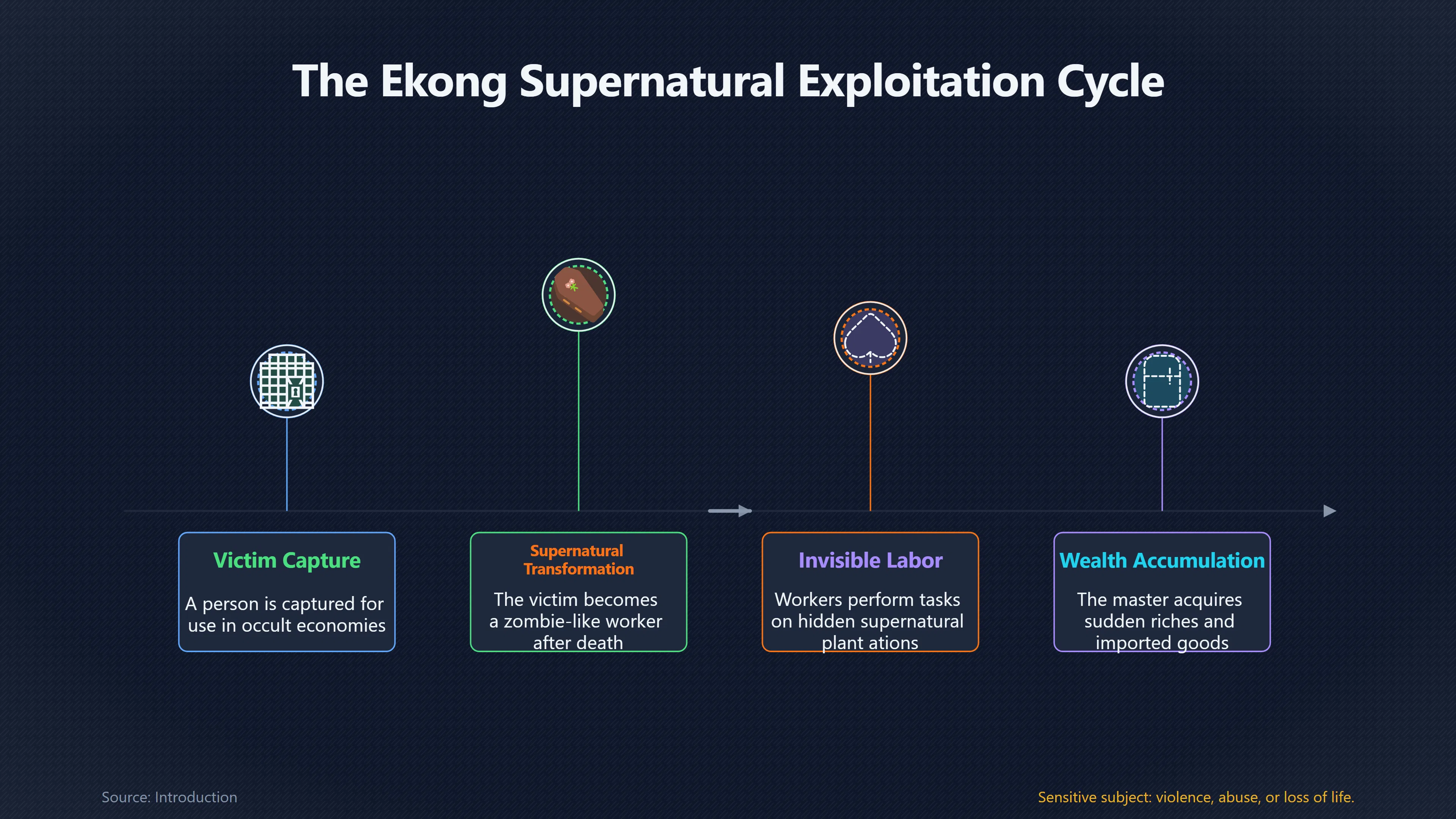
Unlike older forms of witchcraft that centred on harming or consuming victims, Ekong stories imagined a more organised and economically productive form of supernatural exploitation. According to many accounts collected by anthropologists, a victim was not simply killed but transformed into a zombie-like worker who continued labouring after death on invisible plantations or estates, enriching the person responsible for their capture.[Wiley Online Library]onlinelibrary.wiley.comWiley Online LibraryGlobalization and the Power of Indeterminate Meaning: Witchcraft and Spirit Cults in Africa and East Asia - Geschiere…
A particularly disturbing feature of the belief was that acquiring this hidden source of wealth often supposedly required sacrificing or “selling” a close relative. This idea made unexplained prosperity morally suspect. If someone suddenly built a large house, bought imported goods or accumulated wealth without an obvious explanation, neighbours might wonder whether unseen human suffering lay behind that success. Anthropologists stress that these stories reflected social suspicion rather than documented criminal practices.[ecoi.net]ecoi.netACCORD – Austrian Centre for Country of Origin and Asylum Research and Documentation (Author): “a-5433 (ACC-CMR-5433)”, Document #1053387…
Invisible labour, death and stolen prosperity
The image of invisible workers was not random. Historians and anthropologists have long noted that the Ekong complex emerged in regions profoundly shaped by slavery, forced labour and colonial plantation economies. Invisible plantations echoed the very real experience of labour disappearing into distant places where families often lost contact with relatives recruited or coerced into work.[cambridge.org]cambridge.orgCambridge University Press & AssessmentClandestine Recruitment Networks in the Bight of Biafra: Fernando Pó's Answer to the Labour Questi…
Instead of viewing wealth as the reward for entrepreneurship alone, Ekong stories suggested that prosperity might depend upon concealed exploitation. The supernatural explanation transformed economic inequality into a moral question: if riches appeared too quickly or without visible effort, perhaps hidden labour—not honest work—had produced them.
The symbolism became especially powerful because the alleged labourers were imagined as neither fully alive nor fully dead. Families mourning unexplained deaths could therefore imagine that loved ones had not disappeared completely but were still being forced to work elsewhere for another person’s benefit. This linked grief, economic anxiety and supernatural suspicion into a single narrative.[UCL Discovery]discovery.ucl.ac.ukUCL Discovery1REPRESENTATIONS OF SLAVERY AND THE…
Why economic inequality fed supernatural suspicion
Researchers consistently argue that Ekong beliefs expanded alongside dramatic economic change rather than surviving unchanged from a distant past. Colonial rule introduced wage labour, cash crops, imported consumer goods and new opportunities for unequal accumulation. After independence, some individuals acquired houses with metal roofs, vehicles, refrigerators and other symbols of modern success that had previously been unattainable.
Anthropologist Peter Geschiere argued that Ekong represented a distinctly modern form of witchcraft because it addressed precisely these new inequalities. Instead of explaining ordinary illness or personal misfortune, it tried to explain capitalism’s uneven rewards by imagining an occult economy in which wealth came from hidden human exploitation.[wiley.com]onlinelibrary.wiley.comWiley Online LibraryGlobalization and the Power of Indeterminate Meaning: Witchcraft and Spirit Cults in Africa and East Asia - Geschiere…
This interpretation closely parallels the broader idea of “occult economies” developed by anthropologists studying postcolonial Africa. Where rapid economic change created uncertainty about how fortunes were made, rumours of supernatural wealth could become a way of discussing corruption, patronage, exploitation and unequal access to opportunity without relying solely on economic language.[Wiley Online Library]onlinelibrary.wiley.comWiley Online LibraryGlobalization and the Power of Indeterminate Meaning: Witchcraft and Spirit Cults in Africa and East Asia - Geschiere…
Why these stories mattered socially
Ekong beliefs helped communities make sense of difficult questions that had no obvious answers:
- Why did some people become wealthy while others remained poor?
- Why did relatives sometimes die unexpectedly during periods of economic change?
- How could modern consumer goods appear in villages where most people remained poor?
- Could visible success conceal invisible suffering?
Seen this way, the stories acted as moral commentary rather than simple supernatural folklore. They warned that wealth detached from recognised obligations to family and community could become socially suspicious. Sudden prosperity carried not only admiration but also the risk of accusation.[codesria.org]publication.codesria.orgPublications Values and Development in Southern AfricaCODESRIA PublicationsValues and Development in Southern Africa…
Interpreting Ekong today
Modern scholars do not treat Ekong as evidence for literal invisible plantations or organised zombie labour. Instead, they interpret it as a culturally meaningful response to profound historical experiences, including colonial labour systems, memories of enslavement, expanding inequality and uncertainty created by rapid social change.[UCL Discovery]discovery.ucl.ac.ukUCL Discovery1REPRESENTATIONS OF SLAVERY AND THE…
Because Fang communities extend across present-day Equatorial Guinea, Cameroon and Gabon, similar beliefs appear under related names in neighbouring regions. Although details differ, they share a common concern: wealth gained without visible labour is morally dangerous because it may imply hidden exploitation.[ecoi.net]ecoi.netACCORD – Austrian Centre for Country of Origin and Asylum Research and Documentation (Author): “a-5433 (ACC-CMR-5433)”, Document #1053387…
For understanding Equatorial Guinea’s history of collective belief, Ekong is therefore significant less as a story about monsters than as a powerful explanation of inequality. It transformed fears about colonial labour, bereavement and unexplained prosperity into a vivid narrative in which every sudden fortune might conceal an invisible human cost.
Amazon book picks
Further Reading
Books and field guides related to Did Sudden Wealth Hide an Invisible Human Cost?. Use these as the next step if you want deeper reading beyond the article.

The state of Africa
First published 2005. Subjects: History, Politics and government, Africa, history, Africa, politics and government.
The fate of Africa
First published 2004. Subjects: Politics and government, Social conditions, Economic conditions, Politique et gouvernement, Conditions so...
Persuasions and performances
First published 1986. Subjects: Ethnology, Philosophy, Rites and ceremonies, Social life and customs, Symbolism.
Witchcraft, Oracles and Magic Among the Azande
Explains how witchcraft beliefs interpret inequality and misfortune.
Endnotes
1.
Source: onlinelibrary.wiley.com
Link:https://onlinelibrary.wiley.com/doi/pdf/10.1111/1467-7660.00100
Source snippet
Wiley Online LibraryGlobalization and the Power of Indeterminate Meaning: Witchcraft and Spirit Cults in Africa and East Asia - Geschiere...
2.
Source: publication.codesria.org
Title: Publications Values and Development in Southern Africa
Link:https://publication.codesria.org/index.php/pub/catalog/download/76/495/1157?inline=1
Source snippet
CODESRIA PublicationsValues and Development in Southern Africa...
3.
Source: ecoi.net
Link:https://www.ecoi.net/en/document/1053387.html
Source snippet
ACCORD – Austrian Centre for Country of Origin and Asylum Research and Documentation (Author): “a-5433 (ACC-CMR-5433)”, Document #1053387...
4.
Source: cambridge.org
Link:https://www.cambridge.org/core/journals/international-review-of-social-history/article/clandestine-recruitment-networks-in-the-bight-of-biafra-fernando-pos-answer-to-the-labour-question-19261945/75076E11F44983608543E3587FCAE298
Source snippet
Cambridge University Press & AssessmentClandestine Recruitment Networks in the Bight of Biafra: Fernando Pó's Answer to the Labour Questi...
5.
Source: discovery.ucl.ac.uk
Title: UCL Discovery1
Link:https://discovery.ucl.ac.uk/1397876/1/Omuku_PhD_Thesis_Combine.pdf
Source snippet
REPRESENTATIONS OF SLAVERY AND THE...
6.
Source: anthrosource.onlinelibrary.wiley.com
Title: j.1548 1360.2010.01065.x
Link:https://anthrosource.onlinelibrary.wiley.com/doi/10.1111/j.1548-1360.2010.01065.x
7.
Source: cambridge.org
Link:https://www.cambridge.org/core/journals/journal-of-african-history/article/wealth-in-people-as-wealth-in-knowledge-accumulation-and-composition-in-equatorial-africa/18893CBAD6854E637C8BE091CF0B5CC2
8.
Source: onlinelibrary.wiley.com
Title: 1467 7660.00100
Link:https://onlinelibrary.wiley.com/doi/full/10.1111/1467-7660.00100
9.
Source: anthrosource.onlinelibrary.wiley.com
Link:https://anthrosource.onlinelibrary.wiley.com/doi/abs/10.1525/aa.1965.67.4.02a00030
10.
Source: es.scribd.com
Link:https://es.scribd.com/document/187263776/ekong
Additional References
11.
Source: journal.uii.ac.id
Link:https://journal.uii.ac.id/Millah/article/view/40977
Source snippet
and the Igbo Conception of Wealth: Death, Prosperity, and Ancestral Fulfillment in Indigenous Cosmology | Millah: Journal of Religious St...
12.
Source: notes-culture.blogspot.com
Title: Geschiere, Witchcraft & New Wealth | Notes on Culture
Link:https://notes-culture.blogspot.com/2019/11/geschiere-witchcraft-new-wealth.html
Source snippet
Djambe is a spiritual energy which can also be positive. DUALA Believe that an ekong owner puts the customer to sleep, and cust...
13.
Source: anthropologies.es
Title: Mitología Y Brujería Fang, Guinea Ecuatorial (2/2) | Antropología Explicada
Link:https://www.anthropologies.es/mitologia-y-brujeria-fang-guinea-ecuatorial-2-2/
Source snippet
Mitología Y Brujería Fang, Guinea Ecuatorial (2/2) | Antropología Explicada...
14.
Source: youtube.com
Title: Witchcraft Act Was Used to Suppress Traditional Healers | Gogo Dineo Explains
Link:https://www.youtube.com/watch?v=nImfi58BeyI
Source snippet
The Light & The Darkness 2: Africa Edition | Witchcraft Documentary...
15.
Source: researchgate.net
Link:https://www.researchgate.net/publication/287087678The%27working-dead%27_in_nyongo_occult_economy_in_cameroonian_society
16.
Source: mdpi.com
Link:https://www.mdpi.com/2313-5778/3/1/7
17.
Source: era.anthropology.ac.uk
Link:https://era.anthropology.ac.uk/Era_Resources/Era/Ancestors/gluckman.html
18.
Source: youtube.com
Title: On Intimacy–with Peter Geschiere
Link:https://www.youtube.com/watch?v=AtD4ABTpSeE
Source snippet
Inside Azande Witchcraft and Oracles - Africa's Mysterious Belief System...
19.
Source: studocu.com
Title: “ENGL 101: The Entrepreneur and the Zombie – Sorcery and Wealth in Cameroon”
Link:https://www.studocu.com/en-us/document/university-of-colorado-denver/topics-in-archaeology/title-the-entrepreneur-and-the-zombie-sorcery-and-wealth-in-cameroon/124857506
20.
Source: youtube.com
Title: Money Rituals: Africa’s Deadliest Taboo
Link:https://www.youtube.com/watch?v=EjDe1D8NlOY
Source snippet
On Intimacy–with Peter Geschiere...
Topic Tree