Within Central African Republic
Why Does the State Prosecute Witchcraft?
Criminalising alleged witchcraft gives official force to unprovable claims and places older women at exceptional risk of imprisonment.
On this page
- What the penal code criminalises
- Why supernatural claims resist fair proof
- Women detained in Bimbo prison
Page outline Jump by section
Introduction
The Central African Republic is one of the few countries where alleged witchcraft has long been treated as a criminal offence under state law rather than solely as a matter of local belief or mob accusation. This gives official legal force to claims that cannot be tested using ordinary standards of evidence. Although men are also prosecuted, women—especially older, widowed, poor or socially isolated women—are disproportionately affected. Human rights organisations have repeatedly argued that the combination of criminal law, widespread belief in supernatural harm and weak judicial safeguards has produced a system in which vulnerable women can be imprisoned for accusations that cannot be objectively proved.[Avocats Sans Frontières]asf.beAvocats Sans FrontièresThe penalisation of charlatanism and witchcraft practices: An obstacle to the realisation of the rights of women a…

The issue matters because it illustrates how a legal system can reinforce a broader witch panic. Instead of acting solely as protection against mob violence, the courts may legitimise accusations that begin within families or communities. As a result, imprisonment often becomes part of the cycle of persecution rather than an escape from it.[Avocats Sans Frontières]asf.beAvocats Sans FrontièresThe penalisation of charlatanism and witchcraft practices: An obstacle to the realisation of the rights of women a…
Why Does the State Prosecute Witchcraft?
Unlike countries where accusations remain largely informal, the Central African Republic has retained criminal provisions against what its penal code describes as charlatanism and witchcraft practices. Earlier versions of the law technically allowed the death penalty, although this was not carried out in practice for witchcraft convictions. Legal reforms replaced this with prison sentences and fines, but the offence itself remained. Human rights advocates argue that the change reduced the severity of punishment without addressing the underlying problem of criminalising alleged supernatural acts.[Refworld]refworld.org2008 Report on International Religious Freedom - Central African Republic | Refworld…
The continued existence of the offence reflects the strength of popular belief in witchcraft across much of the country. Politically, removing the law has been difficult because many citizens expect the justice system to respond when illness, unexplained death or repeated misfortune is attributed to supernatural attack. Courts therefore operate under pressure to provide legal answers to questions that communities regard as real, even when those questions cannot be resolved through conventional evidence.[Avocats Sans Frontières]asf.beOpen source on asf.be.
What the Penal Code Criminalises
The law does not simply punish fraud by people pretending to possess magical powers. It also criminalises alleged witchcraft itself, allowing prosecutions based on claims that someone caused harm through supernatural means. This creates an unusual legal situation: prosecutors must deal with accusations that cannot be verified through physical evidence in the same way as offences such as assault or theft.[Avocats Sans Frontières]asf.beAvocats Sans FrontièresThe penalisation of charlatanism and witchcraft practices: An obstacle to the realisation of the rights of women a…
Historically, prosecutions have frequently relied upon:
- testimony from neighbours or relatives;
- statements from traditional healers or spiritual practitioners;
- interpretations of personal behaviour or reputation;
- objects said to have supernatural significance rather than forensic evidence.
Government officials have themselves acknowledged the difficulty of investigating such allegations. Even where convictions are not secured, accused people have often spent months or years in detention awaiting trial.[Refworld]refworld.org2007 Report on International Religious Freedom - Central African Republic | RefworldSeptember 14, 2007…
Why Supernatural Claims Resist Fair Proof
The central legal problem is that alleged supernatural harm cannot be independently demonstrated or disproved through ordinary judicial methods. Criminal courts normally require evidence capable of being examined, challenged and tested. Witchcraft accusations instead depend upon belief, interpretation and personal conviction.
This creates several risks for fair trials:
- No objective test. There is no recognised scientific or legal method for proving that supernatural powers caused illness, death or bad fortune.
- Circular reasoning. A denial of guilt may be interpreted as evidence that the accused is concealing secret powers.
- Community pressure. Judges and police operate within the same society as complainants and may share similar assumptions about witchcraft.
- Weak defence. Poor defendants often lack legal representation capable of challenging unreliable testimony or procedural failures.[asf.be]asf.beAvocats Sans FrontièresThe penalisation of charlatanism and witchcraft practices: An obstacle to the realisation of the rights of women a…
Human rights organisations therefore argue that criminal prosecutions for witchcraft are fundamentally incompatible with the principles of due process because the alleged offence cannot be established through evidence meeting ordinary criminal standards.[Avocats Sans Frontières]asf.beAvocats Sans FrontièresThe penalisation of charlatanism and witchcraft practices: An obstacle to the realisation of the rights of women a…

Why Women Are Disproportionately Imprisoned
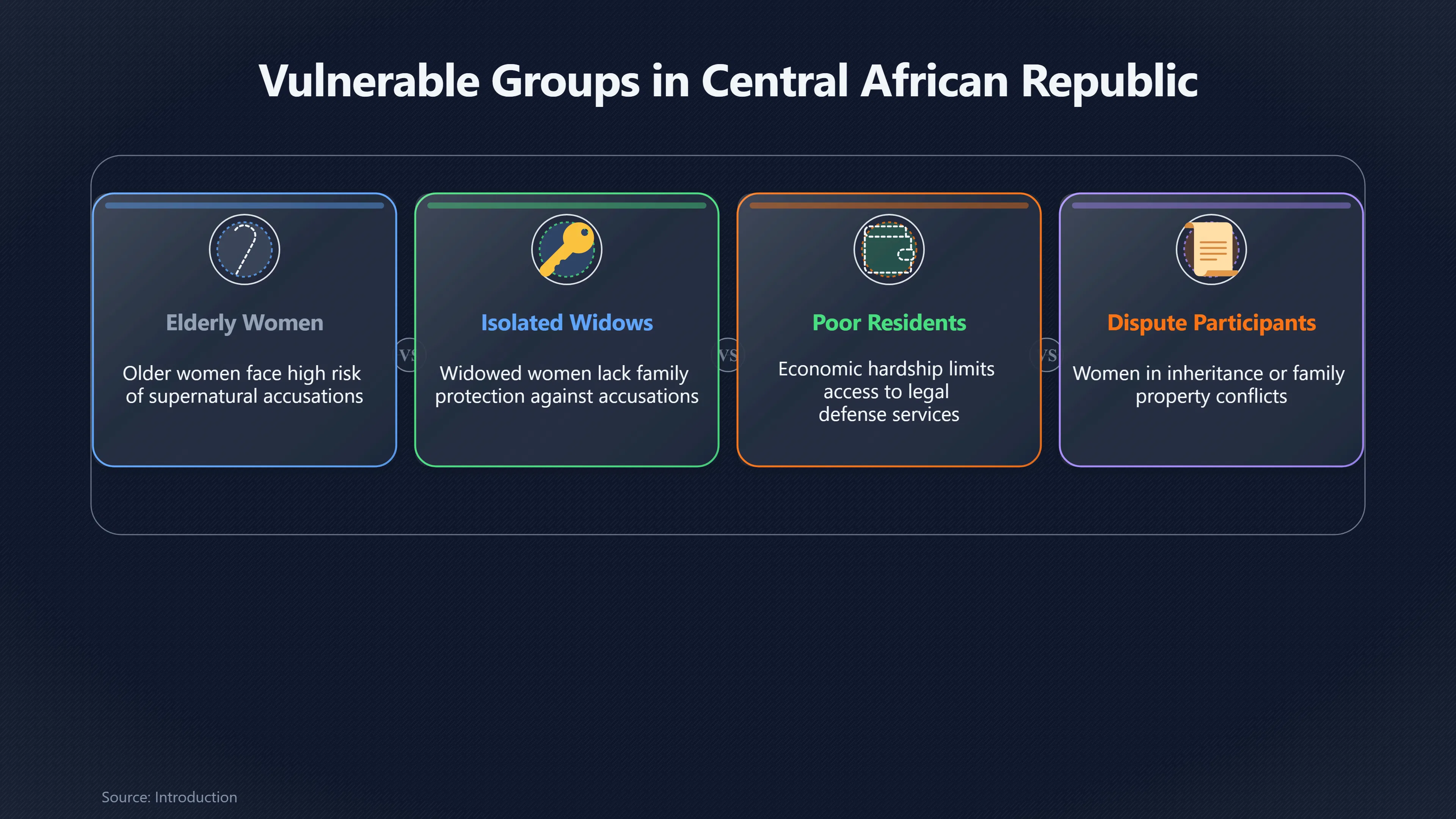
Women are not accused because they are legally defined as more likely to practise witchcraft. Rather, social conditions make particular groups especially vulnerable.
Those most frequently targeted include:
- older women;
- widows;
- women living alone;
- women with little economic or family protection;
- women involved in inheritance or family disputes.
An accusation may emerge after an unexplained death, prolonged illness or domestic conflict, but underlying disputes over property, authority or family relationships often shape who becomes the suspected witch. Human rights researchers describe accusations as interacting with existing gender inequalities rather than arising randomly.[Avocats Sans Frontières]asf.beAvocats Sans FrontièresThe penalisation of charlatanism and witchcraft practices: An obstacle to the realisation of the rights of women a…
Because women often possess fewer financial resources, they may also struggle to obtain lawyers or secure release while awaiting trial, increasing the practical consequences of an accusation even where conviction is uncertain.[Refworld]refworld.org2011 Country Reports on Human Rights Practices - Central African Republic | Refworld…
Women Detained in Bimbo Prison
The women’s prison at Bimbo, near Bangui, has become the clearest symbol of how witchcraft prosecutions affect female prisoners.
Reporting over many years has documented substantial numbers of women held there on witchcraft-related charges. Earlier United States government human rights reports described dozens of women detained or awaiting trial, with prison officials stating that some were kept there partly because they feared lynching if released into their home communities.[Refworld]refworld.org2008 Report on International Religious Freedom - Central African Republic | Refworld…
More recent research by Avocats Sans Frontières suggests that the pattern has persisted. Its legal aid work found that around half of the women imprisoned at Bimbo were serving sentences connected with alleged witchcraft or charlatanism offences. The organisation argues that imprisonment frequently reflects broader discrimination against women and children rather than reliable proof of criminal conduct.[Avocats Sans Frontières]asf.beAvocats Sans FrontièresThe penalisation of charlatanism and witchcraft practices: An obstacle to the realisation of the rights of women a…
This situation illustrates a difficult paradox. Authorities sometimes describe detention as protecting accused women from mob violence. Yet imprisonment itself also legitimises the accusation by treating alleged supernatural activity as a genuine criminal offence. In practice, women may face both community persecution and formal prosecution.[Refworld]refworld.org2008 Report on International Religious Freedom - Central African Republic | Refworld…
The Human Rights Debate
Critics do not deny that many citizens sincerely believe witchcraft causes real harm. Instead, they argue that criminal law is the wrong instrument for resolving those beliefs.
The principal criticisms include:
- criminal liability rests upon allegations that cannot be objectively verified;
- prolonged pretrial detention punishes defendants before guilt is established;
- prosecutions reinforce social stigma against women and other vulnerable groups;
- legal recognition of witchcraft accusations may encourage further accusations rather than reducing them.
Supporters of reform have therefore called for repealing witchcraft offences, strengthening legal aid, improving evidential standards and addressing the social conflicts that generate accusations in the first place.[Avocats Sans Frontières]asf.beAvocats Sans FrontièresThe penalisation of charlatanism and witchcraft practices: An obstacle to the realisation of the rights of women a…
Why This Matters Beyond Individual Cases
The Central African Republic provides an important example in the study of witch panics because the state itself has historically participated in validating supernatural accusations through criminal law. In many societies, witchcraft accusations occur outside formal legal institutions. Here, however, legislation, policing and imprisonment have often become part of the accusation process.
For historians and legal scholars, this makes the country unusual. The issue is not simply that people believe in witchcraft, but that courts have attempted to adjudicate claims that resist ordinary standards of proof. The resulting burden has fallen disproportionately on older and socially vulnerable women, making witchcraft law both a question of criminal justice and a question of gender equality.[Avocats Sans Frontières]asf.beAvocats Sans FrontièresThe penalisation of charlatanism and witchcraft practices: An obstacle to the realisation of the rights of women a…
Amazon book picks
Further Reading
Books and field guides related to Why Does the State Prosecute Witchcraft?. Use these as the next step if you want deeper reading beyond the article.


African religions and philosophy
Explains belief systems underlying legal accusations.
Endnotes
1.
Source: refworld.org
Link:https://www.refworld.org/reference/annualreport/usdos/2012/en/86541
Source snippet
2011 Country Reports on Human Rights Practices - Central African Republic | Refworld...
2.
Source: refworld.org
Link:https://www.refworld.org/reference/annualreport/usdos/2008/en/61552
Source snippet
2008 Report on International Religious Freedom - Central African Republic | Refworld...
3.
Source: refworld.org
Link:https://www.refworld.org/reference/annualreport/usdos/2007/en/46955
Source snippet
2007 Report on International Religious Freedom - Central African Republic | RefworldSeptember 14, 2007...
Published: September 14, 2007
4.
Source: refworld.org
Link:https://www.refworld.org/reference/annualreport/usdos/2011/en/78757
Source snippet
2010 Country Reports on Human Rights Practices - Central African Republic | RefworldApril 8, 2011 — Civilians continued to take vigilante...
Published: April 8, 2011
5.
Source: refworld.org
Link:https://www.refworld.org/reference/annualreport/usdos/2009/en/70677
6.
Source: refworld.org
Link:https://www.refworld.org/reference/annualreport/usdos/2008/en/69554
7.
Source: asf.be
Link:https://asf.be/the-penalisation-of-charlatanism-and-witchcraft-practices-an-obstacle-to-the-realisation-of-the-rights-of-women-and-minors-in-the-central-african-republic/
Source snippet
Avocats Sans FrontièresThe penalisation of charlatanism and witchcraft practices: An obstacle to the realisation of the rights of women a...
8.
Source: asf.be
Link:https://asf.be/country/cf-en/page/3/
9.
Source: asf.be
Link:https://asf.be/la-penalisation-des-pratiques-de-charlatanisme-et-de-sorcellerie-entrave-a-la-realisation-des-droits-des-femmes-et-des-personnes-mineures-en-republique-centrafricaine/?lang=fr
Source snippet
es en République centrafricaine – Avocats Sans FrontièresNovember 14, 2022 — 14 novembre 2022 LA PÉNALISATION DES PRATIQUES DE CHARLATANI...
Published: November 14, 2022
Additional References
10.
Source: prison-insider.com
Title: Central African Republic: witchcraft
Link:https://www.prison-insider.com/en/articles/republique-centrafricaine-sorcellerie
Source snippet
July 28, 2023 — Central African Republic Africa Women Justice Torture See the panorama Interview July 28, 2023 CENTRAL AFRICAN REPUBLIC...
Published: July 28, 2023
11.
Source: youtube.com
Title: ‘Witchcraft’ in Africa: Many women find it hard to prove innocence
Link:https://www.youtube.com/watch?v=wV0ubcWkC4k
Source snippet
GHANA: JAIL FOR WOMEN ACCUSED OF WITCHCRAFT | RTVE News...
12.
Source: youtube.com
Title: GHANA: JAIL FOR WOMEN ACCUSED OF WITCHCRAFT | RTVE News
Link:https://www.youtube.com/watch?v=qzXVpoQdaAg
Source snippet
Inside Ghana's last 'witch camps' • FRANCE 24 English...
13.
Source: youtube.com
Title: Ghanaian Lawmakers Push to Close Witch Camps
Link:https://www.youtube.com/watch?v=blqNFL9ihts
Source snippet
Accusing someone of witchcraft attracts a jail term of 5 years...
14.
Source: youtube.com
Title: Inside Ghana’s last ‘witch camps’ • FRANCE 24 English
Link:https://www.youtube.com/watch?v=didjLZkEoRI
Source snippet
Ghanaian Lawmakers Push to Close Witch Camps...
15.
Source: youtube.com
Title: Accusing someone of witchcraft attracts a jail term of 5 years
Link:https://www.youtube.com/watch?v=FFWnVBasDic
16.
Source: Wikipedia
Title: Laws against witchcraft
Link:https://en.wikipedia.org/wiki/Laws_against_witchcraft
17.
Source: icnl.org
Title: Human Rights Report
Link:https://www.icnl.org/research/library/central-african-republic_carhrreport/
18.
Source: dullahomarinstitute.org.za
Link:https://dullahomarinstitute.org.za/acjr/resource-centre/US%20Department%20of%20State%20Human%20Rights%20Report%20Central%20African%20Republic%202011.pdf/view
Topic Tree