Within Azerbaijan Belief
How Soviet Power Turned Faith Into Suspicion
Soviet authorities recast faith, pilgrimage and ritual as backward threats that had to be controlled or erased.
On this page
- Closing Mosques and Targeting Clergy
- Scientific Atheism and the Language of Superstition
- How Religious Practice Survived Outside Institutions
Page outline Jump by section
Introduction
From the late 1920s onwards, Soviet rule transformed religion in Azerbaijan from a normal part of everyday life into something the state increasingly portrayed as politically suspect, socially backward and intellectually obsolete. Rather than treating faith simply as a private belief, communist authorities argued that religious practice, pilgrimage, shrine devotion and traditional rituals were obstacles to creating a modern socialist society. Mosques were closed, religious leaders were arrested or silenced, children were educated through officially atheist schools, and public campaigns urged citizens to abandon what officials labelled “superstition”. Yet these efforts never completely eliminated religious life. Instead, many practices moved into homes, villages and sacred sites beyond the reach of formal institutions. The result was not the disappearance of belief but its adaptation, leaving a legacy that still shapes Azerbaijani attitudes towards religion, secularism and state authority today.[Sciences Po]sciencespo.frSciences PoSoviet rule, Islam and Azerbaijan. | Sciences Po Center for International StudiesOctober 2, 2024…

How Soviet Power Turned Faith Into Suspicion
The Soviet campaign against religion in Azerbaijan formed part of a much wider ideological project across the USSR. Marxist-Leninist doctrine regarded religion as a product of ignorance and social inequality rather than divine truth. Party leaders expected scientific education and socialism eventually to make religion disappear.
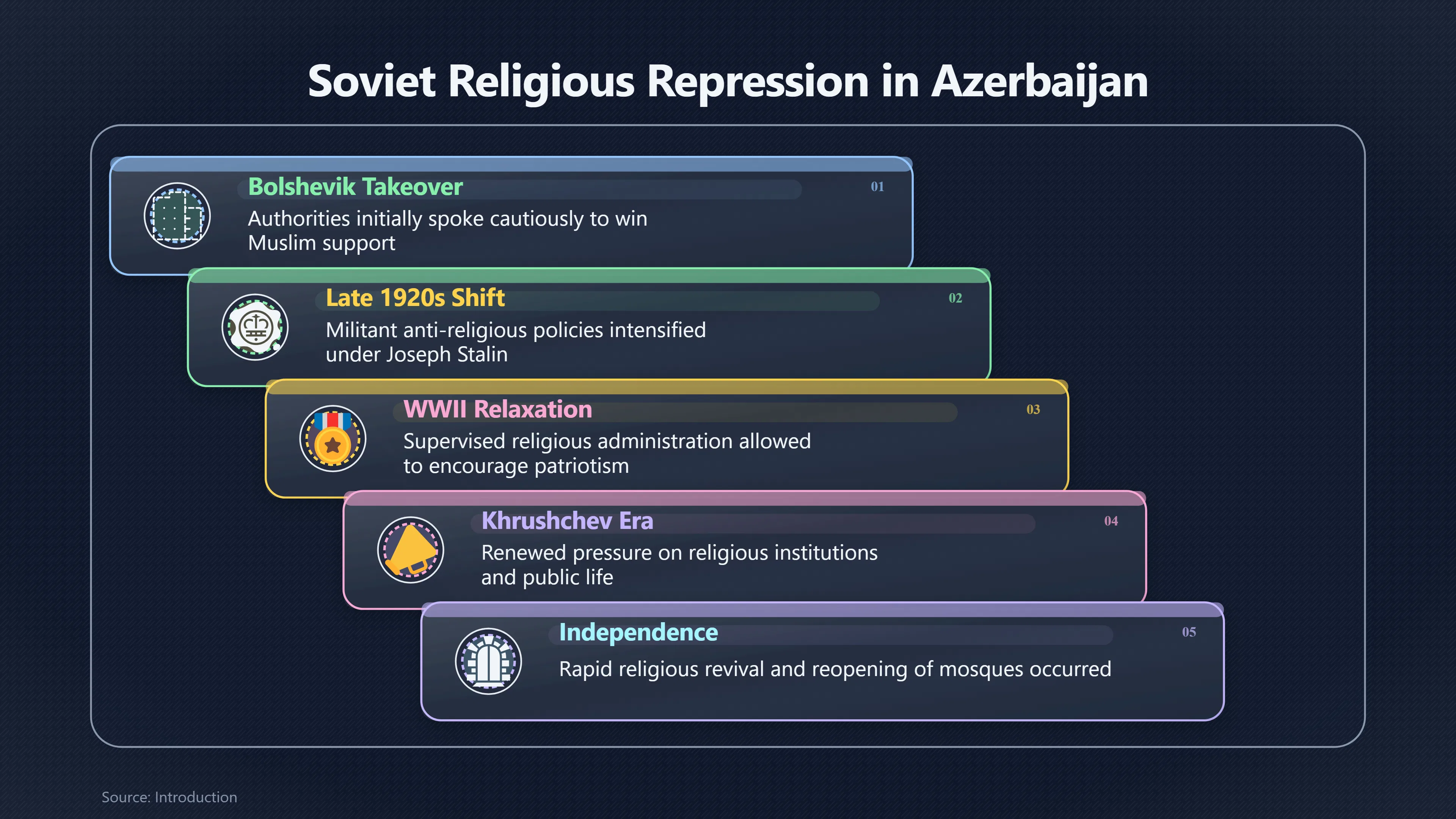
The campaign, however, was not constant. During the first years after the Bolshevik takeover in 1920, Soviet authorities often spoke cautiously about Islam because they hoped to win support among Muslim populations and distinguish themselves from the former Russian Empire. That relatively restrained approach changed dramatically at the end of the 1920s. Under Joseph Stalin, militant anti-religious policies intensified, and Islam became one of many faiths subjected to systematic repression.[Sciences Po]sciencespo.frSciences PoSoviet rule, Islam and Azerbaijan. | Sciences Po Center for International StudiesOctober 2, 2024…
In Azerbaijan, religion was portrayed not merely as incorrect but as a danger to socialist progress. Clergy could be depicted as exploiting ordinary people, religious customs as remnants of feudal society, and pilgrimage or shrine devotion as irrational practices preventing scientific thinking. This official language transformed ordinary religious observance into evidence of political or cultural backwardness.
Closing Mosques and Targeting Clergy
The most visible aspect of the campaign was the dismantling of religious institutions.
Across Azerbaijan, many mosques were closed, demolished, converted into warehouses or assigned entirely secular functions. Religious schools disappeared, while opportunities to train new clerics became extremely limited. Numerous religious leaders were dismissed from public life, imprisoned during periods of political repression or prevented from exercising their traditional roles within local communities.[Sciences Po]sciencespo.frSciences PoSoviet rule, Islam and Azerbaijan. | Sciences Po Center for International StudiesOctober 2, 2024…
These policies affected far more than places of worship.
Mosques had traditionally served as centres for:
- religious education;
- community dispute resolution;
- charitable activity;
- festivals and public ceremonies;
- transmission of local religious knowledge between generations.
Removing these institutions disrupted established networks of authority. Families increasingly had to preserve religious knowledge privately because few recognised teachers remained.
The Second World War produced a temporary relaxation. Soviet authorities allowed a tightly supervised religious administration to function in order to encourage patriotism and demonstrate limited religious tolerance abroad. However, this did not represent genuine religious freedom. Only a small number of officially approved mosques operated, while independent religious activity remained heavily controlled. Later anti-religious campaigns, particularly under Nikita Khrushchev, again placed pressure on religious institutions.[OUP Academic]academic.oup.comOUP AcademicSoviet and Muslim: The Institutionalization of Islam in Central Asia, 1943-1991 | Oxford Academic…
Scientific Atheism and the Language of Superstition
The Soviet Union did not rely solely on police powers. It also attempted to reshape how citizens understood reality.
Schools, universities, newspapers, museums and public lectures promoted what became known as “scientific atheism”. Religion was presented as a historical mistake that modern science had overcome. Children learned evolutionary biology and communist philosophy while religious explanations of illness, natural events or personal misfortune were dismissed as relics of an unenlightened past.[OUP Academic]academic.oup.comOUP AcademicSoviet and Muslim: The Institutionalization of Islam in Central Asia, 1943-1991 | Oxford Academic…
In Azerbaijan this campaign often focused on practices that lay outside formal mosque worship.
Officials criticised:
- visits to saints’ tombs and local shrines;
- healing rituals connected with sacred places;
- protective amulets and blessings;
- religious mourning ceremonies;
- seasonal customs associated with spiritual protection.
Rather than distinguishing carefully between religious devotion, folklore and local custom, Soviet propaganda frequently grouped them together under the single label of “superstition”. This language mattered because it suggested these practices were not merely incorrect but socially harmful.
The campaign also sought to replace religious ceremonies with secular alternatives. Civil marriage, state-organised celebrations, officially approved naming ceremonies and communist commemorations were intended to substitute for religious milestones throughout a person’s life.

How Religious Practice Survived Outside Institutions
Despite decades of pressure, religion did not disappear from Azerbaijan.
Instead, it adapted.
Many families continued observing important rituals inside the home, where they attracted less official attention. Older relatives quietly transmitted prayers, customs and religious stories even when formal education had disappeared.
Sacred shrines became particularly important because they often lay outside the institutional structures most heavily targeted by the state. Rural pilgrimage sites associated with revered figures continued attracting visitors seeking healing, blessing or spiritual comfort. While officials frequently criticised these practices, their dispersed nature made complete eradication difficult. Anthropological research across the Soviet Muslim world shows that such local sacred places often preserved religious continuity even where formal religious institutions had been destroyed or tightly controlled.[OUP Academic]academic.oup.comOUP AcademicSoviet and Muslim: The Institutionalization of Islam in Central Asia, 1943-1991 | Oxford Academic…
Religious identity therefore shifted from public institutions towards family memory, informal networks and local tradition. Many Azerbaijanis retained a sense of Muslim identity even if their detailed religious education had largely disappeared.
Why the Campaign Did Not Achieve Its Goals
The Soviet authorities expected that religion would steadily fade as each new generation received atheist education.
Instead, they achieved a more complicated outcome.
Public religious knowledge certainly declined. Many Azerbaijanis grew up with limited understanding of theology, Islamic law or religious history because those subjects were unavailable through normal education. Yet religious identity itself proved far more resilient than Soviet planners anticipated.[Sciences Po]sciencespo.frSciences PoSoviet rule, Islam and Azerbaijan. | Sciences Po Center for International StudiesOctober 2, 2024…
When Azerbaijan regained independence in 1991, religious revival occurred surprisingly quickly. Mosques reopened, pilgrimage increased and people sought religious education after decades of suppression. Historians such as Altay Goyushov argue that Soviet policies weakened traditional local religious learning without eliminating religious identity, creating a vacuum that was later filled by a wide variety of foreign religious influences and new educational networks.[Sciences Po]sciencespo.frSciences PoSoviet rule, Islam and Azerbaijan. | Sciences Po Center for International StudiesOctober 2, 2024…
This helps explain an apparent paradox. The Soviet campaign succeeded in making Azerbaijan one of the most secular societies in the Muslim world, yet it failed to erase religion altogether.
Why It Matters for Understanding Collective Belief
The Soviet campaign against religion illustrates an important distinction within the history of collective belief.
This was not an episode of spontaneous mass hysteria. Nor was it primarily a popular moral panic emerging from below. Instead, it was a state-directed ideological project that deliberately framed religious belief as a public danger requiring correction.
Official propaganda encouraged citizens to see faith through a particular lens:
- believers could be viewed as politically unreliable;
- traditional rituals became symbols of backwardness;
- pilgrimage was portrayed as irrational behaviour;
- sacred authority competed with loyalty to the socialist state.
Those narratives resemble the mechanisms found in many moral panics, even though they were organised from above rather than spreading organically through society.
The long-term consequences remain visible in modern Azerbaijan. Public life retains a strong secular character shaped by the Soviet period, while many religious customs that survived decades of repression continue to carry deep cultural importance. Understanding this history helps explain why contemporary debates over religion in Azerbaijan often concern not simply belief itself, but who has the authority to define what counts as legitimate religion, harmful superstition or acceptable public tradition.[Sciences Po]sciencespo.frSciences PoSoviet rule, Islam and Azerbaijan. | Sciences Po Center for International StudiesOctober 2, 2024…



Endnotes
1.
Source: academic.oup.com
Link:https://academic.oup.com/book/5128
Source snippet
OUP AcademicSoviet and Muslim: The Institutionalization of Islam in Central Asia, 1943-1991 | Oxford Academic...
2.
Source: history.com
Title: joseph stalin religion atheism ussr
Link:https://www.history.com/articles/joseph-stalin-religion-atheism-ussr
3.
Source: azerbaijan.az
Title: History of religions
Link:https://azerbaijan.az/en/related-information/213
4.
Source: sciencespo.fr
Link:https://www.sciencespo.fr/ceri/en/content/soviet-rule-islam-and-azerbaijan-interview-altay-goyushow
Source snippet
Sciences PoSoviet rule, Islam and Azerbaijan. | Sciences Po Center for International StudiesOctober 2, 2024...
Published: October 2, 2024
5.
Source: sciencespo.fr
Link:https://www.sciencespo.fr/recherche/en/news/analysing-azerbaijan-how-can-a-secular-state-manage-a-revival-of-religion/
Source snippet
Sciences Po ResearchOctober 25, 2024 — 25 October 2024 ANALYSING AZERBAIJAN: HOW CAN A SECULAR STATE MANAGE A REVIVAL OF RELIGION? With...
Published: October 25, 2024
Additional References
6.
Source: bakuresearchinstitute.org
Title: The Campaign Against Religion and the Promotion of Atheism in the Soviet Union
Link:https://bakuresearchinstitute.org/en/the-campaign-against-religion-and-the-promotion-of-atheism-in-the-soviet-union/
Source snippet
Over time, this struggle became increasingly severe, and religion—once regarded merely as an obs...
7.
Source: researchgate.net
Title: Authors: Jeyhun Valeh Mammadov * Azerbaijan Inst
Link:https://www.researchgate.net/publication/390667870_Gosudarstvenno-religioznye_otnosenia_v_Azerbajdzanskoj_SSR_v_period_Sovetskoj_vlasti_1920-1927-e_gody
Source snippet
(PDF) Государственно-религиозные отношения в Aзербайджанской ССР в период Советской власти (1920-1927-е годы)April 10, 2025 — ГОСУДАРСТВЕ...
Published: April 10, 2025
8.
Source: dergipark.anas.az
Title: Mammadov AMEA KEYWORDS: Nukha,, Zaga
Link:https://dergipark.anas.az/index.php/ah/article/view/581
Source snippet
THE RELIGIOUS POLICY OF THE SOVIET AUTHORITIES ON THE PLACES IN THE 1920S (BASED ON THE MATERIALS OF THE NORTH-WESTERN REGION OF AZERBAIJ...
9.
Source: youtube.com
Title: An Islamic revival in Azerbaijan: The Road to Hajj | Featured Documentary
Link:https://www.youtube.com/watch?v=rCU45MvDVEQ
Source snippet
The Broken Promise: Islam Under Soviet Rule...
10.
Source: youtube.com
Title: The Broken Promise: Islam Under Soviet Rule
Link:https://www.youtube.com/watch?v=7QEsBC130eE
Source snippet
A Sacred Space is Never Empty: A History of Soviet Atheism, Smolkin, 4/11/18...
11.
Source: dergipark.org.tr
Link:https://dergipark.org.tr/en/pub/gttad/article/1736833
Source snippet
AZERBAYCAN’IN SOVYETLEŞTİRİLMESİ SÜRECİNDE DİN (1920-1929) - Journal of General Turkish History ResearchJanuary 24, 2026 — AZERBAYCAN’IN...
Published: January 24, 2026
12.
Source: documentsdelivered.com
Link:https://documentsdelivered.com/source/018/692/018692514.php
13.
Source: ait.edu.az
Link:https://ait.edu.az/en/tedqiqat/scientific-publications/i-lahiyyat-fakult-si-elmi-m-cmu-si-2/
14.
Source: dovlet-din.az
Link:https://www.dovlet-din.az/en/article/27/sovetler-birliyinin-ilk-dovrlerinde-azerbaycanda-dine-qarsi-mubarize
15.
Source: journal.ait.edu.az
Link:https://journal.ait.edu.az/elmi-mecmua/article/view/400
Topic Tree