Within Singapore Panics
Were Singapore's Factory Possessions Illness or Protest?
Episodes of screaming, fainting and spirit possession revealed how medicine, belief and factory discipline competed to explain distress.
On this page
- What happened on factory floors
- Medical and spiritual explanations
- Industrialisation and hidden emotional strain
Page outline Jump by section
Introduction
During the 1970s, Singapore experienced a series of striking outbreaks in which groups of young women working in electronics factories suddenly screamed, fainted, shook violently or appeared to enter trance-like states. To some families and co-workers these episodes were clear evidence of spirit possession. To doctors they resembled what is now commonly called mass psychogenic illness: genuine physical and emotional symptoms spreading through a group without evidence of a shared toxic exposure or infectious disease. Neither explanation can be understood in isolation. The outbreaks occurred during a period of rapid industrialisation, when thousands of young women entered disciplined factory work under demanding conditions. They remain important because they reveal how medicine, religious belief, industrial management and the emotional pressures of modernisation all competed to explain the same events.[Taylor & Francis]taylorfrancis.comOpen source on taylorfrancis.com.
What happened on factory floors?
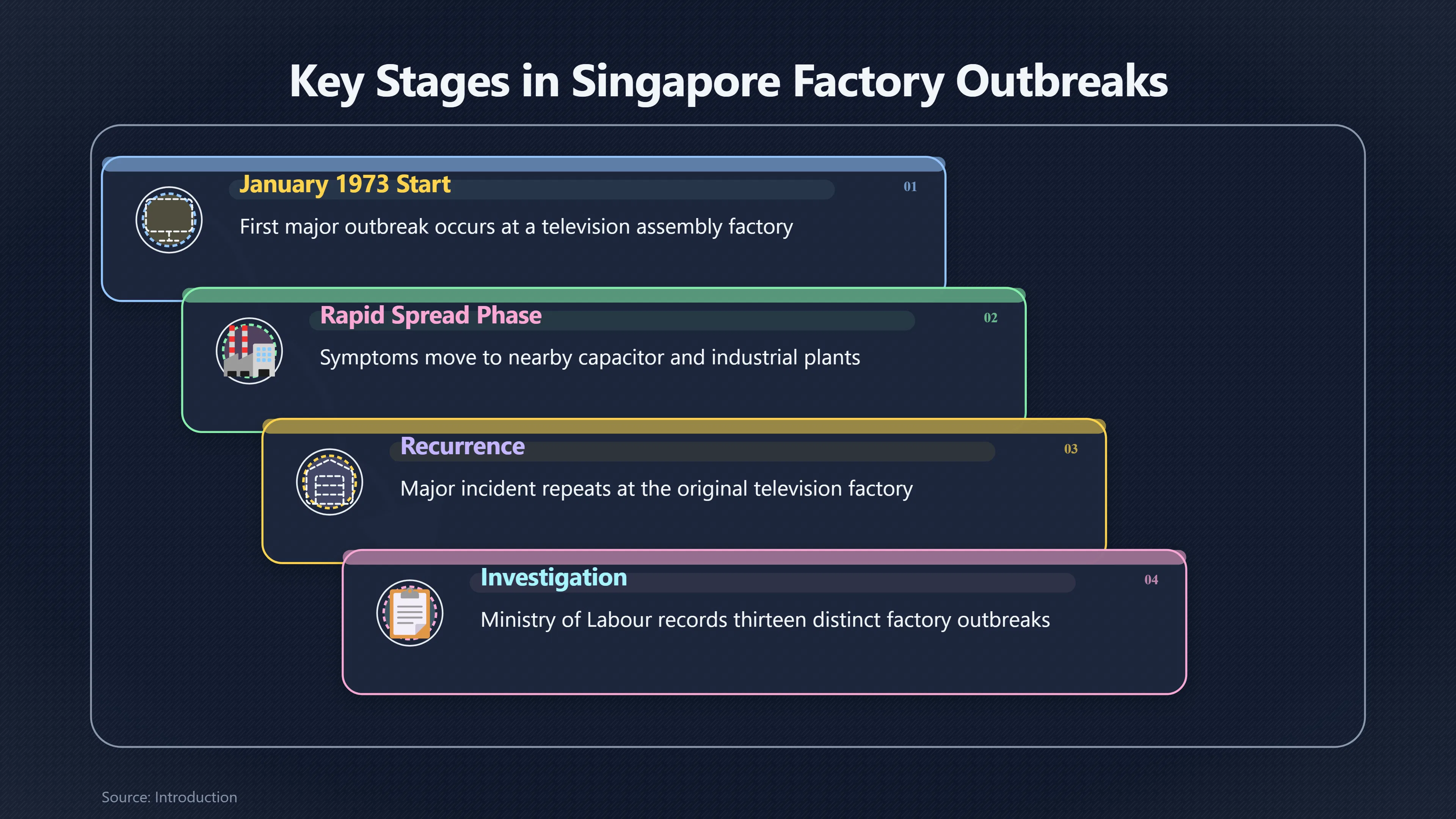
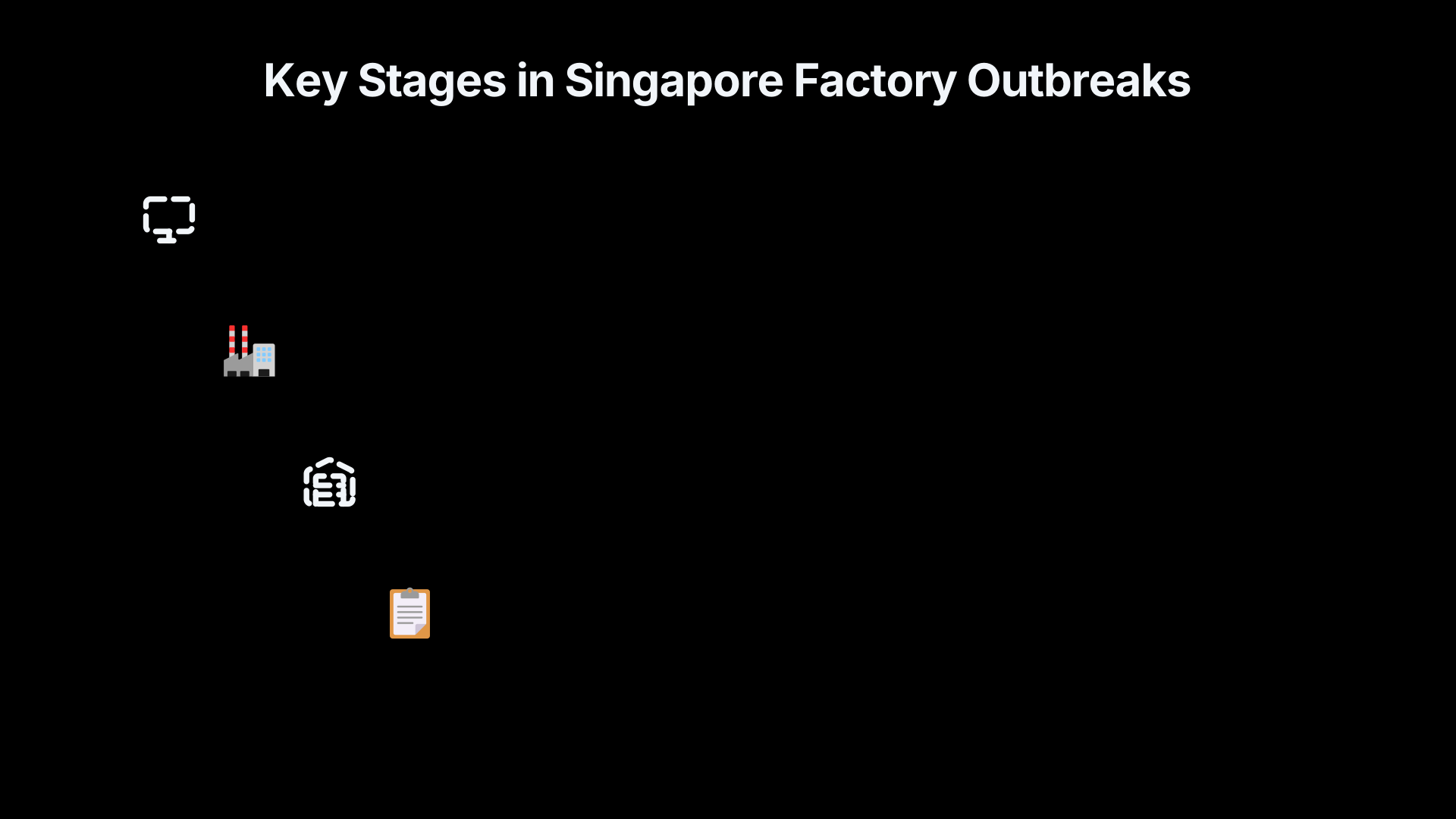
The best documented incidents occurred between 1973 and 1979 in Singapore’s expanding electronics industry. One widely studied outbreak began in January 1973 at a television assembly factory employing hundreds of young women, many of them Malay. A worker suddenly screamed, fainted and struggled violently while being carried to the factory clinic. Within hours other women displayed similar behaviour. The factory closed early, but when production resumed after the weekend the attacks returned and spread. Soon a nearby capacitor factory experienced similar episodes, followed by another factory in the same industrial estate. Researchers eventually recorded 107 attacks affecting 97 workers across the three factories.[CDC Stacks]stacks.cdc.govCDC StacksOpening Remarks: A Symposium on the Diagnosis and Amelioration of Mass Psychogenic Illness in IndustryJune 16, 2009…
Medical reports described two broad patterns of behaviour. Some women entered dramatic seizure-like states, shouting, crying, kicking or thrashing while remaining physically healthy once the episode passed. Others became overwhelmed by fear, dizziness, numbness or an intense feeling that something dangerous was present. A number of workers experienced repeated attacks, illustrating how the phenomenon could recur once anxiety spread through a workplace.[smj.sma.org.sg]smj.sma.org.sgSINGAPORE MEDICAL JOURNALVol. 17, No. I. Ma…
Further outbreaks occurred in later years, including another major incident at the same television factory in 1979 and additional cases in other electronics plants. By 1980 the Ministry of Labour had investigated at least thirteen factory outbreaks involving several hundred workers, although not every case received extensive public attention.[The Straits Times]straitstimes.comThe Straits TimesFrom The Straits Times Archives: Past 'mass hysteria' cases in Singapore | The Straits TimesJuly 7, 2026…
Why did possession seem believable?
For many affected workers, the idea of spirit possession was neither irrational nor unusual. The outbreaks disproportionately affected young Malay women, among whom beliefs about unseen spiritual forces formed part of a wider religious and cultural landscape. When workers or their families interpreted the attacks as possession, factory managers sometimes invited traditional healers to perform rituals intended to remove malevolent spirits before production resumed.[CDC Stacks]stacks.cdc.govCDC StacksOpening Remarks: A Symposium on the Diagnosis and Amelioration of Mass Psychogenic Illness in IndustryJune 16, 2009…
These rituals sometimes reassured individuals, but they did not consistently stop the outbreaks. In several documented cases, attacks continued after exorcism ceremonies or spread to neighbouring factories despite them. Medical investigators therefore cautioned against treating spiritual rituals as a sufficient explanation, even while recognising that belief systems influenced how workers understood their distress.[CDC Stacks]stacks.cdc.govCDC StacksOpening Remarks: A Symposium on the Diagnosis and Amelioration of Mass Psychogenic Illness in IndustryJune 16, 2009…
The important historical point is not deciding whether spiritual experiences were “real” or “false”. Rather, different communities interpreted the same dramatic behaviour through different frameworks. Families and fellow workers often saw supernatural causes; occupational physicians searched for psychological, environmental or organisational ones.
Medical explanations and the search for physical causes
Because many workers believed something in the factory environment had harmed them, investigators carefully considered physical explanations. Industrial hygienists examined ventilation systems, chemicals and other workplace hazards. They found no environmental exposure capable of explaining the sudden cluster of symptoms or its rapid spread between individuals.[Sage Journals]journals.sagepub.comSage JournalsAn Investigation of Job Satisfaction Factors in an Incident of Mass Psychogenic Illness at the Workplace - Barbara G.F. Cohe…
Occupational physicians instead argued that the outbreaks fitted the pattern of mass psychogenic illness. In this condition, symptoms are genuine rather than fabricated, but they arise through psychological and social processes rather than a shared toxic agent. The sight of one distressed colleague can heighten anxiety in others, particularly where workers already face uncertainty or stress. Once concern spreads through observation and conversation, additional cases may appear quickly.[CDC Stacks]stacks.cdc.govCDC StacksThree incidents of industrial mass psychogenic illness: a preliminary report…
Singapore’s medical literature became internationally significant because it documented several industrial outbreaks in a short period. Researchers distinguished between the dramatic seizure-like episodes and less visible attacks characterised mainly by overwhelming fear, helping shape later occupational-health research into workplace mass psychogenic illness.[Taylor & Francis]taylorfrancis.comOpen source on taylorfrancis.com.

Industrialisation and hidden emotional strain
The factory outbreaks coincided with one of the most dramatic transformations in Singapore’s economic history. Export-oriented manufacturing expanded rapidly, particularly electronics assembly. Thousands of young women, many from relatively traditional backgrounds, entered regimented workplaces with strict production targets, repetitive tasks and close supervision.
Researchers did not argue that factory work alone caused the outbreaks. Instead, they suggested that industrial conditions created an environment in which existing emotional pressures could find collective expression. Factors repeatedly identified included:
- repetitive assembly-line work requiring sustained concentration;
- tightly controlled production schedules;
- limited autonomy over daily tasks;
- demanding supervisory relationships;
- pressures arising from family responsibilities alongside paid employment; and
- the social isolation that could accompany migration into industrial work.[nih.gov]pubmed.ncbi.nlm.nih.govAn investigation of job satisfaction factors in an incident of mass psychogenic illness at the workplace - PubMedJanuary 1, 1978…
Studies of similar incidents in Singapore and elsewhere found that affected workers often reported higher levels of job dissatisfaction, family stress and personal conflict than unaffected colleagues. These findings did not imply that the women were mentally ill. Instead, they suggested that accumulated stress increased vulnerability when a frightening event occurred within a closely connected workforce.[PubMed]pubmed.ncbi.nlm.nih.govAn investigation of job satisfaction factors in an incident of mass psychogenic illness at the workplace - PubMedJanuary 1, 1978…
Some later scholars have gone further, proposing that possession episodes could also function as an indirect form of protest where young women had few socially acceptable ways to express distress or challenge workplace authority. This interpretation remains debated, but it has influenced discussions of gender, labour and mental health across Southeast Asia.[ScienceDirect]sciencedirect.comA transcultural perspective on women and madness: The case of the mystical affliction - ScienceDirect…
Were these illnesses or a form of protest?
Modern historians generally reject simple either-or explanations.
The attacks were not merely workers pretending to be ill. Contemporary observers consistently reported genuine physical symptoms, intense fear and temporary loss of control. Equally, there is little evidence that a hidden industrial poison or chemical exposure explained the outbreaks.[smj.sma.org.sg]smj.sma.org.sgSINGAPORE MEDICAL JOURNALVol. 17, No. I. Ma…
Instead, most current interpretations combine several interacting influences:
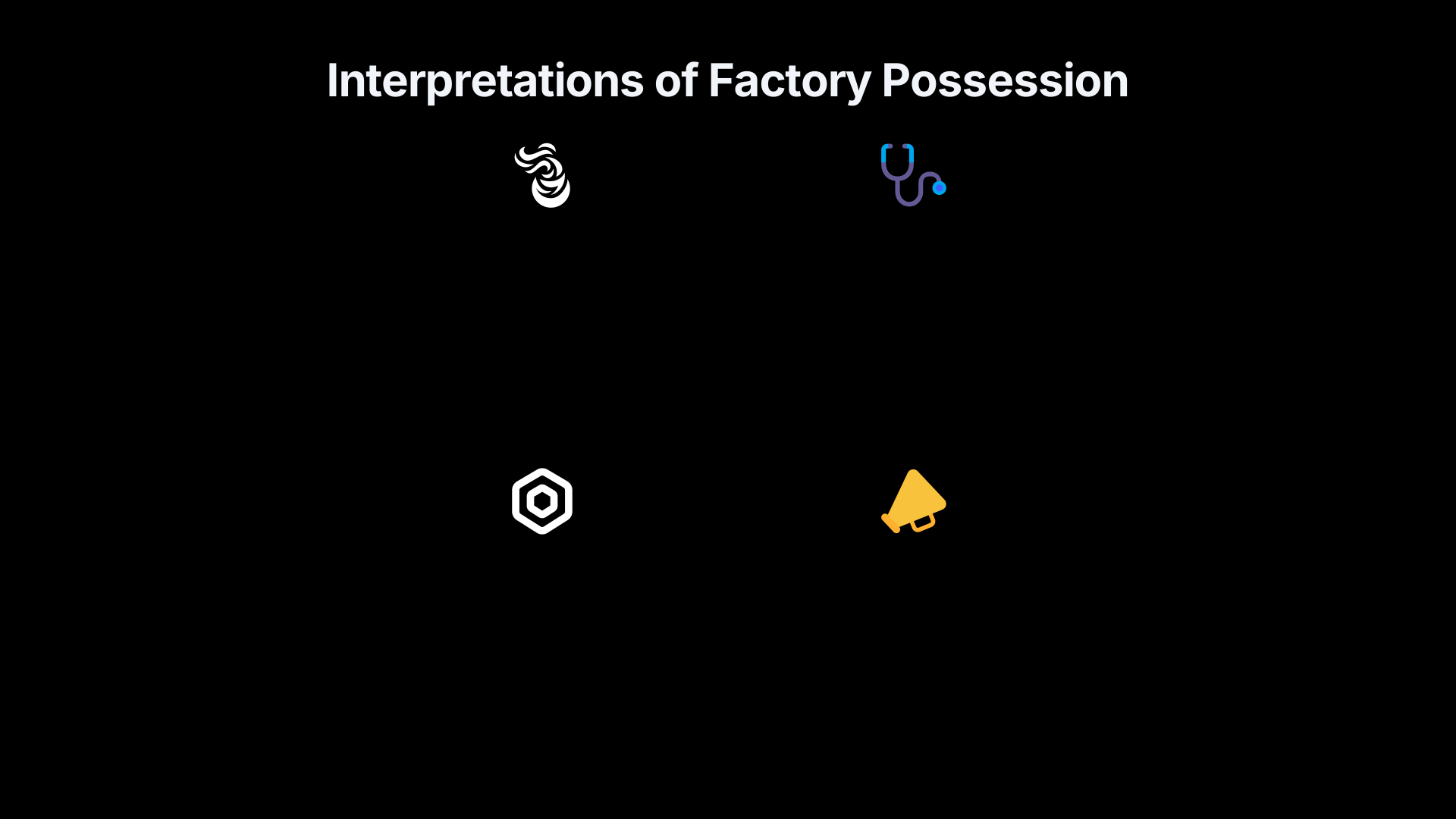
- Psychological contagion: witnessing distress made additional attacks more likely.
- Cultural interpretation: beliefs about spirits shaped how symptoms were understood and expressed.
- Workplace stress: repetitive, closely supervised industrial labour increased vulnerability.
- Gender and social expectations: young women often occupied positions with limited authority both at work and at home, influencing how emotional strain was experienced and communicated.[taylorfrancis.com]taylorfrancis.comOpen source on taylorfrancis.com.
This layered interpretation avoids dismissing workers as irrational while also recognising that sincerely held supernatural beliefs formed part of the social reality of 1970s Singapore.
Why these outbreaks still matter
The factory possession episodes remain among Singapore’s best-known examples of collective psychological distress because they sit at the intersection of rapid economic development, cultural belief and occupational health.
They also influenced practical responses. By 1980 government agencies and industry leaders were discussing how factories should respond to future outbreaks, reflecting growing recognition that management, communication and worker welfare mattered alongside medical investigation.[The Straits Times]straitstimes.comThe Straits TimesFrom The Straits Times Archives: Past 'mass hysteria' cases in Singapore | The Straits TimesJuly 7, 2026…
Today the episodes are less often presented simply as cases of “mass hysteria”. Historians, psychologists and occupational-health researchers increasingly view them as windows into the hidden emotional costs of industrialisation. They demonstrate that dramatic collective behaviour can emerge not from a single cause but from the interaction of workplace conditions, social expectations, cultural belief and genuine psychological suffering.
Amazon book picks
Further Reading
Books and field guides related to Were Singapore's Factory Possessions Illness or Protest?. Use these as the next step if you want deeper reading beyond the article.

The Spirit Catches You and You Fall Down
Explores clashes between medical and spiritual explanations.



Endnotes
1.
Source: smj.sma.org.sg
Title: SINGAPORE MEDICAL JOURNAL
Link:https://smj.sma.org.sg/1701/1701smj4.pdf
Source snippet
Vol. 17, No. I. Ma...
2.
Source: stacks.cdc.gov
Link:https://stacks.cdc.gov/view/cdc/179040/cdc_179040_DS1.pdf
Source snippet
CDC StacksOpening Remarks: A Symposium on the Diagnosis and Amelioration of Mass Psychogenic Illness in IndustryJune 16, 2009...
Published: June 16, 2009
3.
Source: stacks.cdc.gov
Link:https://stacks.cdc.gov/view/cdc/184235
Source snippet
CDC StacksThree incidents of industrial mass psychogenic illness: a preliminary report...
4.
Source: stacks.cdc.gov
Title: Stacks Mass psychogenic illness in organization: an overview
Link:https://stacks.cdc.gov/view/cdc/184299
Source snippet
CDC StacksMass psychogenic illness in organization: an overview...
5.
Source: sciencedirect.com
Link:https://www.sciencedirect.com/science/article/abs/pii/0277539582900036
Source snippet
A transcultural perspective on women and madness: The case of the mystical affliction - ScienceDirect...
6.
Source: sciencedirect.com
Title: ScienceDirect PSYCHIC POSSESSION AMONG INDUSTRIAL WORKERS
Link:https://www.sciencedirect.com/science/article/abs/pii/S0140673678910966
Source snippet
PSYCHIC POSSESSION AMONG INDUSTRIAL WORKERS - ScienceDirect...
7.
Source: taylorfrancis.com
Link:https://www.taylorfrancis.com/chapters/edit/10.4324/9781315825694-3/outbreaks-mass-hysteria-workplaces-singapore-patterns-modes-presentation-phoon
8.
Source: straitstimes.com
Link:https://www.straitstimes.com/singapore/from-the-straits-times-archives-past-mass-hysteria-cases-in-singapore
Source snippet
The Straits TimesFrom The Straits Times Archives: Past 'mass hysteria' cases in Singapore | The Straits TimesJuly 7, 2026...
Published: July 7, 2026
9.
Source: Wikipedia
Title: Mass psychogenic illness
Link:https://en.wikipedia.org/wiki/Mass_psychogenic_illness
10.
Source: journals.sagepub.com
Link:https://journals.sagepub.com/doi/abs/10.1177/216507997802600102
Source snippet
Sage JournalsAn Investigation of Job Satisfaction Factors in an Incident of Mass Psychogenic Illness at the Workplace - Barbara G.F. Cohe...
11.
Source: pubmed.ncbi.nlm.nih.gov
Link:https://pubmed.ncbi.nlm.nih.gov/564008/
Source snippet
An investigation of job satisfaction factors in an incident of mass psychogenic illness at the workplace - PubMedJanuary 1, 1978...
Published: January 1, 1978
Additional References
12.
Source: pure.johnshopkins.edu
Link:https://pure.johnshopkins.edu/en/publications/a-case-study-of-stress-and-mass-psychogenic-illness-in-industrial-3/
Source snippet
Johns Hopkins UniversityA case study of stress and mass psychogenic illness in industrial workers - Johns Hopkins University...
13.
Source: youtube.com
Link:https://www.youtube.com/watch?v=ua2ifz6wrIQ
Source snippet
Mass hysteria factory Singapore Malaysia [TRAILER] The screaming schoolgirls of Kelantan | The Unsolved Mysteries of South-east Asia Ep 5...
14.
Source: youtube.com
Link:https://www.youtube.com/watch?v=MlB8Cf6K80M
Source snippet
Why Mass Hysteria is Thriving in the 21st Century - Robert Bartholomew...
15.
Source: youtube.com
Title: Ghost appears in School’s corridor in Malaysia, campus evacuated
Link:https://www.youtube.com/watch?v=aHmPVHyYkuM
Source snippet
Dozens of Garment Factory Employees Possessed of Demons, Allegedly Caused by Fallen Tree...
16.
Source: youtube.com
Title: Why Mass Hysteria is Thriving in the 21st Century
Link:https://www.youtube.com/watch?v=vKZ9uJNEv80
Source snippet
Episode 71. Frenzy – The Turmoil of Mass Psychogenic Illness...
17.
Source: youtube.com
Title: Episode 71. Frenzy – The Turmoil of Mass Psychogenic Illness
Link:https://www.youtube.com/watch?v=e2AdorYLDF8
Source snippet
Ghost appears in School's corridor in Malaysia, campus evacuated...
Topic Tree