Within Dominica
How Dominica's Dreads Became Public Enemies
A varied youth movement became a public enemy when crime, dissent, dreadlocks and Rastafari identity were treated as one threat.
On this page
- Who the Dreads Were
- How Fear Spread Beyond the Evidence
- Arrests, Violence and Life in Hiding
Page outline Jump by section
Introduction
The so-called Dread Scare of 1970s Dominica was not simply a response to crime. It was a period in which a broad and diverse group of young people—many influenced by Rastafari, Black Power, anti-colonial politics or communal rural living—became identified in the public imagination as a single dangerous enemy. While some individuals associated with the movement committed serious crimes, fear expanded far beyond those cases. Dreadlocks, political dissent, religious identity and criminal violence increasingly became treated as interchangeable, creating one of the Caribbean’s clearest examples of a moral panic with lasting human consequences.[domfari.omeka.net]domfari.omeka.netDom Fari | The Dread Act · History of The RastafariansDom Fari | The Dread Act · History of The Rastafarians
The campaign reached its peak with the 1974 Prohibited and Unlawful Societies and Associations Act, widely known as the Dread Act. The law gave extraordinary powers to police and granted legal protections in circumstances where people identified as “Dreads” were injured or killed. Historians generally argue that the resulting repression extended well beyond the prosecution of actual offenders, affecting an entire social and cultural current whose members varied widely in their beliefs and behaviour.[domfari.omeka.net]domfari.omeka.netDom Fari | The Dread Act · History of The RastafariansDom Fari | The Dread Act · History of The Rastafarians
Who the Dreads Were
The label “Dreads” described no single organisation. Instead, it covered a loose collection of predominantly young men whose influences included Rastafari spirituality, Black Power politics, African cultural pride, environmental ideals and dissatisfaction with the island’s social order.
Some established communal farms in the island’s interior. Others rejected conventional employment, criticised social inequality, wore dreadlocks as an expression of identity, or adopted the Rastafarian practice of natural living. Many had little interest in organised politics, while others were associated with radical student movements. Treating them as one disciplined movement obscures important differences that contemporaries themselves recognised.[DOM767]dom767.comDreads – DOM767Dreads – DOM767…
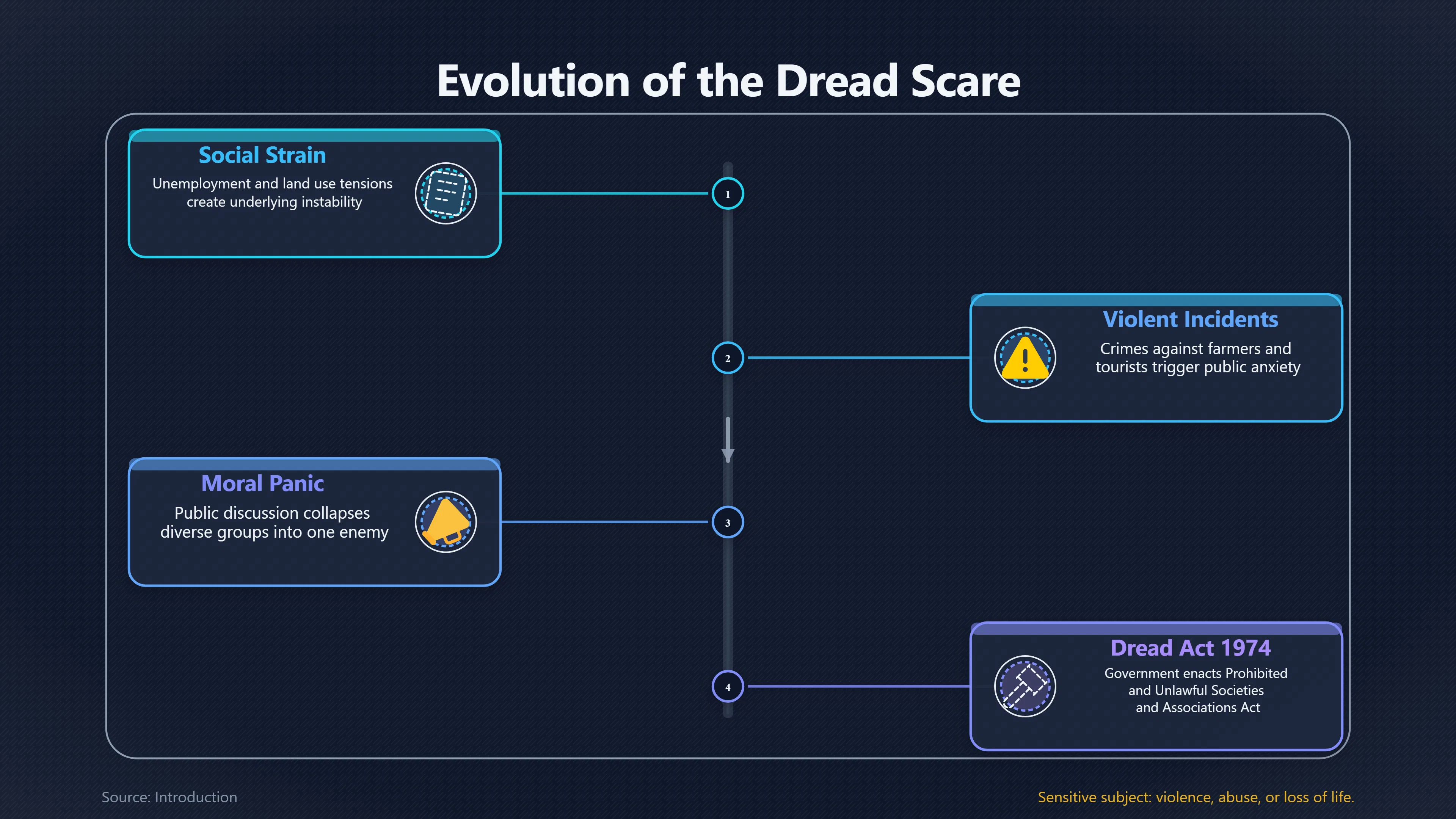
The movement also emerged during a period of genuine social strain. Dominica faced unemployment, economic uncertainty, political polarisation and tensions over land use. Farmers complained about theft, trespass and intimidation. Several violent attacks, including crimes against farmers and tourists, heightened public anxiety and convinced many citizens that the state had lost control in rural districts. These events gave public fears a real foundation, but they did not justify assuming that every young person with dreadlocks belonged to a violent conspiracy.[dominicanewsonline.com]dominicanewsonline.comDominica News Online Let's discuss the period of the Dread ActDominica News OnlineLet's discuss the period of the Dread Act - Henry Shillingford - Dominica News OnlineNovember 19, 2012…
How Fear Spread Beyond the Evidence
The defining feature of the Dread Scare was the expansion of suspicion beyond those responsible for particular crimes.
Instead of distinguishing between individual offenders, peaceful Rastafarians, political activists and young people adopting a visible cultural style, public discussion increasingly collapsed them into one threatening category. Hair, clothing and language became shorthand for dangerous intent. Rumours spread more easily than verified evidence, while newspapers, political speeches and everyday conversation often reinforced the impression that “the Dreads” represented a unified menace.[domfari.omeka.net]domfari.omeka.netDom Fari | The Dread Act · History of The RastafariansDom Fari | The Dread Act · History of The Rastafarians
This pattern closely resembles what sociologists describe as a moral panic. A real problem—in this case violent incidents involving some members or associates of the wider movement—became transformed into a simplified image of an all-purpose public enemy. Once that happened, appearance itself became evidence in the public mind.
The government argued that extraordinary measures were needed to restore security and reassure frightened farming communities. Critics responded that emergency powers blurred the distinction between policing crime and suppressing an unpopular identity. Both perspectives are important for understanding why the period remains controversial: fear did not arise from pure invention, but the official response reached far beyond those directly responsible for violence.[Dominica News Online]dominicanewsonline.comDominica News Online Let's discuss the period of the Dread ActDominica News OnlineLet's discuss the period of the Dread Act - Henry Shillingford - Dominica News OnlineNovember 19, 2012…
Arrests, Violence and Life in Hiding
The Dread Act transformed this climate of fear into state policy.
The legislation allowed warrantless arrests of people identified as members of unlawful societies, restricted access to bail and included an indemnity provision that protected civilians and members of the security forces in specified circumstances when they injured or killed someone classified as a Dread. These provisions remain among the most controversial ever enacted in Dominica.[Wikipedia]WikipediaThe Prohibited and Unlawful Societies and Associations ActThe Prohibited and Unlawful Societies and Associations Act
For many young men, daily life changed dramatically.
Some were arrested primarily because they wore dreadlocks. Others had their hair forcibly cut, an act that represented not only physical humiliation but also an assault on religious and cultural identity. Many abandoned visible Rastafarian practices to avoid harassment. Others fled into Dominica’s mountainous interior, where they attempted to survive in isolated settlements beyond the reach of police patrols.[omeka.net]domfari.omeka.netDom Fari | The Dread Act · History of The RastafariansDom Fari | The Dread Act · History of The Rastafarians
Security operations against armed groups continued through the later 1970s, producing armed confrontations in several parts of the island. Contemporary accounts and later historical studies agree that people were killed, beaten and driven into hiding. What remains disputed is the precise number of deaths. Some writers suggest significantly higher totals than can be independently documented, while historians generally note that many alleged killings were never formally investigated or publicly recorded. The uncertainty itself reflects the chaotic nature of the period and the limited surviving documentation.[omeka.net]domfari.omeka.netDom Fari | The Dread Act · History of The RastafariansDom Fari | The Dread Act · History of The Rastafarians

The Human Cost Beyond Physical Violence
The consequences extended well beyond those who were imprisoned or killed.
Families became reluctant to shelter relatives for fear of attracting official attention. Young people concealed their beliefs, altered their appearance or left communities where they felt vulnerable. Trust between citizens and the security forces deteriorated, especially among Rastafarians and poorer rural communities.
The campaign also damaged the public standing of Rastafari itself. Spiritual practices, dietary customs and hairstyles became associated with criminality in ways that persisted long after the emergency had passed. People who had no involvement in violence nevertheless encountered suspicion in employment, education and public life because they resembled the stereotype created during the panic.[omeka.net]domfari.omeka.netDom Fari | Dominica After The Dread Act · History of The RastafariansDom Fari | Dominica After The Dread Act · History of The Rastafarians
The psychological effects are harder to measure but appear repeatedly in memoirs and retrospective accounts. Survivors describe years spent hiding in forests, avoiding towns or living under constant fear of arrest. Such experiences illustrate how moral panics can reshape ordinary lives even when no formal conviction occurs.[domfari.omeka.net]domfari.omeka.netDom Fari | The Dread Act · History of The RastafariansDom Fari | The Dread Act · History of The Rastafarians
Why Historians View the Episode as More Than a Security Campaign
Modern scholarship generally rejects two simplistic interpretations.
One is the claim that the Dreads were merely peaceful idealists persecuted without cause. The other is that every person labelled a Dread belonged to a violent movement requiring exceptional repression.
Instead, historians describe a more complicated picture. Serious crimes committed by some individuals created legitimate public alarm, but political leaders, sections of the media and wider society expanded that fear into a broad campaign against a cultural identity. Once appearance and association became substitutes for evidence, ordinary legal protections weakened and many people with no proven involvement in violence suffered alongside genuine offenders.[omeka.net]domfari.omeka.netDom Fari | The Dread Act · History of The RastafariansDom Fari | The Dread Act · History of The Rastafarians
This interpretation places Dominica’s experience alongside other historical moral panics in which visible minorities became symbols of wider social anxieties. The island’s particular circumstances were rooted in post-colonial politics, economic uncertainty and rapid cultural change, but the underlying mechanism—turning a heterogeneous group into a single threatening stereotype—is familiar across many societies.

Why the Dread Scare Still Matters
The Dread Scare remains one of the defining episodes in Dominica’s modern social history because it demonstrates how quickly fear can widen beyond the evidence that first created it.
Its legacy is remembered not only through the controversial Dread Act but also through continuing debates over civil liberties, policing, religious freedom and the treatment of minorities during periods of public anxiety. The eventual repeal of the legislation did not erase the memory of those who were arrested, forced into hiding, stripped of their identity or killed during the campaign.
Today the episode serves as a cautionary example of how governments confronting genuine security problems can, under intense public pressure, blur the line between pursuing individual criminals and treating an entire community as a threat.
Amazon book picks
Further Reading
Books and field guides related to How Dominica's Dreads Became Public Enemies. Use these as the next step if you want deeper reading beyond the article.


Folk devils and moral panics
Introduces the concept of moral panic central to the article.
Endnotes
1.
Source: domfari.omeka.net
Title: Dom Fari | The Dread Act · History of The Rastafarians
Link:https://domfari.omeka.net/exhibits/show/rastahistory/the-dread-act
2.
Source: thedominican.net
Title: Dominica’s History Revisited
Link:https://www.thedominican.net/articles/domhist.htm
3.
Source: Wikipedia
Title: The Prohibited and Unlawful Societies and Associations Act
Link:https://en.wikipedia.org/wiki/The_Prohibited_and_Unlawful_Societies_and_Associations_Act
4.
Source: dom767.com
Title: Dreads – DOM767
Link:https://www.dom767.com/dompedia/dreads-in-dominica/
Source snippet
Dreads – DOM767...
5.
Source: sundominica.com
Title: The Rise & Fall of Patrick John | Local | The Sun
Link:https://sundominica.com/articles/the-rise-fall-of-patrick-john-6277/
6.
Source: thedominican.net
Title: Letters from Dominica to the Editor
Link:https://www.thedominican.net/articles/dread.htm
7.
Source: dom767.com
Title: Dread Act – DOM767
Link:https://www.dom767.com/dompedia/dread-act-of-dominica/
Source snippet
Dread Act – DOM767...
8.
Source: domfari.omeka.net
Title: Dom Fari | Dominica After The Dread Act · History of The Rastafarians
Link:https://domfari.omeka.net/exhibits/show/rastahistory/after-the-dread-act
9.
Source: dom767.com
Title: Dreadlocks – DOM767
Link:https://www.dom767.com/dompedia/dreadlocks-in-dominica/
10.
Source: rastafari.tv
Link:https://rastafari.tv/dominicas-the-dread-act-revisited-created-to-stop/
11.
Source: thedominican.net
Link:https://www.thedominican.net/2011/11/dread-act-in-dominica.html
12.
Source: dom767.com
Link:https://www.dom767.com/dompedia/rastafari-in-dominica/
13.
Source: dom767.com
Title: rastafarian movement in dominica
Link:https://www.dom767.com/dompedia/rastafarian-movement-in-dominica/
14.
Source: dom767.com
Link:https://www.dom767.com/dompedia/rasta-in-dominica/
15.
Source: dom767.com
Title: prohibited and unlawful societies and associations act 1974 of dominica
Link:https://www.dom767.com/dompedia/prohibited-and-unlawful-societies-and-associations-act-1974-of-dominica/
16.
Source: youtube.com
Title: Undreading the Dread Act (2)
Link:https://www.youtube.com/watch?v=SrB5wdgu_CM
Source snippet
The Dread Act | A Year-Long solemn Observation...
17.
Source: youtube.com
Title: The Dread Act | A Year-Long solemn Observation
Link:https://www.youtube.com/watch?v=1Ano8AJMx_0
Source snippet
Dominica Dread Act 1974 Dread Rastafari and Ethiopia | The Dread Act: Dominica's Controversial Legislation of 1974 Ras Albert Williams...
18.
Source: dominicanewsonline.com
Title: Dominica News Online Let’s discuss the period of the Dread Act
Link:https://dominicanewsonline.com/news/homepage/news/general/lets-discuss-the-period-of-the-dread-act-henry-shillingford/
Source snippet
Dominica News OnlineLet's discuss the period of the Dread Act - Henry Shillingford - Dominica News OnlineNovember 19, 2012...
Published: November 19, 2012
19.
Source: dominicanewsonline.com
Title: Dominica News Online Dr. Irving Andre’s Gripping Biography of Promise & Loss
Link:https://dominicanewsonline.com/news/homepage/news/dr-irving-andres-gripping-biography-of-promise-loss-the-rise-fall-of-patrick-john/
Source snippet
Dominica News OnlineDr. Irving Andre’s Gripping Biography of Promise & Loss - The Rise & Fall of Patrick John - Dominica News Online...
20.
Source: dominicanewsonline.com
Link:https://dominicanewsonline.com/news/homepage/features/commentary/commentary-dread-act-forty-years/
Source snippet
Dominica News OnlineCOMMENTARY: Dread Act....Forty Years On - Dominica News Online...
Additional References
21.
Source: youtube.com
Link:https://www.youtube.com/watch?v=mA4J-6A0JWI
Source snippet
EP 471 Dominica's War On Ras Tafari: The Dread Act & Life In Prison As Ras Tafari...
22.
Source: youtube.com
Link:https://www.youtube.com/watch?v=lFKqv-Lrr40
Source snippet
Conversation with Dominica's Rastas in the Woods (MODERN MAROONS)...
23.
Source: ecoi.net
Link:https://www.ecoi.net/en/document/1300961.html
24.
Source: youtube.com
Title: Conversation with Dominica’s Rastas in the Woods (MODERN MAROONS)
Link:https://www.youtube.com/watch?v=qWox1OIFbE8
Source snippet
Undreading the Dread Act (2)...
25.
Source: dlis.gov.dm
Title: Discoveries ‘La Kou’ featuring Peter Alleyne
Link:https://dlis.gov.dm/resources/48-national-documentation-centre/oral-history-biographies/194-discoveries-la-kou-featuring-peter-alleyne
26.
Source: dlis.gov.dm
Title: Dominica Library and Information Service
Link:https://dlis.gov.dm/index.php?catid=47&id=194&option=com_content&view=article
Topic Tree