Within Yemen Beliefs
Why Did Messiahs Keep Appearing in Yemen?
From the twelfth century to the 1890s, rival claimants turned persecution, poverty and political disorder into promises of sacred deliverance.
On this page
- The Twelfth Century Crisis and the Epistle to Yemen
- Shukr Kuhayl and the Nineteenth Century Movements
- Why Followers, Clerics and Authorities Responded Differently
Page outline Jump by section
Introduction
Messianic movements have appeared repeatedly in Yemeni history not because Yemen was unusually prone to collective delusion, but because prolonged periods of persecution, poverty and political fragmentation repeatedly encouraged people to interpret current events through deeply rooted expectations of divine intervention. Between the twelfth century and the late nineteenth century, both Jewish and Muslim communities produced figures who claimed, or were believed by followers, to herald a decisive moment of sacred renewal. These movements were genuine religious and social responses to crisis rather than simple examples of “mass hysteria”. They attracted believers because they offered hope, moral purpose and an explanation for suffering at times when ordinary political solutions seemed impossible. Modern historians therefore study them as crisis-driven movements shaped by real historical pressures rather than as irrational outbreaks of belief.[Cambridge University Press & Assessment]cambridge.orgCambridge University Press & AssessmentJewish and Muslim Messianism in Yemen | International Journal of Middle East Studies | Cambridge C…
The Twelfth-Century Crisis and the Epistle to Yemen
One of the best-documented episodes emerged during the political upheavals of the twelfth century. Yemen’s Jewish communities faced persecution while competing Muslim rulers fought for power, creating an atmosphere in which expectations of imminent redemption became especially powerful.
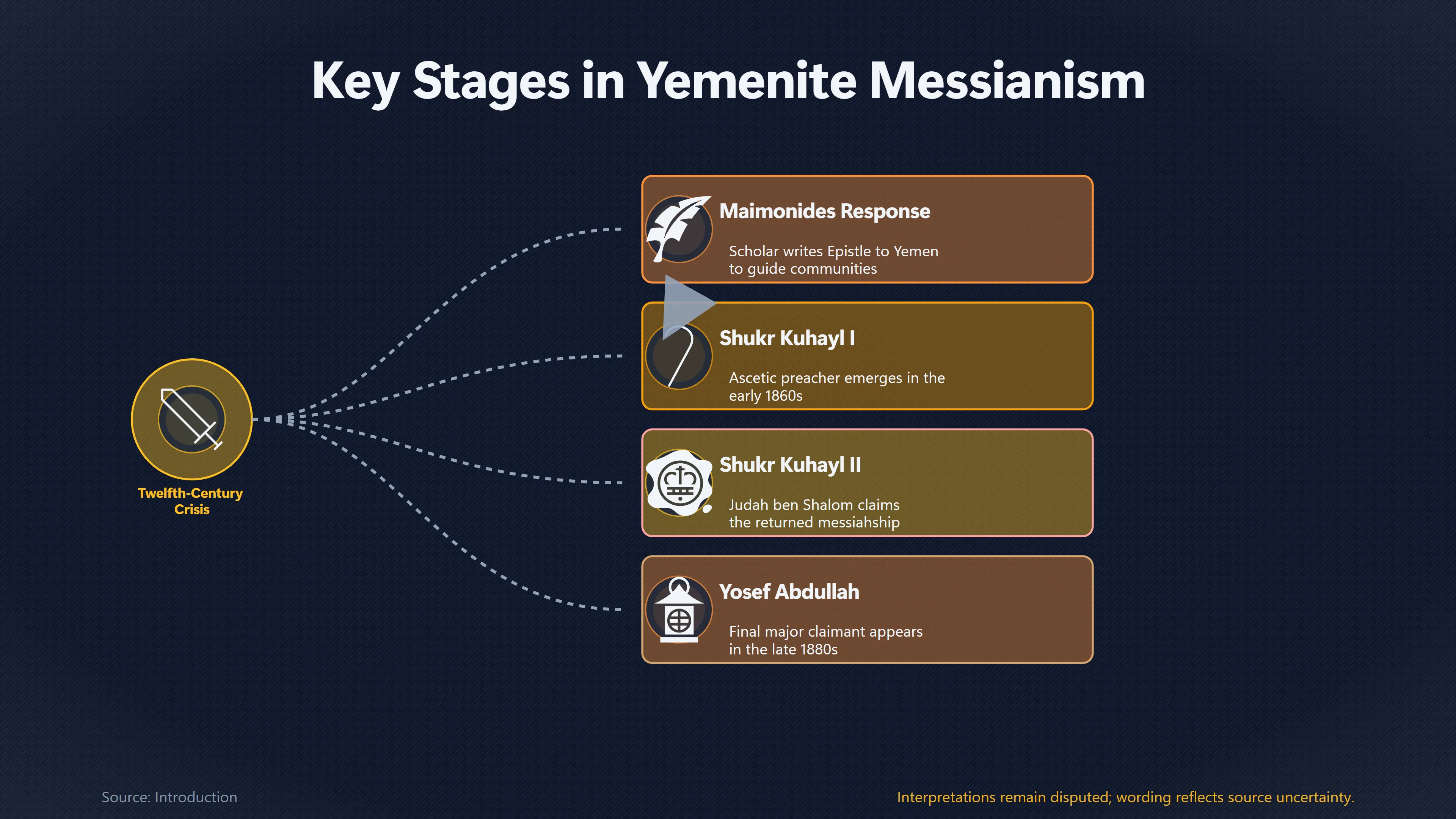
During this crisis an unnamed Jewish claimant declared himself to be a divinely chosen redeemer. According to surviving accounts, he combined elements of Jewish and Islamic teaching, argued that biblical prophecy pointed towards his own mission, and encouraged followers to believe that the age of salvation had begun. His appearance alarmed established Jewish leaders for two reasons. They questioned his religious claims, but they also feared that public excitement could provoke even harsher treatment from hostile authorities.[Wikipedia]WikipediaEpistle to YemenEpistle to Yemen
The most influential response came from the philosopher and legal scholar Maimonides, whose Epistle to Yemen was written specifically to guide Yemen’s Jewish communities through the crisis. Rather than dismissing popular hopes altogether, he acknowledged that persecution naturally encouraged longing for redemption. At the same time, he warned against accepting self-proclaimed messiahs or attempting to calculate the exact date of the world’s transformation. He argued that false certainty could damage both religious life and the physical safety of the community.[Wikipedia]WikipediaEpistle to YemenEpistle to Yemen
The episode illustrates an important distinction. The suffering that encouraged messianic expectations was entirely real. What was contested was not the existence of crisis but the claim that a particular individual represented its divinely appointed solution.
Shukr Kuhayl and the Nineteenth-Century Movements
The nineteenth century witnessed the most remarkable concentration of documented Jewish messianic claimants anywhere in the Jewish diaspora after the early modern period. Historians generally identify three major figures: Shukr Kuhayl I, Shukr Kuhayl II and Yosef Abdullah. Their appearance coincided with decades marked by political instability, economic hardship and uncertainty within Yemen itself.[Google Books]books.google.comGoogle BooksThe Jews of Yemen in the Nineteenth Century: A Portrait of a Messianic Community - B. Z. Eraqi Klorman - Google Books…
Shukr Kuhayl I
Shukr Kuhayl I first appeared in the early 1860s as an ascetic preacher who urged repentance and moral reform. Contemporary descriptions portray him as a modest craftsman who abandoned ordinary life after claiming to have received a divine calling. His message initially focused less on political revolution than on spiritual preparation for redemption.[Persée]persee.frPersée Messiahs and Rabbis: The Yemeni ExperiencePerséeMessiahs and Rabbis: The Yemeni Experience - PerséeJanuary 1, 1992…
As his reputation spread, increasing numbers of followers regarded him as the long-awaited messianic figure. Reports describe communities contributing money to support his mission and expecting dramatic divine intervention. His death in the mid-1860s did not completely extinguish these hopes, since some believers anticipated his return.[Persée]persee.frPersée Messiahs and Rabbis: The Yemeni ExperiencePerséeMessiahs and Rabbis: The Yemeni Experience - PerséeJanuary 1, 1992…
Shukr Kuhayl II
Only a few years later another claimant, Judah ben Shalom, declared himself to be the returned Shukr Kuhayl and became known to historians as Shukr Kuhayl II.
Recently published collections of letters reveal that this second movement was far more organised than once assumed. Correspondence circulated among Jewish communities throughout Yemen discussing repentance, fundraising, military expectations and diplomatic ambitions. These documents show that the movement possessed administrative structures as well as religious enthusiasm, making it much more than an isolated charismatic preacher with a handful of followers.[Bar-Ilan University]cris.biu.ac.ilBar-Ilan University The messiahship of Shukr Kuhayl II a bundle of new lettersBar-Ilan UniversityThe messiahship of Shukr Kuhayl II a bundle of new letters - Bar-Ilan University…
Followers also circulated stories of miracles and divine signs. Modern historians treat these reports as evidence for how believers understood their leader rather than as historical proof that supernatural events occurred. The miracle narratives helped reinforce commitment during a period when ordinary political circumstances offered little hope of improvement.[Bar-Ilan University]cris.biu.ac.ilBar-Ilan UniversityThe Story of Shukr Kuhayl's Messianism in Light of a New Manuscript - Bar-Ilan University…
Yosef Abdullah
The final major nineteenth-century claimant, Yosef Abdullah, emerged during the late 1880s and early 1890s. Although less extensively documented than the Shukr Kuhayl movements, his career demonstrates that expectations of imminent redemption remained powerful well into the end of the century. Together, these three movements represent the last significant cluster of traditional Jewish messianic claimants to emerge before the twentieth century transformed Jewish political and religious life in very different ways.[Google Books]books.google.comGoogle BooksThe Jews of Yemen in the Nineteenth Century: A Portrait of a Messianic Community - B. Z. Eraqi Klorman - Google Books…
Why Did Yemen Produce Repeated Messianic Movements?
Historians no longer explain these episodes simply by appealing to religious enthusiasm. Instead, they identify several interacting pressures.
First, chronic instability repeatedly disrupted everyday life. Warfare, changing rulers, economic insecurity and persecution created circumstances in which promises of divine deliverance became emotionally compelling.
Second, Yemeni religious culture already possessed rich traditions of expecting sacred renewal. Rather than inventing entirely new beliefs, charismatic leaders interpreted familiar scriptures in ways that connected ancient promises with contemporary crises.
Third, Yemen’s Jewish and Muslim communities lived in close proximity for centuries. Scholars have shown that ideas about the approaching end of history, the coming of a redeemer and apocalyptic expectation circulated across communal boundaries more than was once recognised. This did not erase religious differences, but it encouraged parallel ways of interpreting periods of upheaval.[Cambridge University Press & Assessment]cambridge.orgCambridge University Press & AssessmentJewish and Muslim Messianism in Yemen | International Journal of Middle East Studies | Cambridge C…
Finally, these movements addressed practical as well as spiritual needs. They offered explanations for suffering, restored dignity to marginalised communities and created networks of mutual support through preaching, correspondence and shared expectation.
Why Followers, Clerics and Authorities Responded Differently
Not everyone reacted in the same way to these claimants.
Many ordinary believers found the movements persuasive because they seemed to make sense of lived experience. Years of hardship appeared to confirm scriptural expectations that redemption would emerge only after severe trials.
Religious scholars adopted more varied positions. Some rabbis viewed certain claimants sympathetically, particularly when they emphasised repentance and ethical reform. Others feared that failed prophecies would weaken faith or provoke dangerous reactions from political authorities. Research into nineteenth-century Yemen suggests that rabbinic responses ranged from cautious support to determined opposition, depending on each claimant’s teachings and behaviour.[Persée]persee.frPersée Messiahs and Rabbis: The Yemeni ExperiencePerséeMessiahs and Rabbis: The Yemeni Experience - PerséeJanuary 1, 1992…
Political authorities generally evaluated these movements less by their theology than by their potential to disturb public order. Any rapidly expanding religious movement could be interpreted as a possible source of rebellion or instability, especially during periods when government control was already fragile.

What These Movements Reveal About Crisis and Collective Belief
The Yemeni examples are better understood as crisis-driven religious movements than as episodes of mass hysteria. Their followers responded to genuine insecurity, persecution and political collapse by drawing upon long-established religious expectations rather than abandoning reason altogether.
They also remind historians to distinguish carefully between belief and pathology. A community facing violence or discrimination may sincerely interpret events through sacred traditions without those beliefs constituting irrational panic. The more useful historical question is why particular claims became convincing at particular moments.
For that reason, Yemen occupies an important place in the comparative history of messianic movements. Across both the twelfth-century crisis addressed by Maimonides and the remarkable succession of nineteenth-century claimants, the recurring pattern was not blind credulity but the search for meaning, justice and hope during periods when ordinary political life appeared incapable of delivering either.[cambridge.org]cambridge.orgCambridge University Press & AssessmentJewish and Muslim Messianism in Yemen | International Journal of Middle East Studies | Cambridge C…
Amazon book picks
Further Reading
Books and field guides related to Why Did Messiahs Keep Appearing in Yemen?. Use these as the next step if you want deeper reading beyond the article.
The Varieties of Religious Experience
Provides a framework for understanding intense religious experiences.


The Jews of Arab Lands in Modern Times
First published 1991. Subjects: Jews, Ethnic relations, Sources, Zionism, Jewish-Arab relations.
Extraordinary Popular Delusions and the Madness of Crowds
Rating: 4.0/5 from 5 Google Books ratings
First published in 1841, Extraordinary Popular Delusions and the Madness of Crowds is often cited as the best book ever written about mar...
Endnotes
1.
Source: cambridge.org
Link:https://www.cambridge.org/core/journals/international-journal-of-middle-east-studies/article/abs/jewish-and-muslim-messianism-in-yemen/D79E19A5BEDD28755C314B6E87D3772A
Source snippet
Cambridge University Press & AssessmentJewish and Muslim Messianism in Yemen | International Journal of Middle East Studies | Cambridge C...
2.
Source: books.google.com
Link:https://books.google.com/books?id=CW-C4yivlqwC&lr=
Source snippet
Google BooksThe Jews of Yemen in the Nineteenth Century: A Portrait of a Messianic Community - B. Z. Eraqi Klorman - Google Books...
3.
Source: Wikipedia
Title: Epistle to Yemen
Link:https://en.wikipedia.org/wiki/Epistle_to_Yemen
4.
Source: play.google.com
Title: Eraqi Klorman The Jews of Yemen in the Nineteenth
Link:https://play.google.com/store/books/details/Eraqi_Klorman_The_Jews_of_Yemen_in_the_Nineteenth?id=lgMVEQAAQBAJ
5.
Source: cambridge.org
Link:https://www.cambridge.org/core/journals/ajs-review/article/abs/identity-of-the-apostate-in-the-epistle-to-yemen/50A61961F3518D19189AEB64ADBDFB33
6.
Source: persee.fr
Title: Persée Messiahs and Rabbis: The Yemeni Experience
Link:https://www.persee.fr/doc/rjuiv_0484-8616_1992_num
Source snippet
PerséeMessiahs and Rabbis: The Yemeni Experience - PerséeJanuary 1, 1992...
Published: January 1, 1992
7.
Source: cris.biu.ac.il
Link:https://cris.biu.ac.il/en/publications/the-story-of-shukr-kuhayls-messianism-in-light-of-a-new-manuscrip-3/
Source snippet
Bar-Ilan UniversityThe story of shukr kuhayl’s messianism in light of a new manuscript - Bar-Ilan University...
8.
Source: cris.biu.ac.il
Title: Bar-Ilan University The messiahship of Shukr Kuhayl II a bundle of new letters
Link:https://cris.biu.ac.il/en/publications/the-messiahship-of-shukr-kuhayl-ii-a-bundle-of-new-letters-a-bund/
Source snippet
Bar-Ilan UniversityThe messiahship of Shukr Kuhayl II a bundle of new letters - Bar-Ilan University...
9.
Source: cris.biu.ac.il
Link:https://cris.biu.ac.il/en/publications/the-story-of-shukr-kuhayls-messianism-in-light-of-a-new-manuscrip/
Source snippet
Bar-Ilan UniversityThe Story of Shukr Kuhayl's Messianism in Light of a New Manuscript - Bar-Ilan University...
10.
Source: thetelos.org
Title: Epistle to Yemen (Iggeret Teiman)
Link:https://thetelos.org/epistle-to-yemen-iggeret-teiman-maimonides/
Source snippet
Maimonides - The TelosJune 10, 2026 — Maimonides Epistle to Yemen History of Philosophy Judaism Philosophy of religion EPISTLE TO YEMEN (...
Published: June 10, 2026
11.
Source: en.wikisource.org
Link:https://en.wikisource.org/wiki/Epistle_to_Yemen/Introduction
12.
Source: en.wikisource.org
Title: Epistle to Yemen
Link:https://en.wikisource.org/wiki/Epistle_to_Yemen
13.
Source: a.osmarks.net
Title: Epistle to Yemen
Link:https://a.osmarks.net/content/wikipedia_en_all_maxi_2020-08/A/Epistle_to_Yemen
Additional References
14.
Source: youtube.com
Title: Epistle to Yemen – Maimonides on Persecution and False Messiahs
Link:https://www.youtube.com/watch?v=-hN67b04cEA
Source snippet
The FALSE Messiah Who Fooled the Ancient World...
15.
Source: youtube.com
Title: The Epistle to Yemen
Link:https://www.youtube.com/watch?v=t6aCdk5QtBM
Source snippet
Epistle to Yemen – Maimonides on Persecution and False Messiahs...
16.
Source: academic.oup.com
Link:https://academic.oup.com/book/61809/chapter/546661761
Source snippet
the Kingdom of Sheba: The Yemeni Jews | Jews from Elsewhere: Forgotten Diasporas and Singular Jewish Identities | Oxford AcademicJanuary...
17.
Source: youtube.com
Title: The FALSE Messiah Who Fooled the Ancient World
Link:https://www.youtube.com/watch?v=hlgtya4w9XQ
Source snippet
Messiah, Mahdi and End Times in Islam: An Intra-Faith Dialogue...
18.
Source: nli.org.il
Link:https://www.nli.org.il/en/articles/RAMBI990000395480705171/NLI
Source snippet
National Library of IsraelThe attitudes of Yemenite rabbis towards 19th century Jewish messianic figures | Article | RAMBI990000395480705...
19.
Source: encyclopedia.com
Link:https://www.encyclopedia.com/religion/encyclopedias-almanacs-transcripts-and-maps/jacob-ben-nethanel-ben-fayyumi
20.
Source: allbookstores.com
Link:https://www.allbookstores.com/The-Jews-Yemen-Nineteenth-Century/9789004096844
21.
Source: everything.explained.today
Link:https://everything.explained.today/Epistle_to_Yemen/
22.
Source: researchgate.net
Title: 298130649 The messiahship of Shukr Kuhayl II a bundle of new letters
Link:https://www.researchgate.net/publication/298130649_The_messiahship_of_Shukr_Kuhayl_II_a_bundle_of_new_letters
23.
Source: dergipark.org.tr
Title: Arabic Original of Maimonides’ Epistle to Yemen in Arabic Letters
Link:https://dergipark.org.tr/en/pub/auifd/article/487781
Topic Tree