When Belief Became a Threat in Moldova
Moldova’s history of collective belief and social fear is not dominated by a single famous witch hunt or outbreak of mass psychogenic illness.
Page outline Jump by section
Introduction
These episodes matter because the label attached to a group often tells only half the story. Some movements genuinely made extraordinary supernatural claims. Others were treated as threatening because they resisted state authority, rejected an established church or appeared culturally foreign. Moldova therefore offers less a history of inexplicable “mass hysteria” than a history of contagious hope, institutional fear and repeated struggles over who may define legitimate belief.
Inochentism: Moldova’s great apocalyptic movement
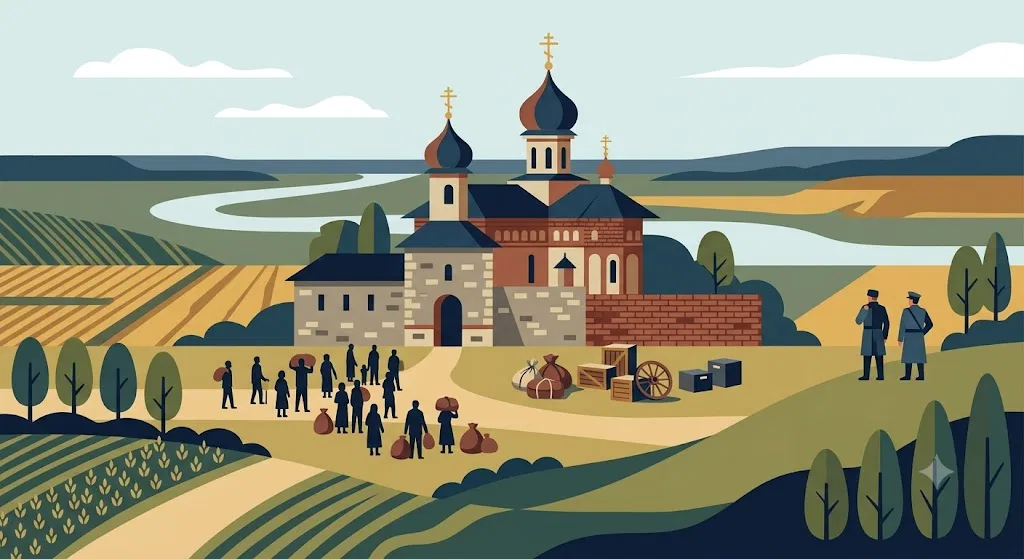
The clearest Moldovan example of a millenarian movement is Inochentism, which arose among Romanian-speaking peasants of Bessarabia in the final years of the Russian Empire. Millenarian movements anticipate a dramatic transformation of the world, often through divine intervention, the defeat of evil or the arrival of a sacred age.
Its founder, Ioan Levizor, was born in what is now Moldova and became an Orthodox monk under the name Inochenție. From about 1908, he preached in the local vernacular rather than relying solely on the church language used by the imperial religious hierarchy. He warned that the end times were approaching, attracted a reputation as a healer and miracle-worker, and gathered large numbers of followers from Bessarabia and neighbouring parts of present-day Ukraine.[dacoromania.net]dacoromania.netInochentie Levizor and his Moldovan Followers | DacoromaniaMoldovan monk Inochentie (loan Levizor, 1875-1917) began to preach the imminen…
The movement’s centre developed around Balta, now in Ukraine but then closely connected to the Moldovan communities of Bessarabia. Admirers regarded Inochenție as a uniquely inspired holy man; some eventually identified him with the Holy Spirit or assigned him a central role in the coming divine order. Pilgrims travelled long distances to hear him, seek cures and prepare for the approaching upheaval. A community promoted as a “New Jerusalem” formed around his mission, complete with underground religious spaces and an intense expectation that ordinary history was nearing its end.[wikipedia.org]WikipediaOpen source on wikipedia.org.
Several forces help explain the movement’s appeal. Bessarabia was a poor and overwhelmingly rural imperial borderland in which many Romanian-speaking peasants felt distant from Russian-speaking institutions. Inochenție offered preaching in language they understood, a sacred role for people usually excluded from power and an explanation for hardship that promised both justice and transformation. Some historians therefore interpret Inochentism not simply as credulity, but as a form of grassroots religious and cultural expression among communities living under alienating political conditions.[Wikipedia]WikipediaOpen source on wikipedia.org.
From pilgrimage to “psychosis”
The rapid growth of the movement alarmed both the Orthodox hierarchy and the imperial authorities. Officials feared gatherings they could not supervise, teachings that departed from church doctrine and the possibility that followers would abandon farms, property or ordinary obligations while awaiting the end of the world.
Medical and administrative investigators described the excitement around Balta in the language of pathology. Contemporary observers spoke of a “Balta psychosis”, while church authorities accused Inochenție of spreading nervous illness, demonic influence and social disorder. Psychiatrists proposed explanations ranging from malnutrition and emotional suggestion to ignorance and manipulation by religious leaders. Such language reflected the assumptions of the period: peasant enthusiasm outside official religion was easily classified as sickness rather than understood as a political or spiritual response to social strain.[Wikipedia]WikipediaOpen source on wikipedia.org.
Inochenție was removed, arrested and exiled, yet his absence initially intensified the commitment of some believers. Hundreds reportedly sold possessions or attempted to follow him into northern Russia. After his death in 1917, the movement fragmented but did not disappear. Followers continued meeting secretly, adapting their beliefs to repeated changes of state power across Bessarabia, Romania, Soviet Ukraine and the Moldavian Soviet Socialist Republic.[Wikipedia]WikipediaOpen source on wikipedia.org.
This is why “mass hysteria” is an inadequate description. The movement certainly involved emotional contagion, miracle reports and apocalyptic expectation. But it also had organised communities, enduring rituals and a social constituency. Calling it a temporary collective delusion obscures the fact that adherents maintained their religious identity for generations.

How states turned minority religions into “dangerous sects”
Under Soviet rule, authorities routinely described independent religious communities as backward, fanatical, criminal or anti-state. “Sect” was not merely a theological category. It became an administrative accusation that could justify surveillance, propaganda, arrest, confiscation and deportation.
Inochentists were particularly vulnerable because their underground organisation, apocalyptic heritage and resistance to official religious structures made them appear politically unreliable. Soviet security reports depicted their leaders as reactionaries who obstructed collectivisation and encouraged peasants to withhold produce. From the late 1940s, leaders received labour-camp sentences, meeting places were closed and the number of openly active followers declined sharply. Research on the movement shows that repression continued in different forms well into the Soviet period.[wikipedia.org]WikipediaOpen source on wikipedia.org.
Yet conduct portrayed as uniquely “sectarian” often overlapped with wider peasant resistance to forced agricultural policies. The accusation worked by converting economic disobedience and religious independence into proof of irrational fanaticism. In this sense, the panic was primarily institutional: security officials treated small religious networks as evidence of a hidden political danger.
Operation North and the Jehovah’s Witnesses
The most severe example was the Soviet campaign against Jehovah’s Witnesses. Their refusal of military service, political neutrality, international organisation and rejection of state-directed religious life made them especially suspect. Soviet propaganda presented them as an “anti-Soviet sect” controlled from abroad, a claim that turned ordinary religious practices into alleged espionage or ideological sabotage.[Carolina Digital Repository]cdr.lib.unc.eduOpen source on unc.edu.
During Operation North in April 1951, Soviet security forces deported Jehovah’s Witnesses and members of their families from several western republics to remote settlements in Siberia. Moldavia was one of the principal targets. Historical accounts place the number removed from the Moldavian Soviet Socialist Republic at more than 2,500 people, including children and relatives who were punished through association rather than for any individually proven offence. Homes and belongings were confiscated, and families were classified as special settlers.[wikipedia.org]WikipediaOperation NorthOperation North
This episode should not be described as a spontaneous public panic. It was a state-manufactured scare, produced through files, surveillance reports and ideological propaganda. The authorities began with the assumption that an unauthorised transnational religion must be politically subversive, then treated secrecy forced upon its members by persecution as further evidence of conspiracy.
The deportations also show the danger of using the word “cult” as though it were a neutral diagnosis. Soviet officials did not need to demonstrate systematic coercion, abuse or violence within the group. The label itself made mass punishment appear protective rather than persecutory.
Falun Dafa and the danger of judging a symbol
Independent Moldova inherited both religious diversity and habits of suspicion developed under earlier regimes. One revealing case involved two registered Falun Dafa associations, whose spiritual practice combines meditation, physical exercises and moral teaching.
The organisations used an emblem incorporating an ancient Asian symbol that resembles a reversed swastika. Moldovan courts banned the emblem under extremism legislation in 2014 and subsequently dissolved the associations. The decision treated visual resemblance to a Nazi symbol as sufficient grounds for suppression, even though the applicants argued that their emblem came from a much older religious tradition and carried an entirely different meaning.[coe.int]hudoc.echr.coe.intOpen source on coe.int.
In 2021, the European Court of Human Rights ruled against Moldova. The case illustrates how genuine historical sensitivity can slide into a symbolic panic: authorities responded to the appearance of an image while failing to assess its context, purpose or actual likelihood of encouraging extremist violence.[HUDOC]hudoc.echr.coe.intOpen source on coe.int.
The distinction is important. Nazi propaganda and antisemitic intimidation are real harms. But banning an unrelated religious association because one element of its traditional imagery looks disturbing to European eyes does not necessarily address those harms. It may instead encourage the assumption that an unfamiliar group is dangerous simply because its symbolism is easy to misunderstand.
The pandemic as an apocalyptic information crisis
COVID-19 produced Moldova’s clearest recent collision between public-health fear, religious authority and conspiracy belief. In May 2020, the Moldovan Orthodox Church publicly circulated claims that a future coronavirus vaccine formed part of an anti-Christian global scheme. Its statement connected vaccination with microchip implantation, remote human control and the coming of the Antichrist. The church later distanced itself from some of the language, but the episode gave extraordinary claims the authority of a major national institution.[RadioFreeEurope/RadioLiberty]rferl.orgOpen source on rferl.org.
The narrative was powerful because it combined several established fears:
- Loss of bodily control: vaccination was imagined not as medicine but as forced technological penetration.
- Religious apocalypse: public-health measures became signs of the Antichrist rather than temporary emergency policies.
- Foreign manipulation: international institutions and wealthy global figures were presented as secret directors of the crisis.
- Distrust of government: weak confidence in political and medical institutions made alternative explanations more persuasive.
By 2021, Orthodox priests and monks were visibly involved in anti-vaccination demonstrations in Chișinău. International religious-freedom reporting and regional studies of pandemic extremism noted the strong religious component in Moldova’s conspiracy narratives and public protests.[State.gov]2021-2025.state.govOpen source on state.gov.
This was a moral and informational panic rather than a mass psychogenic illness. Believers did not merely copy physical symptoms from one another. They shared an explanatory story in which vaccination, digital technology, foreign power and biblical prophecy formed one concealed system. Social media allowed separate rumours to reinforce one another until they appeared to provide mutual confirmation.
The harm was not confined to incorrect belief. When trusted clergy framed medical intervention as spiritual surrender, an ordinary risk calculation became a test of religious loyalty. Public-health authorities then faced a problem that statistics alone could not solve: reassurance about vaccine safety did not directly answer the fear that accepting vaccination might place a person on the wrong side of an apocalyptic struggle.
“Traditional values” and recurring invasion scares
Pandemic conspiracies fit a wider Moldovan pattern in which social change is represented as an organised attack on faith, family and national identity. Political and religious actors have repeatedly warned that closer relations with the European Union will force Moldova to abandon Christianity, accept foreign control or submit to an imposed sexual ideology.
Claims about LGBTQ+ rights have been particularly useful in this form of mobilisation. Rather than debating specific laws, campaigners often describe equality measures as proof of a comprehensive plan to destroy the family, silence believers or erase Moldovan identity. Fact-checkers and European institutions have documented similar narratives spreading through Moldova and the wider region, frequently amplified by pro-Kremlin media networks.[euvsdisinfo.eu]euvsdisinfo.eunato forcing lgbtiq agenda on moldova and other countriesnato forcing lgbtiq agenda on moldova and other countries
The mechanism resembles a classic moral panic. A minority becomes a symbol of much larger anxieties: migration, demographic decline, economic insecurity, distrust of elites and uncertainty about Moldova’s position between Russia and the European Union. Political entrepreneurs then present themselves as defenders of ordinary people against an allegedly coordinated moral invasion.
Investigations before Moldova’s 2025 parliamentary election found that newly created parish-linked Telegram channels repeatedly circulated warnings that European integration threatened religion and family life. Reuters reported evidence that Moldovan clergy had been offered Russian-funded trips, bank cards and assistance in building social-media channels, while church representatives denied that the activity amounted to political interference.[Reuters]reuters.comHoly war: How Russia recruited Orthodox priests to sway Moldova's votersAlmost 90 Telegram channels were launched by Moldovan parishes, spreading messages against Western values and echoing pro-Russian opposit…
The controversy should not be reduced to a simple story of gullible believers. Moldova has genuine geopolitical vulnerabilities, competing church jurisdictions and deep disagreement about national identity. Effective scare narratives work precisely because they attach invented plots to real uncertainty. The falsehood is usually not that social change exists, but that every change is the visible edge of one hostile and centrally directed plan.
What Moldova’s history does—and does not—show
There is little strong evidence that the territory of present-day Moldova experienced the kind of large, systematic witch persecution associated with parts of early modern western and central Europe. Research on the wider historical principality of Moldavia identifies isolated witchcraft proceedings, but not an extensive regional witch-hunting machinery comparable with the most notorious European cases.[nationalmuseum.md]nationalmuseum.mdOpen source on nationalmuseum.md.
Belief in magic, curses, healing and supernatural intervention certainly formed part of local popular culture. That fact should not be converted into claims of undocumented witch crazes. Folklore records what people imagined, feared or practised; a witch panic requires further evidence of escalating accusation, collective mobilisation or institutional punishment.
Likewise, Moldova lacks a well-established, widely studied national case of mass psychogenic illness on the scale of famous school fainting or factory-sickness outbreaks elsewhere. The absence is meaningful. It suggests that Moldova’s most important contribution to the history of contagious belief lies in different mechanisms:
Charismatic expectation. Inochentism spread through preaching, pilgrimage, healing reports and the promise that marginalised peasants had a central place in sacred history.
Official threat construction. Soviet institutions transformed independent believers into conspirators and made religious identity grounds for deportation.
Symbolic misrecognition. The Falun Dafa case showed how authorities could mistake unfamiliar sacred imagery for extremist propaganda.
Networked conspiracy. Pandemic and culture-war scares spread by connecting medical uncertainty and political conflict to older apocalyptic stories.
These are related phenomena, but they are not interchangeable. An apocalyptic movement is not automatically a harmful cult. A persecuted minority is not evidence of mass delusion. A conspiracy theory is not the same as a stress-induced illness. A state scare can cause more damage than the belief it claims to suppress.
Why these episodes still matter
Moldova’s position between political, linguistic and ecclesiastical worlds has repeatedly made religion a field in which wider conflicts are expressed. Under the Russian Empire, Bessarabian peasants used a charismatic movement to claim spiritual importance. Under Soviet rule, the state treated religious independence as political treason. In contemporary Moldova, rival geopolitical projects use Christian language to define Europe or Russia as either protector or existential threat.
The recurring danger is not unusual belief by itself. It is the collapse of distinctions: between dissent and conspiracy, symbolism and incitement, medical uncertainty and supernatural plotting, minority practice and social menace. Once those categories merge, punishment can be justified before evidence is examined.
Moldova’s history therefore rewards careful language. “Cult”, “sect”, “psychosis” and “extremism” have all been used by institutions with interests of their own. Some groups deserve scrutiny where there is evidence of coercion, fraud or violence. But the strongest documented Moldovan cases show that hostile labelling has often preceded proof—and, at times, has helped create the very fear that authorities claimed merely to be managing.
Amazon book picks
Further Reading
Books and field guides related to When Belief Became a Threat in Moldova. Use these as the next step if you want deeper reading beyond the article.
When Prophecy Fails
Provides the classic framework for understanding committed belief after failed predictions.
Cults in Our Midst
Helps readers understand public concern about new religious movements.
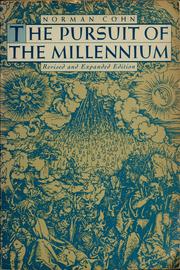
The pursuit of the millennium
Explains recurring patterns in millenarian belief central to Moldova's religious history.
A History of Eastern Europe
Places Moldovan religious developments within wider Eastern European history.
Endnotes
1.
Source: dacoromania.net
Link:https://dacoromania.net/article/apocalypticism_russian_borderlands_inochentie_levizor_and_his_moldovan_followers
Source snippet
Inochentie Levizor and his Moldovan Followers | DacoromaniaMoldovan monk Inochentie (loan Levizor, 1875-1917) began to preach the imminen...
2.
Source: Wikipedia
Link:https://en.wikipedia.org/wiki/Inochentism
3.
Source: hiddengalleries.eu
Title: item set
Link:https://hiddengalleries.eu/digitalarchive/s/en/item-set/179
Source snippet
Inochentism · Hidden Galleries Digital ArchiveInochentie was exiled to the Russian far north from 1913 to 1917 during which time his foll...
4.
Source: cultural-opposition.eu
Link:https://cultural-opposition.eu/courage/individual/n48651
Source snippet
Gheorghe Zgherea Collection at SIS Archive MoldovaIt focuses on the case of Gheorghe Zgherea, a person of peasant background who was a me...
5.
Source: Wikipedia
Title: Operation North
Link:https://en.wikipedia.org/wiki/Operation_North
6.
Source: md.mfa.lt
Title: new collection of testimonies archives of memory look into history of 1950s:467
Link:https://md.mfa.lt/en/news/69/new-collection-of-testimonies-archives-of-memory-look-into-history-of-1950s%3A467
7.
Source: 2021-2025.state.gov
Link:https://2021-2025.state.gov/reports/2021-report-on-international-religious-freedom/moldova/
8.
Source: euvsdisinfo.eu
Title: nato forcing lgbtiq agenda on moldova and other countries
Link:https://euvsdisinfo.eu/report/nato-forcing-lgbtiq-agenda-on-moldova-and-other-countries/
9.
Source: reuters.com
Title: Holy war: How Russia recruited Orthodox priests to sway Moldova’s voters
Link:https://www.reuters.com/investigations/holy-war-how-russia-recruited-orthodox-priests-sway-moldovas-voters-2025-09-26/
Source snippet
Almost 90 Telegram channels were launched by Moldovan parishes, spreading messages against Western values and echoing pro-Russian opposit...
10.
Source: nationalmuseum.md
Link:https://www.nationalmuseum.md/en/press_releases/journal_tyragetia/witchcraft_at_romanians_documents_of_witchcraft_trials_in_transylvania_of_the_16th_17th_centuries/
11.
Source: Wikipedia
Title: List of mass panic cases
Link:https://en.wikipedia.org/wiki/List_of_mass_panic_cases
12.
Source: Wikipedia
Title: Satanic panic
Link:https://en.wikipedia.org/wiki/Satanic_panic
13.
Source: Wikipedia
Title: Old Believers
Link:https://en.wikipedia.org/wiki/Old_Believers
14.
Source: Wikipedia
Title: Anti cult movement
Link:https://en.wikipedia.org/wiki/Anti-cult_movement
15.
Source: Wikipedia
Link:https://en.wikipedia.org/wiki/Bessarabia
16.
Source: Wikipedia
Title: USSR anti religious campaign (1928–1941)
Link:https://en.wikipedia.org/wiki/USSR_anti-religious_campaign_%281928%E2%80%931941%29
17.
Source: 2009-2017.state.gov
Link:https://2009-2017.state.gov/j/drl/rls/irf/2009/127325.htm
18.
Source: state.gov
Link:https://www.state.gov/reports/2023-report-on-international-religious-freedom/ukraine
19.
Source: state.gov
Link:https://www.state.gov/reports/2023-report-on-international-religious-freedom/austria
20.
Source: 2021-2025.state.gov
Link:https://2021-2025.state.gov/report/custom/595918cc4e/
21.
Source: 2021-2025.state.gov
Link:https://2021-2025.state.gov/report/custom/9553a22472/
22.
Source: 2021-2025.state.gov
Link:https://2021-2025.state.gov/report/custom/871744e09e/
23.
Source: 2009-2017.state.gov
Link:https://2009-2017.state.gov/j/drl/rls/irf/2003/27185.htm
24.
Source: 2017-2021.state.gov
Link:https://2017-2021.state.gov/report/custom/3aaf1aaa13/
25.
Source: state.gov
Link:https://www.state.gov/reports/2022-report-on-international-religious-freedom/austria
26.
Source: state.gov
Link:https://www.state.gov/report/custom/581d222458
27.
Source: 2021-2025.state.gov
Link:https://2021-2025.state.gov/reports/2017-report-on-international-religious-freedom/moldova/
28.
Source: context.news
Title: before moldova vote anti lgbtq content spikes online
Link:https://www.context.news/big-tech/before-moldova-vote-anti-lgbtq-content-spikes-online
29.
Source: hiddengalleries.eu
Link:https://hiddengalleries.eu/digitalarchive/s/en/item-set
30.
Source: GOV.UK
Link:https://www.gov.uk/government/news/reforms-to-secure-british-borders-to-be-agreed-by-foreign-ministers-in-moldova-this-week
31.
Source: committees.parliament.uk
Link:https://committees.parliament.uk/publications/52401/documents/290829/default/
32.
Source: scholarlypublishingcollective.org
Title: The Inochentism Faith Ritual Practices and Sacred
Link:https://scholarlypublishingcollective.org/psup/hiperboreea/article/7/2/197/196795/The-Inochentism-Faith-Ritual-Practices-and-Sacred
Source snippet
Scholarly Publishing CollectiveThe Inochentism: Faith, Ritual Practices, and Sacred...30 Nov 2020 — This religious movement took place b...
33.
Source: cdr.lib.unc.edu
Link:https://cdr.lib.unc.edu/concern/dissertations/nz806090m
34.
Source: hudoc.echr.coe.int
Link:https://hudoc.echr.coe.int/eng?i=001-210690
35.
Source: spcommreports.ohchr.org
Title: Down Load Public Communication File
Link:https://spcommreports.ohchr.org/TMResultsBase/DownLoadPublicCommunicationFile?gId=17083
36.
Source: rferl.org
Link:https://www.rferl.org/a/moldova-s-orthodox-church-lashes-out-at-anti-christ-plot-to-develop-virus-vaccine/30624250.html
37.
Source: europarl.europa.eu
Title: EXPO BRI(2021)653644 EN
Link:https://www.europarl.europa.eu/RegData/etudes/BRIE/2021/653644/EXPO_BRI%282021%29653644_EN.pdf
38.
Source: ebsco.com
Link:https://www.ebsco.com/research-starters/social-sciences-and-humanities/mass-hysteria
39.
Source: sk.sagepub.com
Title: millenarian movements
Link:https://sk.sagepub.com/ency/edvol/globalreligion/chpt/millenarian-movements
40.
Source: jw.org
Link:https://www.jw.org/en/library/books/2004-Yearbook-of-Jehovahs-Witnesses/Moldova/
41.
Source: venice.coe.int
Link:https://www.venice.coe.int/webforms/documents/default.aspx?pdffile=CDL-AD%282022%29026-e
42.
Source: bactra.org
Link:https://bactra.org/notebooks/millenarian.html
43.
Source: abcnews.com
Link:https://abcnews.com/International/russias-mysterious-campaign-jehovahs-witnesses/story?id=78629389
Additional References
44.
Source: api.pageplace.de
Link:https://api.pageplace.de/preview/DT0400.9781317116264_A37415262/preview-9781317116264_A37415262.pdf
Source snippet
Inochentism and Orthodox ChristianityInochentism, a controversial new religious movement that emerged in the Russian and Romania...
45.
Source: cora.ucc.ie
Link:https://cora.ucc.ie/bitstreams/6e1bd9ab-67cf-4cb3-b0c5-82456306f7b8/download
Source snippet
Operations against Inochentism in Soviet Ukraine, 1920-23by D Lisnic · 2021 · Cited by 1 — repressive policies against this religious gro...
46.
Source: govinfo.gov
Link:https://www.govinfo.gov/content/pkg/CPRT-108JPRT20429/html/CPRT-108JPRT20429.htm
47.
Source: uscirf.gov
Link:https://www.uscirf.gov/publication/anti-cult-movement-and-religious-regulation-russia-and-former-soviet-union
48.
Source: academia.edu
Link:https://www.academia.edu/17738911/KGB_ARCHIVES_Operation_NORTH_Deportation_of_the_Jehovas_Witnesses_from_Moldavian_SSR_1951
49.
Source: iep-berlin.de
Link:https://iep-berlin.de/site/assets/files/2083/informd_study_against_disinformation_in_moldova.pdf
50.
Source: facebook.com
Link:https://www.facebook.com/CBCPodcasts/posts/all-7-episodes-of-uncover-satanic-panic-are-now-outlearn-how-fears-of-satanic-cu/1536646486484322/
51.
Source: sacc-ejc.org
Link:https://sacc-ejc.org/incident/an-extremist-sect-has-reportedly-emerged-in-moldova-in-the-hincesti-district-and-to-date-over-500-people-are-said-to-be-part-of-it/
52.
Source: crpe.ro
Link:https://crpe.ro/eapfakes/countries/moldova/anti-vaccination-hysteria-moldova/
53.
Source: fieldepidemiology.org
Link:https://fieldepidemiology.org/index.php/ajfe/article/download/7807/6435/21437
Topic Tree
Follow this branch
Related pages 192
- Antigua and Barbuda
- Argentina Belief Scares
- Azerbaijan Belief
- Bahrain Beliefs
- North Korea
- +187 more in sidebar