Within Bahrain Beliefs
How the Qarmatians Built an Apocalyptic State
The Qarmatians turned apocalyptic expectation into state power, warfare and a disastrous attempt to recognise a promised redeemer.
On this page
- From missionary movement to regional state
- The attack on Mecca and seizure of the Black Stone
- The failed messiah and the movement's survival
Page outline Jump by section
Introduction
The Qarmatian state was one of the most unusual political and religious experiments in medieval Islamic history. Emerging from revolutionary Ismaili missionary networks, it established an independent state across much of eastern Arabia, centred on the region then known as Bahrain. Its leaders did not merely oppose the Abbasid Caliphate militarily. They believed they were living at the threshold of a new age in which the existing religious and political order would be swept away and replaced by divine rule. That expectation culminated in one of history’s most dramatic failed messianic episodes, when the Qarmatian ruler Abu Tahir al-Jannabi recognised a young Persian as the promised redeemer in 931. Within months, the experiment collapsed into violence, forcing the movement to execute the man it had proclaimed as its saviour. The episode remains one of the clearest historical examples of an apocalyptic movement confronting the consequences of a failed prophecy.[Iranica Online]iranicaonline.orgIranica Online CARMATIANSIranica OnlineCARMATIANS - Encyclopaedia IranicaDecember 15, 1990…

From missionary movement to regional state
The Qarmatians were not a small, isolated sect but a revolutionary movement that combined religious preaching, military organisation and state-building. They emerged from Ismaili missionary activity during the late ninth century but gradually developed doctrines and institutions that distinguished them from both the Abbasids and the rising Fatimid movement.
Their founder in eastern Arabia, Abu Sa’id al-Jannabi, built a durable political system centred on al-Ahsa. Medieval “Bahrain” referred to a much larger region than today’s island kingdom, covering much of the eastern Arabian coast. From this base, the Qarmatians collected taxes, organised agriculture, maintained armies and controlled major trade and pilgrimage routes. Contemporary observers describe an unusually disciplined state with communal features, although many surviving descriptions come from hostile opponents and must therefore be treated carefully.[The Institute of Ismaili Studies]iis.ac.ukThe Institute of Ismaili Studies CarmatiansThe Institute of Ismaili Studies Carmatians
What made the state distinctive was the way political power and apocalyptic belief reinforced one another. Rather than waiting passively for divine intervention, Qarmatian leaders believed they were helping to bring about the transition to a transformed world. Military victories appeared to confirm that history itself was moving in their favour.
This combination of revolutionary expectation and effective government allowed the movement to survive far longer than many other millenarian movements. Instead of collapsing after an initial uprising, it ruled large parts of eastern Arabia for more than a century.
Why apocalyptic belief mattered
The Qarmatians expected the arrival of a divinely guided figure who would inaugurate a new era. Like many millenarian movements, they did not simply predict catastrophe. They anticipated the end of the existing religious order and the revelation of deeper spiritual truths that would replace established law.
This expectation had practical consequences.
- Military expansion became evidence that prophecy was unfolding.
- Opposition from the Abbasid Caliphate confirmed, rather than weakened, the belief that the old order was collapsing.
- Existing religious institutions could be challenged because they were seen as temporary features of a passing age.
- Political authority became closely tied to recognising and preparing for the expected redeemer.[The Institute of Ismaili Studies]iis.ac.ukThe Institute of Ismaili Studies CarmatiansThe Institute of Ismaili Studies Carmatians
Historians caution that reconstructing Qarmatian beliefs is difficult because almost all surviving accounts were written by enemies. Nevertheless, there is broad agreement that messianic expectation formed one of the movement’s defining characteristics.
The attack on Mecca and seizure of the Black Stone
The most famous demonstration of Qarmatian confidence came under Abu Tahir al-Jannabi.
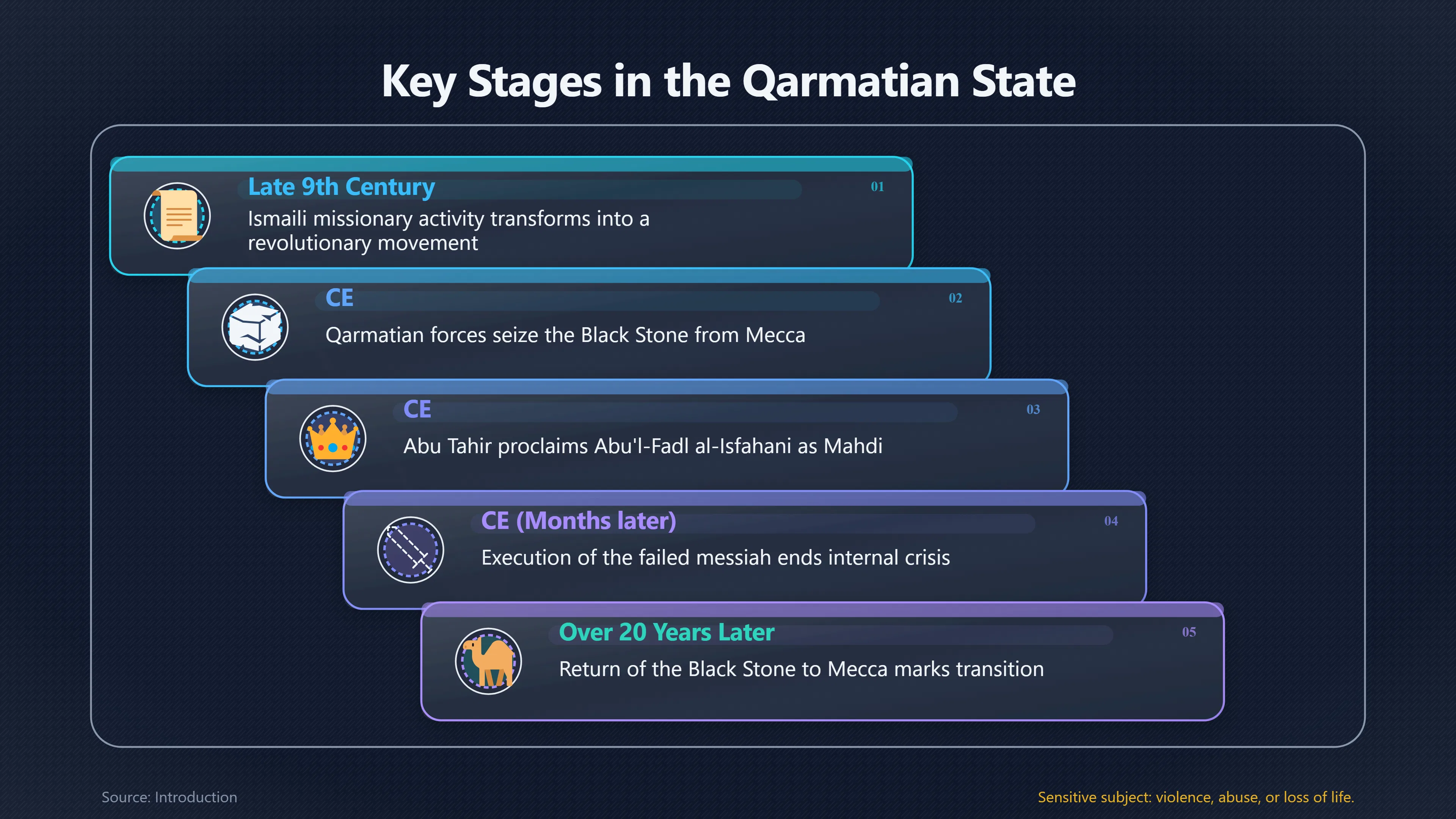
In 930, Qarmatian forces attacked Mecca during the pilgrimage season, killing many pilgrims and inhabitants before removing the Black Stone from the Kaaba and transporting it to their capital in eastern Arabia. The assault shocked Muslims throughout the Islamic world because it struck directly at the symbolic centre of Islamic worship.[Iranica Online]iranicaonline.orgIranica Online CARMATIANSIranica OnlineCARMATIANS - Encyclopaedia IranicaDecember 15, 1990…
Modern historians generally interpret the seizure of the Black Stone as more than an act of plunder. Many argue that it symbolised the belief that the previous religious age had reached its conclusion. If the expected messianic era had begun, the old sacred order no longer held the same authority.
Later stories claimed that the Qarmatians attempted to redirect pilgrimage to their own territory or subjected the Black Stone to deliberate humiliation. Some of these details remain disputed because they derive from hostile medieval chronicles written long after the events. Scholars therefore distinguish between well-supported facts—the massacre, removal of the Black Stone and its eventual return—and later narratives whose accuracy cannot always be verified.[iranicaonline.org]iranicaonline.orgIranica Online CARMATIANSIranica OnlineCARMATIANS - Encyclopaedia IranicaDecember 15, 1990…
The Black Stone remained in Qarmatian possession for over twenty years before being returned to Mecca. Its return marked an implicit acknowledgement that the anticipated transformation of history had not unfolded as expected.[Philtar]philtar.ac.ukPhiltar QarmatiyyahPhiltar Qarmatiyyah

The failed messiah of 931
Only a year after the attack on Mecca, the movement experienced its greatest internal crisis.
In 931, Abu Tahir announced that a young Persian from Isfahan, Abu’l-Fadl al-Isfahani, was the long-awaited Mahdi. This decision appears to have reflected genuine confidence that the predicted new age had finally arrived.[Iranica Online]iranicaonline.orgIranica Online CARMATIANSIranica OnlineCARMATIANS - Encyclopaedia IranicaDecember 15, 1990…
Instead of confirming those expectations, the new ruler rapidly alienated much of the movement.
According to medieval sources, he ordered executions of leading Qarmatians, denounced earlier prophets, promoted practices associated with ancient Persian religion and introduced measures that shocked even committed followers. Some accounts describe orders for fire worship and the rejection of established religious traditions. Because these reports come almost entirely from hostile chroniclers, historians debate the precise details. Even so, there is broad agreement that his rule quickly produced severe internal conflict.[Iranica Online]iranicaonline.orgIranica Online CARMATIANSIranica OnlineCARMATIANS - Encyclopaedia IranicaDecember 15, 1990…
Within a few months, senior Qarmatian leaders concluded that the supposed redeemer was either an impostor or dangerously unstable. He was executed, ending one of history’s shortest-lived messianic regimes.
The episode illustrates a recurring pattern seen in apocalyptic movements across many cultures. Once a leader identifies a living individual as the expected saviour, everyday political realities quickly test supernatural expectations. If the promised transformation fails to materialise, movements must either reinterpret events or risk disintegration.
Why the state survived after its prophecy failed
Many millenarian movements collapse when their central prophecy fails. The Qarmatian state did not.
Instead, its rulers quietly abandoned the failed claimant while preserving the institutions they had already built. Government administration, military organisation and regional power proved more durable than the specific prophetic expectations attached to Abu’l-Fadl al-Isfahani.
Several factors probably explain this resilience.
First, the Qarmatians already possessed functioning political institutions capable of operating independently of a single charismatic figure.
Second, economic control over eastern Arabian trade routes and agricultural production gave the regime practical sources of stability.
Third, leadership passed to an oligarchic ruling family rather than remaining dependent on repeated prophetic claims. Later Qarmatian government became noticeably less centred on imminent messianic fulfilment than it had been during Abu Tahir’s most ambitious years.[philtar.ac.uk]philtar.ac.ukPhiltar QarmatiyyahPhiltar Qarmatiyyah
Although the state eventually declined during the eleventh century through military defeats and changing regional politics, it survived its failed messiah by decades.

What historians see in the episode today
Modern historians generally avoid treating the Qarmatians simply as fanatics or as a prototype for modern ideas of a “cult”. They instead examine the movement as a complex combination of revolutionary religion, state formation, social protest and apocalyptic expectation.
Several themes attract particular attention:
- Millenarian politics: The Qarmatians demonstrate how expectations about the end of one historical age can become the basis for government rather than merely private belief.
- Failed prophecy: The recognition and execution of Abu’l-Fadl al-Isfahani provides a rare documented example of a ruling state confronting the collapse of its own messianic expectations.
- Source criticism: Nearly every surviving narrative was written by hostile Sunni or rival Ismaili authors, requiring historians to distinguish established events from polemical exaggeration.
- Symbolic violence: The seizure of the Black Stone is widely interpreted as an attempt to proclaim the end of the existing religious order rather than simply an act of theft.[iranicaonline.org]iranicaonline.orgIranica Online CARMATIANSIranica OnlineCARMATIANS - Encyclopaedia IranicaDecember 15, 1990…
Within Bahrain’s wider history of collective belief, the Qarmatian state stands apart because it transformed apocalyptic expectation into an enduring political system. Its failed messiah did not merely disappoint followers; he forced an entire revolutionary government to confront the gap between prophetic certainty and historical reality. That combination of organised power, millenarian belief and institutional survival makes the Qarmatians one of the medieval world’s most important examples of an apocalyptic movement that became a state before its central prophecy failed.
Amazon book picks
Further Reading
Books and field guides related to How the Qarmatians Built an Apocalyptic State. Use these as the next step if you want deeper reading beyond the article.


The Venture of Islam, Volume 1
Covers the political and religious world that produced the Qarmatians.

Endnotes
1.
Source: Wikipedia
Title: Black Stone
Link:https://en.wikipedia.org/wiki/Black_Stone
2.
Source: heritage.ismaili.net
Link:https://heritage.ismaili.net/node/98695
3.
Source: iranicaonline.org
Title: Iranica Online CARMATIANS
Link:https://www.iranicaonline.org/articles/carmatians-ismailis/
Source snippet
Iranica OnlineCARMATIANS - Encyclopaedia IranicaDecember 15, 1990...
Published: December 15, 1990
4.
Source: philtar.ac.uk
Title: Philtar Qarmatiyyah
Link:https://www.philtar.ac.uk/encyclopedia/islam/shia/qarma.html
5.
Source: iis.ac.uk
Title: The Institute of Ismaili Studies Carmatians
Link:https://www.iis.ac.uk/scholarly-contributions/carmatians/
6.
Source: justapedia.org
Title: Abu’l-Fadl al-Isfahani
Link:https://justapedia.org/wiki/Abu%27l-Fadl_al-Isfahani
Source snippet
May 14, 2025 — ABU'L-FADL AL-ISFAHANI Jump to navigation Jump to search Abu'l-Fadl al-Isfahani, also known as the Isfahani Mahd...
Published: May 14, 2025
7.
Source: iranicaonline.org
Title: ISM AʿILISM ii. ISMAʿILI HISTORIOGRAPHY
Link:https://www.iranicaonline.org/articles/ismailism-ii-ismaili-historiography/
8.
Source: iranicaonline.org
Title: ḤAMDĀN QARMAṬ
Link:https://www.iranicaonline.org/articles/hamdan-qarmat/
9.
Source: iranicaonline.org
Title: FATIMID S
Link:https://www.iranicaonline.org/articles/fatimids/
10.
Source: iis.ac.uk
Link:https://www.iis.ac.uk/publications-listing/mediaeval-isma%CA%BFili-history-and-thought/
Additional References
11.
Source: medievalists.net
Title: The Scourges of the Desert: The Triumph and Fall of the Qaramita of Bahrayn
Link:https://www.medievalists.net/2022/12/scourges-desert-qaramita-of-bahrayn/
Source snippet
17, 2022 — THE SCOURGES OF THE DESERT: THE TRIUMPH AND FALL OF THE QARAMITA OF BAHRAYN Image by Medievalists.net December 17, 2022 Image...
Published: December 17, 2022
12.
Source: youtube.com
Title: Rise & Fall of the Early Qarmatian Movement (9th-Century Iraq)
Link:https://www.youtube.com/watch?v=KwiuyEj2f7c
Source snippet
Abu Tahir Al-Jannabi, The Muslim Who Sacked Mecca[https://www.youtube.com/watch?v=rfpJcMfXYw0](https://www.youtube.com/watch?v=rfpJcMfXYw0) Grokipedia...
13.
Source: cambridge.org
Title: 3 ^{3} The ʿAlid re
Link:https://www.cambridge.org/core/journals/bulletin-of-the-school-of-oriental-and-african-studies/article/qarmatiismaili-community-of-northwest-iran-during-the-ah-thirdfourthninthtenth-centuries-ce/D3199BB69AC43CDA9430749771BD2B68
Source snippet
The Qarmaṭī/Ismāʿīlī community of north-west Iran during the ah third–fourth/ninth–tenth centuries ce | Bulletin of SOAS | Cambridge Core...
14.
Source: youtube.com
Title: How the Qarmatians Built and Lost a Proto Communist State
Link:https://www.youtube.com/watch?v=IembfDUEBp8
Source snippet
Rise & Fall of the Early Qarmatian Movement (9th-Century Iraq)...
15.
Source: books.apple.com
Link:https://books.apple.com/pl/book/the-black-stone-and-the-hidden-imam-the/id6759486747
Source snippet
apple.comThe Black Stone and the Hidden Imam: The Rise and Fall of the Qarmatian State by Blake Dillon on Apple BooksFebruary 21, 2026 —...
Published: February 21, 2026
16.
Source: en-academic.com
Link:https://en-academic.com/dic.nsf/enwiki/9495254
17.
Source: historyatlas.com
Link:https://www.historyatlas.com/people/abu-tahir-al-jannabi/
18.
Source: en-academic.com
Link:https://en-academic.com/dic.nsf/enwiki/25055
19.
Source: en-academic.com
Link:https://en-academic.com/dic.nsf/enwiki/628858
Topic Tree