Within Malaysia
What Really Happens During Malaysia's School Outbreaks?
Recurring school outbreaks show how real symptoms can spread through fear, group expectations and shared interpretations of strange sensations.
On this page
- The major school possession cases
- How symptoms and explanations spread
- What authorities should rule out first
Page outline Jump by section
Introduction
Malaysia has experienced repeated outbreaks in which groups of school pupils—and occasionally teachers—suddenly begin screaming, crying, fainting, shaking, hyperventilating or entering trance-like states that many witnesses interpret as spirit possession. These incidents are among the country’s best-known examples of what medical researchers usually describe as mass psychogenic illness (also called mass sociogenic illness): genuine, involuntary physical and psychological symptoms that spread through a close-knit group without evidence of poisoning, infection or another shared organic disease. The symptoms are real, but the mechanism differs from contagious illness.[PubMed]pubmed.ncbi.nlm.nih.govFactors related to the occurrence of mass psychogenic illness in schools: a systematic review - PubMedJune 19, 2025…
Malaysia’s school outbreaks are distinctive because they occur in a society where supernatural explanations remain culturally meaningful alongside modern medicine. For many participants, religious or spiritual interpretations coexist with psychological ones rather than replacing them. As a result, outbreaks often become not only medical events but also social dramas involving schools, parents, religious authorities, health professionals and the media.
What Really Happens During Malaysia’s School Outbreaks?
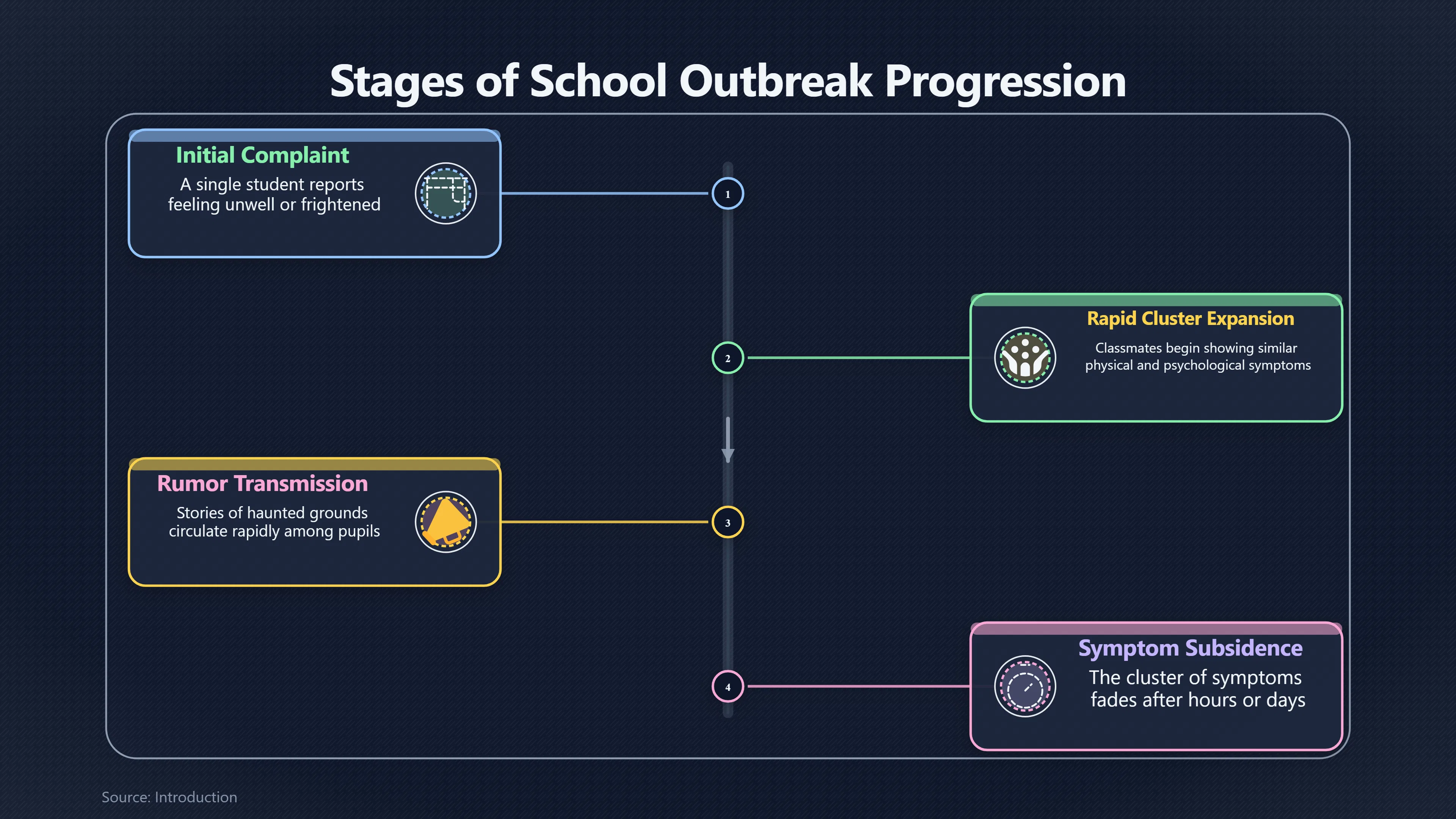
Most reported school outbreaks follow a recognisable pattern. A student complains of feeling unwell, frightened or overwhelmed. Soon afterwards, classmates begin showing similar symptoms. The cluster can expand rapidly through classrooms or dormitories before subsiding hours or days later.
Commonly reported symptoms include:
- Screaming or crying uncontrollably.
- Trembling, shaking or collapsing.
- Fainting or dizziness.
- Hyperventilation and breathing difficulties.
- Trance-like behaviour or apparent loss of awareness.
- Claims of seeing frightening figures or feeling attacked by unseen forces.
Medical investigations frequently fail to identify infectious disease, toxic chemicals or environmental hazards that explain every case. Public health guidance therefore recommends treating the symptoms seriously while simultaneously investigating possible physical causes before concluding that an outbreak is psychogenic.[PubMed]pubmed.ncbi.nlm.nih.govFactors related to the occurrence of mass psychogenic illness in schools: a systematic review - PubMedJune 19, 2025…
Unlike deliberate imitation, mass psychogenic illness is regarded by psychiatrists as an involuntary response. Students are not generally considered to be pretending; instead, stress and expectation become expressed through genuine bodily symptoms.
The Major School Possession Cases
Malaysia has recorded school outbreaks for decades, but several episodes attracted national and international attention because of their scale and repeated occurrence.
Kelantan’s recurring outbreaks
The state of Kelantan has experienced some of the country’s most widely reported incidents. During 2016, multiple secondary schools reported clusters of students and teachers apparently becoming “possessed”. In several schools dozens of people were affected, disrupting lessons and prompting temporary closures while authorities investigated.
One of the most publicised incidents occurred at SMK Pengkalan Chepa 2, where reports described students and staff reacting after claims that a dark figure had been seen on school grounds. Another widely reported outbreak occurred at SMK Ketereh, where dozens of pupils and teachers experienced symptoms during a single day. These episodes became symbols of Malaysia’s wider debate over possession, stress and mental health.[Reddit]reddit.comBBC ArticleBBC Article - The mystery of screaming schoolgirls in MalaysiaAugust 11, 2019…
A continuing rather than isolated phenomenon
Researchers studying Malaysian schools emphasise that these incidents are not one extraordinary event but a recurring pattern. New outbreaks continue to be documented, particularly in residential secondary schools and boarding environments where pupils spend long periods together under shared routines and pressures.
Recent Malaysian psychiatric research notes that outbreaks can interrupt education, lead to temporary school closures and create lasting anxiety among pupils, parents and teachers even after symptoms disappear.[ResearchGate]researchgate.netOpen source on researchgate.net.
How Symptoms and Explanations Spread
One reason these outbreaks fascinate psychologists is that symptoms often spread through social interaction rather than through pathogens.
Several interacting processes appear repeatedly.
Shared expectation. Once one or two pupils are believed to be possessed or dangerously ill, other students become highly alert to ordinary bodily sensations. Anxiety increases, making further symptoms more likely.
Rumours. Stories about haunted classrooms, mysterious figures or previous outbreaks can circulate rapidly within schools. Modern research identifies rumour transmission as one of the strongest predictors of expansion during school outbreaks.[PubMed]pubmed.ncbi.nlm.nih.govFactors related to the occurrence of mass psychogenic illness in schools: a systematic review - PubMedJune 19, 2025…
Close social networks. Boarding schools and tightly organised classrooms place students in constant contact, allowing fear and emotional responses to spread quickly.
Cultural interpretation. In Malaysia, especially within communities where belief in spirits forms part of everyday religious culture, frightening experiences may naturally be interpreted through possession rather than psychological distress alone.
The result is not that belief “creates” illness in a simplistic sense. Rather, existing cultural expectations influence how stress is experienced, interpreted and expressed.
Why Malaysian Schools Are Especially Vulnerable
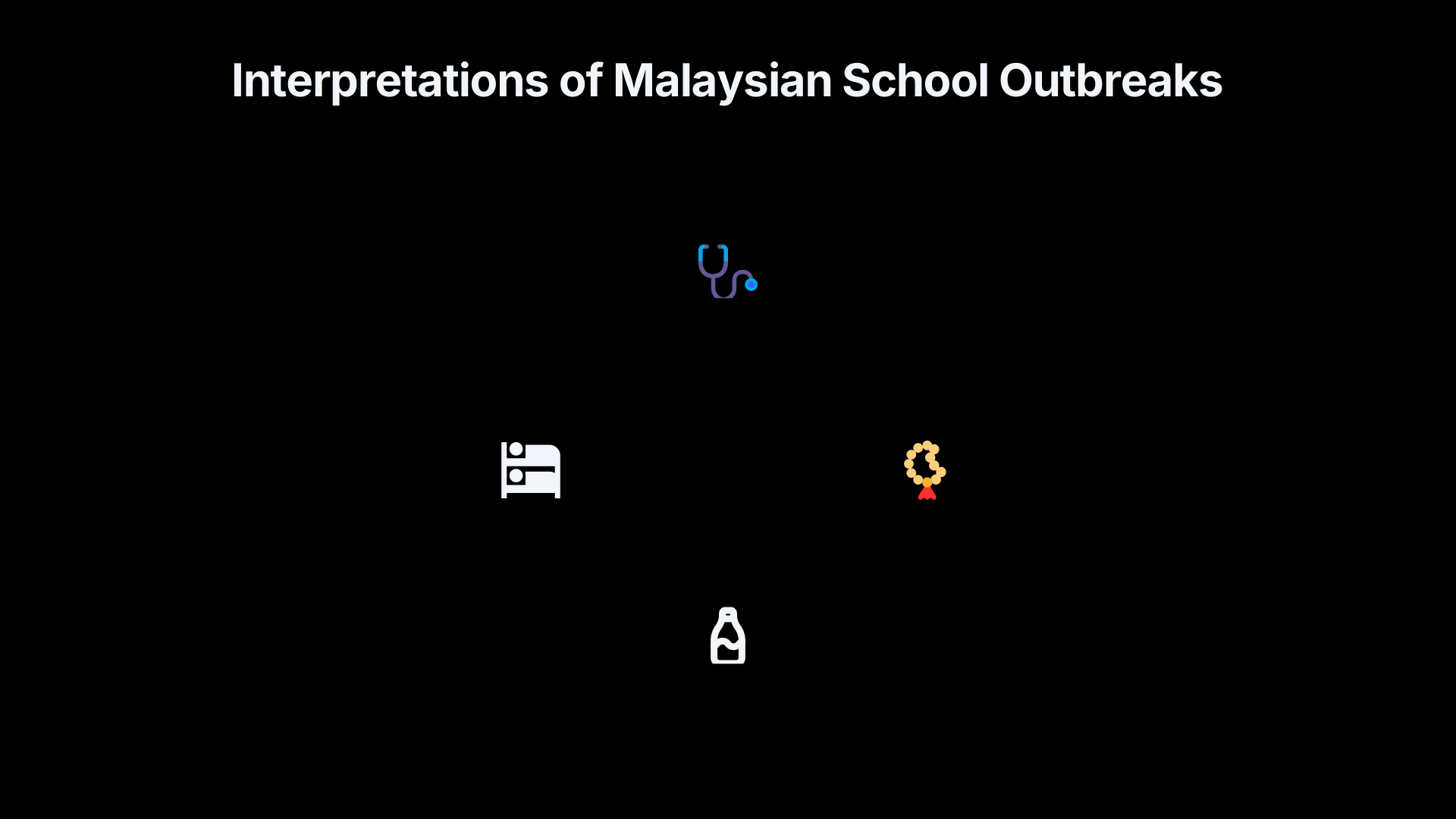
Researchers have proposed several overlapping explanations instead of a single cause.
Academic pressure is frequently mentioned. Examination periods, strict discipline and high expectations from families can create sustained emotional strain, particularly among adolescents.
Boarding schools introduce additional pressures. Students live away from home, follow highly structured routines and experience limited privacy. When emotional distress becomes difficult to express openly, it may emerge in culturally recognised forms.
Gender patterns also attract attention. Many Malaysian outbreaks involve adolescent girls, although boys and teachers have also been affected. This pattern resembles school outbreaks reported elsewhere in the world rather than being unique to Malaysia, suggesting that developmental, social and cultural factors all contribute.[PMC]pmc.ncbi.nlm.nih.govPMCMass hysteria attack rates in children and adolescents: a meta-analysisPMCMass hysteria attack rates in children and adolescents: a meta-analysis
Malaysian qualitative research likewise highlights emotional stress, family expectations and culturally shared beliefs as important influences shaping how students understand and experience these episodes.[ResearchGate]researchgate.netOpen source on researchgate.net.
What Authorities Should Rule Out First
Modern guidance stresses that unexplained outbreaks should never simply be dismissed as “mass hysteria” before proper investigation.
A careful response normally involves several stages.
First, authorities investigate possible physical hazards such as:
- Toxic chemicals.
- Food contamination.
- Carbon monoxide or other gases.
- Infectious disease.
- Environmental exposures.
Only after these possibilities have been reasonably excluded does mass psychogenic illness become the leading explanation for clustered symptoms without an identifiable physical cause.[PubMed]pubmed.ncbi.nlm.nih.govFactors related to the occurrence of mass psychogenic illness in schools: a systematic review - PubMedJune 19, 2025…
Equally important is communication. Health researchers note that dramatic media coverage, alarming rumours and contradictory official statements can unintentionally prolong outbreaks by increasing collective anxiety.
Medical and Spiritual Responses
One striking feature of Malaysian school outbreaks is that responses frequently combine different systems of authority.
Schools commonly seek medical assessment while also inviting Islamic religious leaders or other recognised spiritual practitioners to conduct prayers or blessings. Families often find reassurance in approaches that acknowledge both their religious beliefs and the need for professional healthcare.
Many Malaysian mental health specialists argue that these approaches need not always conflict. A culturally sensitive response can respect religious beliefs while still recognising the role of psychological stress and avoiding unnecessary fear or stigma.[ResearchGate]researchgate.netOpen source on researchgate.net.
Why These Cases Still Matter
Malaysia’s school possession outbreaks have become an important case study in psychiatry, psychology, anthropology and religious studies because they illustrate how culture shapes the expression of distress.
The episodes demonstrate several broader lessons:
- Psychological distress can produce genuine physical symptoms.
- Belief systems influence how unusual experiences are interpreted.
- Rumours and fear can amplify real illness without anyone consciously pretending.
- Effective management requires both careful medical investigation and sensitive communication.
Rather than serving as evidence either for or against supernatural beliefs, the outbreaks reveal how closely human psychology, culture and social environments interact. They remain one of the clearest examples of mass psychogenic illness occurring within a modern educational system while being understood through multiple, overlapping cultural frameworks.
Amazon book picks
Further Reading
Books and field guides related to What Really Happens During Malaysia's School Outbreaks?. Use these as the next step if you want deeper reading beyond the article.
Extraordinary Popular Delusions and the Madness of Crowds
Rating: 4.0/5 from 5 Google Books ratings
Places modern episodes within a long history of collective panics.


Zur psychopathologie des alltagslebens (The psychopathology o...
First published 1904. Subjects: Psychopathology, Mémoire, Troubles de la, Psychology, Repression (Psychology), Psychoanalytic Interpretat...
Mass Hysteria in Schools
Directly addresses mass psychogenic illness in school settings.
Endnotes
1.
Source: pmc.ncbi.nlm.nih.gov
Title: PMCMass hysteria attack rates in children and adolescents: a meta-analysis
Link:https://pmc.ncbi.nlm.nih.gov/articles/PMC8829737/
2.
Source: reddit.com
Title: BBC Article
Link:https://www.reddit.com/r/Brunei/comments/cor729
Source snippet
BBC Article - The mystery of screaming schoolgirls in MalaysiaAugust 11, 2019...
Published: August 11, 2019
3.
Source: researchgate.net
Link:https://www.researchgate.net/publication/399421753_Mass_Hysteria_among_Secondary_School_Students_in_KelantanA_Phenomenological_Approach
4.
Source: researchgate.net
Link:https://www.researchgate.net/publication/392838044_Factors_related_to_the_occurrence_of_mass_psychogenic_illness_in_schools_a_systematic_review
Source snippet
Factors related to the occurrence of mass psychogenic illness in schools: a systematic review | Request PDFJune 19, 2025 — FACTORS RELATE...
Published: June 19, 2025
5.
Source: youtube.com
Link:https://www.youtube.com/watch?v=V5-k-sUQcKk
6.
Source: pubmed.ncbi.nlm.nih.gov
Link:https://pubmed.ncbi.nlm.nih.gov/40537604/
Source snippet
Factors related to the occurrence of mass psychogenic illness in schools: a systematic review - PubMedJune 19, 2025...
Published: June 19, 2025
7.
Source: mysitasi.mohe.gov.my
Title: My Sitasi Faktor gangguan emosi dalam fenomena histeria massa remaja muslim
Link:https://mysitasi.mohe.gov.my/journal-website/get-meta-article?artId=ee7eee26-60e1-11ef-a699-005056a6a970&env=web&jnlId=df7d5d0a-5f76-11ef-a699-005056a6a970&template=_ARTICLE
8.
Source: researchportal.ukhsa.gov.uk
Title: ukhsa.gov.uk Frequency and predictors of mass psychogenic illness
Link:https://researchportal.ukhsa.gov.uk/en/publications/frequency-and-predictors-of-mass-psychogenic-illness/
9.
Source: pubmed.ncbi.nlm.nih.gov
Link:https://pubmed.ncbi.nlm.nih.gov/7952258/
Additional References
10.
Source: gaexcellence.com
Link:https://gaexcellence.com/ijepc/article/view/6263
Source snippet
FREUD’S PSYCHOANALYST ACT AND HYSTERIA AMONG SCHOOL STUDENTS: ONE YEAR FOLLOW-UP | INTERNATIONAL JOURNAL OF EDUCATION, PSYCHOLOGY AND COU...
11.
Source: lifescience.net
Link:https://www.lifescience.net/publications/1339932/factors-related-to-the-occurrence-of-mass-psychoge/
Source snippet
Created on 20 Jun 2025 * Publication details * Citations * Page views * * Reviews * * * * All pu...
12.
Source: youtube.com
Link:https://www.youtube.com/watch?v=MlB8Cf6K80M
Source snippet
3 100 Students And Teachers "POSSESSED" In Malaysia | Mysteries Of Asia...
13.
Source: youtube.com
Title: Ghost appears in School’s corridor in Malaysia, campus evacuated
Link:https://www.youtube.com/watch?v=aHmPVHyYkuM
Source snippet
2 [TRAILER] The screaming schoolgirls of Kelantan | The Unsolved Mysteries of South-east Asia Ep 5...
14.
Source: nejm.org
Link:https://www.nejm.org/doi/full/10.1056/NEJM200001133420206
15.
Source: sciencedirect.com
Link:https://www.sciencedirect.com/science/article/pii/S0736467915010598
16.
Source: gaexcellence.com
Link:https://gaexcellence.com/ijepc/article/view/3626
17.
Source: spaj.ukm.my
Link:https://spaj.ukm.my/jalhikmah/index.php/jalhikmah/article/view/68
18.
Source: erepo.usm.my
Link:https://erepo.usm.my/handle/123456789/23871
19.
Source: jsass.uis.edu.my
Link:https://jsass.uis.edu.my/index.php/jsass/article/view/155
Topic Tree