Within Mexico Panics
Who Was Branded a Witch in Colonial Mexico?
Colonial sorcery cases reveal how conquest, translation and unequal power turned local practices into suspicions of spiritual danger.
On this page
- How colonial sorcery cases began
- Practices hidden beneath the witchcraft label
- Gender, power and cultural exchange
Page outline Jump by section
Introduction
Colonial Mexico did not experience the vast witch hunts that scarred parts of early modern Germany, Scotland or Switzerland. Yet accusations of sorcery still became an important instrument of religious control after the Spanish conquest. What colonial officials called “witchcraft” often included Indigenous healing, African ritual knowledge, European folk remedies, love magic, divination and everyday attempts to understand illness or misfortune. By translating these diverse practices into the language of heresy, demons and false religion, colonial authorities reshaped local conflicts into matters of religious discipline and political authority. Modern historians therefore see these cases not as evidence of organised communities of witches, but as records of conquest, cultural exchange and unequal power.[Cambridge University Press & Assessment]cambridge.orginquisitions sorcery investigations and the law in mexicoCambridge University Press & AssessmentInquisitions, Sorcery Investigations, and the Law in Mexico, 1521–1571 (Chapter 3) - The Women Who…
Rather than revealing a single hidden religion, the surviving trials show how Spanish officials tried to define acceptable belief while Indigenous, African and European communities adapted, exchanged and concealed religious knowledge. The result was a complex colonial landscape in which accusations of witchcraft reflected struggles over authority as much as fears of supernatural harm.
Who Was Branded a Witch in Colonial Mexico?
The people accused of witchcraft rarely matched the familiar European stereotype of isolated women flying to sabbaths or making pacts with the Devil. Instead, colonial records describe a remarkably diverse population that included:
- Indigenous healers and diviners preserving pre-conquest medical knowledge.
- African slaves and free Black women practising healing or protective rituals.
- Spanish settlers using folk magic inherited from Iberia.
- Mixed-race communities combining traditions from several cultures.
- Midwives, herbalists and neighbours offering practical remedies alongside spiritual advice.[Cambridge University Press & Assessment]cambridge.orgUniversity Press & Assessment A Multiethnic World of Magic (Chapter 5Cambridge University Press & AssessmentA Multiethnic World of Magic (Chapter 5) - The Women Who Threw CornMay 28, 2025…
Many accusations arose from ordinary social tensions. A failed romance, unexplained illness, infertility, business rivalry or family dispute could become evidence of hidden supernatural activity once interpreted through colonial religious ideas.
Importantly, colonial authorities did not invent every accusation themselves. Neighbours reported neighbours, clients denounced healers and local rivalries entered the courtroom. The legal system then reframed those disputes through Catholic concepts of heresy and demonic influence.
How Colonial Sorcery Cases Began
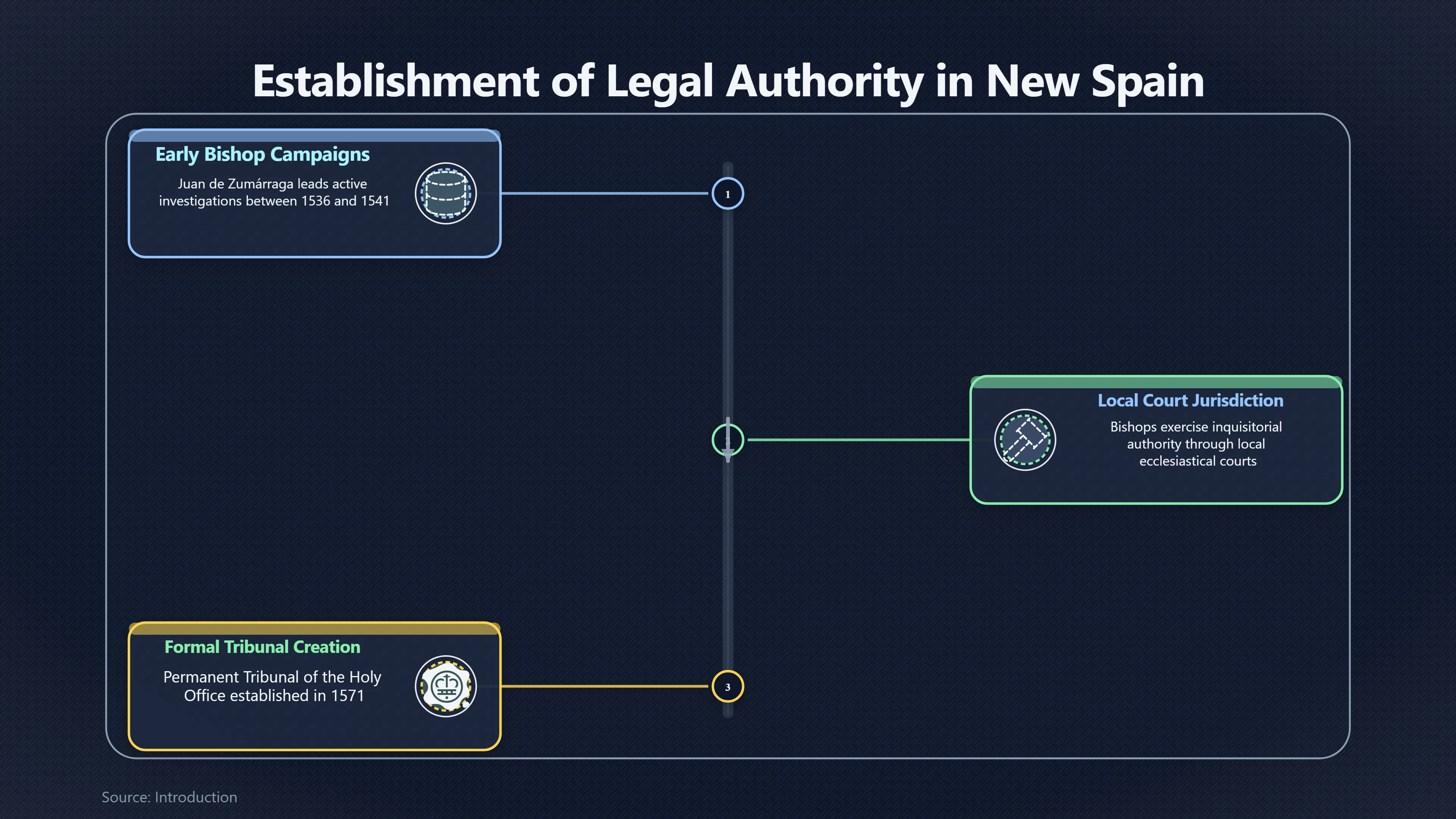
During the decades immediately following the conquest, New Spain did not yet possess the permanent Holy Office familiar from later centuries. Instead, bishops exercised inquisitorial authority through local ecclesiastical courts. Mexico’s first bishop, Juan de Zumárraga, conducted the most active early campaign between roughly 1536 and 1541, investigating clusters of alleged sorcery alongside other religious offences. The permanent Tribunal of the Holy Office was only established in Mexico City in 1571.[Cambridge University Press & Assessment]cambridge.orginquisitions sorcery investigations and the law in mexicoCambridge University Press & AssessmentInquisitions, Sorcery Investigations, and the Law in Mexico, 1521–1571 (Chapter 3) - The Women Who…
This distinction matters because early prosecutions were uneven and local rather than part of a continuous campaign. Recent research also shows that early colonial Mexico experienced nothing resembling the mass witch crazes found elsewhere in Europe. Witchcraft cases formed only a small proportion of religious investigations, and many attracted relatively modest punishments rather than executions.[Cambridge University Press & Assessment]cambridge.orginquisitions sorcery investigations and the law in mexicoCambridge University Press & AssessmentInquisitions, Sorcery Investigations, and the Law in Mexico, 1521–1571 (Chapter 3) - The Women Who…
Church authorities were generally more concerned with preserving religious conformity than eliminating an imagined conspiracy of witches. Their broader objective was to establish Catholic authority over a newly conquered society where many different religious traditions coexisted.
Practices Hidden Beneath the Witchcraft Label
The colonial label of “witchcraft” concealed practices that originally had very different meanings.
Indigenous healers often diagnosed illness through cosmological traditions that pre-dated Christianity. Remedies could involve herbs, ritual speech, offerings or symbolic acts that were meaningful within local religious systems rather than attempts to invoke demons. Spanish investigators frequently interpreted these practices through European demonology because they lacked an equivalent framework for understanding them.[Cambridge University Press & Assessment]cambridge.orginquisitions sorcery investigations and the law in mexicoCambridge University Press & AssessmentInquisitions, Sorcery Investigations, and the Law in Mexico, 1521–1571 (Chapter 3) - The Women Who…
African communities brought healing knowledge, protective rituals and magical traditions from several regions of West and North Africa. These practices evolved further in the Americas as enslaved people adapted to colonial conditions.
European settlers contributed their own traditions as well. Love charms, fortune telling, protective amulets, household blessings and folk medicine had long existed in Spain. Once transplanted to New Spain, they mixed with Indigenous botanical knowledge and African ritual expertise.
Rather than remaining separate, these traditions increasingly blended together. Historians now describe sixteenth-century Mexico as a multiethnic world of magical practice in which knowledge crossed linguistic, ethnic and social boundaries despite official attempts to police them.[Cambridge University Press & Assessment]cambridge.orgUniversity Press & Assessment A Multiethnic World of Magic (Chapter 5Cambridge University Press & AssessmentA Multiethnic World of Magic (Chapter 5) - The Women Who Threw CornMay 28, 2025…

Gender, Power and Cultural Exchange
Women appear frequently in colonial sorcery records, but not simply because they were viewed as inherently more vulnerable to witchcraft.
Many women occupied social roles closely associated with healing, childbirth, cooking and household management. These everyday responsibilities gave them practical knowledge of herbs, medicines and ritual practices. When authorities became suspicious of unofficial healing, these same roles made women especially visible to investigators.
At the same time, recent scholarship has shown that colonial magic often emerged through cooperation rather than isolation. Markets, kitchens and neighbourhoods became places where Indigenous, African and European women exchanged remedies, recipes and ritual techniques. What inquisitors interpreted as dangerous superstition often reflected ordinary social interaction within a multicultural colonial society.[Cambridge University Press & Assessment]cambridge.orgUniversity Press & Assessment A Multiethnic World of Magic (Chapter 5Cambridge University Press & AssessmentA Multiethnic World of Magic (Chapter 5) - The Women Who Threw CornMay 28, 2025…
One striking example comes from investigations in 1537, where African women, Spanish women and a Nahua intermediary were accused of participating in interconnected networks of healing and love magic. The records suggest that Mesoamerican plants, African ritual knowledge and European folk practices circulated together across ethnic boundaries, illustrating cultural exchange rather than rigidly separate traditions.[Cambridge University Press & Assessment]cambridge.orgUniversity Press & Assessment A Multiethnic World of Magic (Chapter 5Cambridge University Press & AssessmentA Multiethnic World of Magic (Chapter 5) - The Women Who Threw CornMay 28, 2025…
Unequal Justice in Colonial Society
Although accusations crossed ethnic lines, punishment did not fall equally.
Recent historical research indicates that social rank, race and legal status strongly influenced outcomes. Elite Spanish women who sought magical services could escape prosecution altogether, while poorer women, enslaved Africans and Indigenous participants often faced harsher treatment for similar behaviour.[Cambridge University Press & Assessment]cambridge.orgUniversity Press & Assessment A Multiethnic World of Magic (Chapter 5Cambridge University Press & AssessmentA Multiethnic World of Magic (Chapter 5) - The Women Who Threw CornMay 28, 2025…
This pattern reminds historians that witchcraft prosecutions were not simply about religious belief. They also reinforced colonial hierarchies by determining whose knowledge counted as legitimate medicine and whose became criminal superstition.
The courts therefore regulated both belief and social order. Punishing selected individuals publicly demonstrated the power of colonial institutions to define acceptable religion while discouraging alternative sources of authority within local communities.

Why Colonial Mexico Avoided European-Style Witch Hunts
One common misconception is that the Spanish Inquisition created witch panics throughout its American territories. The historical record suggests a more complicated picture.
Compared with several regions of northern Europe, colonial Mexico saw relatively few witchcraft prosecutions and very few executions for sorcery. The Inquisition devoted considerable attention to offences such as Protestantism, Judaism, blasphemy and religious dissent among Christians, while many accusations involving folk healers never developed into major criminal cases.[Cambridge University Press & Assessment]cambridge.orginquisitions sorcery investigations and the law in mexicoCambridge University Press & AssessmentInquisitions, Sorcery Investigations, and the Law in Mexico, 1521–1571 (Chapter 3) - The Women Who…
This does not mean colonial authorities tolerated Indigenous or African religious traditions. Campaigns against idolatry, local ritual specialists and non-Christian worship continued through other legal mechanisms, especially in Indigenous communities outside the Holy Office’s later jurisdiction. Religious control therefore remained extensive even when witchcraft itself was not the primary legal category.[Cambridge University Press & Assessment]cambridge.orginquisitions sorcery investigations and the law in mexicoCambridge University Press & AssessmentInquisitions, Sorcery Investigations, and the Law in Mexico, 1521–1571 (Chapter 3) - The Women Who…
Why These Cases Still Matter
Colonial witchcraft accusations illuminate how conquest transformed cultural difference into religious suspicion. Trial records preserve fragments of Indigenous medicine, African ritual practice and European folk belief, but they do so through documents written by officials determined to classify unfamiliar traditions as religious error.
For historians, these records are therefore both invaluable and problematic. They reveal genuine exchanges of knowledge across colonial society while also exposing how legal institutions reshaped those exchanges into narratives of heresy and spiritual danger.
Within Mexico’s broader history of collective fears and religious conflict, colonial sorcery prosecutions are best understood not as episodes of mass hysteria but as examples of how state and church authorities used accusations of hidden supernatural threats to strengthen political and religious control. At the same time, the records testify to the resilience and creativity of communities that continued to adapt and combine traditions despite sustained efforts to suppress them.[Cambridge University Press & Assessment]cambridge.orginquisitions sorcery investigations and the law in mexicoCambridge University Press & AssessmentInquisitions, Sorcery Investigations, and the Law in Mexico, 1521–1571 (Chapter 3) - The Women Who…
Amazon book picks
Further Reading
Books and field guides related to Who Was Branded a Witch in Colonial Mexico?. Use these as the next step if you want deeper reading beyond the article.

The devil in the shape of a woman
Provides strong comparative context for colonial witchcraft accusations.
Endnotes
1.
Source: cambridge.org
Title: inquisitions sorcery investigations and the law in mexico 1521 1571
Link:https://www.cambridge.org/core/services/aop-cambridge-core/content/view/0C4E0CFC955FBEB9144D53567A353606/9781009550529c4_75-92.pdf/inquisitions-sorcery-investigations-and-the-law-in-mexico-1521-1571.pdf
Source snippet
Cambridge University Press & AssessmentInquisitions, Sorcery Investigations, and the Law in Mexico, 1521–1571 (Chapter 3) - The Women Who...
2.
Source: cambridge.org
Title: University Press & Assessment The Women Who Threw Corn
Link:https://www.cambridge.org/core/journals/americas/article/women-who-threw-corn-witchcraft-and-inquisition-in-sixteenthcentury-mexico-by-martin-austin-nesvig-cambridge-cambridge-university-press-2025-pp-320-3995-isbn-9781009550529/645867C64FADC1ECF0AEA20C0BEDD4BE
Source snippet
Witchcraft and Inquisition in Sixteenth-Century Mexico. By Martin Austin Nesvig. Cambridge: Cambridge University Press, 2025. Pp. 320. $3...
3.
Source: cambridge.org
Title: University Press & Assessment A Multiethnic World of Magic (Chapter 5)
Link:https://www.cambridge.org/core/books/abs/women-who-threw-corn/multiethnic-world-of-magic/749C72CE43D880E44DDEE30ED8758225
Source snippet
Cambridge University Press & AssessmentA Multiethnic World of Magic (Chapter 5) - The Women Who Threw CornMay 28, 2025...
Published: May 28, 2025
4.
Source: cambridge.org
Title: University Press & Assessment A Multiethnic World of Magic (Chapter 5)
Link:https://www.cambridge.org/core/services/aop-cambridge-core/content/view/749C72CE43D880E44DDEE30ED8758225/9781009550529c6_123-136.pdf/a-multiethnic-world-of-magic.pdf
Source snippet
Cambridge University Press & AssessmentA Multiethnic World of Magic (Chapter 5) - The Women Who Threw Corn...
5.
Source: cambridge.org
Link:https://www.cambridge.org/core/books/abs/women-who-threw-corn/inquisitions-sorcery-investigations-and-the-law-in-mexico-15211571/0C4E0CFC955FBEB9144D53567A353606
Source snippet
Inquisitions, Sorcery Investigations, and the Law in Mexico, 1521–1571 (Chapter 3) - The Women Who Threw CornMay 28, 2025 — 3 - INQUISITI...
Published: May 28, 2025
6.
Source: cambridge.org
Title: A Multiethnic World of Magic (Chapter 5)
Link:https://www.cambridge.org/core/books/women-who-threw-corn/multiethnic-world-of-magic/749C72CE43D880E44DDEE30ED8758225/core-reader
7.
Source: resolve.cambridge.org
Title: nahua women teach iberian women how to cast spells
Link:https://resolve.cambridge.org/core/services/aop-cambridge-core/content/view/5B56EDD451DD7B0130608F16A39ABD56/9781009550529c5_95-122.pdf/nahua_women_teach_iberian_women_how_to_cast_spells.pdf
8.
Source: resolve.cambridge.org
Link:https://resolve.cambridge.org/core/books/women-who-threw-corn/healing-and-magic-in-oaxaca-and-michoacan/BE844B2ED50F6E55506F58E90402DD4F
9.
Source: resolve.cambridge.org
Link:https://resolve.cambridge.org/core/books/women-who-threw-corn/select-bibliography/C0F8492A7A28C38C175884AF4862678F
Additional References
10.
Source: cambridgebookshop.co.uk
Title: The Women Who Threw Corn – Cambridge University Press Bookshop
Link:https://www.cambridgebookshop.co.uk/products/the-women-who-threw-corn
Source snippet
June 26, 2025 — THE WOMEN WHO THREW CORN The Women Who Threw Corn Witchcraft and Inquisition in Sixteenth-Century Mexico Author(s): Marti...
Published: June 26, 2025
11.
Source: youtube.com
Title: The Women Who Threw Corn: Witchcraft and Inquisition in Sixteenth-Century Mexico
Link:https://www.youtube.com/watch?v=iRsGciI0imA
Source snippet
The Mexican Inquisition in Early Eighteenth-Century New Mexico...
12.
Source: youtube.com
Title: The Aztec Witches of New Mexico with Rob Martinez
Link:https://www.youtube.com/watch?v=lChDTMCz0GQ
Source snippet
Historian Robert Martinez on New Mexico's History of Witchcraft and Sorcery...
13.
Source: academic.oup.com
Link:https://academic.oup.com/ahr/article-pdf/131/1/328/67555215/rhaf608.pdf
Source snippet
The Women Who Threw Corn: Witchcraft and Inquisition in Sixteenth-Century Mexico | The American Historical Review | Oxford AcademicMarch...
14.
Source: youtube.com
Title: Aztec Witches in New Mexico?
Link:https://www.youtube.com/watch?v=JnfUDDDV_rA
Source snippet
The Aztec Witches of New Mexico with Rob Martinez...
15.
Source: youtube.com
Title: The Mexican Inquisition in Early Eighteenth-Century New Mexico
Link:https://www.youtube.com/watch?v=G2nVdbxg2UU
Source snippet
Aztec Witches in New Mexico?...
16.
Source: youtube.com
Title: Historian Robert Martinez on New Mexico’s History of Witchcraft and Sorcery
Link:https://www.youtube.com/watch?v=4d6ZsSNRujw
17.
Source: academic.oup.com
Link:https://academic.oup.com/edited-volume/61800/chapter-abstract/546381806
Topic Tree