When Belief and Fear Swept Through Turkey
Turkey’s history of collective belief and collective fear does not fit one simple story of “mass hysteria”. Its most revealing episodes range from a seventeenth-century messianic movement born in İzmir, through the violent Mahdist rising at Menemen in 1930, to modern scares about Satanists, heavy-metal fans and supposedly lethal internet games.
Page outline Jump by section
Introduction
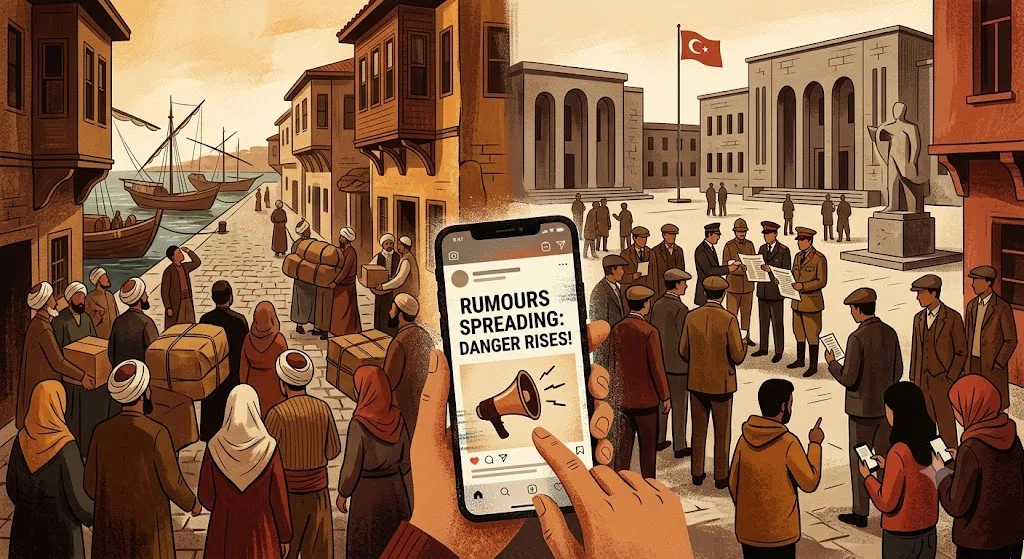
The crucial distinction is between several different phenomena. A millenarian movement is organised around hopes of imminent divine transformation. A moral panic exaggerates a perceived threat and identifies a group as a danger to society. Mass psychogenic illness involves genuine bodily symptoms spreading through expectation and social contact after physical causes have been investigated. Pogroms and sectarian attacks, by contrast, are not imaginary outbreaks: rumours may help mobilise them, but their violence and victims are real. Turkey’s cases matter because they show how belief spreads through trusted networks, newspapers, television, state institutions and, increasingly, social media.
A messiah from İzmir who stirred the Jewish world
One of the most important messianic movements in early modern Jewish history began in the Ottoman port city of İzmir. Sabbatai Zevi, a Jewish mystic born there in 1626, declared himself the long-awaited Messiah. His movement reached its height in 1665 and 1666, drawing followers across the Ottoman Empire and far beyond it. Scholars describe it not as a minor local sect but as a transnational religious upheaval that affected Jewish communities from the eastern Mediterranean to northern Europe.[cambridge.org]cambridge.orgCambridge University Press & AssessmentSabbatai Zevi and the Sabbatean Movement (Chapter 18)The messianic movement surrounding Sabbatai Z…
The movement spread because it spoke to conditions of intense uncertainty. Jewish communities had experienced war, displacement and persecution, while mystical calculations gave the year 1666 exceptional significance. Letters, travelling merchants, rabbis and preachers carried reports of Zevi’s actions between cities. Followers prepared for redemption, altered prayers and, in some places, reorganised ordinary life around the expectation that history was about to change. The episode illustrates how an apocalyptic belief could travel rapidly long before modern mass media.
Ottoman authorities did not initially launch a broad campaign against Zevi’s followers. The decisive intervention came when Zevi was brought before Sultan Mehmed IV’s court in 1666 and converted to Islam under pressure. His conversion shattered many expectations, but it did not simply end the movement. Some followers concluded that the conversion itself formed part of a hidden redemptive plan. A community of descendants publicly living as Muslims while retaining distinctive Sabbatean traditions subsequently developed, particularly in Salonica, then an Ottoman city.
In later Ottoman and republican Turkey, these descendants became the object of conspiracy stories. Writers on both the religious right and nationalist left sometimes portrayed them as secret Jews manipulating politics, finance or the founding of the secular republic. Historian Marc David Baer argues that their combination of public Muslim identity, private communal traditions and association with Salonica made them unusually convenient targets for antisemitic explanations of political change. The resulting literature tells readers more about modern anxieties over hidden power and national authenticity than it does about the actual political influence of the community.[jstor.org]jstor.orgTHE FIRST CONSPIRACY THEORIES ABOUT THE DÖNME. Anti-Semitic conspiracy theories are not new to Turkey…. ANTI-SEMITISM AND ANTI-DÖNME C…
This is therefore both a history of millenarian belief and a warning about later mythmaking. The original movement was real, extensive and religiously transformative. Claims that its descendants secretly controlled modern Turkey belong to a much later conspiratorial tradition.
Menemen: a Mahdist rising and a founding republican trauma
On 23 December 1930, a small group entered Menemen, north of İzmir, behind a man known as Dervish Mehmed. He proclaimed a divinely sanctioned mission, invoked the restoration of religious law and gathered supporters around a green banner. When reserve officer and teacher Mustafa Fehmi Kubilay confronted the group, he was killed and beheaded. Two local watchmen also died. The incident lasted only a few hours, but it became one of the defining symbolic confrontations between the early Turkish Republic and organised religious opposition.[historystudies.net]historystudies.netMenemen Incident" in the Official Documents and the PressThe "Kubilay Incident" or "Menemen Incident" on December 23, 1930, is one of th…
The belief at the centre of the episode was Mahdism: the expectation that a divinely guided redeemer would appear near the end of time to restore justice and true religion. Yet treating Menemen merely as a burst of irrational fanaticism hides its political and social setting. The republic had abolished the caliphate, closed religious lodges and reshaped education, dress and law. For supporters of these reforms, Menemen appeared to reveal a hidden counter-revolution. For some opponents, it became evidence of state persecution or even a supposed provocation. Historians instead examine how messianic language interacted with poverty, political exclusion, religious networks and resentment of authoritarian modernisation.[openedition.org]journals.openedition.orgOpen source on openedition.org.
The government’s response was far larger than the original gathering. Martial law was imposed, military tribunals tried numerous defendants and executions followed. Religious figures and members of Sufi networks were arrested well beyond the immediate group. The young Kubilay was transformed into a republican martyr, while annual commemorations turned Menemen into a lesson about the vulnerability of secularism. Research on his public memory shows that the incident became an enduring political symbol rather than remaining a narrowly local crime.[universiteitleiden.nl]scholarlypublications.universiteitleiden.nlOpen source on universiteitleiden.nl.
Menemen is often described as a revolt, a reactionary uprising or a Mahdist incident. Each label highlights something different. It was a genuine act of lethal political violence, not an invented threat. Yet its scale was subsequently enlarged through official memory, public ceremony and competing conspiracy stories. The lasting “panic” lay partly in the belief that a tiny band represented a vast underground force ready to overturn the republic.
When rumours turn neighbours into enemies
Some of Turkey’s gravest episodes of collective fear involved religious and ethnic minorities. These should not be reduced to “hysteria”, because organised political violence, entrenched prejudice and failures of state protection were central. Rumour mattered, however, because it could present an already stigmatised population as an immediate threat and make aggression seem defensive.
In December 1978, violence in Kahramanmaraş targeted Alevis and left-wing residents amid Turkey’s wider conflict between revolutionary and ultranationalist organisations. The killings developed from political clashes into sustained sectarian attacks on homes, businesses and neighbourhoods. Historical studies place the massacre within the severe polarisation of the 1970s, when anti-communism, Sunni–Alevi division and armed party networks reinforced one another.[De Gruyter Brill]degruyterbrill.comOpen source on degruyterbrill.com.
The Sivas massacre of 2 July 1993 followed a different immediate sequence but exposed similar mechanisms. Writers, musicians and Alevi intellectuals had gathered for a cultural festival at the Madımak Hotel. Anger focused especially on the participation of writer Aziz Nesin, who had become associated with plans to publish material regarded by many Muslims as blasphemous. After inflammatory speeches and demonstrations, a crowd surrounded and set fire to the hotel. Thirty-seven people died, including participants, hotel workers and two attackers.[uscirf.gov]uscirf.govsivas massacre and turkeys persecution alevi communitysivas massacre and turkeys persecution alevi community
Descriptions of Sivas sometimes focus on a suddenly irrational mob, but that framing can conceal responsibility. The crowd formed within a recognisable atmosphere of sectarian hostility and political mobilisation. Authorities had ample warning that tensions were rising, yet the intervention was disastrously inadequate. The fear that religion was under attack did not emerge from nowhere: it was cultivated through denunciation, public rhetoric and existing stereotypes about Alevis and secular intellectuals.
Rumour-driven violence has also affected refugees. In Adana in 2019, a false claim that a Syrian man had sexually assaulted a Turkish child circulated rapidly online and helped trigger attacks on Syrian-owned shops. Officials later stated that the suspect was a Turkish citizen. The episode followed a familiar pattern: an emotionally powerful allegation, an already distrusted minority, rapid repetition through social media and collective punishment before facts could be established.[Stanford University Press]sup.orgStanford University Press The Horrors of AdanaStanford University Press The Horrors of Adana
These cases show why “moral panic” must be used carefully. The public story may exaggerate or invent the minority’s supposed threat, but the resulting persecution is concrete. Calling the whole event mass hysteria risks making deliberate incitement, political organisation and institutional failure disappear from view.
The Satanist scare of the late 1990s
Turkey’s clearest modern example of a classic moral panic followed the murder of 17-year-old Şehriban Coşkunfırat in Istanbul in 1999. Three young defendants associated themselves with Satanism, and the case received intense newspaper and television coverage. A horrific but specific murder was rapidly reframed as evidence of a wider hidden subculture threatening children, morality and the nation.[academia.edu]academia.eduFraming the First Satanic Murder in TurkeyFraming the First Satanic Murder in Turkey
The panic drew on visible features of youth culture: black clothing, heavy-metal music, unusual jewellery, occult imagery and internet use. Journalists searched for supposed Satanist meeting places and warned families about behavioural “signs”. Metal fans and socially isolated teenagers could be treated as possible members of a violent underground even when there was no evidence connecting them to crime. Academic work on Turkey’s metal scene describes how media coverage joined Satanism, criminality and Western cultural influence into a single threatening image.[universiteitleiden.nl]scholarlypublications.universiteitleiden.nlOpen source on universiteitleiden.nl.
Religious and secular commentators did not frame the threat in exactly the same way. Conservative voices could present Satanism as the outcome of spiritual decline and imitation of the West. Secularist accounts often blamed inadequate parenting, youth alienation or uncontrolled religious irrationality. Despite their differences, both narratives turned a small and poorly understood identity into a symbol of national disorder.
The murder itself was real, and the offenders’ beliefs were relevant to understanding them. What made the response a moral panic was the leap from one case to claims about a broad, organised menace. Media attention did not simply report a subculture; it helped define who counted as a Satanist and encouraged the public to read ordinary adolescent difference as evidence of danger. One study of newspaper coverage found that reporting quickly moved beyond the defendants into general warnings about an alleged occult crime problem.[Academia]academia.eduFraming the First Satanic Murder in TurkeyFraming the First Satanic Murder in Turkey
The panic damaged young people whose tastes were treated as suspicious, while also obscuring more ordinary explanations for violence, including personal vulnerability, abusive relationships and individual criminal responsibility. It remains culturally important because similar symbols reappear whenever unfamiliar youth practices are blamed for a wider social breakdown.
From Satanists to the Blue Whale
By the late 2010s, the imagined dangerous group was no longer necessarily a secret gathering in a park or flat. It could be an anonymous online controller said to manipulate children through their phones. The “Blue Whale Challenge” was presented internationally as a fifty-day internet game in which participants were given escalating tasks ending in suicide. Turkish media, schools, police statements and family discussions helped turn it into a major child-safety fear.
The danger of online self-harm communities is genuine, and suicide can be socially contagious. Yet researchers examining alleged online “suicide games” found little evidence for a single organised game operating in the systematic form described by viral warnings. Their review concluded that news reports and official alerts often spread the very narrative they were intended to suppress.[PMC]pmc.ncbi.nlm.nih.govOpen source on nih.gov.
A 2026 study concentrating on Turkey describes the Blue Whale episode as a digital moral panic and explicitly links it to the country’s 1999 Satanism scare. In both cases, distressed young people were imagined as being recruited by a hidden, malevolent network. In both, frightening stories offered adults a simple external enemy for problems rooted in mental health, family stress, social isolation and changing youth culture.[Wiley Online Library]onlinelibrary.wiley.comOpen source on wiley.com.
This does not mean every reported case was fabricated or that online coercion is harmless. Turkish medical literature includes individual cases in which vulnerable young people encountered Blue Whale-related material. The more defensible conclusion is narrower: the popular image of a centrally controlled death cult was never established at the scale suggested by public warnings.[JournalAgent]pdf.journalagent.comJournal Agent Life-threatening Blue Whale Violent Video GameJournal Agent Life-threatening Blue Whale Violent Video Game
The transition from Satanist covens to online curators also reveals a change in how fear spreads. Television and national newspapers dominated the earlier panic. The Blue Whale story circulated through a feedback loop involving news sites, social platforms, parental messaging groups and institutional warnings. Attempts to raise awareness could increase searches, curiosity and imitation.
Where mass psychogenic illness fits — and where it does not
Turkey has a growing research literature on mass psychogenic illness, but its documented outbreaks are less prominent in international historical accounts than Menemen, Sivas or the Satanism panic. Recent Turkish research reviewing institutional cases reports the familiar pattern found elsewhere: clusters of nausea, dizziness, headaches, fainting or anxiety, often among female students, with outbreaks shaped by environmental fears and dramatic emergency responses.[DergiPark]dergipark.org.trDergi Park Institutional Context, Triggers and Symptoms of MassDergi Park Institutional Context, Triggers and Symptoms of Mass
Mass psychogenic illness is not the same as pretending, delusion or mass political excitement. The symptoms are real. The diagnosis becomes plausible only after investigators consider toxic exposure, infection and other physical causes. Episodes often begin with an ambiguous smell, an unexplained collapse or a rumour of poisoning. People then notice sensations in their own bodies, watch others become unwell and interpret ordinary stress responses as confirmation that a shared hazard is present. Research emphasises social ties, expectation and visible emergency activity as mechanisms of spread.[PMC]pmc.ncbi.nlm.nih.govPMCMass psychogenic illness and the social networkPMCMass psychogenic illness and the social network
The label “mass hysteria” is increasingly avoided because it sounds dismissive and has historically carried sexist assumptions. “Mass psychogenic illness” or “mass sociogenic illness” better conveys a collective stress response without implying that sufferers are deceitful or mentally unstable.
It would be misleading, however, to use that medical concept for Turkey’s religious movements or political mobs. Sabbatai Zevi’s followers shared an apocalyptic theology; they were not experiencing a contagious medical syndrome. The Menemen group pursued a religious and political objective. The Sivas crowd carried out organised violence. The Satanism and Blue Whale episodes were media-driven moral panics. Similar language about collective irrationality can be applied loosely to all of them, but doing so erases the different causes and responsibilities involved.
Why these episodes keep returning
Turkey’s recurring scares are shaped by unusually sharp disputes over who represents the nation. Republican secularism, Sunni religious authority, minority identities, Westernisation, youth culture and fears of foreign influence have repeatedly been cast as struggles for social survival. In such an atmosphere, small groups can be imagined as signs of a much larger hidden transformation.
Several mechanisms appear across otherwise different cases:
- Hidden-network explanations: Sabbatean descendants, Sufi communities, Satanists and online “curators” have all been portrayed as secret organisations exercising power out of proportion to the evidence.
- Threats to children or the future: Youth recruitment, corrupted education and family breakdown make fears feel urgent and morally unquestionable.
- Symbolic individuals: Sabbatai Zevi, Kubilay, Aziz Nesin and Şehriban Coşkunfırat became figures through whom much larger conflicts were narrated.
- Media amplification: Printed letters carried messianic expectation in the seventeenth century; newspapers and television expanded the Satanism scare; social platforms accelerated refugee rumours and Blue Whale warnings.
- State validation: Arrests, tribunals, broadcasting penalties and official alerts can calm a crisis, but they can also make an exaggerated threat appear confirmed.
Turkey’s broadcasting controversies continue to show how sensitive the boundary between religion, secularism and cultural representation remains. In 2024, regulators temporarily halted episodes of a popular television drama about a religious brotherhood after accusations that it insulted religious values. The programme’s later success suggested that many viewers wanted more complicated portrayals than the initial controversy allowed.[Le Monde.fr]lemonde.frDespite early controversy, the series grew immensely popular, drawing over seven million viewers and becoming Turkey’s most-watched show…
The most useful lesson from Turkey’s history is not that crowds are naturally irrational. Beliefs and fears spread when they fit existing pressures, travel through trusted channels and are reinforced by visible reactions from authorities or neighbours. Some perceived threats prove largely imaginary; others attach themselves to real crimes or conflicts and magnify them beyond the evidence. The task is therefore to ask not only whether a belief was true, but who circulated it, what made it persuasive, whose interests it served and who suffered when fear became action.
Amazon book picks
Further Reading
Books and field guides related to When Belief and Fear Swept Through Turkey. Use these as the next step if you want deeper reading beyond the article.
Extraordinary Popular Delusions and the Madness of Crowds
Rating: 4.0/5 from 5 Google Books ratings
Broad historical treatment of collective belief and panic.
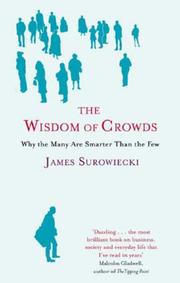
The Wisdom of Crowds:Why the Many Are Smarter Than the Few an...
Provides broader context on collective behaviour.

Sabbatai Ṣevi
First published 1973. Subjects: Sabbathaians, Jews, Biography, Cabala, Jews, turkey.
Endnotes
1.
Source: cambridge.org
Link:https://www.cambridge.org/core/books/cambridge-history-of-judaism/sabbatai-zevi-and-the-sabbatean-movement/10D5A1FB8D131C58B6F9792E824E7EA1
Source snippet
Cambridge University Press & AssessmentSabbatai Zevi and the Sabbatean Movement (Chapter 18)The messianic movement surrounding Sabbatai Z...
2.
Source: jstor.org
Link:https://www.jstor.org/stable/20101190
Source snippet
Sabbatai Zevi case is derived from Christian Millenarian expectations. might...
3.
Source: onlinelibrary.wiley.com
Link:https://onlinelibrary.wiley.com/doi/10.1111/1467-9809.12818
Source snippet
Wiley Online LibraryThe True Messiah (1669) by Yoannikii Galiatovskii: An Anti...16 Jan 2022 — Sabbatai Zevi, a Kabbalist from Izmir, le...
4.
Source: jstor.org
Link:https://www.jstor.org/stable/43298763
Source snippet
THE FIRST CONSPIRACY THEORIES ABOUT THE DÖNME. Anti-Semitic conspiracy theories are not new to Turkey.... ANTI-SEMITISM AND ANTI-DÖNME C...
5.
Source: dayan.org
Title: conspiracy theory culture turkey and crypto jews donmes
Link:https://dayan.org/content/conspiracy-theory-culture-turkey-and-crypto-jews-donmes
Source snippet
He is the author of Online Anti-Semitism in Turkey (Palgrave)...
6.
Source: historystudies.net
Link:https://www.historystudies.net/eng/menemen-incident-in-the-official-documents-and-the-press_450
Source snippet
"Menemen Incident" in the Official Documents and the PressThe "Kubilay Incident" or "Menemen Incident" on December 23, 1930, is one of th...
Published: December 23, 1930
7.
Source: ismetinonu.org.tr
Link:https://www.ismetinonu.org.tr/en/today-in-history-23-december/
8.
Source: jstor.org
Link:https://www.jstor.org/stable/4283969
9.
Source: journals.openedition.org
Link:https://journals.openedition.org/remmm/261?lang=en
10.
Source: researchgate.net
Link:https://www.researchgate.net/publication/341101924_A_Reaction_to_Authoritarian_Modernization_in_Turkey_The_Menemen_Incident_and_the_Creation_and_Contestation_of_a_Myth
11.
Source: jstor.org
Link:https://www.jstor.org/stable/4283411
12.
Source: jhi.pl
Link:https://www.jhi.pl/en/articles/the-false-messiah-who-was-sabbatai-zevi%2C4472
13.
Source: jstor.org
Link:https://www.jstor.org/stable/10.2979/jfolkrese.56.1.03
14.
Source: uscirf.gov
Title: sivas massacre and turkeys persecution alevi community
Link:https://www.uscirf.gov/news-room/uscirf-spotlight/sivas-massacre-and-turkeys-persecution-alevi-community
15.
Source: amnestyusa.org
Title: the ghosts of sivas justice denied in turkey
Link:https://www.amnestyusa.org/blog/the-ghosts-of-sivas-justice-denied-in-turkey/
16.
Source: academia.edu
Title: Framing the First Satanic Murder in Turkey
Link:https://www.academia.edu/21046113/Framing_the_First_Satanic_Murder_in_Turkey
17.
Source: onlinelibrary.wiley.com
Link:https://onlinelibrary.wiley.com/doi/10.1111/johs.70032?af=R
18.
Source: compass.onlinelibrary.wiley.com
Title: Online Library Heavy metal in Turkey: Tracking the tensions
Link:https://compass.onlinelibrary.wiley.com/doi/10.1111/soc4.13122
19.
Source: journals.openedition.org
Link:https://journals.openedition.org/volume/3354
20.
Source: pmc.ncbi.nlm.nih.gov
Link:https://pmc.ncbi.nlm.nih.gov/articles/PMC7312265/
21.
Source: pdf.journalagent.com
Title: Journal Agent Life-threatening Blue Whale Violent Video Game
Link:https://pdf.journalagent.com/cayb/pdfs/CAYB-12599-CASE_REPORT-UYSAL_YAZICI.pdf
22.
Source: pmc.ncbi.nlm.nih.gov
Title: PMCMass psychogenic illness and the social network
Link:https://pmc.ncbi.nlm.nih.gov/articles/PMC3536509/
23.
Source: jstor.org
Link:https://www.jstor.org/stable/4283799
24.
Source: jstor.org
Link:https://www.jstor.org/stable/25188259
25.
Source: jstor.org
Link:https://www.jstor.org/stable/26538860
26.
Source: jstor.org
Link:https://www.jstor.org/stable/25567843
27.
Source: jstor.org
Link:https://www.jstor.org/stable/10.1525/nr.2012.16.2.47
28.
Source: researchgate.net
Link:https://www.researchgate.net/publication/386017206_Global_migrations_of_the_discourse_of_gender_ideology_and_moral_panics_transnational_fundamentalism_from_the_Vatican_to_Turkey
29.
Source: researchgate.net
Link:https://www.researchgate.net/publication/297162036_Satanism_and_Ritual_Abuse
30.
Source: researchgate.net
Link:https://www.researchgate.net/publication/357172459_Investigation_of_Social_Approaches_in_Different_Countries_towards_Suicide_of_the_Blue_Whale_Game_through_Newspaper_News
31.
Source: researchgate.net
Link:https://www.researchgate.net/publication/265883339_An_Enemy_Old_and_New_The_Donme_Anti-Semitism_and_Conspiracy_Theories_in_the_Ottoman_Empire_and_Turkish_Republic
32.
Source: researchgate.net
Link:https://www.researchgate.net/publication/292145151_Deconstructing_a_Modern_Witch_Hunt_Satanic_Cults_Ritual_Abuse_and_Moral_Panic
33.
Source: researchgate.net
Link:https://www.researchgate.net/publication/403056167_Secular_nationalism_in_Turkey_mapping_of_a_reactionary_ideological_domain
34.
Source: researchgate.net
Link:https://www.researchgate.net/publication/375429283_Sectarianism_as_racism_the_collective_punishment_of_Alevi_communities_in_Turkey
35.
Source: researchgate.net
Link:https://www.researchgate.net/publication/238566706_Emotions_in_Conflict_Correlates_of_Fear_and_Hope_in_the_Israeli-Jewish_Society
36.
Source: researchgate.net
Title: 382085056 In Between Invisibility and Recognition The Sivas Massacre
Link:https://www.researchgate.net/publication/382085056_In_Between_Invisibility_and_Recognition_The_Sivas_Massacre
37.
Source: cambridge.org
Link:https://www.cambridge.org/core/books/cambridge-companion-to-metal-music/metal-in-the-middle-east/E611F77E491E2859BC417197A5533975
38.
Source: youtube.com
Title: Sabbatai Zevi
Link:https://www.youtube.com/watch?v=qxQIodTHhjI
Source snippet
Shabtai Zvi, the Mystical Messiah (1626-1676)...
39.
Source: scholarlypublications.universiteitleiden.nl
Link:https://scholarlypublications.universiteitleiden.nl/access/item%3A2723343/download
40.
Source: degruyterbrill.com
Link:https://www.degruyterbrill.com/document/doi/10.1515/9783110654509-009/html?srsltid=AfmBOopckgAwV5-IoEUVAbhRrp9qc_E2PFUGCs8wf_3ockk3tYnA9EI-
41.
Source: journal.fi
Link:https://journal.fi/scripta/article/view/67304/27601
42.
Source: sup.org
Title: Stanford University Press The Horrors of Adana
Link:https://www.sup.org/books/middle-east-studies/horrors-adana/excerpt/introduction-excerpt
43.
Source: scholarlypublications.universiteitleiden.nl
Link:https://scholarlypublications.universiteitleiden.nl/handle/1887/17503
44.
Source: scholarlypublications.universiteitleiden.nl
Link:https://scholarlypublications.universiteitleiden.nl/access/item%3A2716252/view
45.
Source: openaccess.bilgi.edu.tr
Link:https://openaccess.bilgi.edu.tr/bitstream/handle/11411/1735/A%20moral%20panic%20sketch%20%28re%29presenting%20the%20contours%20of%20a%20moral%20panic%20and%20partaking%20of%20media.pdf?isAllowed=y&sequence=1
46.
Source: dergipark.org.tr
Title: Dergi Park Institutional Context, Triggers and Symptoms of Mass
Link:https://dergipark.org.tr/en/download/article-file/5049491
47.
Source: lemonde.fr
Link:https://www.lemonde.fr/en/international/article/2024/12/06/in-turkey-a-tv-series-that-mirrors-society-from-ban-to-audience-success_6735322_4.html
Source snippet
Despite early controversy, the series grew immensely popular, drawing over seven million viewers and becoming Turkey’s most-watched show...
48.
Source: Wikipedia
Title: Moral panic
Link:https://en.wikipedia.org/wiki/Moral_panic
49.
Source: Wikipedia
Title: Mass psychogenic illness
Link:https://en.wikipedia.org/wiki/Mass_psychogenic_illness
50.
Source: Wikipedia
Title: Sabbatai Zevi
Link:https://en.wikipedia.org/wiki/Sabbatai_Zevi
51.
Source: pmc.ncbi.nlm.nih.gov
Link:https://pmc.ncbi.nlm.nih.gov/articles/PMC4884863/
52.
Source: pmc.ncbi.nlm.nih.gov
Link:https://pmc.ncbi.nlm.nih.gov/articles/PMC9210177/
53.
Source: pmc.ncbi.nlm.nih.gov
Link:https://pmc.ncbi.nlm.nih.gov/articles/PMC12860665/
54.
Source: pmc.ncbi.nlm.nih.gov
Link:https://pmc.ncbi.nlm.nih.gov/articles/PMC9893309/
55.
Source: anthropologymatters.com
Link:https://www.anthropologymatters.com/index.php/anth_matters/article/view/44/82
56.
Source: ebsco.com
Link:https://www.ebsco.com/research-starters/social-sciences-and-humanities/mass-hysteria
57.
Source: scholarship.tricolib.brynmawr.edu
Link:https://scholarship.tricolib.brynmawr.edu/bitstreams/a9b523b1-7a8a-4d21-8bd7-6e632a35f402/download
58.
Source: healthline.com
Title: mass hysteria
Link:https://www.healthline.com/health/mental-health/mass-hysteria
59.
Source: dergipark.org.tr
Link:https://dergipark.org.tr/en/pub/jnbs/article/1741021
60.
Source: dergipark.org.tr
Link:https://dergipark.org.tr/tr/download/article-file/447686
61.
Source: cogitatiopress.com
Link:https://www.cogitatiopress.com/mediaandcommunication/article/download/10526/4756
62.
Source: avesis.yildiz.edu.tr
Title: virtual demons blue whale and moral panic in the digital age
Link:https://avesis.yildiz.edu.tr/yayin/e3e632a1-c97a-4ebd-bb76-a92f3a667fdb/virtual-demons-blue-whale-and-moral-panic-in-the-digital-age
Additional References
63.
Source: journals.sagepub.com
Title: 1467 954X.12016
Link:https://journals.sagepub.com/doi/10.1111/1467-954X.12016
Source snippet
Sage JournalsPolitical Parties' Perceptions and Uses of Anti-Semitic...by TS Nefes · 2013 · Cited by 84 — This paper contributes to the...
64.
Source: arxiv.org
Title: arXiv Online Suicide Games: A Form of Digital Self-harm or A Myth?
Link:https://arxiv.org/abs/2012.00530
65.
Source: discourseunit.com
Link:https://discourseunit.com/wp-content/uploads/2016/05/turkey-i-901-915.pdf
66.
Source: reddit.com
Link:https://www.reddit.com/r/history/comments/4o8dkd/examples_of_mass_hysteria_through_the_ages/
67.
Source: jnbs.org
Link:https://jnbs.org/uploads/files/1032739jnbs123278_tr.pdf
68.
Source: athensjournals.gr
Link:https://www.athensjournals.gr/media/2022-8-1-3-Sezgin.pdf
69.
Source: study.com
Link:https://study.com/learn/lesson/mass-hysteria-moral-panic.html
70.
Source: apothecaries.org
Link:https://www.apothecaries.org/wp-content/uploads/2019/06/Mass-psychogenic-illness-and-how-to-respond.pdf
71.
Source: europenowjournal.org
Link:https://www.europenowjournal.org/2016/10/31/secularism-and-religion-the-attempted-coup-in-turkey/
72.
Source: Wikipedia
Link:https://en.wikipedia.org/wiki/Sivas_massacre
Topic Tree
Follow this branch
Related pages 192
- Antigua and Barbuda
- Argentina Belief Scares
- Azerbaijan Belief
- Bahrain Beliefs
- North Korea
- +187 more in sidebar