Within Sri Lanka Panics
Were Sri Lanka's Grease Devils Real?
Reports of night attackers became a nationwide scare shaped by real assaults, folklore, vigilantism and distrust of the security forces.
On this page
- From prowler reports to nationwide panic
- Why communities suspected state protection
- Crime, folklore and mistaken identity
Page outline Jump by section
Introduction
The 2011 “grease devil” panic was one of the most striking episodes of collective fear in post-war Sri Lanka. Reports of mysterious night-time attackers, described as men whose bodies were coated in grease or dark substances to make them difficult to catch, spread rapidly across much of the country. Although some assaults on women were genuine, the panic quickly expanded beyond documented crimes. Rumours, folklore, political distrust and fear combined to produce armed neighbourhood patrols, mob attacks on innocent people, clashes with the security forces and widespread disruption to daily life. Rather than being a simple case of mass hysteria, the episode is now widely understood as an interaction between real violence, rumour and the deep insecurity left by decades of civil war.[LSE Research Online]researchonline.lse.ac.ukLSE Research OnlineDemonic violence and moral panic in post-war Sri Lanka:explaining the “Grease Devils”June 30, 2014…

From prowler reports to nationwide panic
The figure of the “grease devil” was not entirely new. Sri Lankan folklore already included stories of burglars who smeared themselves with grease so they could slip from the grasp of pursuers. During 2011, however, this familiar criminal image evolved into something far more frightening: an anonymous night-time predator said to stalk women, scratch or assault them, and disappear before capture.[LSE Research Online]researchonline.lse.ac.ukLSE Research OnlineDemonic violence and moral panic in post-war Sri Lanka:explaining the “Grease Devils”June 30, 2014…
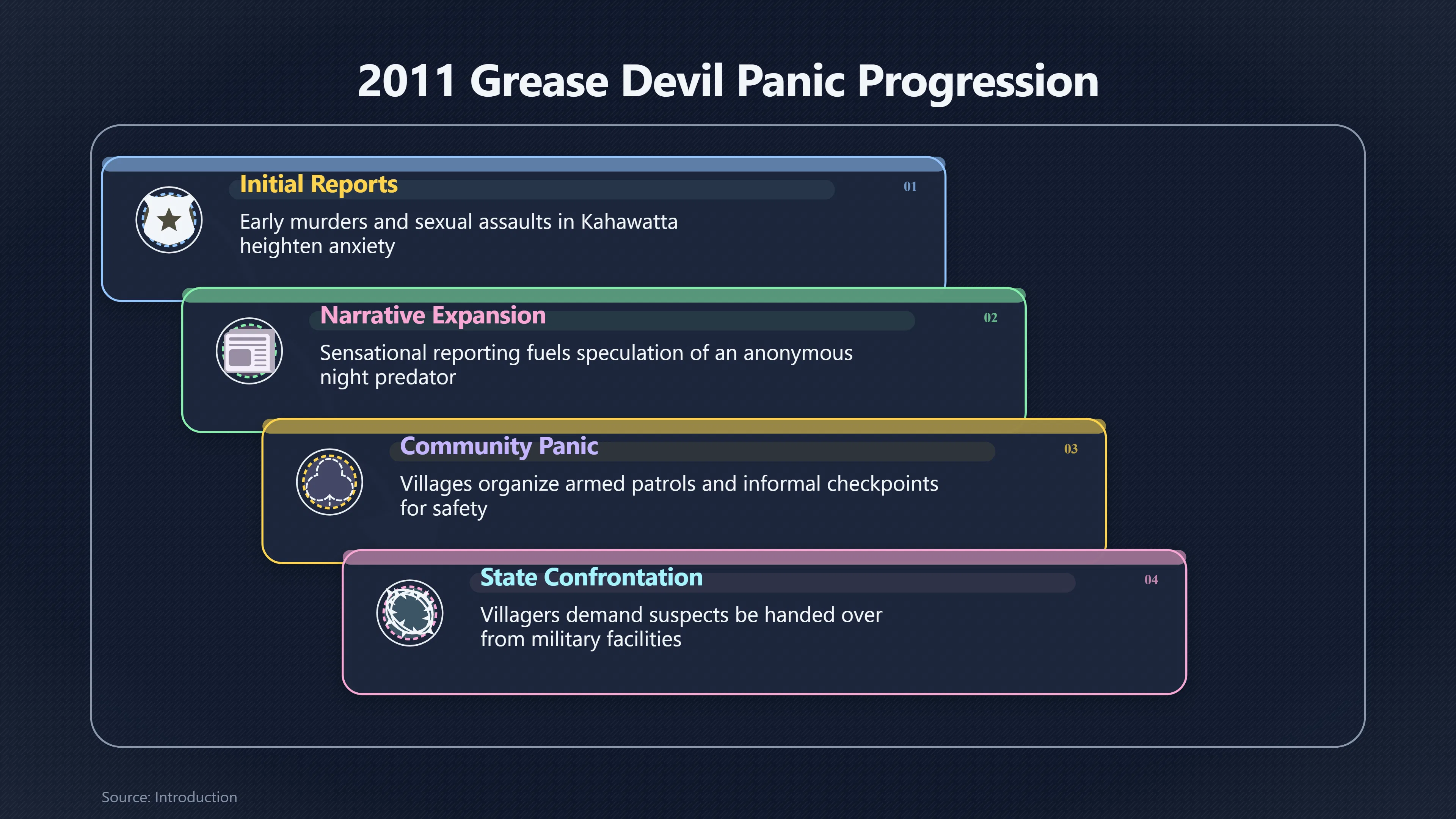
The panic developed during August and early September 2011 after reports of attacks in several districts. Earlier murders and sexual assaults around Kahawatta had already heightened public anxiety, while sensational reporting encouraged speculation that an unknown predator remained at large. As new incidents appeared elsewhere, many communities began interpreting unrelated suspicious events through the same narrative. People reported shadowy figures fleeing into darkness, unexplained noises, scratches and attempted intrusions, all of which became incorporated into the expanding story of the grease devil.[crisisgroup.org]crisisgroup.orgCrisis Group SRI LANKA: WOMEN’S INSECURITY IN THE NORTH AND EASTCrisis Group SRI LANKA: WOMEN’S INSECURITY IN THE NORTH AND EAST
The scare spread especially quickly through plantation districts and the Tamil- and Muslim-majority areas of the north and east. In many villages, women avoided leaving home after dark, schools experienced disruption, and estate workers stayed away from work while groups of local men organised nightly patrols armed with sticks, knives and improvised weapons. The pattern often repeated itself from village to village: a handful of reports would trigger intense vigilance for several days before gradually subsiding, only for similar events to erupt elsewhere.[LSE Research Online]researchonline.lse.ac.ukLSE Research Online Rajesh VenugopalLSE Research OnlineRajesh VenugopalFebruary 12, 2026…
Why communities suspected state protection
The most politically significant feature of the panic was not belief in supernatural powers but widespread suspicion that the attackers enjoyed protection from the security forces.
Many reports claimed that pursued suspects escaped into police stations, military camps or naval bases. In the heavily militarised north and east, where communities had recently emerged from civil war, these stories fitted long-standing fears about surveillance, disappearances and impunity. For many residents, official denials were less persuasive than lived experience of weak accountability during and after the conflict.[Crisis Group]crisisgroup.orgCrisis Group SRI LANKA: WOMEN’S INSECURITY IN THE NORTH AND EASTCrisis Group SRI LANKA: WOMEN’S INSECURITY IN THE NORTH AND EAST
Several confrontations became highly charged. Near Kinniya and elsewhere in the Eastern Province, villagers believed suspects had fled into nearby military facilities and demanded that soldiers hand them over. Similar tensions arose around Navanthurai near Jaffna. These confrontations sometimes escalated into clashes between civilians and the security forces, followed by arrests of local residents rather than the alleged attackers, reinforcing suspicions that authorities were protecting the perpetrators.[srilankabrief.org]srilankabrief.orgSri Lanka Brief Grease Devils • Sri Lanka BriefSri Lanka BriefGrease Devils • Sri Lanka BriefSeptember 11, 2011…
Government statements often proved counterproductive. Officials variously described the grease devil as a myth, a rumour, political sabotage or an anti-government conspiracy, while police simultaneously announced arrests of individuals accused of impersonating grease devils. These contradictory messages undermined public confidence and encouraged many people to believe that the full truth was being concealed.[LSE Research Online]researchonline.lse.ac.ukLSE Research OnlineDemonic violence and moral panic in post-war Sri Lanka:explaining the “Grease Devils”June 30, 2014…
Crime, folklore and mistaken identity
One reason the panic became so dangerous was that it combined several different realities into a single narrative.
There is substantial evidence that some women genuinely experienced night-time assaults. The International Crisis Group reviewed numerous incidents and concluded that many attacks were real, although they varied considerably in nature and no single organised network of attackers was ever established. The existence of genuine victims made it easier for rumours to gain credibility.[Crisis Group]crisisgroup.orgCrisis Group SRI LANKA: WOMEN’S INSECURITY IN THE NORTH AND EASTCrisis Group SRI LANKA: WOMEN’S INSECURITY IN THE NORTH AND EAST
At the same time, folklore supplied an interpretive framework. Traditional stories of slippery thieves merged with demon-like imagery, producing an attacker who appeared almost impossible to catch. Ordinary criminal behaviour, rumours and supernatural expectations became intertwined until almost any suspicious person could be interpreted as a grease devil.[LSE Research Online]researchonline.lse.ac.ukLSE Research OnlineDemonic violence and moral panic in post-war Sri Lanka:explaining the “Grease Devils”June 30, 2014…
The consequences were often tragic. Innocent people were attacked after being mistaken for prowlers. Two men were beaten to death by tea estate workers in Haputale after being identified as grease devils, while other deaths occurred during chases, confrontations and panic-driven accidents. Police officers, soldiers and civilians all became targets of violence in different incidents as fear overwhelmed efforts to establish what had actually happened.[lse.ac.uk]eprints.lse.ac.ukLSE Research Online Rajesh VenugopalLSE Research OnlineRajesh VenugopalNovember 8, 2025…
Why vigilante groups emerged so quickly
The panic illustrates how collective fear can shift from individual anxiety to organised community action.
Many residents believed that waiting for official protection was pointless. In response, neighbourhoods organised patrols, set up informal checkpoints and used whistles, drums or shouted warnings to alert neighbours when suspicious figures were reported. These measures were intended to provide security but also increased the likelihood that rumours would spread rapidly and that strangers would be confronted before their identities could be verified.[LSE Research Online]researchonline.lse.ac.ukLSE Research Online Rajesh VenugopalLSE Research OnlineRajesh VenugopalFebruary 12, 2026…
Researchers note that vigilantism was driven by more than simple panic. In areas recovering from war, it reflected a collapse of confidence in formal policing and justice. Collective self-defence became both a practical response to perceived danger and a symbolic assertion that communities had to protect themselves because the state either could not or would not do so.[LSE Research Online]researchonline.lse.ac.ukLSE Research OnlineDemonic violence and moral panic in post-war Sri Lanka:explaining the “Grease Devils”June 30, 2014…

Were Sri Lanka’s grease devils real?
The answer depends on which part of the story is being examined.
Evidence indicates that some assaults on women genuinely occurred, and police arrested individuals for particular attacks and related offences. However, there is no credible evidence that a single coordinated organisation of “grease devils” operated across Sri Lanka or that supernatural attackers existed. Instead, different local crimes, false alarms, rumours, mistaken identities and deliberate impersonations became fused into one national narrative.[Crisis Group]crisisgroup.orgCrisis Group SRI LANKA: WOMEN’S INSECURITY IN THE NORTH AND EASTCrisis Group SRI LANKA: WOMEN’S INSECURITY IN THE NORTH AND EAST
Scholars therefore argue that the crisis cannot be dismissed simply as irrational hysteria. Rajesh Venugopal, whose detailed study combines fieldwork with historical analysis, argues that the episode can be understood in several complementary ways: as a response to genuine insecurity, as a politically meaningful expression of distrust towards state authority, and as a symbolic language through which communities explained fears that were otherwise difficult to articulate after the civil war.[LSE Research Online]researchonline.lse.ac.ukLSE Research OnlineDemonic violence and moral panic in post-war Sri Lanka:explaining the “Grease Devils”June 30, 2014…
Why the episode still matters
The grease devil panic remains one of Sri Lanka’s clearest examples of how rumours become socially powerful when they resonate with existing fears.
Its significance lies not in proving whether every reported attacker existed, but in demonstrating how communities experiencing insecurity interpret uncertain events. Genuine crimes, sensational reporting, historical folklore and political mistrust reinforced one another until collective vigilance itself became a source of violence.
The episode also illustrates why broad labels such as “mass hysteria” are often inadequate. The panic contained documented assaults, false accusations, vigilantism, ethnic and political tensions, institutional failures and deeply rooted memories of conflict. Understanding all of these elements together explains why the fear spread so rapidly, why official reassurances failed to calm it, and why the grease devil crisis remains a defining case in Sri Lanka’s modern history of rumour panics and collective fear.[lse.ac.uk]researchonline.lse.ac.ukLSE Research OnlineDemonic violence and moral panic in post-war Sri Lanka:explaining the “Grease Devils”June 30, 2014…
Amazon book picks
Further Reading
Books and field guides related to Were Sri Lanka's Grease Devils Real?. Use these as the next step if you want deeper reading beyond the article.
Extraordinary Popular Delusions and the Madness of Crowds
Rating: 4.0/5 from 5 Google Books ratings
Strong fit for rumor-driven nationwide panic.
The Psychology of Conspiracy Theories
Explains why alarming stories spread and persist.
Endnotes
1.
Source: ft.lk
Title: “Grease devil” panic grips, at least 3 killed | Daily FT
Link:https://www.ft.lk/front-page/%E2%80%9Cgrease-devil%E2%80%9D-panic-grips-at-least-3-killed/44-43390
2.
Source: Wikipedia
Title: Grease devil crisis in Sri Lanka
Link:https://en.wikipedia.org/wiki/Grease_devil_crisis_in_Sri_Lanka
3.
Source: ft.lk
Title: Thousands besiege govt. office over “Grease Devils” | Daily FT
Link:https://www.ft.lk/News/thousands-besiege-govt-office-over-grease-devils/56-43685
4.
Source: researchonline.lse.ac.uk
Link:https://researchonline.lse.ac.uk/57210/
Source snippet
LSE Research OnlineDemonic violence and moral panic in post-war Sri Lanka:explaining the “Grease Devils”June 30, 2014...
Published: June 30, 2014
5.
Source: crisisgroup.org
Title: Crisis Group SRI LANKA: WOMEN’S INSECURITY IN THE NORTH AND EAST
Link:https://www.crisisgroup.org/sites/default/files/217-sri-lanka-women-s-insecurity-in-the-north-and-east.pdf
6.
Source: researchonline.lse.ac.uk
Title: LSE Research Online Rajesh Venugopal
Link:https://researchonline.lse.ac.uk/id/eprint/57210/1/_lse.ac.uk_storage_LIBRARY_Secondary_libfile_shared_repository_Content_Venugopal%2C%20R_Venugopal_Demonic%20violence_moral_2014Venugopal_Demonic%20violence_moral_2014.pdf
Source snippet
LSE Research OnlineRajesh VenugopalFebruary 12, 2026...
Published: February 12, 2026
7.
Source: srilankabrief.org
Title: Sri Lanka Brief Grease Devils • Sri Lanka Brief
Link:https://srilankabrief.org/grease-devils/
Source snippet
Sri Lanka BriefGrease Devils • Sri Lanka BriefSeptember 11, 2011...
Published: September 11, 2011
8.
Source: eprints.lse.ac.uk
Title: LSE Research Online Rajesh Venugopal
Link:https://eprints.lse.ac.uk/57210/1/_lse.ac.uk_storage_LIBRARY_Secondary_libfile_shared_repository_Content_Venugopal%2C%20R_Venugopal_Demonic%20violence_moral_2014Venugopal_Demonic%20violence_moral_2014.pdf
Source snippet
LSE Research OnlineRajesh VenugopalNovember 8, 2025...
Published: November 8, 2025
Additional References
9.
Source: cambridge.org
Link:https://www.cambridge.org/core/journals/journal-of-asian-studies/article/abs/demonic-violence-and-moral-panic-in-postwar-sri-lanka-explaining-the-grease-devil-crisis/1B9A7A938B1A9175CF70FB66D4F6C99A
Source snippet
Cambridge University Press & AssessmentDemonic Violence and Moral Panic in Postwar Sri Lanka: Explaining the Grease Devil Crisis | The Jo...
10.
Source: researchgate.net
Title: (PDF) Ethnic domination and liberal democracy in Sri Lanka
Link:https://www.researchgate.net/publication/359170947_Ethnic_domination_and_liberal_democracy_in_Sri_Lanka
Source snippet
In July–September 2011, an extraordinary wave of mass tension and anxiety took hold across Sri Lanka with reports of widespread attacks o...
Published: September 2011
11.
Source: youtube.com
Title: ‘Grease devil’ boomeranged back to the govt
Link:https://www.youtube.com/watch?v=50VvBkOLblA
Source snippet
"Grease devil" "sri lanka" Another 'grease devil' attacked, unrest in Nawatkuda adaderana...
12.
Source: youtube.com
Title: Alleged “grease devil” captured and bound in Nawalapitiya
Link:https://www.youtube.com/watch?v=ZpTo-jfH_MI
Source snippet
'Grease devil' boomeranged back to the govt - Tilvin...
13.
Source: youtube.com
Title: Another ‘grease devil’ attacked, unrest in Nawatkuda
Link:https://www.youtube.com/watch?v=fvSc3nV7GEc
Source snippet
Alleged "grease devil" captured and bound in Nawalapitiya...
14.
Source: youtube.com
Title: Collective Trauma Response in Sri Lanka
Link:https://www.youtube.com/watch?v=lJXFRLdf_fY
Source snippet
'Grease Yaka' a myth - Police...
15.
Source: researchgate.net
Link:https://www.researchgate.net/publication/280947556_Demonic_Violence_and_Moral_Panic_in_Postwar_Sri_Lanka_Explaining_the_Grease_Devil_Crisis
16.
Source: lankastandard.com
Title: More than 100 arrested in new Sri Lanka “Grease Devil” clash « LANKA Standard
Link:https://www.lankastandard.com/2011/08/more-than-100-arrested-in-new-sri-lanka-grease-devil-clash/
17.
Source: youtube.com
Title: ‘Grease Yaka’ a myth
Link:https://www.youtube.com/watch?v=OS0ewwnYrGc
Source snippet
Another 'grease devil' attacked, unrest in Nawatkuda...
18.
Source: researchgate.net
Title: 358177605 Figures of Menace Militarisation in Post War Sri Lanka
Link:https://www.researchgate.net/publication/358177605_Figures_of_Menace_Militarisation_in_Post-War_Sri_Lanka
Topic Tree