Within Togo
Why Political Crisis Fuelled Rumours of Occult Power
During Togo's democratic crisis, rumours of hidden rituals and supernatural protection helped explain an opaque and violent presidency.
On this page
- The National Conference and the struggle over state power
- Stories of supernatural protection and secret authority
- Why rumours flourished when reliable information was scarce
Page outline Jump by section
Introduction
Togo’s democratic crisis of 1991 produced the country’s best-documented episode of large-scale political rumour. As President Gnassingbé Eyadéma’s long-standing authoritarian system came under unprecedented pressure from a National Conference that sought to create a democratic transition, many Togolese turned to stories about hidden supernatural forces to explain events that seemed confusing, dangerous and opaque. Rumours that the president possessed mystical protection, relied on secret rituals, or drew strength from invisible powers circulated alongside equally dramatic stories about plots against him and the hidden motives of political rivals. These accounts were not simply colourful folklore. They became part of how ordinary people interpreted power when official information was scarce, censorship had recently collapsed, and violence made reliable reporting difficult. Historians now regard these rumours as an important window into how political authority was understood during one of the most unstable moments in modern Togolese history.[africabib.org]africabib.orgOpen source on africabib.org.
The National Conference and the struggle over state power
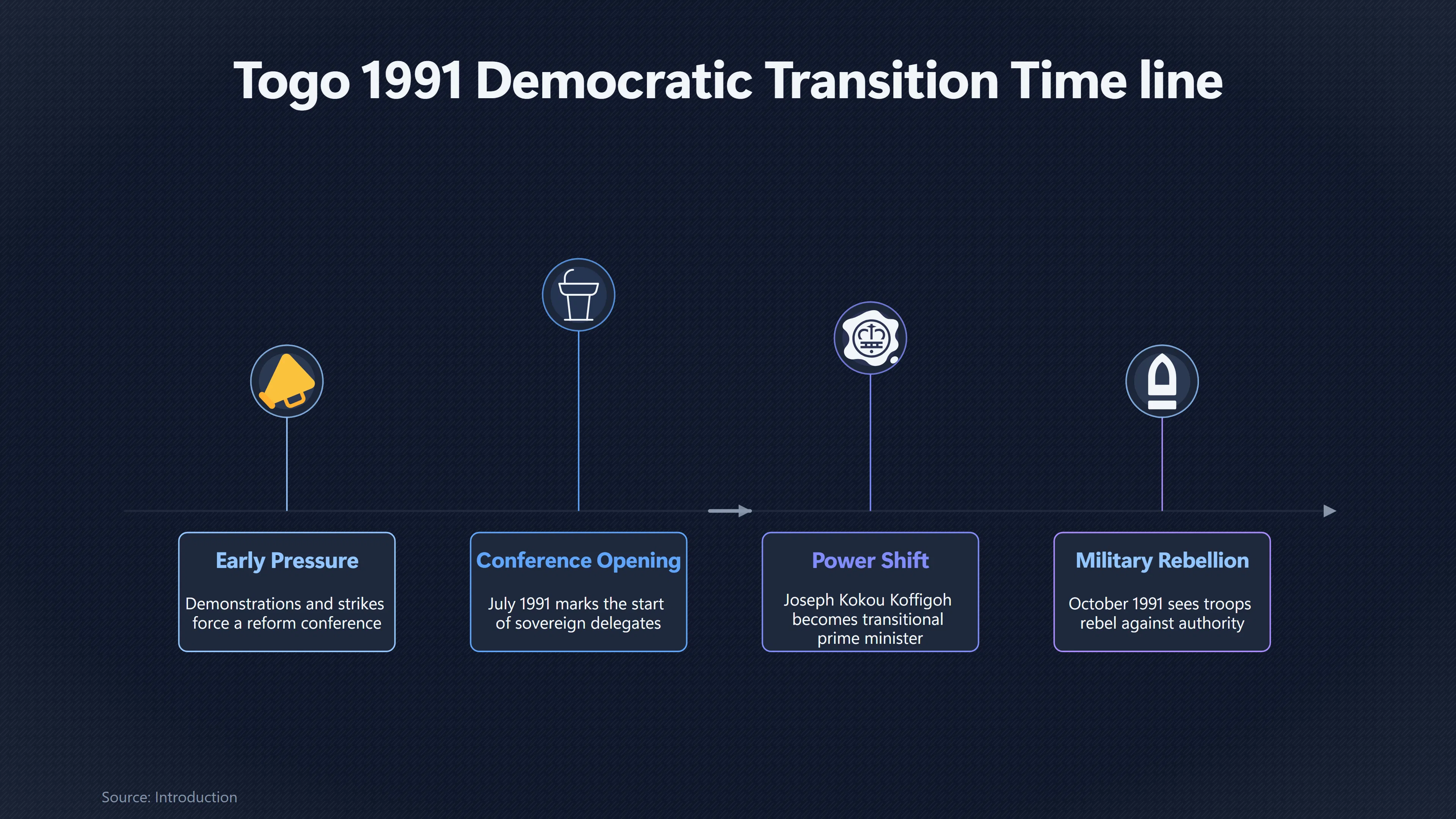
The immediate backdrop was a nationwide movement demanding political reform. Demonstrations, strikes and negotiations during the first half of 1991 forced President Eyadéma to accept a National Conference, which opened in July after weeks of political tension. Inspired by similar conferences elsewhere in Francophone Africa, delegates declared themselves sovereign, established transitional institutions and sharply reduced the president’s formal authority. Joseph Kokou Koffigoh became transitional prime minister while Eyadéma remained head of state with greatly diminished constitutional powers.[latimes.com]latimes.comLos Angeles Times World IN BRIEF: TOGO: President Agrees to Crisis ConferenceLos Angeles TimesWorld IN BRIEF: TOGO: President Agrees to Crisis Conference - Los Angeles TimesJune 13, 1991…
On paper, these decisions suggested that the old political order had been fundamentally transformed. In practice, however, the president retained influence over the armed forces and much of the state apparatus. Military confrontations, attempted coups, negotiations and reversals followed throughout the second half of 1991. What appeared to outsiders as contradictory political developments encouraged many citizens to search for explanations beyond formal constitutional politics.[washingtonpost.com]washingtonpost.comThe Washington Post TROOPS REBEL IN TOGOThe Washington PostTROOPS REBEL IN TOGO - The Washington PostOctober 1, 1991…
Political uncertainty was intensified by the sudden expansion of public discussion. Newspapers that had previously been tightly controlled became far more outspoken, while debates spilled into markets, workplaces and neighbourhoods. Information circulated rapidly but was often impossible to verify, creating ideal conditions for rumours to flourish.[AfricaBib]africabib.orgOpen source on africabib.org.
Stories of supernatural protection and secret authority
Many rumours centred on the apparent resilience of President Eyadéma. After ruling since 1967, he had already cultivated an image of extraordinary personal destiny through official propaganda, including repeated celebrations of surviving a 1974 aircraft crash that the regime portrayed as evidence of exceptional protection and victory over hostile forces. This official political mythology helped make later rumours about supernatural invulnerability seem plausible to many listeners.[Cambridge University Press & Assessment]cambridge.orgUniversity Press & Assessment Rumour and power in Togo | Africa | Cambridge CoreCambridge University Press & AssessmentRumour and power in Togo | Africa | Cambridge Core…
During the 1991 crisis, stories circulated that the president possessed powerful spiritual protection, relied on hidden ritual specialists, or could not be removed through ordinary political means because invisible forces shielded him. Other rumours claimed that important political decisions reflected secret rituals rather than public negotiations. These stories rarely came with verifiable evidence. Instead, they attempted to explain why a ruler who appeared politically isolated repeatedly survived moments when many expected his downfall.[AfricaBib]africabib.orgOpen source on africabib.org.
Not all rumours favoured the regime. Opposition supporters generated their own narratives about hidden conspiracies within the military, secret negotiations between rival elites and unseen manipulation behind dramatic political events. Rumour therefore became a weapon used by competing political camps rather than simply an expression of belief in occult power.[AfricaBib]africabib.orgOpen source on africabib.org.
Stephen Ellis, whose pioneering study remains the principal scholarly examination of the period, argues that these stories should not be dismissed merely as irrational beliefs. Instead, they formed part of a wider political language through which citizens debated authority, legitimacy and power when conventional political information was unreliable.[AfricaBib]africabib.orgOpen source on africabib.org.

Why rumours flourished when reliable information was scarce
Several conditions combined to make political rumours unusually influential during 1991.
First, the state had long operated with limited transparency. Decisions affecting national politics were often taken behind closed doors, encouraging speculation whenever unexpected events occurred. The rapid collapse of censorship created more discussion but did not immediately produce reliable institutions capable of verifying competing claims.[ecoi.net]ecoi.netUSDOS – US Department of State (Author): “Country Report on Human Rights Practices for 1991”, Document #1113279 - ecoi.net…
Second, the crisis involved genuine uncertainty. Military units did not always follow civilian authorities, constitutional arrangements changed repeatedly and negotiations frequently broke down. Since ordinary citizens could observe only fragments of these developments, rumours helped fill the gaps between observable events.[The Washington Post]washingtonpost.comThe Washington Post TROOPS REBEL IN TOGOThe Washington PostTROOPS REBEL IN TOGO - The Washington PostOctober 1, 1991…
Third, oral communication remained extremely important. Ellis highlights the role of radio trottoir—literally “pavement radio”—the informal circulation of news through conversations in streets, markets and workplaces. Rather than representing simple gossip, this network became an alternative public sphere where people interpreted political events collectively. Stories were constantly revised as they spread, mixing eyewitness accounts, political argument and speculation.[AfricaBib]africabib.orgOpen source on africabib.org.
Finally, ideas about spiritual causation already formed part of many people’s broader understanding of misfortune and power. That did not mean everyone accepted every rumour literally. Instead, references to hidden forces provided a culturally familiar vocabulary for discussing leaders whose real sources of power remained difficult to observe.[OUP Academic]academic.oup.comOUP AcademicRumour and Power in Togo | Charlatans, Spirits and Rebels in Africa: The Stephen Ellis Reader | Oxford Academic…
What the evidence can—and cannot—show
It is important to distinguish between documented rumours and documented supernatural events. Historians possess substantial evidence that rumours about occult protection circulated widely during the crisis because they appear in interviews, contemporary reporting and later scholarly analysis. There is no comparable evidence demonstrating that the supernatural claims themselves were factual.[AfricaBib]africabib.orgOpen source on africabib.org.
Similarly, scholars do not interpret the rumours as proof that Togolese society experienced a classic episode of mass hysteria. The available evidence points instead to a period of collective political uncertainty in which rumour became an important means of interpreting rapidly changing events. The rumours reflected real fears about violence, repression and hidden decision-making, even when their specific supernatural explanations cannot be verified.[AfricaBib]africabib.orgOpen source on africabib.org.
This distinction matters because many stories performed political rather than purely religious functions. They expressed anxieties about accountability, military power and authoritarian rule more than they documented shared supernatural experiences.

Why the 1991 rumours remain historically important
The rumours of 1991 illuminate a broader feature of authoritarian politics in Togo. Where governments restrict information and political institutions lack transparency, citizens often construct alternative explanations that combine observable events with speculation about hidden power. In Togo, these explanations naturally drew on familiar ideas about spiritual protection and invisible authority.
The episode also demonstrates that rumours can become part of political participation rather than merely symptoms of confusion. During the National Conference, competing stories helped citizens debate legitimacy, interpret elite behaviour and judge the credibility of leaders at a time when official narratives were rapidly losing authority.[AfricaBib]africabib.orgOpen source on africabib.org.
For historians of Togo, the crisis therefore marks an important intersection between democratic transition and collective belief. Rather than showing a society overwhelmed by irrational panic, it reveals how political uncertainty, limited access to trustworthy information and culturally meaningful ideas about unseen power combined to produce one of West Africa’s most closely studied episodes of political rumour.[africabib.org]africabib.orgOpen source on africabib.org.
Amazon book picks
Further Reading
Books and field guides related to Why Political Crisis Fuelled Rumours of Occult Power. Use these as the next step if you want deeper reading beyond the article.
Political spiritualities
Examines spiritual interpretations of political power in Africa.
African Politics in Comparative Perspective
Provides context for authoritarianism and democratic transition.
Endnotes
1.
Source: africabib.org
Link:https://www.africabib.org/rec.php?RID=118601113
2.
Source: cambridge.org
Title: University Press & Assessment Rumour and power in Togo | Africa | Cambridge Core
Link:https://www.cambridge.org/core/journals/africa/article/rumour-and-power-in-togo/D779384D459CCAA603999E9DC9CA5EDE
Source snippet
Cambridge University Press & AssessmentRumour and power in Togo | Africa | Cambridge Core...
3.
Source: ecoi.net
Link:https://www.ecoi.net/en/document/1113279.html
Source snippet
USDOS – US Department of State (Author): “Country Report on Human Rights Practices for 1991”, Document #1113279 - ecoi.net...
4.
Source: academic.oup.com
Link:https://academic.oup.com/book/44040/chapter-abstract/373132478
Source snippet
OUP AcademicRumour and Power in Togo | Charlatans, Spirits and Rebels in Africa: The Stephen Ellis Reader | Oxford Academic...
5.
Source: academic.oup.com
Link:https://academic.oup.com/book/44040/chapter/373132478
Source snippet
Front Matter 2. Introduction 3. Section One Method * 1 Writing Histories of Contemporary Africa * 2 Africa’s Wars of Liberation: Some His...
6.
Source: cambridge.org
Link:https://www.cambridge.org/core/journals/international-review-of-social-history/article/fraudonomics-cartooning-against-structural-adjustment-in-togo/28F36BEBA1117F0A82B56E24AC184796
Source snippet
“Fraudonomics”: Cartooning against Structural Adjustment in Togo | International Review of Social History | Cambridge CoreMarch 10, 2021...
Published: March 10, 2021
7.
Source: cambridge.org
Link:https://www.cambridge.org/core/journals/journal-of-modern-african-studies/article/abs/social-origins-of-national-conferences-in-benin-and-togo/286A023864E60E2FE9C02E25530BD54B
8.
Source: ecoi.net
Link:https://www.ecoi.net/en/document/1141509.html
9.
Source: latimes.com
Title: Los Angeles Times World IN BRIEF: TOGO: President Agrees to Crisis Conference
Link:https://www.latimes.com/archives/la-xpm-1991-06-13-mn-894-story.html
Source snippet
Los Angeles TimesWorld IN BRIEF: TOGO: President Agrees to Crisis Conference - Los Angeles TimesJune 13, 1991...
Published: June 13, 1991
10.
Source: washingtonpost.com
Title: The Washington Post TROOPS REBEL IN TOGO
Link:https://www.washingtonpost.com/archive/national/1991/10/02/troops-rebel-in-togo/46b1b8ff-384f-4506-9a11-991dfba9cc86/
Source snippet
The Washington PostTROOPS REBEL IN TOGO - The Washington PostOctober 1, 1991...
Published: October 1, 1991
11.
Source: encyclopedia.com
Title: Togo | Encyclopedia.com
Link:https://www.encyclopedia.com/places/africa/togo-political-geography/togo
12.
Source: amnesty.org
Link:https://www.amnesty.org/en/documents/afr57/003/1991/en/
13.
Source: latimes.com
Title: World IN BRIEF: TOGO: Military Ruler Gives Up Power
Link:https://www.latimes.com/archives/la-xpm-1991-08-29-mn-1845-story.html
Additional References
14.
Source: universalis.fr
Title: Encyclopædia Universalis Chronologie contemporaine
Link:https://www.universalis.fr/chronologie/togo/1991/1/
Source snippet
Encyclopædia UniversalisChronologie contemporaine - Togo (1991) - Encyclopédie Universalis...
15.
Source: ascleiden.nl
Link:https://www.ascleiden.nl/publications/rumour-and-power-togo
16.
Source: amnesty.org
Title: Togo: “disappearance” / fear of extrajudicial killing: David Bruce
Link:https://www.amnesty.org/en/documents/afr57/004/1994/en/
17.
Source: amnesty.org
Title: Togo: Impunity for human rights violators at a time of reform
Link:https://www.amnesty.org/zh-hant/documents/afr57/001/1992/en/
18.
Source: hrw.org
Title: Togo: Government Human Rights Commissions in Africa
Link:https://www.hrw.org/reports/2001/africa/togo/togo3.html
19.
Source: refworld.org
Title: Togo: A New Era for Human Rights? | Refworld
Link:https://www.refworld.org/docid/3ae6a9a9c.html
20.
Source: nvdatabase.swarthmore.edu
Title: togolese citizens campaign democracy 1991
Link:https://nvdatabase.swarthmore.edu/content/togolese-citizens-campaign-democracy-1991
21.
Source: youtube.com
Link:https://www.youtube.com/watch?v=7WvpxzjBzmU
22.
Source: youtube.com
Link:https://www.youtube.com/watch?v=FGlww6X0gBQ
23.
Source: youtube.com
Link:https://www.youtube.com/watch?v=OCBsNphQp0g
Topic Tree