When Britain Believed the Unbelievable
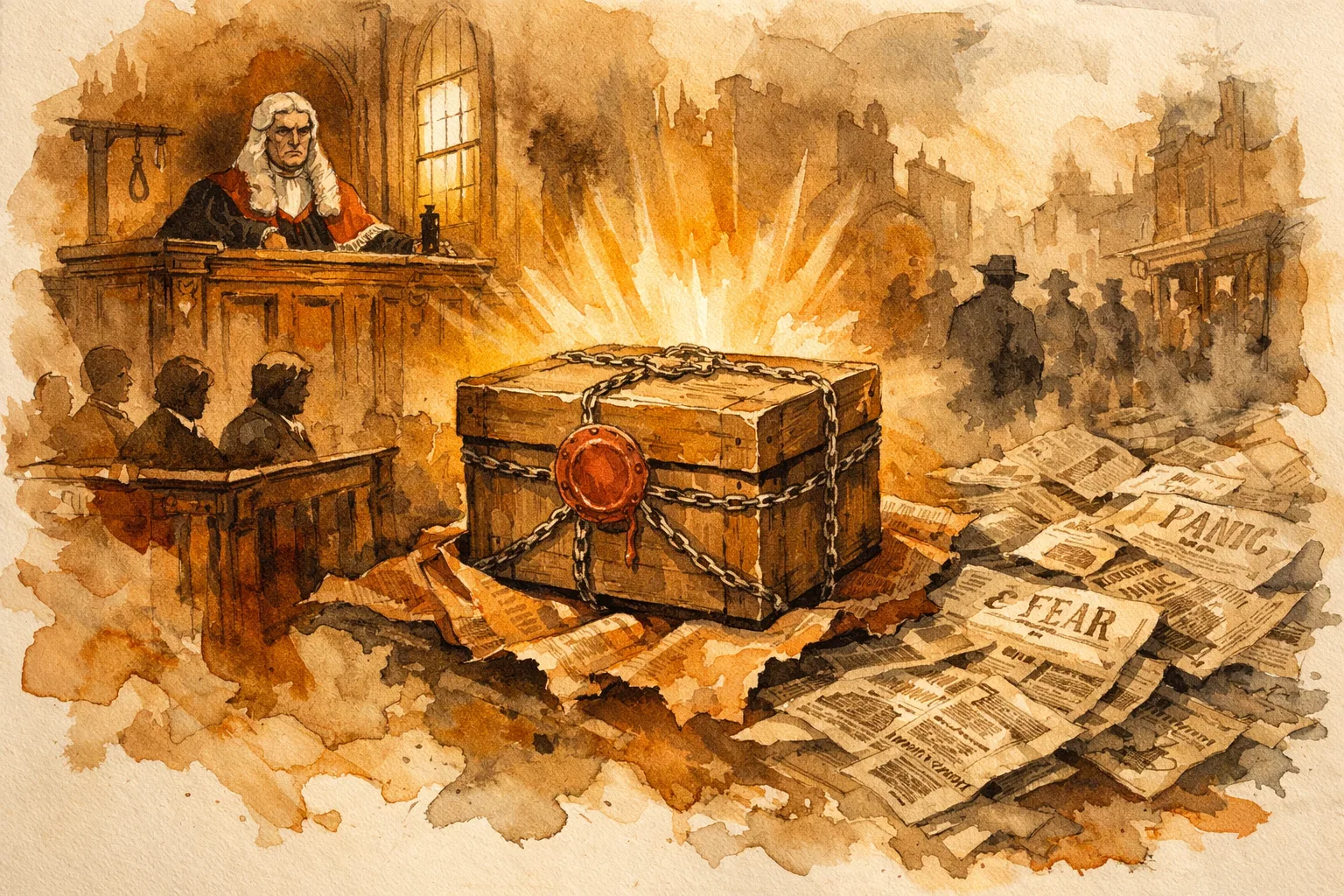
The United Kingdom’s history of collective fear and unusual belief is not one continuous story of “mass hysteria”.
Page outline Jump by section
Introduction
What connects them is the way uncertainty becomes socially contagious. A troubling event is given a compelling explanation; recognised authorities endorse or repeat it; newspapers, sermons, courts or professional networks spread it; and people begin interpreting ambiguous experiences through the same story. Sometimes the result is persecution. Sometimes it is restrictive legislation, family separation or emergency disruption. In other cases it creates a durable religious community. Britain’s record is therefore most useful as a history of how institutions decide what counts as credible danger—and what happens when those decisions are wrong.
Witchcraft became a crime before it became a legend
Britain’s witch trials were not simply outbreaks of irrational crowd behaviour. They were legal persecutions conducted in societies where harmful magic was widely accepted as possible and where governments treated religious uniformity as a matter of public order. Accusations often began with ordinary misfortunes—illness, death, livestock losses or quarrels between neighbours—but became lethal when magistrates, clergy and courts interpreted them through established ideas about demonic conspiracy.
The pattern varied sharply across the kingdoms. England, Scotland and Ireland had different laws, churches and court systems, while Wales experienced comparatively few prosecutions. Scotland’s trials were generally more intensive than England’s, reflecting stronger judicial use of interrogations and a political culture in which witchcraft could be presented as a threat to both church and crown. The North Berwick trials beginning in 1590, for example, grew from allegations that witches had conspired to raise storms against James VI and his Danish bride. Confession, denunciation and royal interest helped transform local accusations into an imagined conspiracy against the state.
In England, the Pendle trials of 1612 remain the best-known example. Twelve people from the Lancashire area were accused of causing ten deaths by witchcraft. One died in prison, one was acquitted and ten were convicted and hanged. The surviving record shows how poverty, family rivalry, reputations for healing or cursing, and the testimony of children could be assembled into a convincing prosecution. It also shows why the modern tourist image of the “Pendle witches” can mislead: the defendants were vulnerable people caught in a judicial process, not members of an organised occult religion.[Historic England]historicengland.org.ukHistoric EnglandWitchcraft and Witch Trials in EnglandOne of the most famous witch trials in British history is that of the Pendle witche…
The most destructive English phase came during the civil wars of the 1640s. In East Anglia, Matthew Hopkins and his associates moved between communities offering to identify witches. Their methods included prolonged watching, searching bodies for supposed marks and encouraging accusations to spread from one suspect to another. Exact totals associated with Hopkins remain disputed, and some popular estimates are inflated, but his campaign clearly exploited wartime disruption, weakened oversight and Puritan fears of hidden enemies.[Historic UK]historic-uk.comMatthew Hopkins Witch Finder GeneralHistoric UKMatthew Hopkins, Witch-Finder General4 Apr 2017 — He and his associates are believed to have been responsible for the deaths o…
The trials declined not because everyone abruptly stopped believing in magic, but because judges and officials became increasingly suspicious of confession evidence, dubious tests and multiplying allegations. Parliament’s 1736 legislation repealed the older laws that treated witchcraft itself as a capital offence. It instead punished people who claimed magical powers in order to deceive others. That change marked an important shift: the law no longer officially accepted that witches could cause supernatural harm, even though popular belief in curses, fortune-telling and spirits continued. The 1736 Act remained available for use against mediums until it was repealed in 1951.[Parliament UK News]parliament.ukNewsWitchcraftThe Act was repealed in 1951 by the Fraudulent Mediums Act which in turn was repealed in 2008…
Later retellings often turn witch trials into stories of timeless superstition defeated by science. The reality is less tidy. The persecutions depended upon institutions—law, theology, local government and print—as much as upon frightened villagers. They also left a warning that remains relevant: once officials accept an invisible conspiracy as the starting assumption, the absence of evidence can itself be interpreted as proof of the conspiracy’s secrecy.
Prophecy could offer hope as well as fear
Apocalyptic belief in Britain has often flourished during periods of war, industrial change and religious upheaval. Yet millenarian movements—groups expecting a dramatic divine transformation of the world—should not automatically be described as panics or “cults”. Many attracted peaceful followers who found dignity, purpose or community in prophecy, even when outsiders considered their expectations absurd.
Joanna Southcott, a Devon-born domestic servant who became a prolific religious prophet, gained thousands of followers around the turn of the nineteenth century. She presented herself as divinely inspired and announced that she would give birth to a messianic child known as Shiloh. In 1814, when she was 64, supporters prepared for the birth. She died later that year and no child was found, but the movement did not simply disappear. Followers reinterpreted the failed expectation and preserved her writings, including a sealed box that she said should be opened by 24 Church of England bishops during a national crisis.[The Panacea Museum]panaceamuseum.orgThe Panacea Museum HistoryThe Panacea MuseumHistoryMarch 6, 2017 — During the 1920s, followers of the Panacea Society moved to Bedford to live near Octavia. In 180…
That box became the centre of one of Britain’s most persistent prophetic campaigns. During the First World War, believers argued that the promised “time of national danger” had arrived. The Panacea Society, established in Bedford after the war, developed from the wider Southcottian tradition. Its members believed that their leader Mabel Barltrop, known as Octavia, held a special divine role, and that Bedford had exceptional spiritual significance. They bought adjoining houses, created a secluded communal “campus” and maintained preparations for the bishops who might eventually open the box.[The Panacea Museum]panaceamuseum.orgThe Panacea Museum HistoryThe Panacea MuseumHistoryMarch 6, 2017 — During the 1920s, followers of the Panacea Society moved to Bedford to live near Octavia. In 180…
The Society’s history illustrates how failed prophecy can sustain rather than destroy belief. Delay could be explained by the bishops’ refusal, humanity’s lack of readiness or uncertainty over which box was authentic. A box opened under the supervision of psychical researcher Harry Price in 1927 contained miscellaneous objects, but Southcottians rejected it as the wrong one. The unresolved condition—24 bishops must open the genuine box—allowed expectation to survive for generations.[The Panacea Museum]panaceamuseum.orgThe Panacea Museum HistoryThe Panacea MuseumHistoryMarch 6, 2017 — During the 1920s, followers of the Panacea Society moved to Bedford to live near Octavia. In 180…
It would nevertheless be misleading to portray the Panacea Society only as a curiosity. Members created a disciplined religious community and distributed pieces of blessed linen to people seeking healing. Its story reveals several recurring features of British millenarianism: charismatic female authority, inventive readings of the Bible, distrust of established churches and the conversion of national emergencies into signs of a sacred timetable. It also demonstrates why the word “cult” can be unhelpful. The label may express an outsider’s judgement without explaining how the group operated, whether people could leave, or what harms—if any—followed from membership.
A later British example linked prophecy to the Space Age. The Aetherius Society was founded in London in the 1950s by George King, who said he received communications from advanced extraterrestrial beings called Cosmic Masters. Scholars generally classify it as a new religious movement or UFO religion combining elements of esotericism, millenarian expectation, spiritual healing and service to humanity. It remained relatively small and is not chiefly known for coercion or violence. Its importance lies in showing how older religious themes—revelation, heavenly beings and planetary salvation—could be reframed in the language of rockets, nuclear danger and extraterrestrial intelligence.[Wikipedia]WikipediaAetherius SocietyAetherius Society
Britain helped define the modern moral panic
A moral panic is not simply a public concern that later proves false. It occurs when a person, group or cultural practice is represented as a serious threat to social values, and the reaction becomes disproportionate, simplified or self-reinforcing. The threatened harm may contain a real element, but publicity and official response turn selected offenders into symbols of a much larger social breakdown.
The concept is strongly associated with sociologist Stanley Cohen’s study of clashes between mods and rockers at English seaside resorts in 1964. There were genuine fights, vandalism and arrests. Cohen’s argument was not that nothing happened, but that press coverage magnified the events, treated loosely connected incidents as evidence of a national youth crisis and established recognisable “folk devils” against whom respectable society could unite. Headlines, predictions of further disorder and intensified policing then helped produce the very confrontations that appeared to confirm the story.[Infodocks]infodocks.files.wordpress.comInfodocks Folk Devils and Moral PanicsInfodocks Folk Devils and Moral Panics
This model remains culturally important because it explains a common British media cycle. A visible incident supplies dramatic images; commentators identify an allegedly new threat; politicians promise action; institutions change their behaviour; and later incidents are interpreted through the same frame. The cycle does not require fabrication. Selective reporting, repetition and exaggerated generalisation may be enough.
The “video nasties” controversy of the early 1980s followed a similar pattern. The arrival of home video allowed low-budget horror films to circulate outside the established cinema classification system. Graphic cover artwork and a small number of extreme titles became evidence, in press and parliamentary debate, of a supposed threat to children and social morality. Some concerns about children accessing violent material were reasonable, but the category “video nasty” was never a stable artistic or scientific classification. It grouped together films of widely varying content and reputation, while claims about their effects often ran ahead of available evidence.
The controversy contributed to the Video Recordings Act 1984 and a more comprehensive classification system for home video. It therefore demonstrates that moral panics can produce lasting regulatory change even after their most dramatic claims fade. It also created a familiar cultural afterlife: films once described as corrupting contraband are now studied, restored and marketed as artefacts of censorship history.
Public scares can also attach themselves to folklore. Victorian reports of Spring-heeled Jack—a mysterious attacker said to leap extraordinary heights, breathe fire or display claw-like hands—mixed criminal assault reports, rumour, theatrical imagery and newspaper embellishment. There is evidence that some people were genuinely frightened and that individuals may have exploited the legend to frighten or attack others. There is no good evidence for a single supernatural or technologically equipped figure responsible for all the stories. The legend endured because each retelling made later sightings easier to interpret as part of the same phenomenon.

The satanic panic caused harm while obscuring real abuse
Britain’s satanic ritual-abuse controversy of the late 1980s and early 1990s was one of the gravest modern examples of an invisible-conspiracy narrative entering professional practice. Allegations described secret networks committing organised sexual abuse, torture, forced pregnancy, sacrifice and murder within satanic ceremonies. Variants of the story had already circulated in North America through fundamentalist Christian networks, sensational books, training conferences and disputed therapeutic ideas about repressed memory.
The British panic did not arise from newspapers alone. Some social workers, therapists, police officers and campaigners came to believe that ordinary child-protection indicators might reveal a hidden satanic system. Lists of supposed signs—particular drawings, fears, words or family practices—could encourage investigators to treat ambiguous behaviour as corroboration. Repeated or leading questioning risked shaping children’s accounts, while disbelief by parents was sometimes interpreted as evidence that the family belonged to the network.
The Orkney case became a national warning. In 1991, children were removed from their homes amid allegations of sexual and ritual abuse. A sheriff found the investigative process deeply flawed and ordered their return. The subsequent inquiry criticised professional judgement and warned that adopting “ritual abuse” as an explanatory concept could damage objectivity. The episode was not proof that child sexual abuse was imaginary; it showed how a preconceived conspiracy narrative could distort the investigation of possible abuse and inflict additional harm on children and families.[Wikipedia]WikipediaList of satanic ritual abuse allegationsList of satanic ritual abuse allegations
Government-commissioned research by anthropologist Jean La Fontaine examined reported British cases. Her work did not substantiate the idea of a nationwide satanic organisation carrying out the elaborate crimes described in the panic. Where abuse could be established, ritual elements could function as intimidation, fantasy or staging by offenders rather than evidence of a coherent devil-worshipping network. Her findings also emphasised that fascination with satanic claims could distract from demonstrable sexual and physical abuse.[parliament.uk]hansard.parliament.ukHansard Ritual AbuseHansard Ritual Abuse
This distinction remains essential. Discrediting claims of vast sacrificial conspiracies must never become a reason to dismiss allegations of abuse. Perpetrators can use religious, occult or supernatural language to control victims, and children have suffered violence linked to beliefs about possession or witchcraft. British safeguarding guidance has therefore addressed abuse connected to spirit-possession beliefs without assuming the existence of a hidden satanic organisation.[GOV.UK]assets.publishing.service.gov.ukUK A rapid literature review of evidence on child abuse linkedUK A rapid literature review of evidence on child abuse linked
The language is still contested. Recent British work on “organised ritual abuse” argues that ritualised humiliation, ideological theatre and supernatural threats may form part of real abusive settings, even where the lurid conspiracy model of the 1980s is unsupported. The safest conclusion is neither automatic belief nor automatic dismissal. Investigators must test specific claims with open-ended interviewing, physical and digital evidence, independent corroboration and ordinary criminal standards—rather than beginning with a theory that explains both evidence and its absence.[hydrantprogramme.co.uk]hydrantprogramme.co.ukThe Hydrant Programme Organised ritual abuse and its wider contextThe Hydrant Programme Organised ritual abuse and its wider context
When symptoms spread through a group
Mass psychogenic illness is different from a moral panic. It involves real physical symptoms spreading within a group without an identified infectious, toxic or structural cause sufficient to explain the pattern. Symptoms may include dizziness, fainting, nausea, breathing difficulties, weakness, tremors or spasms. “Mass hysteria” is now often avoided because it is vague, stigmatising and historically associated with dismissive assumptions about women.
One of Britain’s clearest recorded cases occurred at a girls’ school in Blackburn in October 1965. Several pupils became dizzy or fainted, and within hours 85 girls were taken to hospital. Symptoms included rapid breathing, muscle spasms and chattering teeth. Investigators found no evidence of contaminated food or air. The outbreak appeared to move through social and age networks, and the original medical analysis interpreted it as an epidemic of overbreathing associated with emotional vulnerability and the strain of a lengthy parade the previous day.[wikipedia.org]WikipediaMass psychogenic illnessMass psychogenic illness
The pupils were not pretending. Anxiety and expectation can alter breathing, muscle tension, balance, attention and perception, producing symptoms that are involuntary and distressing. Once people see others becoming ill, they monitor their own bodies more closely. Normal sensations become threatening; fear intensifies the sensations; and visible emergency activity confirms that something dangerous appears to be happening.
Modern researchers describe social networks as central to such outbreaks. Symptoms often spread most readily among people who are physically close, share a strong group identity or trust one another’s interpretation of danger. Publicity can extend the process by giving participants a common symptom script. At the same time, psychogenic explanations must not be declared prematurely: infection, environmental exposure and other medical causes have to be investigated first.[PMC]pmc.ncbi.nlm.nih.govPMCMass psychogenic illness and the social networkPMCMass psychogenic illness and the social network
The 2015 incident at a school in Ripon illustrates the difficulty. Dozens of pupils received treatment after several fainted during an Armistice Day service. Emergency responders initially had to consider a hazardous substance because dizziness and nausea can have many causes. Mass psychogenic illness was discussed only after no obvious environmental explanation emerged. That sequence matters: careful exclusion of physical danger is part of responsible diagnosis, not an obstacle to it.[The Guardian]theguardian.comwas ripon school gripped by mass psychogenic illnesswas ripon school gripped by mass psychogenic illness
Why these episodes spread
British cases across four centuries differ greatly, but several mechanisms recur.
A trusted explanation arrives early. A magistrate identifies witchcraft, a preacher recognises prophecy, a newspaper names a dangerous youth tribe, or a professional introduces the idea of ritual conspiracy. Early explanations organise later evidence.
Ambiguity is treated as confirmation. Illness, dreams, children’s behaviour, rumours and coincidences acquire a shared meaning. Once the theory is established, contradictions may be reinterpreted as secrecy, deception or supernatural power.
Institutions amplify belief. Courts, churches, social services, police, broadcasters and newspapers do more than transmit information. Their attention signals that a claim is serious. Official action can therefore spread fear even when intended to contain it.
Social pressures make the story useful. Witchcraft accusations could express neighbourhood conflict; millenarianism could make suffering part of a divine plan; youth panics could channel anxiety about class and generational change; satanic narratives could promise a single explanation for the poorly understood realities of organised abuse.
Repetition creates apparent independent evidence. Stories may circulate between newspapers, training sessions, interviews and communities, returning in altered form as supposed corroboration. Several witnesses repeating the same cultural narrative are not necessarily several independent sources.
Fear produces observable effects. Heavier policing may provoke confrontation. Suggestive interviews may influence testimony. Anxiety can generate bodily symptoms. These effects then appear to prove that the original threat was real.

What authorities learned—and often forgot
The strongest lesson is not that official intervention is always mistaken. Witch accusations sometimes concealed assault or poisoning allegations; youth clashes involved real offences; horror films raised legitimate classification questions; children can be abused within families, institutions and organised networks; and sudden illness clusters require urgent medical investigation. The problem begins when a dramatic theory replaces careful inquiry.
Good responses separate the immediate harm from the larger story attached to it. In a school illness outbreak, authorities should treat symptoms, test environmental possibilities and limit alarming speculation. In child-protection work, investigators should use evidence-based interviewing and examine each allegation without introducing an elaborate narrative. In public disorder, police and journalists should distinguish confirmed incidents from predictions and stereotypes.
Language also matters. Calling a minority religion a “cult” may conceal more than it reveals. Calling public concern “hysteria” can dismiss rational fear or real suffering. Calling a media episode a “moral panic” does not establish that the underlying problem was invented. Useful analysis asks more precise questions: Was the alleged threat documented? Was its scale exaggerated? Who defined it? What evidence was ignored? Did the response create new harm?
Britain’s legal and institutional record shows slow, uneven learning. Witchcraft ceased to be treated as a supernatural crime, yet an eighteenth-century law was still used against mediums in the twentieth century. Child-protection systems became more alert to hidden abuse, but that necessary vigilance also made some professionals susceptible to satanic-conspiracy claims. Newspapers repeatedly criticised earlier panics while adopting similar patterns around new targets.
Why the stories still matter
These episodes survive because they have become part of British cultural memory. Pendle is simultaneously a history of persecution, a local identity and a tourism brand. Joanna Southcott’s box remains an image of prophecy indefinitely postponed. Mods and rockers became inseparable from the mythology of the 1960s. “Video nasties” now evoke both censorship and collectors’ culture. The satanic panic continues to shape arguments about recovered memory, safeguarding and conspiracy belief.
Their cultural afterlives can flatten uncomfortable realities. Accused witches become Halloween figures; failed prophets become eccentric curiosities; frightened schoolchildren become a strange anecdote. Restoring the human stakes changes the meaning.
Amazon book picks
Further Reading
Books and field guides related to When Britain Believed the Unbelievable. Use these as the next step if you want deeper reading beyond the article.
The witch-hunt in early modern Europe
Places British witch persecutions in wider European context.


Endnotes
1.
Source: historic-uk.com
Title: Matthew Hopkins Witch Finder General
Link:https://www.historic-uk.com/HistoryUK/HistoryofEngland/Matthew-Hopkins-WitchFinder-General/
Source snippet
Historic UKMatthew Hopkins, Witch-Finder General4 Apr 2017 — He and his associates are believed to have been responsible for the deaths o...
2.
Source: parliament.uk
Link:https://www.parliament.uk/about/living-heritage/transformingsociety/private-lives/religion/overview/witchcraft/
Source snippet
NewsWitchcraftThe Act was repealed in 1951 by the Fraudulent Mediums Act which in turn was repealed in 2008...
3.
Source: hansard.parliament.uk
Title: Hansard Fraudulent Mediums Bill
Link:https://hansard.parliament.uk/Lords/1951-05-03/debates/8f3ed4a6-c03e-4950-8249-24b74d90f0e7/FraudulentMediumsBill
Source snippet
Fraudulent Mediums Bill - Hansard - UK Parliament721 Witchcraft Act of 1735 for the purpose of prosecuting a medium. It is a bad...
4.
Source: Wikipedia
Title: Joanna Southcott
Link:https://en.wikipedia.org/wiki/Joanna_Southcott
5.
Source: Wikipedia
Title: Aetherius Society
Link:https://en.wikipedia.org/wiki/Aetherius_Society
6.
Source: Wikipedia
Title: List of satanic ritual abuse allegations
Link:https://en.wikipedia.org/wiki/List_of_satanic_ritual_abuse_allegations
7.
Source: hansard.parliament.uk
Title: Hansard Ritual Abuse
Link:https://hansard.parliament.uk/commons/1994-02-15/debates/c7f71000-8161-4e99-815e-806d6abf09ef/RitualAbuse
8.
Source: archive.org
Link:https://archive.org/details/extentnatureofor0000lafo
9.
Source: assets.publishing.service.gov.uk
Title: UK A rapid literature review of evidence on child abuse linked
Link:https://assets.publishing.service.gov.uk/media/5a7aa997ed915d670dd7db6c/CWRC-00115-2012.pdf
10.
Source: napac.org.uk
Link:https://napac.org.uk/wp-content/uploads/2025/09/NPCC-Organised-ritual-abuse-and-its-wider-context-Degradation-deception-and-disavowal.pdf
11.
Source: Wikipedia
Title: Mass psychogenic illness
Link:https://en.wikipedia.org/wiki/Mass_psychogenic_illness
12.
Source: pmc.ncbi.nlm.nih.gov
Title: PMCMass psychogenic illness and the social network
Link:https://pmc.ncbi.nlm.nih.gov/articles/PMC3536509/
13.
Source: historicengland.org.uk
Link:https://historicengland.org.uk/whats-new/features/halloween/witchcraft-and-witch-trials-in-england/
Source snippet
Historic EnglandWitchcraft and Witch Trials in EnglandOne of the most famous witch trials in British history is that of the Pendle witche...
14.
Source: historicengland.org.uk
Link:https://historicengland.org.uk/listing/the-list/list-entry/1243453
Source snippet
Historic EnglandAshlar House and Ashlar Cottage, Higham-with-West...The House is purported to have been used during the Lancashire witch...
15.
Source: panaceamuseum.org
Title: The Panacea Museum History
Link:https://panaceamuseum.org/about/history
Source snippet
The Panacea MuseumHistoryMarch 6, 2017 — During the 1920s, followers of the Panacea Society moved to Bedford to live near Octavia. In 180...
Published: March 6, 2017
16.
Source: cdamm.org
Title: Panacea Society
Link:https://www.cdamm.org/articles/panacea-society
17.
Source: infodocks.files.wordpress.com
Title: Infodocks Folk Devils and Moral Panics
Link:https://infodocks.files.wordpress.com/2015/01/stanley_cohen_folk_devils_and_moral_panics.pdf
18.
Source: hydrantprogramme.co.uk
Title: The Hydrant Programme Organised ritual abuse and its wider context
Link:https://www.hydrantprogramme.co.uk/assets/NPCC-Report-Organised-ritual-abuse-and-its-wider-context.-Degradation-deception-and-disavowal-July-2025.pdf
19.
Source: theguardian.com
Link:https://www.theguardian.com/lifeandstyle/1999/jul/06/healthandwellbeing.health
20.
Source: theguardian.com
Title: was ripon school gripped by mass psychogenic illness
Link:https://www.theguardian.com/science/2015/nov/14/was-ripon-school-gripped-by-mass-psychogenic-illness
Additional References
21.
Source: impact.ref.ac.uk
Title: REF Impact The Oxford Faculty of Theology and the Panacea Society
Link:https://impact.ref.ac.uk/casestudies/CaseStudy.aspx?Id=8845
Source snippet
Joanna Southcott (1750-1814). Centred on beliefs in direct divine inspiration and an imminent millennium, Southcottianism evolved a compl...
22.
Source: youtube.com
Title: The Rise and Fall of The VIDEO NASTY: How The UK Started A War On Horror
Link:https://www.youtube.com/watch?v=VVGgWPhuXMI
Source snippet
Don't Panic - It's Just a MORAL PANIC | BBC Archive presents...
23.
Source: youtube.com
Title: Don’t Panic
Link:https://www.youtube.com/watch?v=JKaIqGh6LWM
Source snippet
The forgotten 'monster' that terrified Georgian London – BBC REEL...
24.
Source: youtube.com
Title: The King’s Curse: Scotland’s Notorious Witch Trials
Link:https://www.youtube.com/watch?v=qCBsLNF0Rg8
Source snippet
The Rise and Fall of The VIDEO NASTY: How The UK Started A War On Horror...
25.
Source: youtube.com
Title: The forgotten ‘monster’ that terrified Georgian London – BBC REEL
Link:https://www.youtube.com/watch?v=D7Q4V6eJKw0
Source snippet
The Chilling True Story of the Pendle Witch Trials...
26.
Source: archiv.ub.uni-marburg.de
Link:https://archiv.ub.uni-marburg.de/ep/0004/article/download/3762/3578/7599
27.
Source: thetcj.org
Link:https://thetcj.org/child-care-history-policy/speak-of-the-devil-tales-of-satanic-abuse-in-contemporary-england-by-jean-la-fontaine
28.
Source: mairsinn.org.uk
Link:https://www.mairsinn.org.uk/uploads/7/1/3/6/71362945/child_abuse_review_-2012-salter-_the_role_of_ritual_in_the_organised_abuse_of_children.pdf
29.
Source: underground-england.com
Link:https://underground-england.com/folk-devils-and-moral-panics-the-creation-of-the-mods-and-rockers-by-stanley-cohen/
30.
Source: bps.org.uk
Title: dancing plagues and mass hysteria
Link:https://www.bps.org.uk/psychologist/dancing-plagues-and-mass-hysteria
Topic Tree
Follow this branch
Related pages 192
- Antigua and Barbuda
- Argentina Belief Scares
- Azerbaijan Belief
- Bahrain Beliefs
- North Korea
- +187 more in sidebar