Within Liberia
How Witchcraft Accusations Became Their Own Proof
Witchcraft claims turned illness, misfortune and family conflict into persecution, forced confession and dangerous ordeals.
On this page
- Who Was Accused and Why
- How Trials by Ordeal Worked
- Law, Protection and Continuing Harm
Page outline Jump by section
Introduction
Witchcraft accusations in Liberia are not simply expressions of traditional belief. They have often functioned as an informal justice system in which suspicion itself becomes evidence, leading to forced confessions, violent punishment and dangerous trials by ordeal. Illness, unexplained death, family conflict, financial hardship or repeated misfortune can all trigger accusations that someone has caused harm through hidden supernatural powers. Once an allegation gains social acceptance, ordinary standards of proof frequently disappear. Human rights investigations have shown that women, children, older people and other vulnerable members of society are especially at risk, while official attempts to prohibit abusive practices have struggled against deeply rooted local customs and weak law enforcement.[OHCHR]ohchr.orgUNITED NATIONS MISSION IN LIBERIA An AssSeptember 25, 2024…
How Witchcraft Accusations Became Their Own Proof
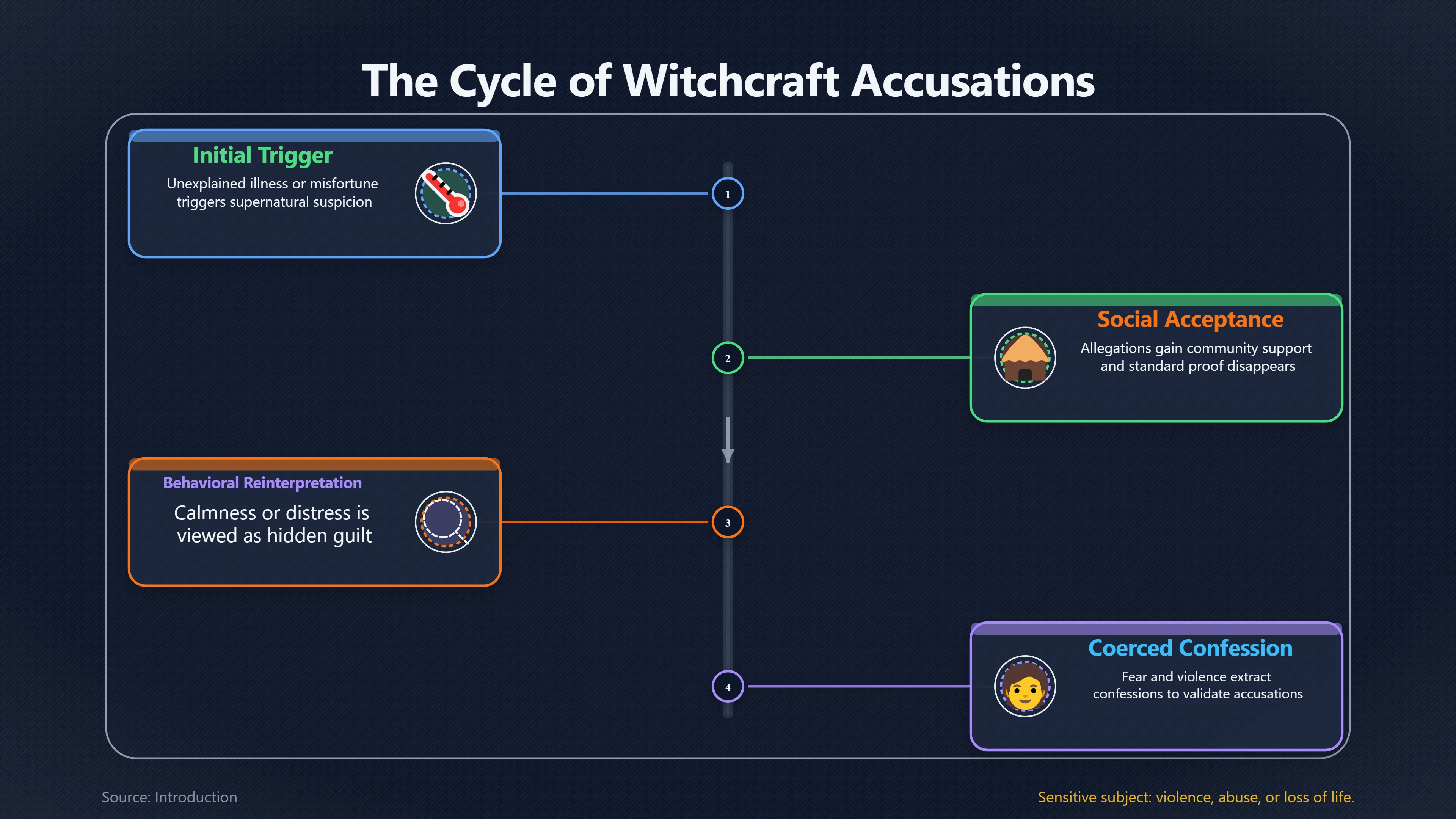
Unlike a criminal investigation based on physical evidence, many witchcraft accusations begin with events that have no obvious explanation. A child’s illness, a failed harvest, an unexpected death or a business failure may be interpreted as the work of hidden supernatural forces rather than chance or natural causes.
This creates a self-reinforcing process. Once someone is identified as a suspected witch, almost any behaviour can be reinterpreted as confirmation. Calmness may be viewed as concealment, distress as guilt, and denial as further proof that supernatural powers are being hidden. Confessions extracted through fear, intimidation or violence are then presented as validating the original accusation, even though they were obtained under coercion. Human rights organisations describe this as a cycle in which accusations generate the very “evidence” used to justify further punishment.[OHCHR]ohchr.orgUNITED NATIONS MISSION IN LIBERIA An AssSeptember 25, 2024…
The accusations rarely emerge in isolation. They are often intertwined with disputes over inheritance, land, marriage, family authority or community tensions. In communities where official policing or courts are distant or mistrusted, accusations may become an alternative way of resolving conflict outside the formal legal system.[OHCHR]ohchr.orgUNITED NATIONS MISSION IN LIBERIA An AssSeptember 25, 2024…
Who Was Accused and Why
The pattern of accusations documented in Liberia shows that vulnerability matters as much as belief.
A joint investigation by the United Nations Mission in Liberia (UNMIL) and the Office of the High Commissioner for Human Rights recorded 31 documented incidents between January 2012 and September 2015 involving at least 214 accused people. Among them were at least:
- 86 children, including some only four years old.
- 59 women.
- Several elderly people.
- Numerous victims whose ages or identities could not be fully confirmed because of the secrecy surrounding the cases.[OHCHR]ohchr.orgUNITED NATIONS MISSION IN LIBERIA An AssSeptember 25, 2024…
Children are especially vulnerable because adults may insist that a child can practise witchcraft without understanding it. A frightened child may eventually repeat accusations suggested by relatives or religious figures simply to end questioning or abuse. UNICEF has documented children being beaten, isolated, expelled from their communities, denied education and subjected to exorcisms or cleansing rituals after such allegations. Some abandoned children later become homeless or vulnerable to trafficking.[UNICEF]unicef.orgUNICEF and partners bring hope to children accused of witchcraft in Liberia | UNICEF Liberia…
Women, particularly widows and older women, also face elevated risks. Inheritance disputes, family disagreements or longstanding social tensions may become reframed as evidence of witchcraft. Human rights investigators even documented cases in which women accused of witchcraft were sexually assaulted during ordeals intended to establish their guilt.[OHCHR]ohchr.orgUNITED NATIONS MISSION IN LIBERIA An AssSeptember 25, 2024…
How Trials by Ordeal Worked
A trial by ordeal attempts to determine guilt through physical suffering or ritual rather than factual investigation. In Liberia these practices are commonly known by the term “sassywood”, although methods vary between regions and practitioners.
The UN investigation documented numerous forms of ordeal, including:
- forcing suspects to drink poisonous or emetic substances;
- requiring them to retrieve objects from boiling oil;
- pressing heated metal against the skin;
- suspending victims from trees;
- severe beatings;
- rubbing chilli pepper into wounds or bodily openings;
- prolonged deprivation of food or water;
- forcing victims to sit on hot coals or endure long exposure to sun or rain;
- compelling ingestion of substances intended to induce violent vomiting or illness.[OHCHR]ohchr.orgUNITED NATIONS MISSION IN LIBERIA An AssSeptember 25, 2024…
The outcome was rarely objective. A person’s injuries, survival, vomiting or inability to complete the ordeal could all be interpreted according to the judgement of the ordeal practitioner. Since the interpretation rested with the ritual authority rather than any independent evidence, the procedure could validate almost any conclusion.
The investigations also noted financial incentives. Ordeal practitioners often charged substantial fees, which were commonly paid by the accused themselves. In some documented cases, chiefs and ordeal practitioners reportedly shared fines imposed after accusations of witchcraft, creating an economic motive for sustaining the practice.[OHCHR]ohchr.orgUNITED NATIONS MISSION IN LIBERIA An AssSeptember 25, 2024…
Why Formal Law Often Failed to Stop Them
Liberian law has long rejected trial by ordeal.
The country’s Supreme Court has repeatedly ruled that determining guilt through ordeals rather than lawful evidence is unconstitutional. Legal commentary notes that the Court condemned these practices because they bypass the ordinary justice system and expose suspects to torture or death without due process.[OHCHR]ohchr.orgUNITED NATIONS MISSION IN LIBERIA An AssSeptember 25, 2024…
In practice, however, enforcement has often been inconsistent.
The UN investigation found that chiefs, traditional authorities, ordeal practitioners and even some officials connected with local government structures continued to participate in or tolerate ordeals. In some areas, cases described as “cultural” were handled through traditional authority structures rather than the ordinary courts. Limited policing, lack of resources, deference to customary authority and fear of challenging community beliefs all contributed to continued use of these practices.[OHCHR]ohchr.orgUNITED NATIONS MISSION IN LIBERIA An AssSeptember 25, 2024…
United States human rights reporting similarly concluded that although trial by ordeal was illegal, authorities frequently failed to investigate or prosecute offenders because of limited capacity and the perceived cultural sensitivity of the issue.[ecoi.net]ecoi.netUSDOS – US Department of State (Author): “Country Report on Human Rights Practices 2017 - Liberia”, Document #1430141 - ecoi.net…
Protection Without Criminalising Belief
Human rights organisations distinguish between holding supernatural beliefs and committing harmful acts because of those beliefs.
Neither the UN nor UNICEF argues that cultural or religious beliefs themselves should be criminalised. Instead, they focus on preventing violence, coercion, torture, forced confessions and discrimination arising from accusations.
Recommended responses include:
- protecting accused children through child welfare services;
- strengthening criminal investigations so unexplained deaths and disputes are examined using evidence rather than ordeal;
- educating communities about children’s rights;
- working with traditional and religious leaders to discourage harmful practices;
- ensuring police and prosecutors intervene when accusations lead to assault, unlawful detention or torture.[OHCHR]ohchr.orgUNITED NATIONS MISSION IN LIBERIA An AssSeptember 25, 2024…
This approach recognises that directly attacking deeply held beliefs may prove counterproductive, while enforcing laws against violence offers clearer protection for victims.

Why the Pattern Persists
The persistence of witchcraft accusations reflects broader social conditions rather than a simple survival of old customs.
Periods of insecurity, poverty, weak public services and limited confidence in formal justice make supernatural explanations more persuasive when tragedy strikes. If communities believe ordinary institutions cannot explain sudden misfortune or punish hidden wrongdoing, alternative systems of accusation and ordeal may appear to offer certainty where evidence cannot.
For that reason, researchers generally interpret Liberia’s witchcraft accusations less as episodes of irrational mass panic than as mechanisms of informal social control. They become powerful because they provide culturally meaningful explanations during moments of uncertainty, while simultaneously redistributing blame onto individuals who often have little ability to defend themselves. The resulting cycle—suspicion, accusation, coerced confession and ordeal—helps explain why witchcraft allegations have remained one of Liberia’s most persistent forms of collective persecution despite their clear illegality.[ohchr.org]ohchr.orgUNITED NATIONS MISSION IN LIBERIA An AssSeptember 25, 2024…
Amazon book picks
Further Reading
Books and field guides related to How Witchcraft Accusations Became Their Own Proof. Use these as the next step if you want deeper reading beyond the article.
African Religions A Very Short Introduction
Explains indigenous belief systems often misunderstood by colonial authorities.
Witchcraft, Violence, and Democracy in South Africa
Offers comparative insight into African witchcraft accusations.
Endnotes
1.
Source: ohchr.org
Link:https://www.ohchr.org/sites/default/files/Documents/Countries/LR/HarmfulTraditionalPracticesLiberia.pdf
Source snippet
UNITED NATIONS MISSION IN LIBERIA An AssSeptember 25, 2024...
Published: September 25, 2024
2.
Source: unicef.org
Link:https://www.unicef.org/liberia/stories/unicef-and-partners-bring-hope-children-accused-witchcraft-liberia
Source snippet
UNICEF and partners bring hope to children accused of `witchcraft` in Liberia | UNICEF Liberia...
3.
Source: ecoi.net
Link:https://www.ecoi.net/en/document/1395487.html
Source snippet
USDOS – US Department of State (Author): “Country Report on Human Rights Practices 2016 - Liberia”, Document #1395487 - ecoi.netMarch 3...
4.
Source: ecoi.net
Link:https://www.ecoi.net/en/document/1407927.html
Source snippet
STATUS OF SOCIETAL RESPECT FOR RELIGIOUS FREEDOM In a December 2015 report UNICEF expressed concern over “prayer camps” in the country. C...
Published: December 2015
5.
Source: ecoi.net
Link:https://www.ecoi.net/en/document/1430141.html
Source snippet
USDOS – US Department of State (Author): “Country Report on Human Rights Practices 2017 - Liberia”, Document #1430141 - ecoi.net...
6.
Source: docstore.ohchr.org
Title: Files Handler.ashx
Link:https://docstore.ohchr.org/SelfServices/FilesHandler.ashx?enc=vIuqIdj8SbjpJXXIpHJJmEUMCCvIA%2B6afTtacIDwg2Tx5XzKETS%2BUjel74I6ms1VVNLQpQiLnGVZz9r70MPpOw%3D%3D
7.
Source: docstore.ohchr.org
Title: Files Handler.ashx
Link:https://docstore.ohchr.org/SelfServices/FilesHandler.ashx?enc=HcREnJw%2Fy3BirpwTBHuCIBuvmnz%2BNFf4GiisaeV2%2BmzIb5uH9sTh9x4%2FDhDHZBHajIiINftO%2BkHNcAxRvNRqaw%3D%3D
8.
Source: academic.oup.com
Link:https://academic.oup.com/edited-volume/61663/chapter/553472333?searchresult=1
Source snippet
in Liberia | Oxford Research Encyclopedia of African History | Oxford AcademicApril 17, 2024 — Oxford Research Encyclopedia of African Hi...
Published: April 17, 2024
Additional References
9.
Source: youtube.com
Title: Meet the anti-witch hunter
Link:https://www.youtube.com/watch?v=yzBi8KVSwlY
Source snippet
Dispatches: Return To Africa's Witch Children | Extreme Christianity Documentary...
10.
Source: youtube.com
Title: Dispatches: Return To Africa’s Witch Children | Extreme Christianity Documentary
Link:https://www.youtube.com/watch?v=5Y06sKAg9Do
Source snippet
5 Strange & Disturbing Trials By Ordeal From History...
11.
Source: youtube.com
Title: Public Torture & Humiliation Over Witchcraft Accusation in River Gee
Link:https://www.youtube.com/watch?v=_9bSPjoKW7A
Source snippet
'Witchcraft' in Africa: Many women find it hard to prove innocence...
12.
Source: youtube.com
Title: ‘Witchcraft’ in Africa: Many women find it hard to prove innocence
Link:https://www.youtube.com/watch?v=wV0ubcWkC4k
Source snippet
Meet the anti-witch hunter - BBC Trending podcast, BBC World Service...
13.
Source: refworld.org
Link:https://www.refworld.org/reference/annualreport/usdos/2017/en/116377
Source snippet
2016 Country Reports on Human Rights Practices - Liberia | RefworldMarch 3, 2017 — The LNP commander was relieved of duty pending the out...
Published: March 3, 2017
14.
Source: scribd.com
Link:https://www.scribd.com/document/900515932/Harmful-Traditional-Practices18Dec-2015
15.
Source: youtube.com
Title: 5 Strange & Disturbing Trials By Ordeal From History
Link:https://www.youtube.com/watch?v=CtCwlVN6E5o
16.
Source: news.trust.org
Title: 20151218162423 n8153
Link:https://news.trust.org/item/20151218162423-n8153
17.
Source: digitallibrary.un.org
Link:https://digitallibrary.un.org/record/801006
18.
Source: uprdatabase.org
Link:https://www.uprdatabase.org/node/19949
Topic Tree