Within Bolivia
Why Bolivians Feared the Fat Stealing Stranger
Stories of fat-stealing strangers turn inequality, illness and intrusive outsiders into a vivid and sometimes dangerous threat.
On this page
- What the kharisiri is said to do
- Why outsiders become suspected predators
- When folklore turns into collective action
Page outline Jump by section
Introduction
The kharisiri is one of the most enduring fear figures in the Bolivian Andes. Rather than a simple monster from folklore, it represents a persistent belief that seemingly ordinary outsiders can secretly steal a person’s body fat or vital essence, leaving victims to weaken, fall ill and sometimes die. The story has changed over time, but its central theme has remained remarkably stable: unequal encounters with strangers can hide deadly forms of extraction. Anthropologists argue that this makes the kharisiri less a fantasy than a cultural language for expressing anxieties about exploitation, colonial domination, modern institutions and unequal economic relationships.[RAI Online Library]rai.onlinelibrary.wiley.comRAI Online LibraryFear and loathing on the kharisiri trail: Alterity and identity in the Andes - Canessa - 2000 - Journal of the Royal An…

Unlike many urban legends, kharisiri rumours have occasionally influenced real behaviour. Travellers, aid workers, officials and other unfamiliar visitors have sometimes attracted suspicion, while unexplained illness has been interpreted through the kharisiri tradition rather than as purely medical misfortune. The belief therefore offers an important example of how folklore can shape collective perceptions of danger without fitting neatly into the category of mass hysteria.
What the kharisiri is said to do
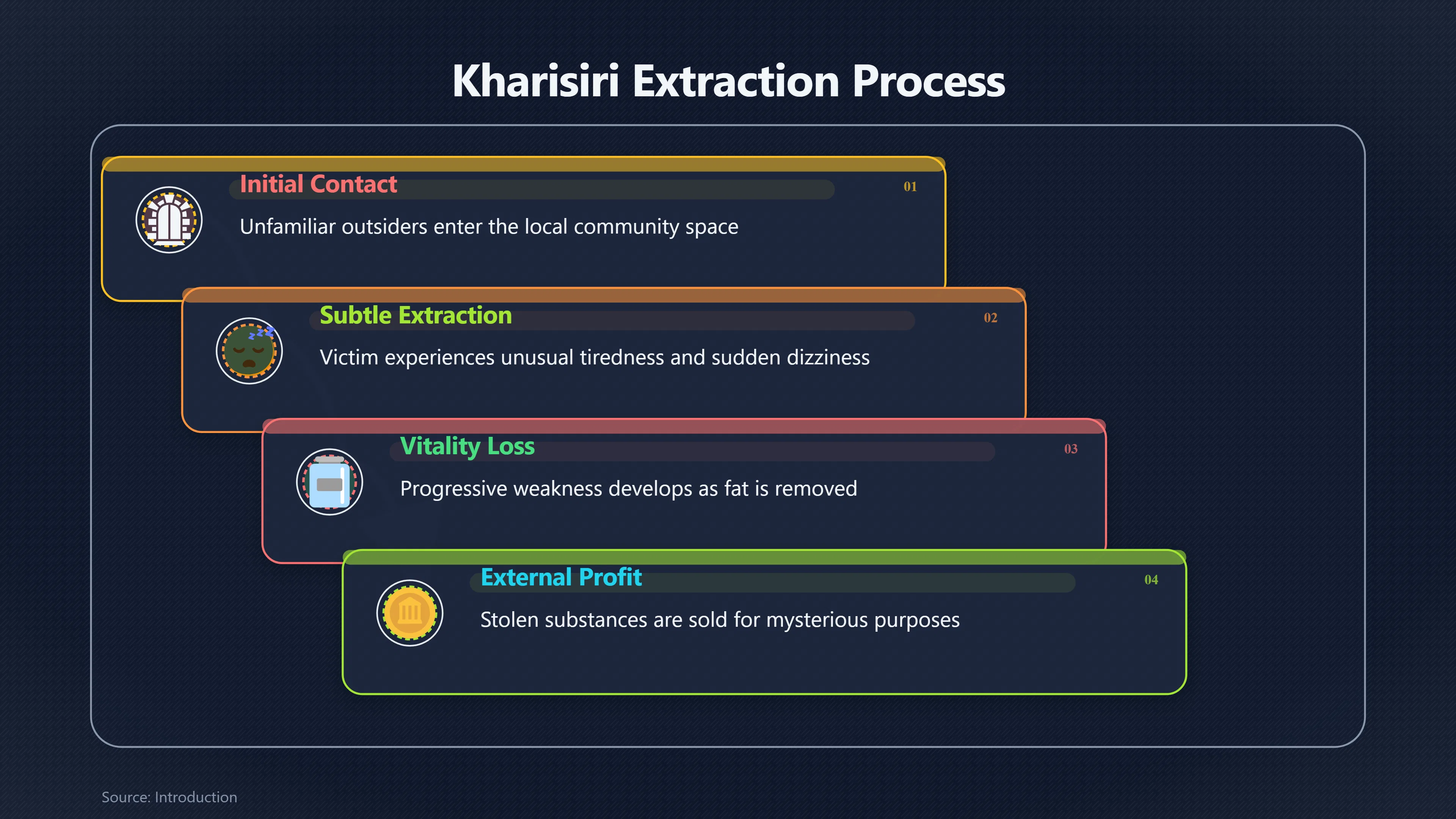
Traditional accounts describe the kharisiri as someone who extracts fat from a victim without obvious violence. In some versions blood or other bodily substances are also taken. Victims may initially notice little more than unusual tiredness or dizziness before developing progressive weakness. The stolen fat is then supposedly sold or used elsewhere for mysterious or profitable purposes.
The importance of fat reflects Andean ideas about health rather than modern nutritional science. In many Indigenous understandings of the body, fat symbolises strength, vitality and productive life. Losing it is therefore not simply a physical injury but a loss of the life force that enables people to work, maintain relationships and fulfil social obligations. This cultural meaning helps explain why fat theft became such a powerful image.[RAI Online Library]rai.onlinelibrary.wiley.comRAI Online LibraryFear and loathing on the kharisiri trail: Alterity and identity in the Andes - Canessa - 2000 - Journal of the Royal An…
Anthropologist Andrew Canessa argues that understanding these beliefs requires taking local concepts of the body seriously rather than dismissing them as irrational superstition. Within that worldview, the kharisiri threatens the very substance that makes a person socially and physically complete.[RAI Online Library]rai.onlinelibrary.wiley.comRAI Online LibraryFear and loathing on the kharisiri trail: Alterity and identity in the Andes - Canessa - 2000 - Journal of the Royal An…
Why outsiders become suspected predators
One striking feature of kharisiri stories is that the suspected attacker is rarely an ordinary neighbour. Instead, the figure usually represents someone who stands outside the local community.
Across different periods, alleged kharisiris have included:
- foreign travellers;
- Catholic clergy during parts of the colonial and republican eras;
- wealthy landowners;
- doctors or hospital workers;
- engineers and development workers;
- government officials;
- miners or road builders;
- anthropologists and other researchers;
- anyone perceived as socially powerful but lacking reciprocal obligations to the community.[RAI Online Library]rai.onlinelibrary.wiley.comRAI Online LibraryFear and loathing on the kharisiri trail: Alterity and identity in the Andes - Canessa - 2000 - Journal of the Royal An…
The identity changes with history, but the underlying pattern remains similar. The dangerous outsider is someone who benefits from local people while giving little in return.
This distinguishes the kharisiri from many European bogeymen. The fear is not simply of strangers as strangers. It is specifically directed at unequal relationships in which outsiders possess technology, wealth, political authority or specialised knowledge that ordinary villagers cannot easily understand or control.[RAI Online Library]rai.onlinelibrary.wiley.comRAI Online LibraryFear and loathing on the kharisiri trail: Alterity and identity in the Andes - Canessa - 2000 - Journal of the Royal An…
Why the rumour survives across generations
Anthropologists have proposed several overlapping explanations for the persistence of kharisiri beliefs.
First, the tradition reflects the long history of extraction in the Andes. Colonial conquest, forced labour, mining and unequal trade all involved outsiders profiting from Indigenous bodies and lands. Stories about stolen fat express this history through the human body itself. Rather than extracting silver, labour or taxes, the kharisiri extracts bodily vitality.[RAI Online Library]rai.onlinelibrary.wiley.comRAI Online LibraryFear and loathing on the kharisiri trail: Alterity and identity in the Andes - Canessa - 2000 - Journal of the Royal An…
Second, the belief adapts easily to changing circumstances. Earlier stories sometimes claimed the stolen fat was used by church authorities or for religious purposes. Modern versions may connect it to hospitals, pharmaceutical companies, industrial machinery or international markets. Although the destination changes, the logic remains one of hidden exploitation by powerful outsiders.[RAI Online Library]rai.onlinelibrary.wiley.comRAI Online LibraryFear and loathing on the kharisiri trail: Alterity and identity in the Andes - Canessa - 2000 - Journal of the Royal An…
Third, the rumours provide an explanation for illnesses that appear suddenly and have no obvious cause. When someone weakens without visible injury, the kharisiri offers a culturally meaningful account linking personal suffering to wider social relationships rather than to random chance.
When folklore turns into collective action
Most kharisiri stories circulate as cautionary tales rather than producing violence. Nevertheless, the rumours have sometimes affected real interactions with outsiders.
Communities have occasionally viewed unfamiliar visitors with suspicion, particularly during periods of political instability, economic hardship or rapid social change. Aid workers, survey teams, researchers and health personnel have at times needed local intermediaries to establish trust before working in rural communities. Suspicion has usually reflected broader concerns about exploitation rather than fear of a single mythical creature.[Chicago Journals]journals.uchicago.eduChicago JournalsAre anthropologists monsters? An Andean dystopian critique of extractivist ethnography and Anglophone-centric anthropolog…
The belief can also influence health decisions. Where unexplained illness is interpreted as evidence of kharisiri attack, families may seek ritual healing alongside or instead of biomedical treatment. Anthropologists stress that these choices should be understood within local systems of knowledge rather than dismissed as simple ignorance.[ResearchGate]researchgate.netOpen source on researchgate.net.
Although rumours occasionally contribute to confrontations with strangers, there is little evidence for a nationwide moral panic centred on the kharisiri. Instead, historians and ethnographers describe recurring local episodes shaped by particular social tensions.
More than a monster: a commentary on extraction
Recent scholarship has pushed the interpretation beyond folklore alone.
Anthropologist Anders Burman notes that some Aymara people have even compared anthropologists themselves to kharisiris. The comparison is deliberately provocative. Researchers enter communities, gather valuable knowledge and often build careers from it while local people receive relatively little benefit. In this reading, calling someone a kharisiri is a criticism of extractive relationships rather than a literal accusation of supernatural violence.[Chicago Journals]journals.uchicago.eduChicago JournalsAre anthropologists monsters? An Andean dystopian critique of extractivist ethnography and Anglophone-centric anthropolog…
This perspective helps explain why the kharisiri remains relevant in contemporary Bolivia. The figure continues to symbolise unequal exchange, whether involving natural resources, scientific research, development projects or state institutions.

How historians and anthropologists interpret the belief today
Modern scholarship generally rejects the idea that kharisiri rumours are merely irrational fears of outsiders.
Instead, researchers see them as combining several social functions:
- expressing memories of colonial exploitation;
- defining the boundary between trusted insiders and potentially dangerous outsiders;
- explaining otherwise mysterious illness within an Indigenous understanding of the body;
- warning against relationships perceived as one-sided or exploitative;
- providing a moral critique of systems that extract value from Indigenous communities.[wiley.com]rai.onlinelibrary.wiley.comRAI Online LibraryFear and loathing on the kharisiri trail: Alterity and identity in the Andes - Canessa - 2000 - Journal of the Royal An…
This interpretation also explains why the identity of the alleged kharisiri changes over time while the underlying story survives. The rumour is less about a fixed supernatural being than about recurring experiences of inequality.
Why the kharisiri remains culturally important
The kharisiri endures because it sits at the intersection of folklore, history and social memory. It reminds readers that collective fears often emerge from real historical relationships rather than from imagination alone. In Bolivia, stories of fat-stealing outsiders have helped communities express concerns about colonial rule, economic extraction, racial hierarchy and unfamiliar institutions in a vivid and memorable form.
For historians of collective belief, the kharisiri therefore represents neither a simple myth nor a classic episode of mass hysteria. It is better understood as a flexible cultural mechanism through which changing forms of unequal power become visible, personalised and morally intelligible.[wiley.com]rai.onlinelibrary.wiley.comRAI Online LibraryFear and loathing on the kharisiri trail: Alterity and identity in the Andes - Canessa - 2000 - Journal of the Royal An…
Amazon book picks
Further Reading
Books and field guides related to Why Bolivians Feared the Fat-Stealing Stranger. Use these as the next step if you want deeper reading beyond the article.


Open Veins Of Latin America
Helps explain why extraction themes resonate in Andean folklore.
Endnotes
1.
Source: researchgate.net
Link:https://www.researchgate.net/publication/290186206_Fear_and_loathing_on_the_kharisiri_trail_Alterity_and_identity_in_the_Andes
2.
Source: researchgate.net
Title: Fear and Loathing on the Kharisiri Trail
Link:https://www.researchgate.net/publication/227624091_Fear_and_Loathing_on_the_Kharisiri_Trail
3.
Source: researchgate.net
Link:https://www.researchgate.net/publication/325862089_Are_anthropologists_monsters_An_Andean_dystopian_critique_of_extractivist_ethnography_and_Anglophone-centric_anthropology
4.
Source: rai.onlinelibrary.wiley.com
Link:https://rai.onlinelibrary.wiley.com/doi/abs/10.1111/1467-9655.00041
Source snippet
RAI Online LibraryFear and loathing on the kharisiri trail: Alterity and identity in the Andes - Canessa - 2000 - Journal of the Royal An...
5.
Source: journals.uchicago.edu
Link:https://www.journals.uchicago.edu/doi/abs/10.1086/698413
Source snippet
Chicago JournalsAre anthropologists monsters? An Andean dystopian critique of extractivist ethnography and Anglophone-centric anthropolog...
6.
Source: czasopisma.bg.ug.edu.pl
Link:https://czasopisma.bg.ug.edu.pl/index.php/etnografia/article/view/6106
Source snippet
Praktyki, Teorie, DoświadczeniaAugust 14, 2020 — Canessa, A. (2000). Fear and loathing on the kharisiri trail: Alterity and identity in...
Published: August 14, 2020
Additional References
7.
Source: tandfonline.com
Link:https://www.tandfonline.com/doi/abs/10.1080/14753820.2022.2044134
Source snippet
panish Studies: Vol 99, No 2March 29, 2022 — Bulletin of Spanish Studies Hispanic Studies and Researches on Spain, Portugal and Latin Ame...
Published: March 29, 2022
8.
Source: haujournal.org
Link:https://www.haujournal.org/index.php/hau/article/view/698413
Source snippet
HAU JournalAre anthropologists monsters? An Andean dystopian critique of extractivist ethnography and Anglophone-centric anthropology | B...
9.
Source: journals.sagepub.com
Link:https://journals.sagepub.com/doi/10.1177/0308275X13519275
Source snippet
Sage JournalsConflict, claim and contradiction in the new ‘indigenous’ state of Bolivia - Andrew Canessa, 2014...
10.
Source: anthroencyclopedia.com
Title: Monsters | Open Encyclopedia of Anthropology
Link:https://www.anthroencyclopedia.com/entry/monsters
Source snippet
October 15, 2021 — In anthropology, perhaps the best-known monsters of alterity roam in South America, where they have generated many fas...
Published: October 15, 2021
11.
Source: youtube.com
Title: The Kari Kari is one of the most unsettling legends of Andean folklore
Link:https://www.youtube.com/watch?v=JKt-Kz7UYps
Source snippet
All the Mythological Creatures of Latin America Explained...
12.
Source: youtube.com
Title: Peru’s Most Terrifying Mystery | The Face Peelers
Link:https://www.youtube.com/watch?v=TJDT8vn-nVU
Source snippet
The Kari Kari is one of the most unsettling legends of Andean folklore...
13.
Source: youtube.com
Title: The Kharisiri Unveiled: The Truth Behind the Bolivian Myth
Link:https://www.youtube.com/watch?v=HHJk684ocqc
Source snippet
Peru's Most Terrifying Mystery | The Face Peelers...
14.
Source: youtube.com
Title: The Legends of Bolivia That People Still Respect
Link:https://www.youtube.com/watch?v=VnnGzI6qHeE
Source snippet
The Kharisiri Unveiled: The Truth Behind the Bolivian Myth...
15.
Source: eurekamag.com
Link:https://eurekamag.com/research/068/210/068210435.php
16.
Source: deepdyve.com
Link:https://www.deepdyve.com/lp/wiley/fear-and-loathing-on-the-kharisiri-trail-alterity-and-identity-in-the-kkVDyXxY4t
Topic Tree