Within Kuwait
When Sorcery Claims Become a Tool for Fraud
Claims of possession and black magic have repeatedly become tools for alleged fraud, coercion and sensational policing in Kuwait.
On this page
- How alleged spiritual healers gained trust
- Money, coercion and evidence of harm
- Police labels, court scrutiny and migrant stereotypes
Page outline Jump by section
Introduction
In Kuwait, stories about sorcery and spirit possession have periodically become the basis for criminal investigations, but the strongest documented cases are not evidence of organised occult movements. Instead, they usually involve allegations that self-described spiritual healers or fortune tellers exploited clients by claiming they could remove possession, break curses, restore relationships or solve financial problems in return for large sums of money. The central public issue has therefore been fraud rather than proof of supernatural powers. Police statements, court processes and media reports consistently frame these incidents as deception targeting vulnerable people, even while using the language of witchcraft or black magic. At the same time, critics caution that sensational reporting and official rhetoric can blur the line between prosecuting fraud and reinforcing stereotypes, particularly when suspects are migrants or members of socially marginalised communities.
How alleged spiritual healers gained trust
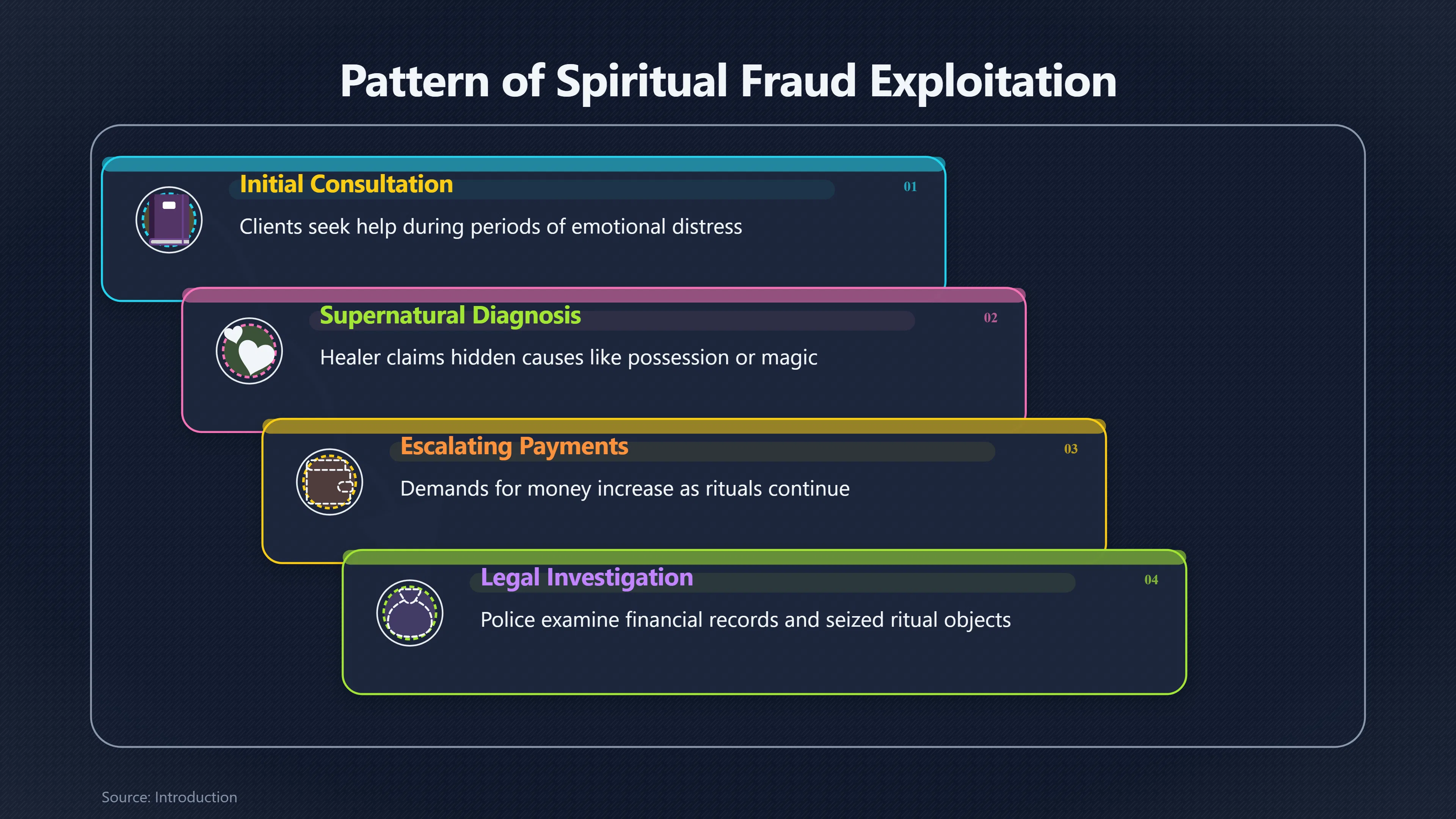
Most reported Kuwaiti cases follow a recognisable pattern. Individuals approach a healer during periods of emotional distress, illness, marital conflict or financial difficulty. The healer claims to diagnose possession, harmful magic or another hidden supernatural cause and then offers a series of paid rituals, prayers or objects said to remove the problem.
The relationship often develops gradually. Initial consultations may require modest payments, but once the client accepts the supernatural explanation, demands for further money can escalate. Alleged victims frequently describe being told that the treatment is incomplete or that stronger rituals are needed to overcome powerful forces.
A widely reported example emerged in 2021 when a Kuwaiti woman complained that two women had convinced her she was possessed by a jinn and persuaded her to pay almost 30,000 Kuwaiti dinars through bank transfers and cash payments for repeated attempts to expel the spirit. Police opened a fraud investigation after she produced financial records supporting her complaint.[Gulf News]gulfnews.comGulf News Kuwaiti woman pays $96,000 to get rid of jinnGulf NewsKuwaiti woman pays $96,000 to get rid of jinnMarch 31, 2021…
The importance of this case lies less in the supernatural claim than in the evidence. Investigators focused on documented payments and alleged deception rather than attempting to establish whether possession existed.
Money, coercion and evidence of harm
The most substantiated Kuwaiti investigations centre on conduct that ordinary criminal law can examine: financial transfers, false promises, deception and exploitation.
Several recurring features appear across reported cases:
- Emotional vulnerability. Clients often seek help during bereavement, illness, family disputes or relationship breakdowns.
- Repeated payments. Rather than a single fee, alleged healers may request continuing payments while claiming that the spiritual problem has not yet been resolved.
- Material “proof”. Police commonly report seizing charms, handwritten talismans, herbs, oils, books or ritual objects, not as evidence that magic works, but as items allegedly used to support fraudulent claims.
- Documentary evidence. Bank transfers, messages and witness testimony generally provide the strongest evidence in court-related reporting.
This emphasis on financial evidence reflects a broader pattern. The legal challenge is usually not whether supernatural forces exist but whether someone knowingly obtained money by making deceptive claims that cannot be substantiated.
Police operations and changing enforcement
Kuwaiti police have periodically conducted undercover operations targeting individuals advertising supernatural services.
In one 2017 case, residency detectives arrested a man described in local reporting as a spiritual healer after an undercover officer posed as a client. According to police accounts, he claimed to treat psychological problems and prepared materials intended to influence employers of domestic workers. The investigation relied on surveillance and a controlled police operation rather than reports of paranormal activity.[Kuwait Times]kuwaittimes.comKuwait Times Thief leads police to 36 stolen cars | Kuwait Times NewspaperKuwait TimesThief leads police to 36 stolen cars | Kuwait Times NewspaperAugust 3, 2017…
More recent Ministry of Interior announcements have followed the same model. In 2025, officials announced the arrest of a suspect accused of offering black magic, fortune telling and supernatural solutions to family and financial problems in exchange for money. Authorities said the operation followed intelligence gathering, legal authorisation and an arrest in possession of ritual materials, while stressing that the investigation concerned fraud and exploitation of vulnerable people.[Kuna]kuna.net.kwArticle Print Page.aspxKUNA:: Kuwait MoI arrests "black magic" swindler 16/07/2025July 16, 2025…
Across these operations, official statements consistently present sorcery as a public-order issue because it allegedly enables deception rather than because police claim to verify supernatural powers.
Court scrutiny and the problem of proof
The evidential problem is straightforward: courts cannot readily determine whether magic or possession is real, but they can examine whether defendants intentionally deceived victims for financial gain.
For that reason, stronger cases typically involve:
- identifiable complainants;
- traceable financial transactions;
- undercover investigations;
- seized materials associated with the alleged scheme; and
- statements showing promises of guaranteed supernatural results.
This distinction matters because belief in possession or spiritual healing is not identical to criminal fraud. Religious belief, private spiritual practice and criminal deception occupy different legal and social categories, even when media reports blur them together.
Public debate has occasionally reflected this tension. Legislative proposals have sought harsher penalties for practising witchcraft or seeking harmful magical services, arguing that such practices exploit vulnerable people and conflict with Islamic principles. Critics, however, questioned how genuine sorcery could be proved in court and argued that fraud laws already address the measurable harm.[Gulf News]gulfnews.comGulf News Kuwaiti MP proposes death for witchcraftGulf NewsKuwaiti MP proposes death for witchcraftApril 13, 2021…
Police labels, media reporting and migrant stereotypes
Another recurring feature of Kuwaiti reporting is the prominence given to suspects’ nationalities. News stories have frequently identified accused individuals as expatriates—including Asian, Iranian or Iraqi nationals—or as members of other socially marginalised groups.[kuwaittimes.com]kuwaittimes.comKuwait Times Thief leads police to 36 stolen cars | Kuwait Times NewspaperKuwait TimesThief leads police to 36 stolen cars | Kuwait Times NewspaperAugust 3, 2017…
That pattern creates two overlapping narratives.
One focuses on genuine exploitation, warning the public against fraudulent healers who profit from fear and desperation. The other risks reinforcing broader stereotypes by associating particular migrant communities with occult practices despite the absence of evidence that such offences are concentrated within any specific nationality.
Human rights observers have also noted that non-citizens in Kuwait may face immigration consequences alongside criminal proceedings, making fair legal process especially important when highly stigmatising allegations are involved.[State Department]2021-2025.state.govDepartment KuwaitState DepartmentKuwait - United States Department of State…
Careful reporting therefore requires separating three distinct questions:
- whether fraud occurred;
- whether the accused can be linked to that fraud through evidence; and
- whether broader cultural assumptions about migrants or minority groups are influencing public perception.
Why these cases matter in Kuwait’s history of collective fear
Sorcery cases illustrate a recurring mechanism in Kuwait’s wider history of social fear. Existing religious beliefs about possession or harmful magic provide a framework through which personal misfortune can be interpreted, but the documented public harm usually arises when those beliefs become instruments for financial exploitation.
Police campaigns therefore serve two purposes. They reassure the public that authorities are responding to deception while also signalling official opposition to practices regarded as socially or religiously unacceptable.
The strongest evidence suggests that Kuwait’s recurring “sorcery scares” are best understood as episodes where belief, vulnerability and criminal fraud intersect. Rather than documenting widespread occult conspiracies, the better-supported cases reveal how supernatural claims can be used to gain trust, extract money and attract dramatic media attention, with criminal investigations ultimately resting on conventional evidence of deception rather than proof of magic itself.
Amazon book picks
Further Reading
Books and field guides related to When Sorcery Claims Become a Tool for Fraud. Use these as the next step if you want deeper reading beyond the article.
Extraordinary Popular Delusions and the Madness of Crowds
Rating: 4.0/5 from 5 Google Books ratings
Provides historical examples of irrational collective beliefs.


The Gift of Fear
Addresses manipulation, vulnerability and decision-making under fear.
Endnotes
1.
Source: gulfnews.com
Title: Gulf News Kuwaiti woman pays $96,000 to get rid of jinn
Link:https://gulfnews.com/world/gulf/kuwait/kuwaiti-woman-pays-96000-to-get-rid-of-jinn-1.78239964
Source snippet
Gulf NewsKuwaiti woman pays $96,000 to get rid of jinnMarch 31, 2021...
Published: March 31, 2021
2.
Source: kuwaittimes.com
Title: Kuwait Times Thief leads police to 36 stolen cars | Kuwait Times Newspaper
Link:https://kuwaittimes.com/thief-leads-police-36-stolen-cars/
Source snippet
Kuwait TimesThief leads police to 36 stolen cars | Kuwait Times NewspaperAugust 3, 2017...
Published: August 3, 2017
3.
Source: kuwaittimes.com
Title: Kuwait Times Social media Iranian sorcerer busted | Kuwait Times Newspaper
Link:https://kuwaittimes.com/social-media-sorcerer-busted
4.
Source: kuna.net.kw
Title: Article Print Page.aspx
Link:https://www.kuna.net.kw/ArticlePrintPage.aspx?id=3240934&language=en
Source snippet
KUNA:: Kuwait MoI arrests "black magic" swindler 16/07/2025July 16, 2025...
Published: July 16, 2025
5.
Source: gulfnews.com
Title: Gulf News Kuwait arrests Iraqi woman for sorcery and financial fraud
Link:https://gulfnews.com/world/gulf/kuwait/kuwait-arrests-iraqi-woman-for-sorcery-and-financial-fraud-1.500215822
6.
Source: gulfnews.com
Title: Gulf News Kuwaiti MP proposes death for witchcraft
Link:https://gulfnews.com/world/gulf/kuwait/kuwaiti-mp-proposes-death-for-witchcraft-1.1618307471720
Source snippet
Gulf NewsKuwaiti MP proposes death for witchcraftApril 13, 2021...
Published: April 13, 2021
7.
Source: 2021-2025.state.gov
Title: Department Kuwait
Link:https://2021-2025.state.gov/reports/2021-country-reports-on-human-rights-practices/kuwait/
Source snippet
State DepartmentKuwait - United States Department of State...
8.
Source: gulfnews.com
Title: Kuwaiti woman arrested for practicing witchcraft and sorcery
Link:https://gulfnews.com/world/gulf/kuwait/kuwaiti-woman-arrested-for-practicing-witchcraft-and-sorcery-1.500232367
Source snippet
August 14, 2025 — Kuwaiti woman arrested for practicing witchcraft and sorcery World / Gulf / Kuwait KUWAITI WOMAN ARRESTED FOR PRACTICIN...
Published: August 14, 2025
9.
Source: gulfnews.com
Title: Kuwaiti woman arrested for practicing witchcraft and sorcery
Link:https://gulfnews.com/amp/story/world%2Fgulf%2Fkuwait%2Fkuwaiti-woman-arrested-for-practicing-witchcraft-and-sorcery-1.500232367
10.
Source: kuna.net.kw
Title: KUN A: Kuwait Mo I arrests “black magic” swindler
Link:https://www.kuna.net.kw/ArticleDetails.aspx?Language=en&id=3240934
11.
Source: gulfnews.com
Title: Kuwait: Mother denied kids’ custody over sorcery
Link:https://gulfnews.com/world/gulf/kuwait/kuwait-mother-denied-kids-custody-over-sorcery-1.103673971
12.
Source: kuna.net.kw
Title: KUN A: WITCHCRAFT AND MAGIC ON THE INCREASE IN KUWAIT
Link:https://www.kuna.net.kw/ArticleDetails.aspx?id=1176288&language=en
Additional References
13.
Source: legalclarity.org
Title: Crime Settlement in Kuwait: Blood Money, Reforms, and Penalties
Link:https://legalclarity.org/crime-settlement-in-kuwait-blood-money-reforms-and-penalties/
Source snippet
June 24, 2026 — CRIME SETTLEMENT IN KUWAIT: BLOOD MONEY, REFORMS, AND PENALTIES Kuwait's criminal justice system allows many...
Published: June 24, 2026
14.
Source: youtube.com
Link:https://www.youtube.com/watch?v=tBoU4Cs1MvE
Source snippet
The Strangest Scenario for Denying Jinn Possession | An Attempt to Debunk Fraud or Undermine the...
15.
Source: youtube.com
Title: Jinn Possessions, Blood Rituals & Black Magic | The Last Days | Ep 4
Link:https://www.youtube.com/watch?v=L13FTrO2mXQ
Source snippet
Online Fraud Exposed, Victims Share Shocking Stories After Gang Arrest, Jurm O Saza...
16.
Source: youtube.com
Title: EXPOSING FAKE HEALERS RUQYA SCAMMERS | Ustadh Mohamad Baajour
Link:https://www.youtube.com/watch?v=hmOI4k_cl1M
Source snippet
Jinn Possessions, Blood Rituals & Black Magic | The Last Days | Ep 4...
17.
Source: loc.gov
Link:https://www.loc.gov/item/global-legal-monitor/2022-02-28/kuwait-constitutional-court-rules-provision-criminalizing-imitating-the-opposite-sex-unconstitutional
18.
Source: aljarida.com
Link:https://www.aljarida.com/articles/1571067609317757400
19.
Source: youtube.com
Title: THE FAKE RAQIS (RUQYA SCAMS EXPOSED)
Link:https://www.youtube.com/watch?v=s7oL5sdOGsY
Source snippet
EXPOSING FAKE HEALERS RUQYA SCAMMERS | Ustadh Mohamad Baajour...
20.
Source: hrw.org
Title: Kuwait Court Rules Anti-Transgender Law Unconstitutional | Human Rights Watch
Link:https://www.hrw.org/news/2022/02/17/kuwait-court-rules-anti-transgender-law-unconstitutional
21.
Source: m.youtube.com
Link:https://m.youtube.com/watch?v=G7TGI_12BS0
22.
Source: timeskuwait.com
Title: Fortune teller fails to predict her destiny, ends up in jail
Link:https://timeskuwait.com/fortune-teller-fails-to-predict-her-destiny-ends-up-in-jail/
Topic Tree