Within Israel
Does Jerusalem Really Turn Visitors Into Prophets?
Jerusalem can shape the content of psychosis, but the idea that the city creates a unique disorder remains deeply disputed.
On this page
- How the syndrome was defined
- Why psychiatrists dispute the label
- How media stories created a modern legend
Page outline Jump by section
Introduction
Jerusalem has long attracted pilgrims who expect a life-changing spiritual experience. A very small number instead develop intense religious delusions, sometimes believing they are a biblical prophet, the Messiah, or another sacred figure. This phenomenon is commonly called Jerusalem syndrome, but the idea that Jerusalem itself causes a unique psychiatric disorder is one of the most disputed claims in modern psychiatry. Most specialists agree that genuine episodes occur, yet many argue they are better understood as psychotic illnesses whose religious content is shaped by the city’s extraordinary symbolic importance rather than by any special property of Jerusalem itself. The result is a striking example of how media narratives can transform a rare clinical observation into a widely repeated cultural myth.[cambridge.org]cambridge.orgUniversity Press & Assessment The British Journal of Psychiatry: Volume 176Cambridge University Press & AssessmentThe British Journal of Psychiatry: Volume 176 - Issue 1 | Cambridge Core…

How Jerusalem syndrome was defined
The modern concept emerged from psychiatrists working at Jerusalem’s Kfar Shaul Mental Health Center, which has treated visitors experiencing religiously themed psychiatric crises for decades. In a widely cited 2000 paper, psychiatrist Yair Bar-El and colleagues proposed three broad categories.
The first and by far the largest group consisted of people who already had recognised psychiatric disorders before arriving in Israel. Their existing delusions simply became focused on Jerusalem’s religious sites. A second group involved people with unusual religious ideas or membership of small millenarian movements whose beliefs intensified during a pilgrimage. Only the third and smallest category was presented as a distinct “pure” Jerusalem syndrome affecting previously healthy visitors who briefly developed psychosis before recovering. Between 1980 and 1993, the authors identified just 42 patients whom they believed might fit this final category.[Cambridge University Press & Assessment]cambridge.orgUniversity Press & Assessment The British Journal of Psychiatry: Volume 176Cambridge University Press & AssessmentThe British Journal of Psychiatry: Volume 176 - Issue 1 | Cambridge Core…
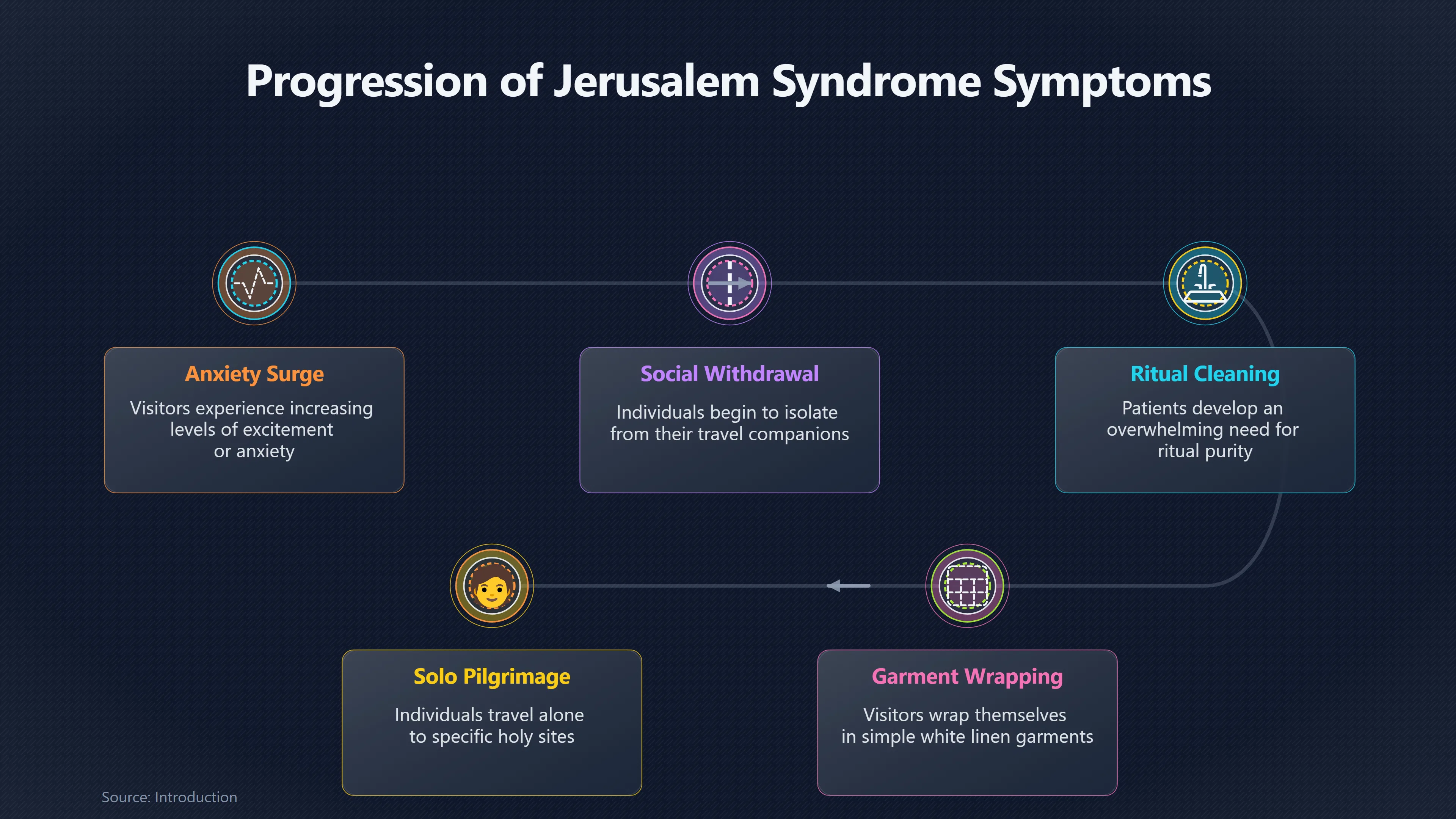
The proposed pattern often followed a similar sequence. Visitors became increasingly anxious or excited, withdrew from companions, developed an overwhelming need for ritual cleanliness, wrapped themselves in simple white garments made from hotel linen, travelled alone to holy places, and delivered improvised sermons calling for moral reform or redemption. These performances frequently attracted police attention or concerned bystanders before the individuals were taken for psychiatric assessment.[Cambridge University Press & Assessment]cambridge.orgUniversity Press & Assessment The British Journal of Psychiatry: Volume 176Cambridge University Press & AssessmentThe British Journal of Psychiatry: Volume 176 - Issue 1 | Cambridge Core…
Why do some visitors believe they are prophets?
The popular image of Jerusalem syndrome centres on tourists who suddenly announce themselves as Elijah, John the Baptist, Samson, Mary or even Jesus. Such cases have been widely reported and have helped create the enduring “prophet myth”.
Psychiatrists, however, emphasise that the prophetic identity usually reflects the person’s existing religious imagination rather than an entirely new belief created by the city. Delusions often draw on familiar biblical stories because Jerusalem is filled with powerful symbolic locations that already occupy an important place in Jewish, Christian and Muslim traditions. For someone experiencing psychosis, these surroundings can supply vivid content for beliefs that might have taken a different form elsewhere.[nih.gov]pubmed.ncbi.nlm.nih.govThe "Jerusalem syndrome"–fantasy and reality a survey of accounts from the 19th century to the end of the second millennium - PubMed…
This distinction matters. The city appears to influence what some people believe during a psychotic episode, not necessarily whether they become psychotic in the first place.

Why psychiatrists dispute the label
The strongest criticism has come from Israeli psychiatrists Moshe Kalian and Eliezer Witztum, who argue that Jerusalem syndrome is better viewed as a cultural presentation of ordinary psychotic illness than as a separate diagnosis.
Their historical research found remarkably similar accounts stretching back into the nineteenth century. Pilgrims who believed themselves to be prophets or biblical figures appeared long before modern psychiatry coined the term. In their interpretation, Jerusalem did not create these illnesses. Rather, individuals already affected by psychosis or fixed religious delusions were naturally drawn to one of the world’s most symbolically important cities.[PubMed]pubmed.ncbi.nlm.nih.govThe "Jerusalem syndrome"–fantasy and reality a survey of accounts from the 19th century to the end of the second millennium - PubMed…
Critics also question whether the supposedly “pure” cases really lacked previous psychiatric problems. They argue that proving someone had no earlier symptoms is extremely difficult, especially when relying on emergency admissions involving international tourists. Because evidence for completely healthy individuals suddenly developing a unique Jerusalem-specific psychosis is limited, many psychiatrists remain unconvinced that the syndrome deserves recognition as a distinct diagnostic category.[psychiatryonline.org]psychiatryonline.orgOpen source on psychiatryonline.org.
Importantly, Jerusalem syndrome does not appear as a separate disorder in major psychiatric diagnostic manuals. Instead, clinicians generally diagnose recognised conditions such as schizophrenia, bipolar disorder with psychotic features or brief psychotic disorder, while acknowledging that religious settings may shape the content of delusions.[Cambridge University Press & Assessment]cambridge.orgCambridge University Press & AssessmentAn explorative look at Jerusalem syndrome and its validity? | European Psychiatry | Cambridge Core…
How media stories created a modern legend
Jerusalem syndrome became internationally famous because it offers an irresistible headline: a holy city that can supposedly transform ordinary tourists into prophets.
Newspapers, documentaries and travel features often highlighted dramatic individual cases while overlooking two important facts. First, the number of affected visitors has always been tiny compared with the millions of tourists who visit Jerusalem every year. Second, most people treated for Jerusalem-related religious delusions already showed evidence of significant psychiatric illness before or during their journey.[PubMed]pubmed.ncbi.nlm.nih.govThe "Jerusalem syndrome"–fantasy and reality a survey of accounts from the 19th century to the end of the second millennium - PubMed…
The media’s preference for extraordinary stories helped create the impression that Jerusalem possesses a mysterious psychological force. Psychiatrists critical of the diagnosis have argued that the label itself became part of popular folklore, encouraging journalists to describe almost any bizarre religious behaviour in the city as another example of the syndrome, even when conventional psychiatric explanations were sufficient.[Psychiatry Online]psychiatryonline.orgOpen source on psychiatryonline.org.
This process illustrates how medical language can escape the clinic and become a cultural myth in its own right. Today, many people have heard of Jerusalem syndrome without realising that specialists continue to debate whether it exists as a unique condition at all.
What Jerusalem syndrome tells us about belief and place
The continuing debate highlights an important distinction between cultural influence and medical causation.
Few researchers deny that Jerusalem is emotionally overwhelming for many visitors. The concentration of sacred sites, centuries of religious expectation and the hope of profound spiritual transformation can create an unusually intense psychological environment. Yet intensity alone does not demonstrate that the city produces a new psychiatric illness.[Cambridge University Press & Assessment]cambridge.orgCambridge University Press & AssessmentAn explorative look at Jerusalem syndrome and its validity? | European Psychiatry | Cambridge Core…
Instead, Jerusalem syndrome is increasingly understood as an example of how culture shapes mental illness. Delusions do not arise in a vacuum. Their themes often reflect the person’s beliefs, expectations and surroundings. In Jerusalem those themes naturally become biblical, prophetic and apocalyptic, just as different cultural settings may produce different symbolic content without requiring a separate diagnosis.[nih.gov]pubmed.ncbi.nlm.nih.govThe "Jerusalem syndrome"–fantasy and reality a survey of accounts from the 19th century to the end of the second millennium - PubMed…
Within Israel’s wider history of collective belief and moral panics, Jerusalem syndrome therefore occupies an unusual place. It is less an example of mass hysteria than a debate about how rare psychiatric episodes are interpreted, publicised and transformed into enduring legends about one of the world’s most symbolically charged cities.
Amazon book picks
Further Reading
Books and field guides related to Does Jerusalem Really Turn Visitors Into Prophets?. Use these as the next step if you want deeper reading beyond the article.

The Man Who Mistook His Wife for a Hat
Introduces unusual psychiatric presentations in an accessible way.


Jerusalem: The Biography
Captures the city's unique religious symbolism that shapes the syndrome.
Endnotes
1.
Source: cambridge.org
Title: University Press & Assessment The British Journal of Psychiatry: Volume 176
Link:https://www.cambridge.org/core/journals/the-british-journal-of-psychiatry/issue/9A6572FB40FD1863241EB702B779BB55
Source snippet
Cambridge University Press & AssessmentThe British Journal of Psychiatry: Volume 176 - Issue 1 | Cambridge Core...
2.
Source: cambridge.org
Link:https://www.cambridge.org/core/journals/the-british-journal-of-psychiatry/article/jerusalem-syndrome/2ECCD42AFB48D3C7AB8A5FEB8CB756D9
Source snippet
Cambridge University Press & AssessmentJerusalem syndrome | The British Journal of Psychiatry | Cambridge Core...
3.
Source: cambridge.org
Link:https://www.cambridge.org/core/journals/european-psychiatry/article/an-explorative-look-at-jerusalem-syndrome-and-its-validity/5891327DDB1F24E6938CBAB7C8881848
Source snippet
Cambridge University Press & AssessmentAn explorative look at Jerusalem syndrome and its validity? | European Psychiatry | Cambridge Core...
4.
Source: youtube.com
Title: Insight to Israel
Link:https://www.youtube.com/watch?v=OSWBQTRXUcQ
Source snippet
Jerusalem Syndrome - Israel/Palestine...
5.
Source: youtube.com
Title: Jerusalem Syndrome
Link:https://www.youtube.com/watch?v=JLkBo55OTko
Source snippet
The Jerusalem Syndrome: Why This City Triggers Religious Psychosis...
6.
Source: pubmed.ncbi.nlm.nih.gov
Link:https://pubmed.ncbi.nlm.nih.gov/10687302/
Source snippet
The "Jerusalem syndrome"--fantasy and reality a survey of accounts from the 19th century to the end of the second millennium - PubMed...
7.
Source: psychiatryonline.org
Link:https://psychiatryonline.org/doi/10.1176/appi.ps.51.11.1453
8.
Source: pmc.ncbi.nlm.nih.gov
Link:https://pmc.ncbi.nlm.nih.gov/articles/PMC8359045/
Source snippet
as attraction: the role of travel medicine and psychological travel health care in ‘dark tourism’ - PMCAugust 11, 2021 — THE ROLE OF TRAV...
Published: August 11, 2021
9.
Source: theguardian.com
Title: What is Jerusalem syndrome?
Link:https://www.theguardian.com/society/shortcuts/2018/jan/16/jerusalem-syndrome-psychiatric-condition-oliver-mcafee-british-tourist
Source snippet
Psychiatry | The GuardianJanuary 16, 2018 — Image: Oliver McAfee disappeared into the Negev desert in Israel [Input] Oliver McAfee: the...
Published: January 16, 2018
10.
Source: psychiatryonline.org
Title: Jerusalem Syndrome or Paranoid Schizophrenia? | Psychiatric Services
Link:https://psychiatryonline.org/doi/10.1176/appi.ps.51.11.1454
11.
Source: psychiatryonline.org
Title: The Jerusalem Syndrome | Psychiatric Services
Link:https://psychiatryonline.org/doi/10.1176/appi.ps.51.8.1052-a
12.
Source: pmc.ncbi.nlm.nih.gov
Link:https://pmc.ncbi.nlm.nih.gov/articles/PMC1114957/
13.
Source: pubmed.ncbi.nlm.nih.gov
Link:https://pubmed.ncbi.nlm.nih.gov/21714216/
14.
Source: pubmed.ncbi.nlm.nih.gov
Link:https://pubmed.ncbi.nlm.nih.gov/36592108/
Additional References
15.
Source: jpost.com
Title: Jerusalem Syndrome: What is it and who is susceptible?
Link:https://www.jpost.com/health-and-wellness/mind-and-spirit/article-744725
Source snippet
The Jerusalem PostJune 2, 2023 — JERUSALEM SYNDROME: WHAT IS IT AND WHO IS SUSCEPTIBLE? WHAT IS JERUSALEM SYNDROME? CAN ANYONE FALL PRE...
Published: June 2, 2023
16.
Source: livescience.com
Link:https://www.livescience.com/50373-jerusalem-syndrome.html
17.
Source: sciencedirect.com
Title: An explorative look at Jerusalem syndrome and its validity?
Link:https://www.sciencedirect.com/science/article/pii/S0924933817308660
18.
Source: youtube.com
Title: The Jerusalem Syndrome: Why This City Triggers Religious Psychosis
Link:https://www.youtube.com/watch?v=Xi5xqwgHxik
19.
Source: youtube.com
Title: Jerusalem Syndrome: Real or Not?
Link:https://www.youtube.com/watch?v=lUTuWHLiAcI
Source snippet
Insight to Israel - Jerusalem Syndrome...
20.
Source: youtube.com
Title: TV Nation
Link:https://www.youtube.com/watch?v=1Ivi984hiJA
Source snippet
Jerusalem Syndrome: Real or Not?...
21.
Source: researchgate.net
Title: 12528691 Jerusalem syndrome
Link:https://www.researchgate.net/publication/12528691_Jerusalem_syndrome
22.
Source: bmj.com
Link:https://www.bmj.com/content/318/7182/484.2
Topic Tree