Within Angola Belief and Fear
Why Were Angolan Children Accused of Witchcraft?
Children accused of witchcraft were often blamed for hardship, rejected by relatives and subjected to abuse disguised as spiritual deliverance.
On this page
- How accusations began inside families and churches
- War, poverty and disrupted households
- Abuse, legal responses and child protection
Page outline Jump by section
Introduction
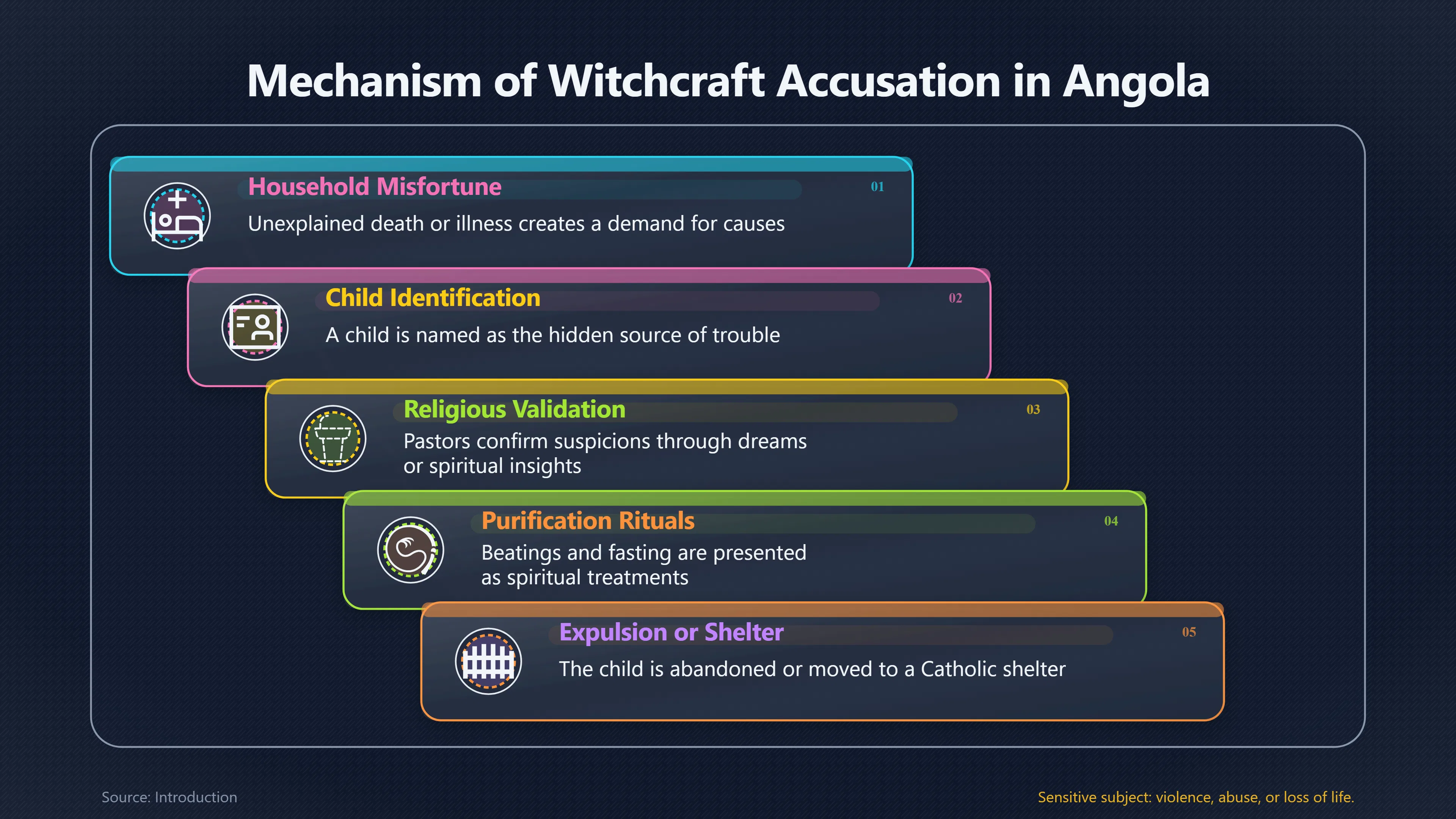
Children accused of witchcraft in Angola were usually not caught in formal trials or a single nationwide panic. The accusation more often began inside a strained household: a parent died, someone became ill, work disappeared or a marriage failed, and a child was identified as the hidden cause. Relatives might then seek confirmation from a pastor or healer, after which rejection, beating, fasting or confinement could be presented as spiritual treatment.

The pattern became especially visible in northern Angola during and after the civil war, when orphanhood, displacement and fractured households left many children dependent on relatives already living in poverty. Reports from M’banza Congo, Uíge and Luanda show how supernatural fear could turn family hardship into violence against children with little power to defend themselves. The issue is best understood not as “mass hysteria” in a clinical sense, but as a dispersed witch panic: shared beliefs and social pressures made accusations credible enough to justify abuse, abandonment and exclusion.[unicef.org]unicef.orgChildren accused of witchcraft in Africa.pdfChildren Accused of Witchcraftby A Cimpric · 2010 · Cited by 19 — This study addresses the issue of children who are victims of vio…
How did an accusation begin?
An accusation commonly followed misfortune within a family. A death without an accepted medical explanation, repeated illness, unemployment, hunger or conflict between adults created a demand for a cause. Witchcraft supplied an explanation that joined several unrelated problems into one story. Once a child had been named, almost any characteristic could be made to fit the suspicion.
UNICEF’s regional study, drawing partly on research from Angola, identified children at particular risk: those who had lost parents and been sent to relatives, those living with a remarried parent, children with disabilities or illnesses, and children described as unusually withdrawn, aggressive, stubborn or gifted. These traits did not cause the accusation. They made a child easier to portray as different, troublesome or threatening within an already unstable household.[UNICEF]unicef.orgChildren accused of witchcraft in Africa.pdfChildren Accused of Witchcraftby A Cimpric · 2010 · Cited by 19 — This study addresses the issue of children who are victims of vio…
The accusation also reversed the normal relationship between adult and child. A dependent child could be imagined as secretly more powerful than the adults around them: able to cause disease, death, poverty or professional failure through invisible means. This gave frightened relatives a way to understand why adult authority seemed unable to prevent disaster. It also allowed an unwanted child to be recast not as someone needing care, but as the reason care had become impossible.[UNICEF]unicef.orgChildren accused of witchcraft in Africa.pdfChildren Accused of Witchcraftby A Cimpric · 2010 · Cited by 19 — This study addresses the issue of children who are victims of vio…
A documented case from Uíge shows this mechanism clearly. Makiesse Jonas was six when his stepmother accused him of causing the illness that killed his father. According to his account, he was repeatedly beaten, made to fast, whipped and isolated during a purification ritual. After relatives nearly burnt him, an uncle removed him and left him at a Catholic shelter in Luanda. The sequence—bereavement, a stepfamily accusation, supposed confirmation through ritual and eventual expulsion—contains many features repeatedly reported in other cases.[The New Humanitarian]thenewhumanitarian.orgThe New Humanitarian"Witchcraft" an excuse for child abuseThe New Humanitarian"Witchcraft" an excuse for child abuse
Why were orphans and stepchildren especially vulnerable?
Angola’s civil war ended in 2002 after decades of conflict, displacement and family separation. Its aftermath left many children without one or both parents, living with grandparents, aunts, uncles or newly formed stepfamilies. These arrangements could provide essential care, but they could also place a child in a household where affection, obligation and scarce resources were unevenly distributed.
In such circumstances, accusation could function as a harsh form of family selection. When food, school costs and housing were difficult to provide, an orphan or stepchild might be treated as an extra burden. Witchcraft language supplied a morally powerful reason for exclusion: the family was not abandoning a dependent, it was supposedly defending itself from danger. UNICEF linked accusations in Angola and neighbouring countries to a wider “multi-crisis” of conflict, poverty, urbanisation, illness and weakened family protection.[unicef.org]unicef.orgChildren accused of witchcraft in Africa.pdfChildren Accused of Witchcraftby A Cimpric · 2010 · Cited by 19 — This study addresses the issue of children who are victims of vio…
This does not mean every accusation was a cynical invention. Many relatives appear to have believed that a supernatural threat was real. Belief and material interest could operate together: a family might sincerely fear a child while also benefiting from removing another mouth to feed. That mixture makes the phenomenon harder to explain than either “primitive superstition” or deliberate fraud. It was a social mechanism through which anxiety, grief and family conflict were translated into blame.
Domingos Pedro’s case, reported from northern Angola in 2007, followed another familiar pattern. After his father died suddenly, relatives blamed Domingos, then aged 12. He was beaten and terrorised, while suspicion persisted even within his immediate family. His experience illustrates how an unexplained death could be converted into a continuing identity: once labelled, a child might remain feared long after the original crisis had passed.[CRIN]archive.crin.orgANGOLA: Children cursed by witchcraft slurs - CRINNovember 16, 2007 — 16 Nov 2007 — Domingos Pedro, 15, left, at home in northern Ang…
What part did churches play?
Churches did not have a single role. Catholic shelters and child-protection workers cared for abandoned children, challenged accusations and tried to reunite families. At the same time, some independent pastors and prophetic churches strengthened accusations by claiming that dreams, visions or spiritual insight revealed a witchcraft spirit in a child.
The crucial step was often validation. A family might arrive with only a suspicion, but a pastor’s diagnosis transformed private anxiety into apparent religious certainty. UNICEF found that pastors could become influential figures in both spreading and legitimising fears about child witches. Deliverance then offered a supposed remedy, sometimes in exchange for payment or continued loyalty to a congregation.[UNICEF]unicef.orgChildren accused of witchcraft in Africa.pdfChildren Accused of Witchcraftby A Cimpric · 2010 · Cited by 19 — This study addresses the issue of children who are victims of vio…
It would be misleading, however, to treat Pentecostal or independent Christianity as inherently abusive. Many Christian leaders opposed accusations, sheltered victims and worked with state agencies. The problem lay in particular leaders and congregations that treated supernatural diagnosis as authority to punish a child. Angolan officials reportedly banned or closed some religious groups after allegations of harmful exorcisms, while two leaders were convicted of child abuse in the mid-2000s.[U.S. Department of State]2009-2017.state.govDepartment of StateAngola - U.S. Department of StateSeventeen religious groups remained banned in Cabinda on charges of practicing harmfu…
Some reconciliation projects also worked through religious ideas rather than attempting to erase them immediately. In M’banza Congo, one approach used a non-violent symbolic purification witnessed by relatives, allowing families who remained convinced of spiritual danger to accept that the child had been “cleared”. From a rights perspective, this was imperfect because it did not directly reject the accusation. In practical terms, however, it could create a path home when legal or secular arguments alone failed to persuade a family.[Religion Info]english.religion.infoangola mending children broken by accusations of witchcraftangola mending children broken by accusations of witchcraft
When “deliverance” became family violence
Once relatives believed that a child contained or controlled a dangerous power, punishment could be described as rescue. Reported practices included beatings, prolonged fasting, isolation, restraint and forced ingestion or application of substances. Some children were expelled after the ritual; others were returned to households where the stigma remained.
The language of deliverance blurred responsibility. Adults could claim they were saving the child, protecting the family or driving out an external spirit. Yet the observable acts were child abuse regardless of the explanation attached to them. International human-rights bodies therefore frame the issue through protection from violence, torture and degrading treatment rather than through debate about whether witchcraft exists.[European Parliament]europarl.europa.euOpen source on europa.eu.
Abandonment was itself a serious form of harm. In 2004, at least 23 boys accused of possessing supernatural powers were reported to be living in a Catholic orphanage in M’banza Congo because their families had expelled them. UNICEF later cited local authorities in northern Angola who had identified 432 street-connected children whose situation followed a witchcraft accusation. Such figures should not be treated as a complete national count: cases were poorly recorded, and different reports covered different locations and periods. They nevertheless show that accusations were capable of moving children out of homes and into shelters or street life on a substantial local scale.[thenewhumanitarian.org]thenewhumanitarian.organgola children victims witchcraft accusationsThe New HumanitarianChildren victims of witchcraft accusations27 Jan 2004 — In M'Banza Congo, the provincial capital of Zaire in northern…
Girls may also have been less visible in street statistics without being less vulnerable. UNICEF noted that boys were more conspicuous among children living publicly on the streets, while girls could remain inside households as domestic labourers or face other forms of exploitation. Later United Nations scrutiny specifically highlighted violence against girls accused of witchcraft, suggesting that a simple count of visibly homeless boys cannot capture the full pattern of abuse.[UNICEF]unicef.orgChildren accused of witchcraft in Africa.pdfChildren Accused of Witchcraftby A Cimpric · 2010 · Cited by 19 — This study addresses the issue of children who are victims of vio…
Why did the fear spread beyond one household?
The phenomenon did not require a central organiser. It spread because several local institutions repeated and reinforced the same explanation. Relatives exchanged stories about children causing illness. Neighbours treated unusual behaviour as suspicious. Pastors confirmed hidden spiritual danger. Shelters and streets then made accused children publicly visible, which could appear to prove that the threat was widespread.
This is why the episode belongs in the history of witch panics even though Angola had no unified campaign resembling an early modern European witch trial. The panic was decentralised and cumulative. Each accusation was largely private, but families drew from a shared repertoire of fears about invisible harm, demonic influence and dangerous children.
The geography also mattered. The strongest documentation came from northern provinces including Zaire, Uíge and Cabinda, within a wider cultural and migration zone connected to the two Congos. Similar accusations had become highly visible in the Democratic Republic of the Congo, particularly in urban settings marked by war, displacement and revivalist churches. Cross-border comparison helps explain how ideas and religious practices circulated, but it should not erase Angola’s specific post-war family conditions.[UNICEF]unicef.orgChildren accused of witchcraft in Africa.pdfChildren Accused of Witchcraftby A Cimpric · 2010 · Cited by 19 — This study addresses the issue of children who are victims of vio…
Nor should the phenomenon be described as an unchanged survival of “African tradition”. UNICEF warned that the modern form combined older beliefs about invisible harm with recent conditions: urban poverty, weakened kinship support, civil conflict and newer Christian language about demonic possession. The child as the principal accused figure was itself a notable development; in many earlier settings, suspected witches were more often adults or elderly people.[UNICEF]unicef.orgChildren accused of witchcraft in Africa.pdfChildren Accused of Witchcraftby A Cimpric · 2010 · Cited by 19 — This study addresses the issue of children who are victims of vio…
What did child-protection programmes change?
The most promising responses treated the accusation as both a safety problem and a family problem. Removing a child could prevent immediate violence, but permanent institutionalisation risked confirming that the child was dangerous or fundamentally separate. Reintegration therefore required work with the relatives, neighbours and religious figures who would shape the child’s life after returning home.
The child-protection committee in Zaire Province brought together local authorities, non-governmental organisations, traditional healers and church leaders. UNICEF reported that it sought to detect accusations early, secure documents for children, close churches linked to abusive pastors and organise community discussions. Of 423 children brought to a centre, 380 were reportedly reintegrated with their families. The figure records programme outcomes rather than proof that every return remained safe, but it demonstrates that family rejection was not always irreversible.[UNICEF]unicef.orgChildren accused of witchcraft in Africa.pdfChildren Accused of Witchcraftby A Cimpric · 2010 · Cited by 19 — This study addresses the issue of children who are victims of vio…
Effective reintegration had to address stigma as well as physical shelter. A child could be allowed home yet remain excluded from meals, schooling, affection or contact with siblings. UNICEF consequently recommended risk assessments before return, continued support for vulnerable families and mediation involving pastors, relatives and child-rights workers. It also warned against creating isolated services that unintentionally marked accused children as a separate category.[UNICEF]unicef.orgChildren accused of witchcraft in Africa.pdfChildren Accused of Witchcraftby A Cimpric · 2010 · Cited by 19 — This study addresses the issue of children who are victims of vio…
The wider lesson is that disbelief alone is not a complete protection strategy. Public education about illness can reduce supernatural explanations for malaria, epilepsy or developmental conditions. Social assistance can lower the pressure that makes dependent children easy targets. Regulation and prosecution can restrain abusive religious leaders. None of these measures works as well in isolation as a system connecting healthcare, schools, police, social workers, families and trusted community figures.
Did the law solve the problem?
Angola increasingly recognised witchcraft accusations as violence against children rather than a legitimate basis for punishment. Religious freedom did not protect assault, unlawful confinement or neglect. Authorities closed some churches, pursued individual abusers and incorporated the issue into child-protection discussions.
International monitoring nevertheless found that enforcement and prevention remained incomplete. The African Committee of Experts on the Rights and Welfare of the Child described accusations as common mainly in northern Angola but present elsewhere, and said the reported level of associated abuse and torture was alarming. It urged prevention focused on orphanhood, illness and family separation, alongside investigation and prosecution of perpetrators.[ACERWC]acerwc.africaAngola CO Initial Report 7Angola CO Initial Report 7
The United Nations Committee on the Rights of the Child also called for violence linked to witchcraft accusations—especially against girls—to be explicitly criminalised within the treatment of harmful practices. Its concern sat within a broader finding that corporal punishment and violence within homes and institutions had not been adequately eliminated. This matters because violent “correction” can make abusive deliverance rituals appear less exceptional in communities where physical punishment is already accepted.[OHCHR Document Store]docstore.ohchr.orgDocument StoreDocument Store
The issue has not disappeared into history. In 2024, discussion of Angola’s national early-childhood policy still identified witchcraft accusations against children under five as a practice needing a more coordinated response. UNICEF’s 2024 country reporting also referred to work on legislation and policy concerning witchcraft accusations, while a 2025 report cited more than 100 complaints received by the National Children’s Institute and described a severe recent case involving a pastor in Luanda. The latter figure comes from news reporting rather than a published national dataset, so it is best read as evidence of continuing complaints, not a measure of prevalence across Angola.[unicef.org]unicef.orgnational workshop presentation national early childhood policy angolanational workshop presentation national early childhood policy angola
What is commonly misunderstood?
The first misunderstanding is that witchcraft belief automatically produces abuse. It does not. Spiritual beliefs can exist without anyone being accused, expelled or harmed. The danger arises when a specific child is made responsible for hardship and adults acquire social permission to act on that claim.
The second is that every accusation is simply a trick for avoiding childcare. Economic pressure plainly mattered, particularly for orphans and stepchildren, but many accusers sincerely feared supernatural attack. Treating all relatives as calculating fraudsters misses why accusations could become so persuasive and why families sometimes continued to reject children even after an exorcism.
The third is that pastors alone created the problem. Some amplified it and profited from deliverance, but accusations frequently began within families before reaching a church. Other religious organisations provided the shelters, mediation and moral authority needed to challenge abuse.
Finally, this was not a single short-lived outbreak with a clear beginning and end. The early 2000s produced the strongest body of reporting because post-war street children and shelter populations drew humanitarian attention. Later official concern shows that the underlying mechanism survived: when illness, bereavement and poverty are interpreted through a shared fear of hidden child witches, ordinary family conflict can still become persecution.

Why the accusations still matter
Angola’s child-witchcraft accusations show how collective belief becomes harmful without requiring a crowd, a state trial or a national propaganda campaign. The decisive arena was often the family home. Fear travelled through stories, religious authority and neighbourhood judgement until a vulnerable child came to embody everything a household could not explain or control.
The most useful interpretation therefore joins belief and circumstance. Supernatural ideas supplied the accusation, but war, bereavement, poverty, unstable caregiving and weak protection systems determined which children were exposed and how far adults could go. The result was not imaginary harm produced by “hysteria”; it was real family violence legitimised by a contagious explanation.
Child protection changed the question. Instead of asking whether a frightened family’s supernatural account was culturally authentic, authorities and aid workers increasingly asked what had happened to the child, whether returning home was safe, who had authorised the violence and what support might prevent another accusation. That shift—from judging belief to preventing harm—remains the central lesson of Angola’s child witch panic.
Amazon book picks
Further Reading
Books and field guides related to Why Were Angolan Children Accused of Witchcraft?. Use these as the next step if you want deeper reading beyond the article.
African religions and philosophy
Provides background on belief systems behind accusations.
The fate of Africa
Explains Angola's postwar conditions that shaped these accusations.
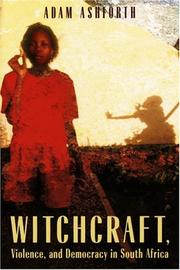
Witchcraft, Violence, and Democracy in South Africa
Explores how social crises become witchcraft accusations.
Endnotes
1.
Source: unicef.org
Title: Children accused of witchcraft in Africa.pdf
Link:https://www.unicef.org/nigeria/media/1326/file/%20Children-accused-of-witchcraft-in-Africa.pdf.pdf
Source snippet
Children Accused of Witchcraftby A Cimpric · 2010 · Cited by 19 — This study addresses the issue of children who are victims of vio...
2.
Source: archive.crin.org
Link:https://archive.crin.org/en/library/news-archive/angola-children-cursed-witchcraft-slurs.html
Source snippet
ANGOLA: Children cursed by witchcraft slurs - CRINNovember 16, 2007 — 16 Nov 2007 — Domingos Pedro, 15, left, at home in northern Ang...
Published: November 16, 2007
3.
Source: 2009-2017.state.gov
Link:https://2009-2017.state.gov/j/drl/rls/irf/2006/71285.htm
Source snippet
Department of StateAngola - U.S. Department of StateSeventeen religious groups remained banned in Cabinda on charges of practicing harmfu...
4.
Source: 2001-2009.state.gov
Link:https://2001-2009.state.gov/g/drl/rls/irf/2007/90081.htm
5.
Source: english.religion.info
Title: angola mending children broken by accusations of witchcraft
Link:https://english.religion.info/2006/12/23/angola-mending-children-broken-by-accusations-of-witchcraft/
6.
Source: acerwc.africa
Title: Angola CO Initial Report 7
Link:https://www.acerwc.africa/sites/default/files/2022-06/Angola_CO_Initial_Report_7.pdf
7.
Source: docstore.ohchr.org
Title: Document Store
Link:https://docstore.ohchr.org/SelfServices/FilesHandler.ashx?enc=0EL1B7T9TvoJ0v4pplY3zzq%2BslltJlU5D78zePycajfPX7i8s9ubUd354I071ic%2B7Gn6fx7qK4Iu4ijAk5cVuA%3D%3D
8.
Source: unicef.org
Title: national workshop presentation national early childhood policy angola
Link:https://www.unicef.org/angola/en/stories/national-workshop-presentation-national-early-childhood-policy-angola
9.
Source: open.unicef.org
Title: UNICE F Angola
Link:https://open.unicef.org/download-pdf?country-name=Angola&year=2024
10.
Source: ohchr.org
Title: committee rights child considers reports angola
Link:https://www.ohchr.org/en/press-releases/2018/05/committee-rights-child-considers-reports-angola
11.
Source: ohchr.org
Link:https://www.ohchr.org/Documents/Issues/Religion/FU-Angola.pdf
12.
Source: ohchr.org
Link:https://www.ohchr.org/sites/default/files/2022-12/PAP-Guidelines-EN.pdf
13.
Source: 2001-2009.state.gov
Link:https://2001-2009.state.gov/g/drl/rls/irf/2008/108352.htm
14.
Source: 2009-2017.state.gov
Link:https://2009-2017.state.gov/j/drl/rls/irf/2010/148660.htm
15.
Source: 2009-2017.state.gov
Link:https://2009-2017.state.gov/j/drl/rls/irf/2009/127216.htm
16.
Source: 2009-2017.state.gov
Link:https://2009-2017.state.gov/documents/organization/186375.pdf
17.
Source: state.gov
Link:https://www.state.gov/report/custom/98797d82f1
18.
Source: 2009-2017.state.gov
Link:https://2009-2017.state.gov/j/drl/rls/hrrpt/2010/af/154330.htm
19.
Source: state.gov
Link:https://www.state.gov/report/custom/a329948607
20.
Source: state.gov
Link:https://www.state.gov/report/custom/08689a0307
21.
Source: 2021-2025.state.gov
Link:https://2021-2025.state.gov/report/custom/1331d63a0e/
22.
Source: acerwc.africa
Title: Study on Implimentation of Decisions
Link:https://www.acerwc.africa/sites/default/files/2025-04/Study%20on%20Implimentation%20of%20Decisions.pdf
23.
Source: unicef.org
Title: and partners bring hope children accused witchcraft liberia
Link:https://www.unicef.org/liberia/stories/unicef-and-partners-bring-hope-children-accused-witchcraft-liberia
24.
Source: unicef.org
Title: dealing child mental health aftermath conflict central african republic
Link:https://www.unicef.org/car/en/stories/dealing-child-mental-health-aftermath-conflict-central-african-republic
25.
Source: archive.crin.org
Title: angola persistent violations childrens rights
Link:https://archive.crin.org/en/library/publications/angola-persistent-violations-childrens-rights.html
26.
Source: thenewhumanitarian.org
Title: angola children victims witchcraft accusations
Link:https://www.thenewhumanitarian.org/report/48287/angola-children-victims-witchcraft-accusations
Source snippet
The New HumanitarianChildren victims of witchcraft accusations27 Jan 2004 — In M'Banza Congo, the provincial capital of Zaire in northern...
27.
Source: europarl.europa.eu
Link:https://www.europarl.europa.eu/RegData/etudes/note/join/2013/433714/EXPO-DROI_NT%282013%29433714_EN.pdf
28.
Source: thenewhumanitarian.org
Title: The New Humanitarian”Witchcraft” an excuse for child abuse
Link:https://www.thenewhumanitarian.org/news/2006/12/12/witchcraft-excuse-child-abuse
29.
Source: thenewhumanitarian.org
Title: rights child witchcraft allegations rise
Link:https://www.thenewhumanitarian.org/report/89858/rights-child-witchcraft-allegations-rise
Source snippet
The New HumanitarianChild witchcraft allegations on the rise16 Jul 2010 — Accusations of child witchcraft are on the rise in sub-Saharan...
30.
Source: humanium.org
Link:https://www.humanium.org/en/angola/
Additional References
31.
Source: youtube.com
Title: Sky News speaks to a man accused of witchcraft as a child
Link:https://www.youtube.com/watch?v=03SKHDqyhYQ
Source snippet
How David Umem Is Rescuing Children Accused Of Witchcraft In Southern Nigeria...
32.
Source: youtube.com
Title: How David Umem Is Rescuing Children Accused Of Witchcraft In Southern Nigeria
Link:https://www.youtube.com/watch?v=7LDn8ZXYf5g
Source snippet
Nigeria: The Plight of the Witch Children...
33.
Source: govinfo.gov
Link:https://www.govinfo.gov/content/pkg/CPRT-110JPRT33723/html/CPRT-110JPRT33723.htm
34.
Source: youtube.com
Title: Dispatches: Return To Africa’s Witch Children
Link:https://www.youtube.com/watch?v=5Y06sKAg9Do
Source snippet
Sky News speaks to a man accused of witchcraft as a child...
35.
Source: researchgate.net
Link:https://www.researchgate.net/publication/349028982_Religio-cultural_beliefs_and_children_accused_of_witchcraft_Describing_the_child-witch_phenomenon
36.
Source: occrp.org
Link:https://www.occrp.org/en/news/africa-witchcraft-accusations-against-children-still-prevalent
37.
Source: refworld.org
Link:https://www.refworld.org/reference/themreport/unicef/2011/104141
38.
Source: cmf.org.uk
Link:https://www.cmf.org.uk/article/child-witch-accusations/
39.
Source: researchgate.net
Link:https://www.researchgate.net/publication/338958125_Christian_Pastors_and_Alleged_Child_Witches_in_Kinshasa_DRC
40.
Source: facebook.com
Link:https://www.facebook.com/61557155651558/posts/grandma-accused-of-witchcraft-in-angolasiting-on-the-middle-of-the-village-kanga/122131214168238521/
Topic Tree