Within Uruguay Belief Scares
How Father Antelo Built Religious Control
The Community of Jerusalem shows how charisma, miracle claims and familiar Catholic language can become tools of sustained control.
On this page
- The rise of the Community of Jerusalem
- Miracle claims, obedience and abuse allegations
- Investigations, testimony and institutional reckoning
Page outline Jump by section
Introduction
The story of Father Adolfo “Fito” Antelo is one of Uruguay’s clearest examples of how religious authority can become coercive without relying on unusual beliefs or apocalyptic prophecies. During the 1980s, Antelo was one of the country’s most recognisable Catholic priests. He attracted large numbers of young followers through the Community of Jerusalem, presenting himself as a gifted spiritual guide whose apparent miraculous recovery from cancer reinforced his reputation. Behind that public image, however, former members later described a closed world built around unquestioning obedience, fear, humiliation and physical abuse. Investigations by journalists, the Catholic Church and the criminal justice system transformed the case into a landmark discussion about spiritual manipulation within mainstream religious institutions rather than at their fringes.[com.uy]elpais.com.uyEL PAISLos Demonios del Padre AnteloEL PAÍS Uruguay…

The rise of the Community of Jerusalem
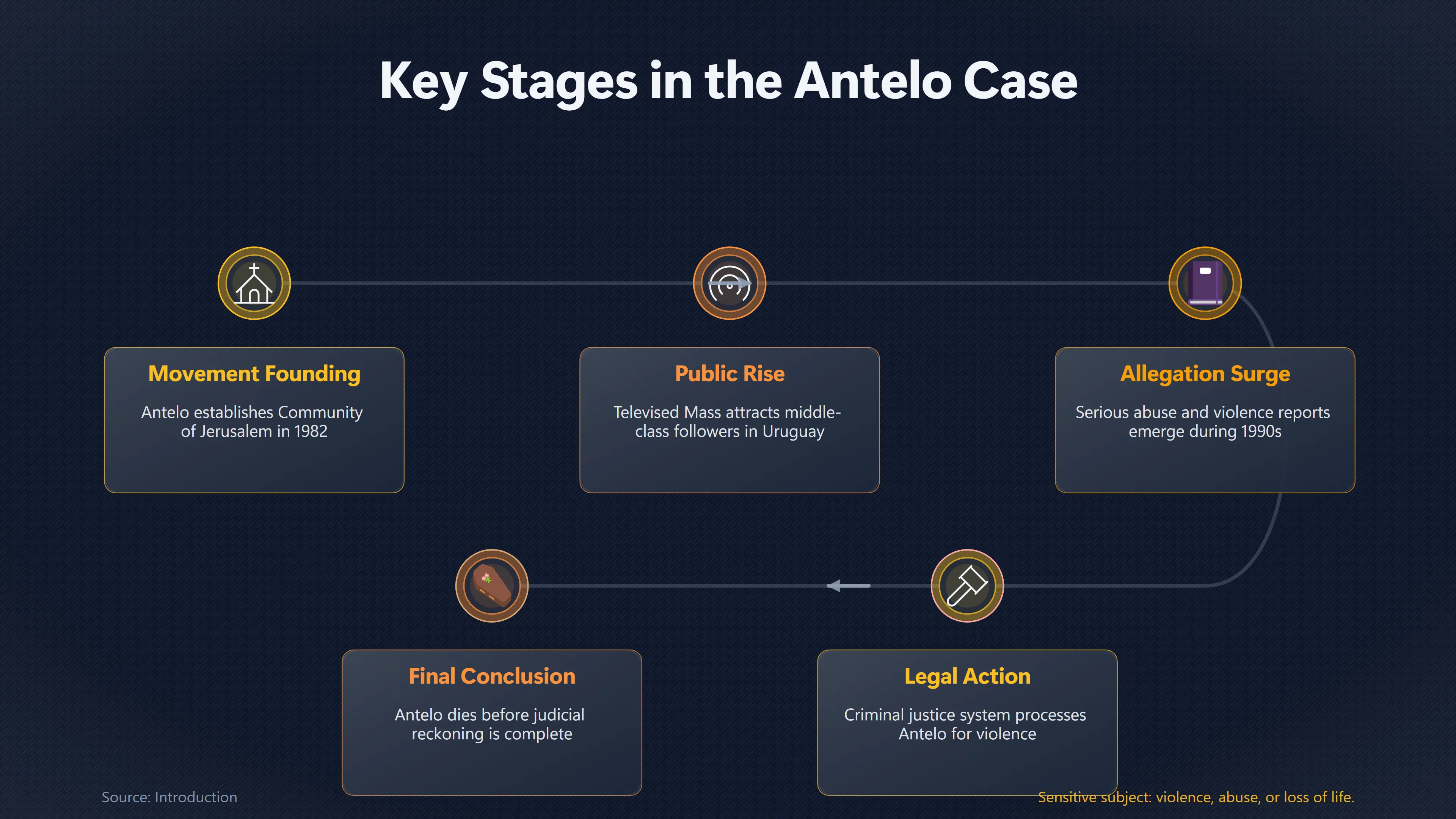
Adolfo Antelo founded the Community of Jerusalem in 1982 while serving as a Salesian priest. Unlike many groups later described as cults, the movement did not present itself as an alternative religion. It used familiar Catholic language centred on prayer, sacrifice, devotion to Christ and missionary commitment. This familiarity gave it credibility among families and churchgoers who saw it as part of Catholic renewal rather than a break from the Church.[Inter Press Service]ipsnews.netOpen source on ipsnews.net.
Antelo himself became an unusually prominent religious figure in secular Uruguay. He celebrated televised Mass, attracted favourable media attention and inspired hundreds of young people, particularly from middle- and upper-class families. According to later investigations, his personal story became central to his authority. After surviving what had been considered a life-threatening cancer as a young man, Antelo interpreted his recovery as evidence of a special divine mission, encouraging followers to see him as someone uniquely chosen by God.[com.uy]elpais.com.uyEL PAISLos Demonios del Padre AnteloEL PAÍS Uruguay…
This combination of institutional legitimacy, personal charisma and claims of exceptional spiritual experience made criticism difficult. Members did not initially join because they rejected Catholicism; they believed they were embracing a more demanding and authentic version of it.
How religious authority became a system of control
Former members consistently described a pattern in which ordinary Catholic ideas were transformed into mechanisms of personal domination.
Rather than relying primarily on bizarre doctrines, Antelo reportedly exercised authority through concepts already familiar within Christian spirituality:
- absolute obedience to a spiritual superior;
- suffering presented as spiritually beneficial;
- constant emphasis on sin and demonic influence;
- confession and self-disclosure used to expose personal vulnerabilities;
- the belief that questioning leadership reflected spiritual weakness rather than legitimate concern.[com.uy]elpais.com.uyEL PAISLos Demonios del Padre AnteloEL PAÍS Uruguay…
These practices, according to former members, gradually isolated followers from independent judgement. Instead of evaluating Antelo’s decisions against broader Catholic teaching or ordinary moral standards, many came to interpret his commands as expressions of God’s will.
Researchers who study coercive religious groups often note that such systems depend less on unusual theology than on monopolising authority. The Antelo case illustrates this pattern: familiar beliefs remained largely intact while the leader increasingly became the exclusive interpreter of those beliefs.
Miracle claims, obedience and abuse allegations
The Community of Jerusalem’s internal culture became the subject of increasingly serious allegations during the 1990s.
Former members described severe physical punishments, psychological intimidation and systematic humiliation carried out under religious justification. Several alleged that beatings were portrayed as acts of spiritual correction rather than violence. Others reported intense pressure to confess sins repeatedly, public humiliation and constant warnings about the Devil’s influence. Sexual abuse allegations also emerged from former insiders, although the criminal proceedings ultimately focused on particular offences supported by available evidence.[ipsnews.net]ipsnews.netOpen source on ipsnews.net.
A recurring feature of testimony was the creation of an atmosphere in which ordinary disagreement became spiritually dangerous. Individuals who questioned Antelo could be portrayed as prideful, spiritually corrupted or influenced by evil. Such framing made resistance psychologically costly because it threatened not only membership in the community but also one’s perceived relationship with God.[Inter Press Service]ipsnews.netOpen source on ipsnews.net.
Investigative reporting has also described a hierarchy within the movement in which selected followers occupied privileged positions close to Antelo while simultaneously being subjected to some of the harshest disciplinary practices. Former members portrayed this as a cycle of favour, fear and punishment that reinforced dependence on the leader.[EL PAIS]elpais.com.uyApril 20, 2025…

Investigations, testimony and institutional reckoning
As complaints accumulated, the controversy expanded beyond dissatisfied former members.
The Catholic Church established an ecclesiastical tribunal to investigate Antelo and the Community of Jerusalem. The proceedings became contentious, eventually involving appeals to the Vatican and disagreements over how the allegations should be handled. Ultimately, Uruguayan church authorities prohibited the Community of Jerusalem and its associated women’s branch from operating within the country, although related organisations continued elsewhere under different structures for a period.[EL PAIS]elpais.com.uyApril 11, 2024…
The criminal justice system also intervened. Following testimony from former members and media investigations, Antelo was prosecuted. Contemporary reporting records that he was processed on charges relating to private violence and serious bodily injury arising from abuse of followers. He denied wrongdoing and maintained his innocence. Before the legal process reached its final conclusion, he died from cancer, leaving many former members feeling that a full judicial reckoning never occurred.[ipsnews.net]ipsnews.netOpen source on ipsnews.net.
Recent investigative journalism has revisited court files, interviews and church records, bringing renewed public attention to testimony that had long remained scattered or largely forgotten outside Uruguay.[EL PAIS]elpais.com.uyEL PAISLos Demonios del Padre AnteloEL PAÍS Uruguay…
Why the case matters beyond one priest
The Antelo affair is significant because it demonstrates that coercive religious systems do not necessarily emerge through exotic doctrines or dramatic predictions about the end of the world.
Instead, the Community of Jerusalem appears to have developed around three reinforcing elements:
- Institutional trust. Antelo was already recognised as a respected Catholic priest, giving him credibility that independent religious movements often lack.
- Personal charisma. Followers viewed him as exceptionally holy, reinforced by the narrative of his recovery from cancer.
- Concentrated authority. Spiritual obedience gradually shifted from commitment to Catholic teaching towards loyalty to a single individual whose interpretations became difficult to challenge.[com.uy]elpais.com.uyEL PAISLos Demonios del Padre AnteloEL PAÍS Uruguay…
For scholars of coercive religious authority, these characteristics are more revealing than debates over whether the Community of Jerusalem should be labelled a “cult”. The important question is not simply what members believed, but how authority operated inside the organisation and whether ordinary safeguards against abuse had broken down.
A lasting place in Uruguay’s history of religious abuse
Uruguay is often portrayed as one of Latin America’s most secular societies, making the Antelo case particularly striking. The controversy showed that even within a country where organised religion occupies a relatively modest public role, charismatic authority can still become powerful when attached to trusted institutions and compelling personal narratives.
The case also reshaped discussion inside the Uruguayan Catholic Church. It highlighted the risks of placing extraordinary confidence in a charismatic leader without effective oversight, encouraged greater attention to testimony from former members and became an early warning of broader debates about abuse, accountability and institutional transparency that would later affect Catholic churches worldwide.[com.uy]elpais.com.uyOpen source on com.uy.
Amazon book picks
Further Reading
Books and field guides related to How Father Antelo Built Religious Control. Use these as the next step if you want deeper reading beyond the article.

Combating cult mind control
Explains coercive control relevant to charismatic religious leaders.
The Oxford handbook of new religious movements
Places the case in wider scholarship on religious movements.
Endnotes
1.
Source: elpais.com.uy
Title: EL PAISLos Demonios del Padre Antelo
Link:https://www.elpais.com.uy/podcast/los-demonios-del-padre-antelo
Source snippet
EL PAÍS Uruguay...
2.
Source: elpais.com.uy
Link:https://www.elpais.com.uy/informacion/sociedad/el-pais-lanzo-el-podcast-los-demonios-del-padre-antelo-la-secta-que-cambio-a-la-iglesia-uruguaya
3.
Source: elpais.com.uy
Link:https://www.elpais.com.uy/cultural/volver-a-la-secta-del-padre-antelo-una-lectura-necesaria-para-una-leccion-que-no-se-debe-olvidar
Source snippet
April 20, 2025...
Published: April 20, 2025
4.
Source: english.elpais.com
Link:https://english.elpais.com/society/2026-04-20/el-pais-submits-to-the-vatican-a-report-identifying-24-people-accused-of-child-sexual-abuse-in-the-americas.html
Source snippet
PAÍS submits to the Vatican a report identifying 24 people accused of child sexual abuse in the Americas | Society | EL PAÍS EnglishApril...
5.
Source: ipsnews.net
Link:https://www.ipsnews.net/1996/02/religion-uruguay-nation-investigates-allegations-against-cult/
6.
Source: ipsnoticias.net
Link:https://ipsnoticias.net/1996/02/religion-justicia-uruguaya-indaga-grupo-catolico-internacional/
7.
Source: elpais.com.uy
Link:https://www.elpais.com.uy/informacion/sociedad/los-demonios-del-padre-antelo-es-el-podcast-mas-escuchado-en-uruguay-la-historia-de-una-secta-en-la-iglesia
Source snippet
April 11, 2024...
Published: April 11, 2024
8.
Source: elpais.com.uy
Link:https://www.elpais.com.uy/informacion/sociedad/los-demonios-del-padre-antelo-podcast-de-una-secta-religiosa-entro-en-el-ranking-de-true-crime-en-mexico
9.
Source: elpais.com.uy
Link:https://www.elpais.com.uy/informacion/sociedad/los-demonios-del-padre-antelo-el-podcast-mas-escuchado-de-uruguay-supero-las-100-000-reproducciones
Source snippet
EL PAÍS Uruguay...
10.
Source: elpais.com.uy
Link:https://www.elpais.com.uy/informacion/sociedad/el-pais-lanza-el-podcast-los-demonios-del-padre-antelo-la-secta-que-cambio-a-la-iglesia-uruguaya
11.
Source: ipsnews.net
Link:https://www.ipsnews.net/1996/02/religious-bulletin-6-uruguay-cult-founded-by-catholic-priest/
Additional References
12.
Source: youtube.com
Title: Reclaiming Our Dignity: Healing from Spiritual Abuse (with Paul Fahey)
Link:https://www.youtube.com/watch?v=qCPH12XvCoM
Source snippet
How 'Cult' Splintered From Catholic Church Operated...
13.
Source: youtube.com
Title: How to heal from spiritual abuse, religious trauma, and church hurt
Link:https://www.youtube.com/watch?v=uPSCzjB2C9c
Source snippet
Religious Abuse and Cults - Childhood Trauma...
14.
Source: youtube.com
Title: Healing Religious Trauma with Dr. Diane Langberg
Link:https://www.youtube.com/watch?v=JlXMoIvM1T8
Source snippet
How to heal from spiritual abuse, religious trauma, and church hurt...
15.
Source: youtube.com
Title: How ‘Cult’ Splintered From Catholic Church Operated
Link:https://www.youtube.com/watch?v=BPi69QP10dQ
Source snippet
Healing Religious Trauma with Dr. Diane Langberg...
16.
Source: ipsnoticias.net
Link:https://ipsnoticias.net/1996/04/uruguay-grupo-catolico-investigado-provoca-crisis-en-la-iglesia/
17.
Source: ipsnoticias.net
Link:https://ipsnoticias.net/1996/05/uruguay-la-iglesia-catolica-vive-fuerte-enfrentamiento-interno/
18.
Source: sitiosdememoria.uy
Link:https://sitiosdememoria.uy/causas/582
19.
Source: music.amazon.es
Link:https://music.amazon.es/podcasts/c528bc08-6a97-4e5a-8bfb-4564a78d4e9b/episodes/d4055fad-42b4-4f69-a44f-1f9723b104fe/los-demonios-del-padre-antelo-episodio-8-el-%C3%BAltimo-suspiro-de-adolfo-antelo?tag=searcht-20
20.
Source: ipsnoticias.net
Link:https://ipsnoticias.net/1995/10/uruguay-la-iglesica-catolica-en-crisis-pierde-sus-fieles/
21.
Source: lr21.com.uy
Title: Justicia investiga “dudosa” desaparición que podría haber terminado en homicidio
Link:https://www.lr21.com.uy/justicia/433457-justicia-investiga-dudosa-desaparicion-que-podria-haber-terminado-en-homicidio
Topic Tree