Within Dominica
Was Obeah Faith, Fraud or Feared Magic?
Dominica's obeah laws turned varied traditions of healing, divination and supernatural protection into a broad criminal category.
On this page
- What Obeah Meant in Dominica
- Colonial Fear and the Obeah Act
- Belief, Healing, Fraud and Modern Interpretation
Page outline Jump by section
Introduction
In Dominica, obeah has long occupied a disputed space between religion, folk healing, spiritual protection, divination and accusations of deception or harmful magic. It was never a single organised faith, nor simply a collection of fraudulent practices. Instead, the word “obeah” became a broad colonial label applied to a wide variety of African-derived spiritual traditions, herbal healing, ritual specialists and claims of supernatural power. That ambiguity made it particularly vulnerable to criminalisation.
The island’s history is therefore less about dramatic witch trials than about the relationship between belief and power. Colonial governments treated obeah as a threat to public order, while many ordinary Dominicans continued to seek healers for illness, protection, finding stolen property or dealing with personal misfortune. The resulting tension shaped law, public attitudes and religious life for generations.
What Obeah Meant in Dominica
In practice, obeah meant different things to different people.
For believers, an obeah practitioner might provide herbal medicines, spiritual cleansing, protective charms or guidance during difficult periods of life. Some practitioners were consulted to remove curses or explain persistent illness that seemed resistant to ordinary remedies. Others claimed to communicate with unseen spiritual forces or predict future events. These activities drew on African traditions adapted to Caribbean conditions and often existed alongside Christian belief rather than replacing it.[The Guardian]theguardian.comThe Guardian Why does the often maligned Caribbean obeah tradition endure?Obeah blends African folk magic, Christianity, and indigenous Caribbean beliefs, involving both healing and supernatural practices using…
For sceptics, however, obeah could also involve people claiming supernatural powers for financial gain. Colonial officials rarely distinguished carefully between respected healers, ritual specialists and outright fraudsters. Instead, the entire spectrum was increasingly treated as one criminal category.
This broad definition mattered because it allowed authorities to prosecute people not simply for causing demonstrable harm, but for claiming supernatural abilities at all.
Colonial Fear and the Obeah Act
Fear of obeah developed within the wider system of slavery and colonial rule rather than emerging from a single episode of public panic.
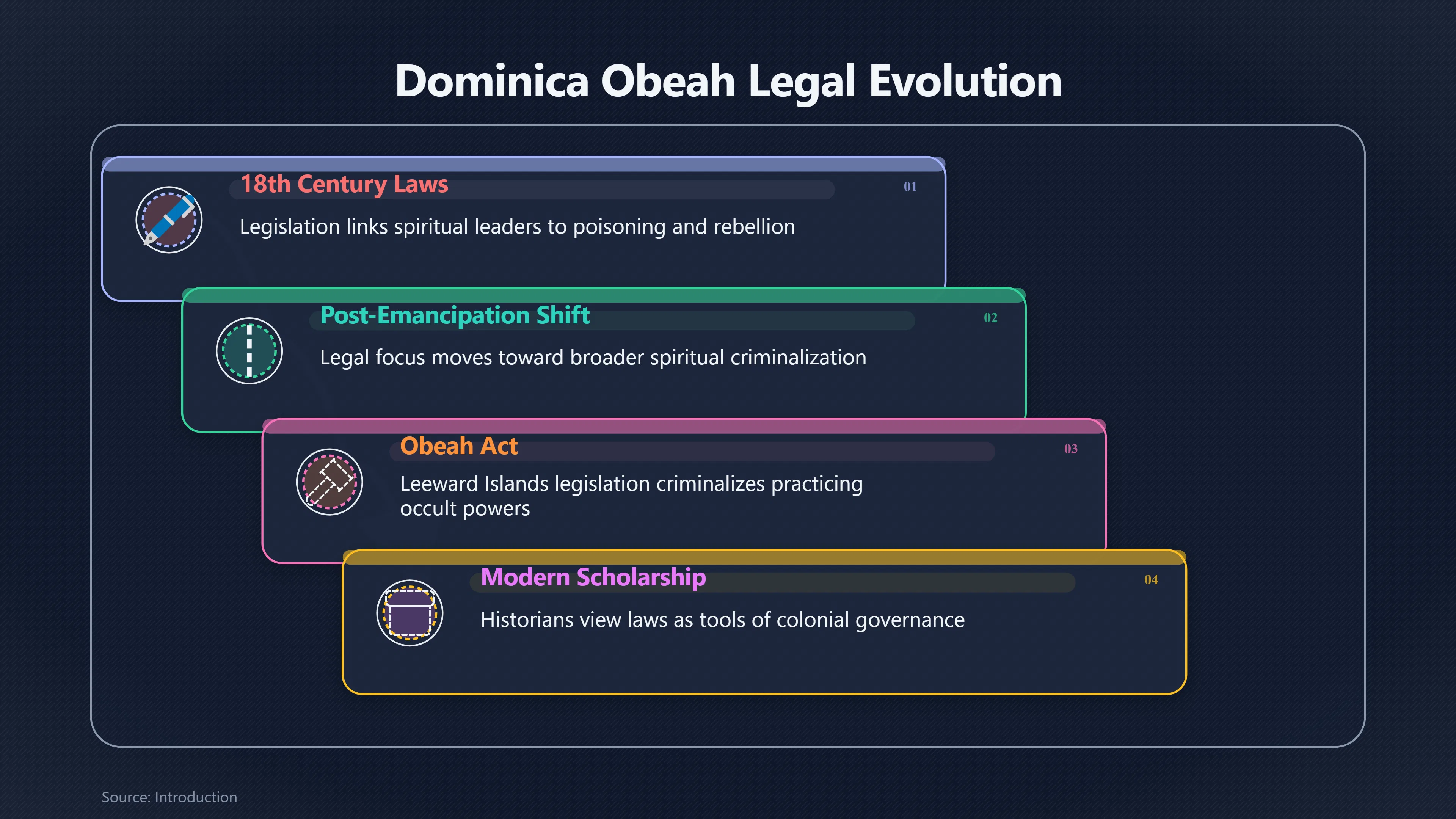
Eighteenth-century legislation in Dominica associated so-called “Obeah or Doctor Men” with poisoning, secret medicines and the possibility of encouraging rebellion among enslaved people. Colonial lawmakers viewed respected spiritual leaders as dangerous because they could influence enslaved communities outside official control. Laws therefore combined fears of supernatural belief with fears of political resistance. [Religion &[Slavery(https://religionandslavery.org/ps%3A-laws-against-obeah)]religionandslavery.org& SlaveryPS: Laws against obeah…
After emancipation, the legal approach changed in form but not entirely in purpose. Dominica eventually adopted the Leeward Islands Obeah Act of 1904, which defined obeah extremely broadly. Rather than requiring proof that supernatural powers existed, the law criminalised practising or pretending to practise occult powers, using spells or witchcraft, possessing instruments associated with obeah and, in some circumstances, consulting practitioners. The legislation was closely modelled on earlier Jamaican law and formed part of a wider pattern across the British Caribbean.[Obeah Histories]obeahhistories.org1904 leeward islands actObeah HistoriesThe Obeah Act,1904 (Leeward Islands) | Obeah HistoriesMarch 2, 1904…
The breadth of these definitions reflected colonial assumptions rather than careful distinctions between religion, medicine and fraud.
Why Colonial Authorities Feared Obeah
The criminalisation of obeah was driven by several overlapping concerns.
Control over enslaved and rural populations. Colonial governments worried that respected spiritual practitioners possessed authority that competed with plantation owners, missionaries and magistrates. A healer trusted by a community could also become a source of leadership or resistance.
Fear of poisoning. Throughout the Caribbean, rumours frequently linked obeah with hidden poisons. Although genuine poisoning cases occasionally occurred, colonial officials often merged separate fears about toxic substances, herbal medicine and supernatural belief into a single legal category. [Religion &[Slavery(https://religionandslavery.org/ps%3A-laws-against-obeah)]religionandslavery.org& SlaveryPS: Laws against obeah…
Christian hostility. Missionaries generally regarded African-derived spiritual traditions as incompatible with Christian teaching. Their descriptions frequently portrayed obeah as superstition, devil worship or deliberate deception, reinforcing its social stigma.
Anxiety about hidden influence. Because many rituals took place in private and relied upon secrecy, rumour often filled the gaps in public knowledge. Invisible threats are especially likely to generate exaggerated fear, and accusations of obeah could become difficult to disprove.
Belief, Healing and Fraud Were Not the Same Thing
Modern historians increasingly argue that colonial law collapsed several very different activities into one offence.
Someone selling fake magical cures for money is not the same as a respected herbal healer. Likewise, spiritual rituals intended to comfort grieving families differ fundamentally from criminal fraud or poisoning. Yet colonial legislation often made little distinction between these activities.
Research into Caribbean obeah prosecutions shows that many people prosecuted under obeah laws were engaged in healing, religious practice or divination rather than acts that would today normally be treated as criminal offences. Where genuine fraud occurred, separate fraud laws could often have addressed it without criminalising an entire body of religious and cultural practice.[Obeah Histories]obeahhistories.orgOpen source on obeahhistories.org.
This distinction has become central to modern historical interpretation.
How Fear Persisted After Colonial Rule
Even after slavery ended, public suspicion surrounding obeah remained strong.
Christian churches continued to condemn it, while many families privately consulted healers during illness or personal crises. This produced a form of social duality in which public disapproval coexisted with private belief.
Stories about curses, supernatural attacks or protective rituals also remained part of local folklore. Such stories reinforced both belief and fear, regardless of whether any specific claim could be verified. Unlike a classic moral panic with a clearly defined beginning and end, fear surrounding obeah became embedded in everyday culture over many generations.
This helps explain why accusations of obeah could still damage reputations even when no legal prosecution followed.
How Historians View the Law Today
Most modern scholarship sees anti-obeah legislation as part of a broader colonial project of governing religion, medicine and social authority rather than simply protecting the public from fraud.
Researchers note that laws against obeah appeared across much of the Anglophone Caribbean using remarkably similar wording, suggesting that colonial administrations shared a common legal model rather than responding to unique local emergencies. These statutes often targeted claims of supernatural power themselves, regardless of whether measurable harm could be demonstrated.[Obeah Histories]obeahhistories.orgObeah Histories Legislation | Obeah HistoriesObeah Histories Legislation | Obeah Histories
The surviving legislation in Dominica therefore illustrates how colonial governments transformed diverse cultural and spiritual practices into a single criminal offence. Although concerns about deception and exploitation were real in some cases, historians generally argue that the law swept far more broadly than ordinary fraud prevention.
Why Obeah Remains Historically Important
Obeah remains significant in Dominica because it reveals how belief, law and colonial power became intertwined.
The history is not primarily one of mass hysteria in the sense of sudden collective delusion. Instead, it demonstrates a long-running pattern in which fear of hidden supernatural influence shaped legislation, public attitudes and religious life. Colonial authorities interpreted African-derived spiritual traditions through the lenses of disorder, rebellion and superstition, while many ordinary people continued to value healing and protective practices despite official condemnation.
Understanding this history also helps distinguish between several different phenomena that are often confused: genuine religious belief, traditional medicine, folklore, deliberate fraud, social rumour and colonial systems of control. That distinction remains essential for interpreting Dominica’s cultural history without either romanticising or demonising obeah.
Amazon book picks
Further Reading
Books and field guides related to Was Obeah Faith, Fraud or Feared Magic?. Use these as the next step if you want deeper reading beyond the article.
The Black Jacobins
First published 1935. Subjects: History, Biography, Revolutionaries, Generals, Revolution, 1791-1804.
The Serpent and the Rainbow
First published 1985. Subjects: Social life and customs, Description and travel, Zombiism, Bizango (Cult), Religious life and customs.

Endnotes
1.
Source: theguardian.com
Title: The Guardian Why does the often maligned Caribbean obeah tradition endure?
Link:https://www.theguardian.com/news/2026/jun/17/why-does-the-often-maligned-caribbean-obeah-tradition-endure
Source snippet
Obeah blends African folk magic, Christianity, and indigenous Caribbean beliefs, involving both healing and supernatural practices using...
2.
Source: obeahhistories.org
Link:https://obeahhistories.org/
3.
Source: religionandslavery.org
Link:https://religionandslavery.org/ps%3A-laws-against-obeah
Source snippet
& SlaveryPS: Laws against obeah...
4.
Source: obeahhistories.org
Title: Obeah Histories Legislation | Obeah Histories
Link:https://obeahhistories.org/law/
5.
Source: obeahhistories.org
Title: 1904 leeward islands act
Link:https://obeahhistories.org/1904-leeward-islands-act/
Source snippet
Obeah HistoriesThe Obeah Act,1904 (Leeward Islands) | Obeah HistoriesMarch 2, 1904...
Published: March 2, 1904
6.
Source: endcorporalpunishment.org
Link:https://endcorporalpunishment.org/reports-on-every-state-and-territory/dominica/
7.
Source: dominica.gov.dm
Link:https://dominica.gov.dm/laws-of-dominica
Additional References
8.
Source: cambridge.org
Link:https://www.cambridge.org/core/journals/journal-of-law-and-religion/article/abs/obeah-vagrancy-and-the-boundaries-of-religious-freedom-analyzing-the-proscription-of-pretending-to-possess-supernatural-powers-in-the-anglophone-caribbean/11EEE1AD5948F72F423FE174FFE61F87
Source snippet
Cambridge University Press & AssessmentOBEAH, VAGRANCY, AND THE BOUNDARIES OF RELIGIOUS FREEDOM: ANALYZING THE PROSCRIPTION OF “PRETENDIN...
9.
Source: repeatingislands.com
Title: Why does the often-maligned Caribbean Obeah tradition endure?
Link:https://repeatingislands.com/2026/06/19/why-does-the-often-maligned-caribbean-obeah-tradition-endure/
Source snippet
Repeating IslandsJune 19, 2026 — June 19, 2026 WHY DOES THE OFTEN-MALIGNED CARIBBEAN OBEAH TRADITION ENDURE? Image Nesrine Malik (The G...
Published: June 19, 2026
10.
Source: youtube.com
Title: How Colonial Jamaica Turned Obeah Into A Crime with Dr. Katharine Gerbner
Link:https://www.youtube.com/watch?v=u0LjnvBHQ2c
Source snippet
Archival Irruptions: Moravians, Obeah, and Hidden Caribbean Histories...
11.
Source: youtube.com
Title: Archival Irruptions: Moravians, Obeah, and Hidden Caribbean Histories
Link:https://www.youtube.com/watch?v=crP-n_zfkZc
Source snippet
Obeah: The Forbidden Spiritual Practices in Jamaica...
12.
Source: dominica.gov.dm
Title: Bills for Review
Link:https://www.dominica.gov.dm/bills-for-review
Source snippet
ernment of Dominica Web PortalFebruary 18, 2026 — BILLS FOR REVIEW Filters [Select] [Input] [Input] [Input] [Input] [Button: Filter] T...
Published: February 18, 2026
13.
Source: youtube.com
Title: Obeah: The Forbidden Spiritual Practices in Jamaica
Link:https://www.youtube.com/watch?v=5DSzuZZzEeU
Source snippet
Obeah Is Jamaican Culture: How Colonialism Criminalized Our Tradition...
14.
Source: youtube.com
Title: FAMOUS OBEAH CASES IN JAMAICA
Link:https://www.youtube.com/watch?v=70DFUDwOkvQ
Source snippet
Dominica Obeah law history Proof that witchcraft is real #shorts #youtubeshorts #tiktok Geoweez...
15.
Source: researchgate.net
Link:https://www.researchgate.net/publication/250942559_Enchanting_Panics_and_Obeah_Anxieties_Concealing_and_Disclosing_Eastern_Caribbean_Witchcraft
16.
Source: dom767.com
Link:https://www.dom767.com/dompedia/[dread-act
17.
Source: dom767.com
Link:https://www.dom767.com/dompedia/obeah-act-chapter-1038-dominica/
Topic Tree