Within Dominican Belief Panics
How Religion Became a Tool of Border Control
Dominican authorities cast Haitian and Afro-Dominican practices as dangerous while using religious control to enforce racial and political order.
On this page
- Afro Dominican and Haitian religious traditions
- Trujillo's bans, coercion and racial nationalism
- Border violence, stigma and cultural survival
Page outline Jump by section
Introduction
Anti-Haitianism in the Dominican Republic was never only about nationality or immigration. During the dictatorship of Rafael Trujillo (1930–1961), the state also treated many Haitian and Afro-Dominican religious traditions as symbols of an unwanted racial and cultural presence. Practices linked to Haitian Vodou and related Afro-Dominican forms of popular religion were portrayed as backward, dangerous or incompatible with the nation the regime wanted to create. Religious repression therefore became one element of a broader programme of border control, racial nationalism and political centralisation, especially after the 1937 massacre of Haitians and Dominicans of Haitian descent along the frontier. Historians argue that these campaigns were aimed less at theology than at reshaping Dominican identity by separating it from Haiti and weakening autonomous community networks.[Scholars Archive]scholarsarchive.library.albany.eduhistory honorsScholars ArchiveRafael Trujillo is Not Dead: The Role of the Memory of the 1937 Massacre in Reshaping Anti-Haitianism and Education in th…
How Religion Became a Tool of Border Control
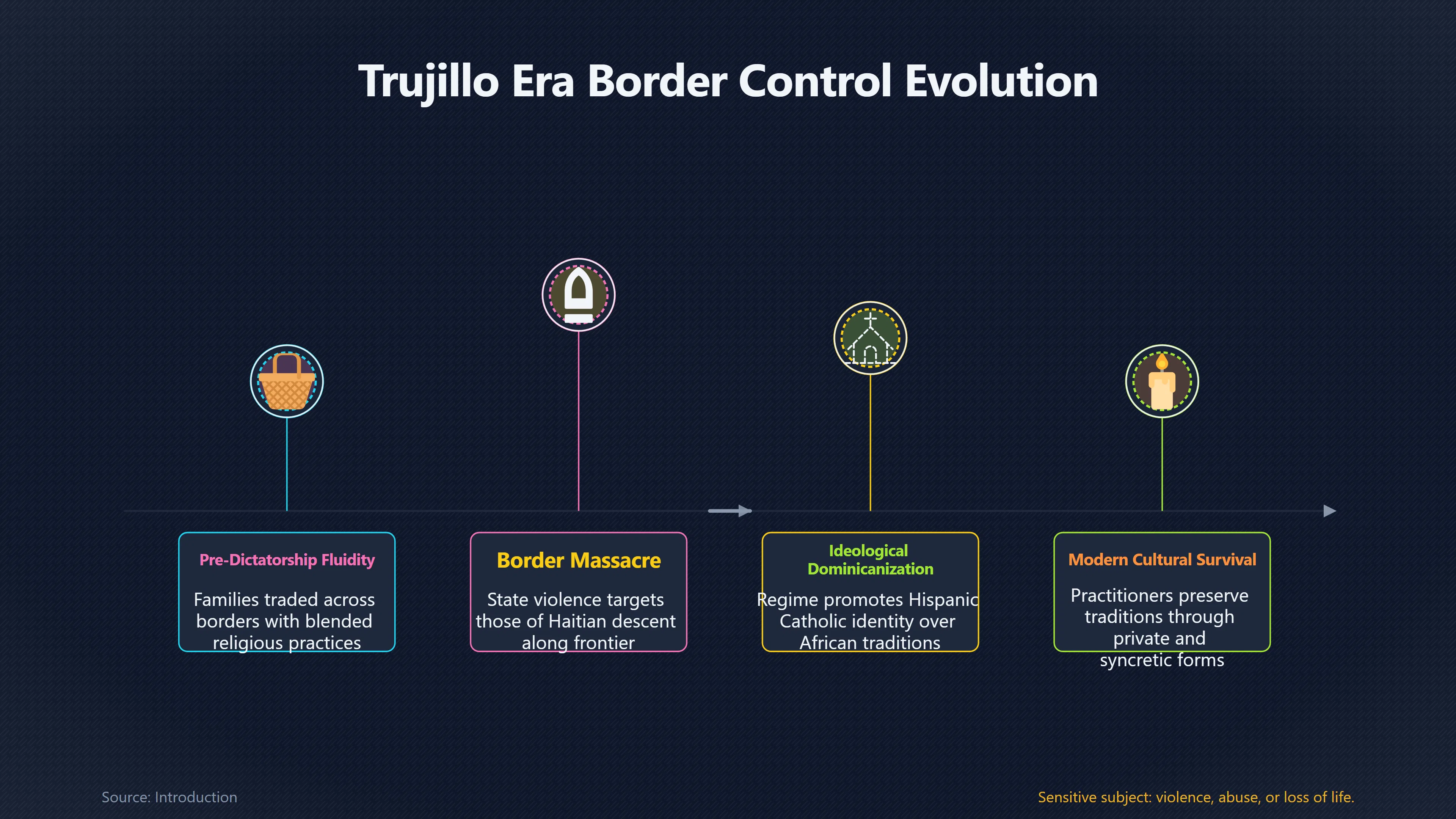
Before Trujillo consolidated power, the Dominican-Haitian border was far more culturally fluid than later nationalist narratives suggested. Families traded across the frontier, migration was common, and religious life often blended Catholic devotion with African-derived healing, spirit possession, herbal medicine and local saints. Many communities did not see these practices as separate from Christianity but as complementary forms of popular religion.[UD Space]udspace.udel.eduUD Space El vudú dominicano: religiosidad, magia y culturaUD Space El vudú dominicano: religiosidad, magia y cultura
Trujillo’s government sought to replace this shared border culture with a sharply defined national identity. Official ideology increasingly presented the Dominican Republic as Hispanic, Catholic and culturally distinct from Haiti, which was portrayed as African, foreign and spiritually suspect. Within that framework, religious practices associated with Haitians became convenient markers of supposed disloyalty or backwardness rather than simply expressions of faith.[Scholars Archive]scholarsarchive.library.albany.eduhistory honorsScholars ArchiveRafael Trujillo is Not Dead: The Role of the Memory of the 1937 Massacre in Reshaping Anti-Haitianism and Education in th…
Unlike a conventional campaign against a single religious organisation, this was a broader effort to regulate culture itself. Suppressing particular rituals, discouraging public ceremonies and promoting a narrowly defined national Catholic identity all reinforced the state’s attempt to control border populations whose everyday lives crossed political boundaries.
Afro-Dominican and Haitian Religious Traditions
Popular religion in the Dominican Republic has long combined influences from Catholicism, West and Central African traditions, indigenous Caribbean beliefs and Spiritism. Scholars describe Dominican Vodou—often known as the Twenty-One Divisions—as a syncretic tradition that incorporates Catholic saints, healing practices, spirit possession and herbal medicine while sharing historical roots with Haitian Vodou. Although the traditions are related, they are not identical, and practitioners themselves recognise important local differences.[UD Space]udspace.udel.eduUD Space El vudú dominicano: religiosidad, magia y culturaUD Space El vudú dominicano: religiosidad, magia y cultura
This complexity mattered because official propaganda frequently collapsed these distinctions. Practices with long histories among Afro-Dominican communities were increasingly labelled simply as “Haitian” regardless of their local development. That framing allowed racial prejudice and religious suspicion to reinforce one another. What had been ordinary community healing, devotional ceremonies or ancestral practices could now be interpreted as evidence of undesirable foreign influence.[UD Space]udspace.udel.eduUD Space El vudú dominicano: religiosidad, magia y culturaUD Space El vudú dominicano: religiosidad, magia y cultura
Many ceremonies also served practical social purposes. Religious specialists acted as healers, counsellors and custodians of local knowledge. Shrines and festivals helped maintain community ties in regions where state institutions were weak. Suppressing these traditions therefore affected more than worship alone; it disrupted networks of mutual support and local authority.

Trujillo’s Bans, Coercion and Racial Nationalism
Following the consolidation of dictatorship and particularly after the 1937 border massacre, Trujillo intensified efforts to “Dominicanise” the frontier. The campaign combined military violence, educational reform, language policy, migration controls and cultural regulation. Religious practices associated with Haiti became part of the same ideological project.[Scholars Archive]scholarsarchive.library.albany.eduhistory honorsScholars ArchiveRafael Trujillo is Not Dead: The Role of the Memory of the 1937 Massacre in Reshaping Anti-Haitianism and Education in th…
Rather than relying solely on formal religious legislation, authorities frequently used policing, surveillance and administrative pressure. Public ceremonies could be broken up, practitioners intimidated and communities encouraged to abandon traditions portrayed as incompatible with modern Dominican citizenship. The state’s close relationship with dominant Catholic institutions further reinforced the idea that officially approved Christianity represented civilisation, while African-derived practices represented superstition or foreign contamination.[UD Space]udspace.udel.eduUD Space El vudú dominicano: religiosidad, magia y culturaUD Space El vudú dominicano: religiosidad, magia y cultura
Historians emphasise that these policies were political as much as religious. By defining acceptable belief, the regime strengthened its wider authority over rural populations that already maintained independent religious leaders, healing networks and cross-border relationships. Controlling religion therefore complemented broader efforts to centralise power and reduce alternative sources of influence.
Border Violence, Stigma and Cultural Survival
The religious dimension of anti-Haitianism cannot be separated from the violence inflicted on border communities. During and after the 1937 massacre, cultural markers—including language, customs and perceived religious identity—could increase suspicion toward individuals living near the frontier. Although victims were targeted primarily because they were Haitian or believed to be Haitian, stereotypes surrounding Vodou and African-derived religion reinforced official narratives portraying border populations as alien to the Dominican nation.[Scholars Archive]scholarsarchive.library.albany.eduhistory honorsScholars ArchiveRafael Trujillo is Not Dead: The Role of the Memory of the 1937 Massacre in Reshaping Anti-Haitianism and Education in th…
Long after the dictatorship ended, the stigma attached to these religious traditions persisted. Some practitioners preferred to emphasise specifically Dominican names for their traditions rather than labels associated with Haiti. Others practised discreetly within private homes or blended ceremonies more closely with mainstream Catholic devotion. These adaptations reflected strategies for preserving religious life while avoiding discrimination rather than evidence that the traditions had disappeared.[UD Space]udspace.udel.eduUD Space El vudú dominicano: religiosidad, magia y culturaUD Space El vudú dominicano: religiosidad, magia y cultura
Researchers conducting fieldwork in the twenty-first century continue to document active communities across the Dominican Republic, demonstrating that popular religion survived despite decades of marginalisation. Contemporary scholarship presents these traditions as part of the country’s own cultural heritage rather than as foreign intrusions.[UD Space]udspace.udel.eduUD Space El vudú dominicano: religiosidad, magia y culturaUD Space El vudú dominicano: religiosidad, magia y cultura
Why This Matters in the History of Collective Fear
The suppression of Afro-Dominican and Haitian religious traditions illustrates a form of moral panic shaped by state power rather than spontaneous public hysteria. The central claim was not merely that certain rituals were spiritually mistaken but that they threatened national identity, racial order and political stability. Once these beliefs were embedded in official propaganda, they justified closer surveillance of border communities and normalised discrimination against people whose religious practices symbolised an imagined national danger.[Scholars Archive]scholarsarchive.library.albany.eduhistory honorsScholars ArchiveRafael Trujillo is Not Dead: The Role of the Memory of the 1937 Massacre in Reshaping Anti-Haitianism and Education in th…
Modern historians therefore interpret anti-Haitian religious repression as an example of how governments can transform cultural differences into perceived security threats. Popular religion became a political language through which broader anxieties about race, migration and sovereignty were expressed. This helps explain why debates over Haitian identity, Afro-Dominican heritage and religious freedom remain intertwined in discussions of Dominican history today.[Scholars Archive]scholarsarchive.library.albany.eduhistory honorsScholars ArchiveRafael Trujillo is Not Dead: The Role of the Memory of the 1937 Massacre in Reshaping Anti-Haitianism and Education in th…
Amazon book picks
Further Reading
Books and field guides related to How Religion Became a Tool of Border Control. Use these as the next step if you want deeper reading beyond the article.
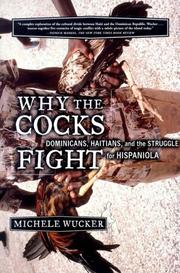
Why the cocks fight
Directly examines Dominican-Haitian relations and anti-Haitianism.
Endnotes
1.
Source: scholarsarchive.library.albany.edu
Title: history honors
Link:https://scholarsarchive.library.albany.edu/history_honors/33/
Source snippet
Scholars ArchiveRafael Trujillo is Not Dead: The Role of the Memory of the 1937 Massacre in Reshaping Anti-Haitianism and Education in th...
2.
Source: udspace.udel.edu
Title: UD Space El vudú dominicano: religiosidad, magia y cultura
Link:https://udspace.udel.edu/items/8e6948bb-eb36-4d4b-9882-d802b19caed1
3.
Source: udspace.udel.edu
Link:https://udspace.udel.edu/items/8e6948bb-eb36-4d4b-9882-d802b19caed1/full
4.
Source: revistas.intec.edu.do
Title: intec.edu.do Vudú dominicano o vudú en Santo Domingo? | Ciencia y Sociedad
Link:https://revistas.intec.edu.do/index.php/ciso/article/view/597
5.
Source: minorityrights.org
Title: Dominican Republic
Link:https://minorityrights.org/country/dominican-republic/
Additional References
6.
Source: academic.oup.com
Link:https://academic.oup.com/florida-scholarship-online/book/17153/chapter-abstract/174518581
Source snippet
OUP AcademicPluralism, Heterodoxy, and Christian Hegemony | Negotiating Respect: Pentecostalism, Masculinity, and the Politics of Spiritu...
7.
Source: doi.org
Link:https://doi.org/10.1093/ahr/rhag037
Source snippet
May 19, 2026 — However, while historians have recognized Haiti as a symbol of Black pride for nineteenth-century African Americans, Domin...
Published: May 19, 2026
8.
Source: sciencedirect.com
Title: Religion, Power, Politics, and History in the Southern Caribbean
Link:https://www.sciencedirect.com/org/science/article/pii/S1382237323001137
Source snippet
September 21, 2023 — NEW WEST INDIAN GUIDE / NIEUWE WESTINDISCHE GIDS Volume 97, Issues 3–4, 21 September 2023, Pages 323-33...
Published: September 21, 2023
9.
Source: cla.umn.edu
Title: katharine gerbner history obeah and religious freedom
Link:https://cla.umn.edu/history/news-events/story/katharine-gerbner-history-obeah-and-religious-freedom
Source snippet
Gerbner on the History of Obeah and Religious Freedom | History | College of Liberal ArtsMay 6, 2026 — KATHARINE GERBNER ON THE HISTORY O...
Published: May 6, 2026
10.
Source: youtube.com
Title: Bêtes Noires: Sorcery as History in the Haitian-Dominican Borderlands
Link:https://www.youtube.com/watch?v=gO5qhPBEIyw
Source snippet
Cold War Haiti vs The Dominican Republic: Neighbors in Name Only...
11.
Source: youtube.com
Title: Cold War Haiti vs The Dominican Republic: Neighbors in Name Only
Link:https://www.youtube.com/watch?v=apgYxvtDFQY
Source snippet
The Dominican Republic Really Hates Haitians...
12.
Source: anthrosource.onlinelibrary.wiley.com
Link:https://anthrosource.onlinelibrary.wiley.com/doi/10.1111/jlca.12735
Source snippet
261-275 RESEARCH ARTICLE TRAIDORES A LA PATRIA: RECONFIGURING THE NATION THROUGH (UN)PATRIOTIC DISCOURSE IN THE DOMINICAN REPUBLIC Amaril...
13.
Source: mdpi.com
Link:https://www.mdpi.com/2313-5778/9/4/129
Source snippet
HISTORICAL CONTEXT The key to understanding the contemporary context of Haitian migration to the Dominican Republic and the latter’s disc...
14.
Source: youtube.com
Link:https://www.youtube.com/watch?v=8Ck0SQyWzC0
Source snippet
Brief Political History of the Dominican Republic...
15.
Source: tandfonline.com
Link:https://www.tandfonline.com/doi/abs/10.1080/01419870.2018.1532097
Topic Tree