Within Norway's Collective Fears
How Black Metal Became a National Scare
Murders and church arsons were real, but provocative musicians and sensational reporting helped enlarge them into a broader story of organised Satanism.
On this page
- The crimes that made the fear credible
- Self mythology, Satanic imagery and media amplification
- Separating documented violence from wider conspiracy claims
Page outline Jump by section
Introduction
Norway’s black metal scare of the early 1990s differed from many earlier Satanic panics because it was built around a mixture of genuine crime and exaggerated interpretation. A small circle of musicians and associates committed real offences, including a series of church arsons and high-profile murders, while deliberately cultivating Satanic imagery, violent rhetoric and an aura of secrecy. Those facts gave journalists and commentators a solid basis for alarm. At the same time, claims that Norway faced a vast, organised Satanic conspiracy went well beyond the available evidence. The resulting story became one of the country’s most internationally recognised moral panics: not because the crimes were imaginary, but because a limited and fragmented subculture was often portrayed as a coordinated underground movement with far greater reach than investigators could demonstrate.[Skepsis Norge]skepsis.nomedia constructions of satanism in norwayrgeSkepsis » Media Constructions of ‘Satanism’ in Norway (1988-1997)September 12, 2005…
The crimes that made the fear credible
Unlike many Satanic scares in Britain or North America, the Norwegian case was anchored in documented criminal acts.
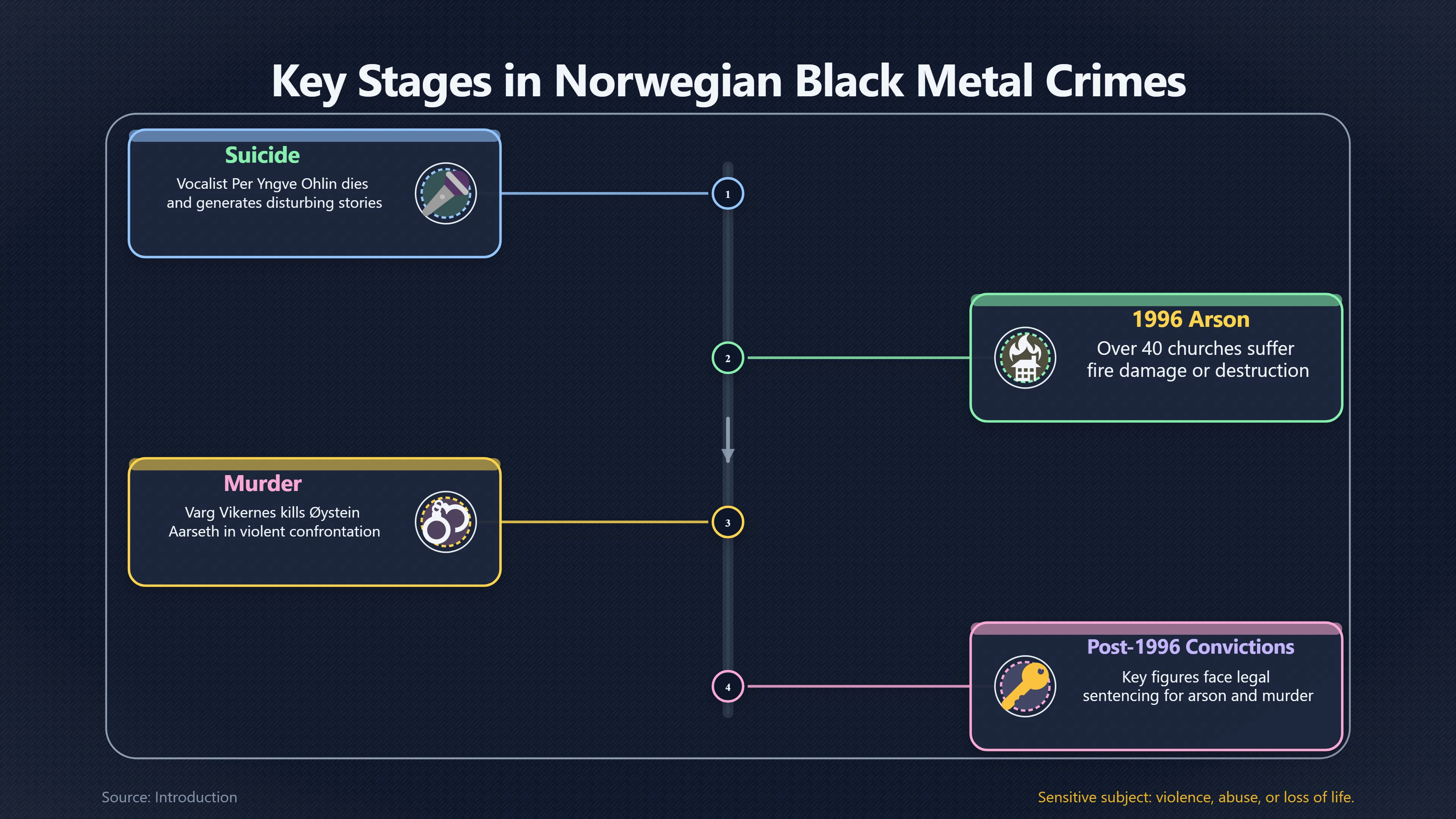
Between 1992 and 1996, more than 40 churches were damaged or destroyed by fire, although responsibility varied from case to case and not every incident was linked to the black metal scene. Several individuals associated with that scene were convicted of arson or related offences. The burning of historic wooden churches shocked a country where many of these buildings were treasured cultural landmarks as well as places of worship.[Skepsis Norge]skepsis.nomedia constructions of satanism in norwayrgeSkepsis » Media Constructions of ‘Satanism’ in Norway (1988-1997)September 12, 2005…
Violence within the scene reinforced public fears. In 1993, Øystein Aarseth, better known as Euronymous, was murdered by Varg Vikernes. Vikernes was later convicted of the killing as well as several church arsons. Earlier, the 1991 suicide of Mayhem vocalist Per Yngve Ohlin (“Dead”) had already become surrounded by disturbing stories, many encouraged by participants themselves. Together, these events created an unusually dramatic sequence of real crimes that appeared to confirm public suspicions that something far darker than a musical subculture was emerging.[Edinburgh Research]research.ed.ac.ukinburgh ResearchTotal F***ing Armageddon: Disentangling the Mythologies of Early Norwegian Black Metal - University of Edinburgh Resear…
Yet even at the height of the crisis, the number of people directly involved remained small. Most Norwegian heavy metal fans had no connection to the violence, and even within black metal the militant circle responsible represented only a fraction of participants.[Edinburgh Research]research.ed.ac.ukinburgh ResearchTotal F***ing Armageddon: Disentangling the Mythologies of Early Norwegian Black Metal - University of Edinburgh Resear…
Self-mythology, Satanic imagery and media amplification
The black metal scene actively encouraged an image of danger. Many musicians adopted pseudonyms, corpse paint, inverted crosses and openly anti-Christian language. Interviews often blurred the line between theatrical provocation and genuine ideological commitment. Some participants claimed allegiance to Satanism, others described themselves as anti-Christian, while still others later portrayed their statements as calculated attempts to shock the public.
This ambiguity proved highly effective. Journalists searching for explanations found interviewees who often exaggerated their own importance, hinted at hidden networks or boasted about crimes. The resulting coverage amplified the impression of a unified Satanic movement rather than a loose collection of rival bands, personalities and competing beliefs. Later scholarship argues that much of the mythology surrounding Norwegian black metal was produced jointly by performers seeking notoriety and media outlets eager for sensational stories.[Edinburgh Research]research.ed.ac.ukinburgh ResearchTotal F***ing Armageddon: Disentangling the Mythologies of Early Norwegian Black Metal - University of Edinburgh Resear…
The movement also emerged during the wider international legacy of the 1980s and early 1990s Satanic panic. Audiences were already familiar with stories of secret cults, ritual abuse and occult conspiracies. Norwegian black metal therefore appeared to confirm fears that had been circulating elsewhere, even though the Norwegian events followed a different pattern. Instead of allegations unsupported by physical evidence, there were real crimes that encouraged much broader speculation.[Edinburgh Research]research.ed.ac.ukinburgh ResearchMythology, Virality, and (Toxic) Masculinity: The Case of Norwegian Black Metal - University of Edinburgh Research Expl…
Why organised Satanism seemed plausible
Several factors made conspiracy theories appear believable.
First, church burnings naturally encouraged police, clergy and journalists to ask whether isolated incidents were coordinated. Some perpetrators knew one another, shared meeting places and exchanged ideas, making the possibility of organised activity worthy of investigation.
Second, the perpetrators deliberately cultivated secrecy. References to hidden circles, esoteric beliefs and exclusive membership created uncertainty about where performance ended and genuine organisation began.
Third, Norway encountered imported claims about ritual abuse and organised Satanic cults at roughly the same time. Although these narratives never gained quite the same strength as in parts of Britain or the United States, they influenced how some journalists and commentators interpreted black metal. Reports about alleged ritual abuse, supposed occult networks and church burnings were sometimes presented side by side, encouraging readers to connect phenomena that investigators could not firmly link.[Skepsis Norge]skepsis.nomedia constructions of satanism in norwayrgeSkepsis » Media Constructions of ‘Satanism’ in Norway (1988-1997)September 12, 2005…
Separating documented violence from wider conspiracy claims
Historical research draws an important distinction between established facts and later legend.
Documented evidence supports several key points:
- Multiple historic churches were deliberately burned.
- Individual musicians and associates committed serious crimes, including murder and arson.
- Some offenders consciously embraced Satanic or aggressively anti-Christian symbolism.
- Certain participants encouraged publicity through provocative interviews and self-promotion.[Skepsis Norge]skepsis.nomedia constructions of satanism in norwayrgeSkepsis » Media Constructions of ‘Satanism’ in Norway (1988-1997)September 12, 2005…
By contrast, stronger claims remain poorly supported:
- There is no convincing evidence that Norway contained a nationwide, centrally directed Satanic organisation controlling the attacks.
- Claims of extensive ritual murder or systematic Satanic conspiracies associated with the music scene were not substantiated.
- The black metal community was internally divided, with personal rivalries and conflicting beliefs rather than unified leadership.[ed.ac.uk]research.ed.ac.ukinburgh ResearchTotal F***ing Armageddon: Disentangling the Mythologies of Early Norwegian Black Metal - University of Edinburgh Resear…
This distinction is central to understanding why the episode belongs in the history of moral panics. The crimes themselves were genuine, but they became the foundation for narratives that often attributed far greater coordination, numbers and ideological consistency than the evidence justified.
Why the story became a lasting national scare
The black metal episode touched several sensitive themes at once. Churches symbolised Norway’s religious and cultural heritage. The offenders were mostly young men whose music, appearance and language already seemed alien to many adults. International media quickly transformed local crimes into stories about “the land of Satanic metal”, reinforcing Norway’s unexpected association with violent occultism.
The musicians themselves also benefited from notoriety. Public outrage increased the underground scene’s mystique, while sensational reporting attracted worldwide attention to Norwegian black metal as a musical genre. In this sense, fear and publicity reinforced one another: media attention elevated the scene’s reputation, while participants sometimes performed increasingly extreme identities in response.[Edinburgh Research]research.ed.ac.ukinburgh ResearchMythology, Virality, and (Toxic) Masculinity: The Case of Norwegian Black Metal - University of Edinburgh Research Expl…
What the episode reveals about moral panic
The Norwegian black metal scare demonstrates that moral panics need not arise from entirely imaginary threats. Real crimes can provide the emotional credibility that allows broader fears to flourish.
For historians and sociologists, the episode illustrates how several mechanisms operated simultaneously:
- Actual criminal violence established legitimate public concern.
- Deliberate self-mythologising blurred the line between performance and belief.
- Sensational reporting often portrayed a fragmented youth subculture as a coherent occult conspiracy.
- Existing cultural fears about Satanism supplied an interpretive framework that encouraged broader claims than investigators could verify.[skepsis.no]skepsis.nomedia constructions of satanism in norwayrgeSkepsis » Media Constructions of ‘Satanism’ in Norway (1988-1997)September 12, 2005…
Unlike the earlier Norwegian witch trials, where authorities prosecuted an imagined supernatural conspiracy, or the later Bjugn nursery-abuse case, where suspicion outpaced reliable evidence, the black metal episode occupied an unusual middle ground. Serious crimes unquestionably occurred, but the wider image of an organised Satanic underground was shaped as much by mythmaking and media amplification as by the documented facts themselves.

Amazon book picks
Further Reading
Books and field guides related to How Black Metal Became a National Scare. Use these as the next step if you want deeper reading beyond the article.
Folk Devils and Moral Panics the Creation of the Mods and Roc...
First published 1972. Subjects: Youth, great britain, Deviant behavior, Case studies, Subculture, Young adults.
Endnotes
1.
Source: skepsis.no
Title: media constructions of satanism in norway 1988 1997
Link:https://www.skepsis.no/media-constructions-of-satanism-in-norway-1988-1997/
Source snippet
rgeSkepsis » Media Constructions of ‘Satanism’ in Norway (1988-1997)September 12, 2005...
Published: September 12, 2005
2.
Source: research.ed.ac.uk
Link:https://www.research.ed.ac.uk/en/publications/total-fing-armageddon-disentangling-the-mythologies-of-early-norw/
Source snippet
inburgh ResearchTotal F***ing Armageddon: Disentangling the Mythologies of Early Norwegian Black Metal - University of Edinburgh Resear...
3.
Source: research.ed.ac.uk
Link:https://www.research.ed.ac.uk/en/publications/mythology-virality-and-toxic-masculinity-the-case-of-norwegian-bl/
Source snippet
inburgh ResearchMythology, Virality, and (Toxic) Masculinity: The Case of Norwegian Black Metal - University of Edinburgh Research Expl...
6.
Source: research.ed.ac.uk
Link:https://www.research.ed.ac.uk/en/publications/mythology-performativity-and-moral-panic-the-case-of-norwegian-bl/
Additional References
7.
Source: norwaytoday.info
Title: How a music genre known as black metal came to be related to church burnings
Link:https://norwaytoday.info/culture/is-life-in-norway-as-happy-as-its-cracked-up-to-be/
Source snippet
Norway TodayAugust 6, 2021 — HOW A MUSIC GENRE KNOWN AS BLACK METAL CAME TO BE RELATED TO CHURCH BURNINGS TOPICS:Black metalNorwegian mus...
Published: August 6, 2021
8.
Source: lifeinnorway.net
Title: Helvete had black walls bedecked with mediev
Link:https://www.lifeinnorway.net/norwegian-black-metal/
Source snippet
The Story of Norwegian Black Metal - Life in NorwayNovember 10, 2019 — THE BLACK CIRCLE A month or so later, Euronymous opened a record s...
Published: November 10, 2019
9.
Source: snl.no
Title: black metal – Store norske leksikon
Link:https://snl.no/black_metal
Source snippet
Den visuelle estetikken er også en stor del av black metal. Den preges av svart-hvit ansiktsmaling (liksminke) og satanistisk symb...
10.
Source: researchgate.net
Title: At this stage, we look fo
Link:https://www.researchgate.net/publication/382357344_Capitalizing_on_Stigma_Valuation_Arbitrage_in_Norwegian_Black_Metal
Source snippet
(PDF) Capitalizing on Stigma: Valuation Arbitrage in Norwegian Black MetalDecember 1, 2025 — We start with a qua litative survey of the s...
Published: December 1, 2025
11.
Source: youtube.com
Link:https://www.youtube.com/watch?v=S1vLC637cx0
Source snippet
Until the Light Takes Us - Various Artists 2008 FULL HD DOCUMENTARY...
12.
Source: youtube.com
Title: Until the Light Takes Us
Link:https://www.youtube.com/watch?v=1hVPZKRodws
Source snippet
Once Upon A Time In Norway (Documentary Film - 2007)...
13.
Source: researchgate.net
Link:https://www.researchgate.net/publication/323633597_Pagan_Terror_The_Role_of_Pagan_Ideology_in_Church_Burnings_and_the_1990s_Norwegian_Black_Metal_Subculture
14.
Source: hnn.us
Link:https://www.hnn.us/article/how-a-music-genre-known-as-black-metal-came-to-be-
15.
Source: cambridge.org
Link:https://www.cambridge.org/core/journals/popular-music/article/abs/kvlter-than-kvlt-true-norwegian-black-metal-and-the-satanic-politics-of-bataillean-authenticity/D34EEFC181EB32A497378BB1FA4F5CB1
16.
Source: muni.cz
Link:https://www.muni.cz/en/research/publications/1351916
Topic Tree