Within Indonesia Panics
When Does Religious Controversy Become Persecution?
Labels such as cult or deviant sect can turn religious disputes into public fear, coercion and punishment without proving a genuine threat.
On this page
- Who defines a religion as deviant
- How moral panic simplifies minority beliefs
- Coercion, state action and human rights
Page outline Jump by section
Introduction
Indonesia is one of the world’s most religiously diverse countries, yet it has also experienced repeated episodes in which unconventional religious movements or minority faiths have been portrayed as threats to public order, morality or national unity. These episodes are not simply disputes about theology. They often become moral panics in which labels such as “deviant”, “heretical” or “blasphemous” encourage public fear, justify discrimination and sometimes lead to violence or forced displacement.
The important question is not whether a religious movement’s teachings are unusual. Every society contains religious disagreement. The key issue is when disagreement turns into persecution through sensational media coverage, official declarations, discriminatory laws or mob action before any genuine public danger has been demonstrated. Indonesia provides several well-documented examples showing how this process can unfold, particularly in relation to Ahmadi Muslims, Shia communities, the Gafatar movement and smaller belief groups.[amnesty.org]amnesty.orgInternational Indonesia: Prosecuting beliefs: Indonesia's blasphemy lawsAmnesty InternationalIndonesia: Prosecuting beliefs: Indonesia's blasphemy laws - Amnesty InternationalNovember 21, 2014…
When does a religious controversy become persecution?
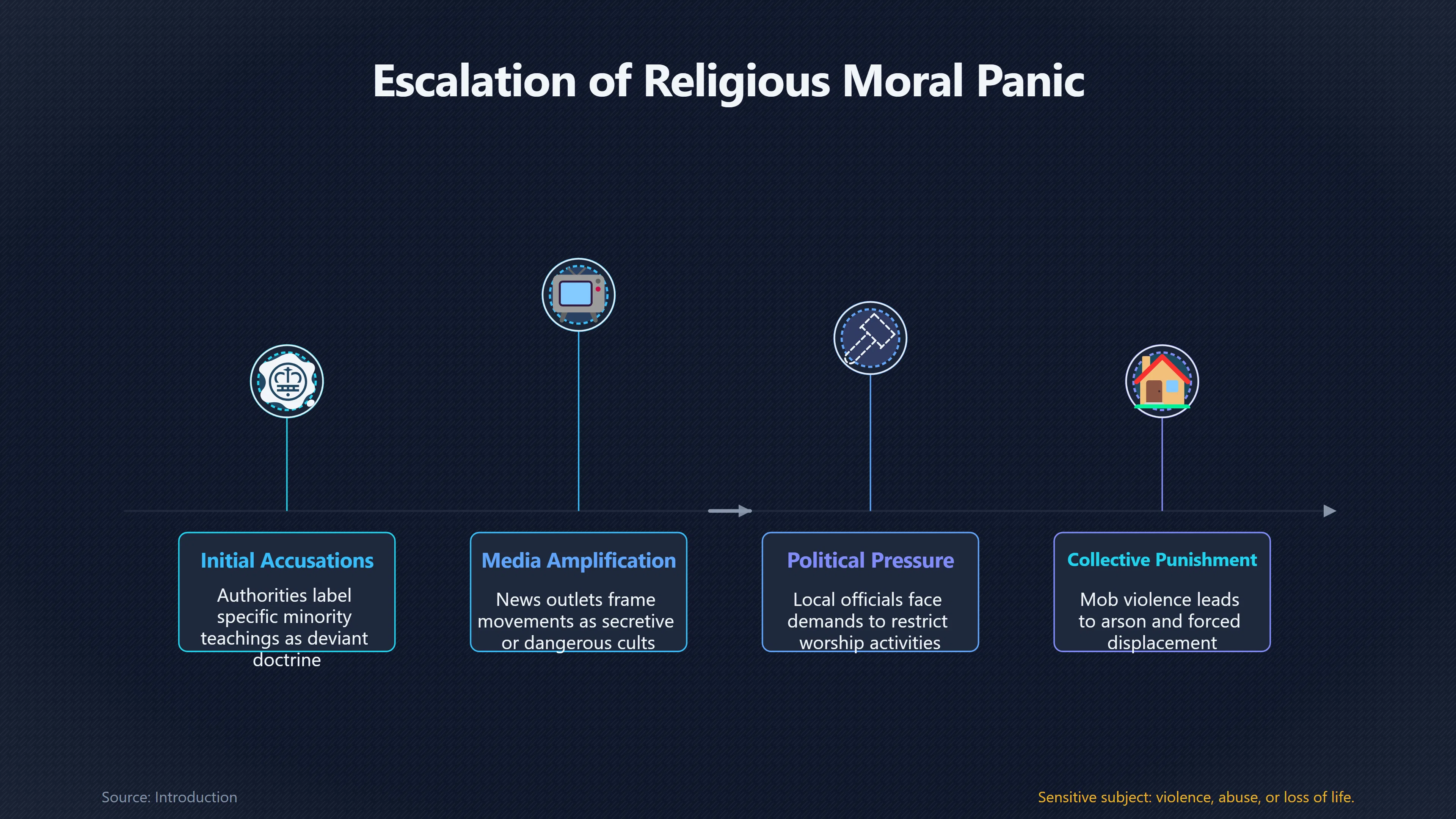
Religious controversy becomes persecution when authorities or the wider public begin treating a minority’s existence as a security problem rather than addressing any specific unlawful acts. In Indonesia, this transition has often followed a recognisable pattern.
A minority movement first attracts accusations that its teachings are “deviant”. Religious authorities or influential organisations issue statements condemning its beliefs. Media coverage frequently frames the group as secretive or dangerous. Local politicians and officials then face pressure to act, sometimes restricting worship, closing meeting places or encouraging members to abandon their beliefs. In the most serious cases, hostile crowds attack communities while police fail to provide effective protection.[Human Rights Watch]hrw.orgOpen source on hrw.org.
This pattern illustrates a classic moral panic. The perceived threat grows faster than verified evidence, while public discussion increasingly focuses on identity and symbolism rather than demonstrable harm.
Who decides that a religion is “deviant”?
Indonesia’s constitution protects religious freedom, but the practical picture is more complicated because several institutions influence how religious legitimacy is judged.
Among the most influential is the Indonesian Ulema Council (MUI), a body whose religious opinions are not themselves criminal law but carry significant political and social influence. Fatwas describing particular movements as deviant have repeatedly shaped public attitudes and government responses, even though they do not automatically establish criminal wrongdoing. Government agencies responsible for religious affairs and prosecutors have also played roles in monitoring or restricting groups accused of religious deviation.[U.S. Department of State]2021-2025.state.govU.S. Department of State IndonesiaU.S. Department of StateIndonesia - United States Department of State…
Human rights organisations argue that this creates a blurred boundary between theological disagreement and state enforcement. A religious judgement intended for believers can become, in practice, a justification for administrative restrictions, criminal investigations or failures to protect vulnerable communities from intimidation.[Amnesty International]amnesty.orgInternational Indonesia: Prosecuting beliefs: Indonesia's blasphemy lawsAmnesty InternationalIndonesia: Prosecuting beliefs: Indonesia's blasphemy laws - Amnesty InternationalNovember 21, 2014…
Why moral panic simplifies minority beliefs
One striking feature of Indonesian religion scares is how complex belief systems become reduced to simple and alarming stereotypes.
Groups are frequently portrayed as seeking to replace mainstream religion, deceive followers or undermine national stability. Such claims often spread far more quickly than careful explanations of what members actually believe.
The Gafatar movement illustrates this process. Emerging publicly in the early 2010s, it combined elements drawn from Islamic, Christian and Jewish traditions under the leadership of Ahmad Mushaddeq. Critics characterised it as an apocalyptic cult or dangerous sect. While its theology was undoubtedly controversial, the public campaign against it rapidly expanded beyond theological criticism into allegations that it threatened society itself. Those broader claims were never demonstrated through evidence comparable to the scale of the public response.[Human Rights Watch]hrw.orgOpen source on hrw.org.
Researchers studying moral panics note that this simplification makes extraordinary measures appear reasonable. Once a movement is portrayed as fundamentally dangerous, calls for dialogue or legal protection become politically difficult.
The Gafatar case: from suspicion to forced displacement
The treatment of Gafatar is among Indonesia’s clearest examples of a religious scare developing into collective punishment.
In early 2016, following growing public hostility and official denunciations, thousands of Gafatar members living in Kalimantan were attacked by local mobs. Homes and property were burned or looted, while many members were evacuated by security forces into temporary government facilities before being returned to their regions of origin. Rather than merely protecting people from immediate violence, authorities also moved to dissolve the organisation and prosecute its leaders.[Human Rights Watch]hrw.orgOpen source on hrw.org.
Subsequent legal action relied heavily upon Indonesia’s blasphemy framework, with movement leaders receiving prison sentences after courts concluded that their teachings deviated from recognised religious doctrine. Human rights organisations argued that these prosecutions demonstrated how theological disagreement had been transformed into criminal liability.[Human Rights Watch]hrw.orgOpen source on hrw.org.
The episode is significant because the greatest immediate harm experienced by ordinary members came not from any proven campaign of violence by Gafatar itself, but from arson, forced displacement and loss of homes suffered by the movement’s followers.
Ahmadi and Shia communities: recurring targets
The experience of Indonesia’s Ahmadi and Shia minorities demonstrates that religious scares need not involve new religious movements.
Ahmadi Muslims have long been accused by mainstream Islamic organisations of departing from accepted doctrine because of their beliefs concerning prophethood. Shia communities have likewise faced accusations of spreading dangerous teachings in some regions. Although theological disagreements are genuine, critics of Indonesia’s legal framework argue that these disputes have too often been accompanied by intimidation, attacks on places of worship, forced closures and inadequate police protection.[Human Rights Watch]hrw.orgOpen source on hrw.org.
Human Rights Watch and Indonesian monitoring organisations have documented repeated incidents in which local governments restricted minority worship or tolerated pressure from militant groups rather than consistently defending constitutional rights. The result is that ordinary believers can become associated with an imagined collective threat simply because they belong to an unpopular minority tradition.[Human Rights Watch]hrw.orgOpen source on hrw.org.
Blasphemy law and the politics of fear
Indonesia’s blasphemy legislation occupies a central place in debates about religious freedom because it criminalises certain forms of religious deviation and has been used against members of minority faiths.
Supporters argue that such laws preserve public harmony by preventing deliberate religious insult and reducing sectarian conflict. Critics respond that broad definitions of “deviant interpretation” encourage selective enforcement and provide legal support for campaigns already driven by social hostility.[Amnesty International]amnesty.orgInternational Indonesia: Prosecuting beliefs: Indonesia's blasphemy lawsAmnesty InternationalIndonesia: Prosecuting beliefs: Indonesia's blasphemy laws - Amnesty InternationalNovember 21, 2014…
This legal environment can reinforce moral panic in several ways:
- Official investigations lend credibility to rumours that a minority group is dangerous.
- Local authorities may feel political pressure to restrict minority worship rather than defend it.
- Vigilante groups may believe that official rhetoric validates their actions.
- Minority communities often become reluctant to defend themselves publicly for fear of prosecution.
The result is that legal and social pressures can reinforce one another, even when no evidence exists that a minority movement presents an actual threat to public safety.
What role do media and rumours play?
Media reporting has frequently amplified religious scares by emphasising dramatic allegations while giving less attention to legal findings or the perspectives of minority communities.
Rumours spread particularly quickly when they connect unfamiliar beliefs with wider public anxieties about social change, political instability or national identity. Stories describing hidden recruitment, secret rituals or conspiracies are often difficult to verify but highly effective at generating public fear.
Modern social media has accelerated this process by allowing emotionally charged claims to circulate rapidly before careful investigation occurs. Researchers studying Indonesian religious conflict note that once a movement becomes publicly associated with words such as “cult”, “heresy” or “blasphemy”, correcting false impressions becomes extremely difficult even if later evidence is more nuanced.[Human Rights Watch]hrw.orgOpen source on hrw.org.
Human rights and changing interpretations
Many Indonesian religious leaders continue to reject the teachings of movements such as Gafatar or Ahmadiyah while simultaneously arguing that disagreement should never justify violence or denial of basic civil rights. This distinction has become increasingly important in discussions of religious freedom.
Human rights organisations consistently argue that governments should distinguish between belief and criminal conduct. Individuals who commit ordinary crimes should face prosecution regardless of religion, but unpopular beliefs alone should not become grounds for imprisonment, forced relocation or mob violence.[Amnesty International]amnesty.orgInternational Indonesia: Prosecuting beliefs: Indonesia's blasphemy lawsAmnesty InternationalIndonesia: Prosecuting beliefs: Indonesia's blasphemy laws - Amnesty InternationalNovember 21, 2014…
Monitoring organisations such as Setara Institute have also emphasised that improvements cannot be measured simply by counting incidents. They argue that systematic discrimination through administrative decisions, official rhetoric and unequal law enforcement can be just as damaging as spectacular outbreaks of violence because they normalise unequal citizenship over time.[Setara]setara-institute.orgSetara Govt involved in ‘more rights violations’ | Setara InstituteSetara Govt involved in ‘more rights violations’ | Setara Institute
Why these religion scares remain important
Indonesia’s experience shows that accusations of religious deviation are never merely theological. They can become powerful political and social tools that reshape public attitudes towards entire communities.
The country’s most significant religion scares reveal a recurring lesson: describing a minority as “deviant” does not itself establish that it threatens society. Once fear becomes detached from demonstrable evidence, the greatest risks often fall not on the wider public but on the minority community itself through intimidation, displacement, discrimination and criminal prosecution.
For historians and sociologists, these episodes are therefore best understood not simply as religious disputes but as examples of how moral panic, legal structures, media narratives and communal anxieties can combine to transform controversial beliefs into campaigns of persecution.[amnesty.org]amnesty.orgInternational Indonesia: Prosecuting beliefs: Indonesia's blasphemy lawsAmnesty InternationalIndonesia: Prosecuting beliefs: Indonesia's blasphemy laws - Amnesty InternationalNovember 21, 2014…
Amazon book picks
Further Reading
Books and field guides related to When Does Religious Controversy Become Persecution?. Use these as the next step if you want deeper reading beyond the article.



Combating cult mind control
Provides readers with a framework for evaluating controversial religious groups.

Interpretation of Cultures
Useful background for understanding religious diversity and belief.
Endnotes
1.
Source: amnesty.org
Title: International Indonesia: Prosecuting beliefs: Indonesia’s blasphemy laws
Link:https://www.amnesty.org/en/documents/ASA21/018/2014/en/
Source snippet
Amnesty InternationalIndonesia: Prosecuting beliefs: Indonesia's blasphemy laws - Amnesty InternationalNovember 21, 2014...
Published: November 21, 2014
2.
Source: 2021-2025.state.gov
Title: U.S. Department of State Indonesia
Link:https://2021-2025.state.gov/reports/2022-report-on-international-religious-freedom/indonesia/
Source snippet
U.S. Department of StateIndonesia - United States Department of State...
3.
Source: setara-institute.org
Title: Setara Govt involved in ‘more rights violations’ | Setara Institute
Link:https://setara-institute.org/en/english-govt-involved-in-more-rights-violations/
4.
Source: amnesty.org
Title: Indonesia: Blasphemy sentences are an injustice that must be reversed
Link:https://www.amnesty.org/en/latest/press-release/2017/03/indonesia-blasphemy-sentences-are-an-injustice-that-must-be-reversed/
5.
Source: amnesty.org
Title: Indonesia: Prosecuting beliefs: Indonesia’s blasphemy laws: Executive
Link:https://www.amnesty.org/en/documents/asa21/030/2014/en/
6.
Source: hrw.org
Link:https://www.hrw.org/news/2017/02/02/indonesias-religious-minorities-under-threat
7.
Source: hrw.org
Link:https://www.hrw.org/news/2016/03/29/indonesia-persecution-gafatar-religious-group
8.
Source: hrw.org
Link:https://www.hrw.org/news/2017/03/07/indonesias-anti-gafatar-campaign-ends-blasphemy-convictions
9.
Source: hrw.org
Link:https://www.hrw.org/world-report/2017/country-chapters/indonesia
Source snippet
Human Rights WatchWorld Report 2017: Indonesia | Human Rights Watch...
10.
Source: hrw.org
Title: Indonesia’s Journalists Grapple With Islamism | Human Rights Watch
Link:https://www.hrw.org/news/2019/08/21/indonesias-journalists-grapple-islamism
11.
Source: minorityrights.org
Link:https://minorityrights.org/country/indonesia/
12.
Source: hrw.org
Title: Indonesia Sends Ominous Signal to Religious Minorities | Human Rights Watch
Link:https://www.hrw.org/news/2017/09/25/indonesia-sends-ominous-signal-religious-minorities
13.
Source: hrw.org
Title: Indonesia: Kriminalisasi terhadap Komunitas Gafatar | Human Rights Watch
Link:https://www.hrw.org/id/news/2016/04/05/indonesia-persecution-gafatar-religious-group
14.
Source: hrw.org
Title: abuses against religious minorities indonesia
Link:https://www.hrw.org/report/2013/02/28/religions-name/abuses-against-religious-minorities-indonesia
Additional References
15.
Source: journal.unpas.ac.id
Link:https://journal.unpas.ac.id/index.php/litigasi/article/view/31471
Source snippet
End of Blasphemy Crimes in Indonesia: Shifts in Human Rights Limitations and MUI’s Fatwa Authority | LITIGASIOctober 31, 2025 — THE END O...
Published: October 31, 2025
16.
Source: journal.perhaki.org
Link:https://journal.perhaki.org/index.php/minority/article/view/139
Source snippet
Political Control: Legal Challenges of Religious Minorities in Indonesia, Focusing on Ahmadiyya | Indonesian Minority Justice ReviewJuly...
17.
Source: youtube.com
Title: Trial opens over Ahmadiyah Muslim sect killings
Link:https://www.youtube.com/watch?v=9Xj4lkJTjwQ
Source snippet
Condemnation of Shias by Sunni leaders lead to new attacks...
18.
Source: cambridge.org
Link:https://www.cambridge.org/core/journals/asian-journal-of-comparative-law/article/religious-liberty-in-indonesia-and-the-rights-of-deviant-sects/697CAD33B0BDC6B30F1CCA409549EF3F
19.
Source: youtube.com
Title: Ahmadiyah faces possible ban from Indonesia
Link:https://www.youtube.com/watch?v=vufgenlxOzQ
Source snippet
Trial opens over Ahmadiyah Muslim sect killings...
20.
Source: ecoi.net
Link:https://www.ecoi.net/en/document/1393567.html
21.
Source: youtube.com
Title: Sectarian killings in Indonesia
Link:https://www.youtube.com/watch?v=f3b4b0eiYvU
Source snippet
Ahmadiyah faces possible ban from Indonesia...
22.
Source: youtube.com
Title: Condemnation of Shias by Sunni leaders lead to new attacks
Link:https://www.youtube.com/watch?v=CYEOmZpye1U
Source snippet
Indonesia: The right to pray | 101 East...
23.
Source: youtube.com
Title: Indonesia: The right to pray | 101 East
Link:https://www.youtube.com/watch?v=b5fwnWNNtWw
24.
Source: freedomhouse.org
Title: freedom world
Link:https://freedomhouse.org/country/indonesia/freedom-world/2017
Topic Tree