Within Kazakhstan Panics
Why Did Kalachi Become the Sleeping Village?
Kalachi's villagers suffered real episodes of prolonged sleep, but the cause remains contested between environmental and medical theories.
On this page
- What happened to the villagers
- Radiation, mine gases and other theories
- Why the mystery became a modern legend
Page outline Jump by section
Introduction
Between 2013 and 2015, the small northern Kazakh village of Kalachi became internationally known as the “sleeping village” after residents repeatedly fell into unusually deep sleep without warning. Some remained unconscious for hours or even several days. Others experienced headaches, confusion, memory loss and vivid hallucinations after waking. The episodes were medically real, affected both adults and children, and prompted extensive investigations by doctors, toxicologists and environmental specialists. Yet despite thousands of tests, no single explanation has achieved universal acceptance.
The Kalachi case became more than a medical mystery. It evolved into a modern legend because an unexplained illness coincided with an abandoned Soviet uranium mine, creating fertile ground for rumours about radiation, secret military experiments and other hidden dangers. Today, the strongest evidence points towards environmental gases associated with the former mine, but competing theories continue to be debated because no explanation accounts perfectly for every aspect of the outbreak.[WIRED]wired.commystery kazakhstani sleeping sicknessThe Mystery of the Kazakhstani Sleeping Sickness | WIREDJuly 16, 2015…
What happened to the villagers?
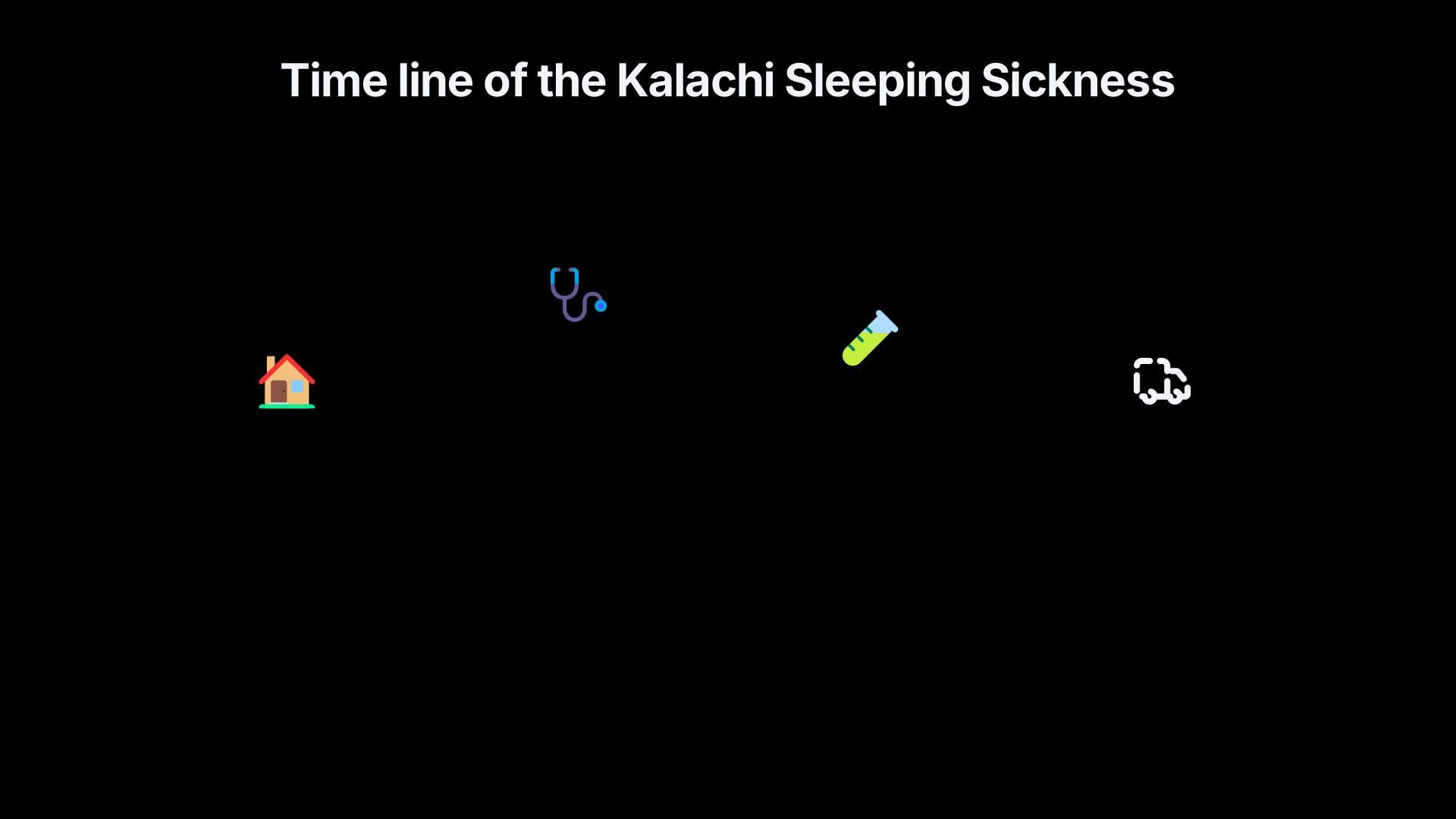
The first recognised cases appeared in spring 2013 in Kalachi and nearby Krasnogorsk, a former uranium-mining settlement. Victims could collapse almost anywhere: while teaching, riding motorcycles, milking cows, shopping or sitting at home. Many could not be awakened normally and remained asleep from several hours to as long as six days.
When patients recovered, they frequently described:
- profound confusion and disorientation;
- temporary memory loss;
- severe headaches;
- dizziness and weakness;
- nausea;
- visual or auditory hallucinations.
Some residents suffered repeated attacks over months or years, while others experienced only a single episode. Children were among those affected, demonstrating that the illness was not confined to one occupation or age group. By 2015, well over 150 episodes had been officially recorded across the two settlements.[Smithsonian Magazine]smithsonianmag.comOpen source on smithsonianmag.com.
Doctors ruled out an ordinary sleep disorder almost immediately. Patients displayed neurological symptoms consistent with reduced brain oxygenation or another toxic process rather than simple fatigue.
Why investigators struggled to find an answer
Kalachi presented investigators with an unusually difficult puzzle.
Extensive testing examined:
- drinking water;
- soil;
- local food;
- radiation levels;
- infectious diseases;
- toxic chemicals;
- household building materials;
- blood samples from patients;[theguardian.com]theguardian.comSource details in endnotes.
- environmental gases.
According to Kazakh authorities, more than 20,000 environmental and medical tests were eventually performed. Yet early investigations repeatedly failed to identify a single factor that consistently matched every episode. This uncertainty encouraged speculation both inside and outside Kazakhstan.[Smithsonian Magazine]smithsonianmag.comOpen source on smithsonianmag.com.
The abandoned uranium mine inevitably became the centre of attention. Soviet uranium mining had ended decades earlier, leaving flooded underground workings beneath the surrounding area. Because uranium carries strong public associations with radiation, many residents assumed radioactive contamination must be responsible.
However, repeated radiation surveys found gamma radiation within accepted safety limits and therefore insufficient to explain sudden unconsciousness. Although elevated indoor radon was detected in some houses, radon exposure is primarily associated with increased long-term lung cancer risk rather than abrupt episodes of deep sleep. This weakened the simplest “radiation poisoning” explanation.[PMC]pmc.ncbi.nlm.nih.govPMCThe health effects of radon and uranium on the population of KazakhstanOctober 1, 2015…
Radiation, mine gases and other theories
Several competing explanations emerged as investigators tried to reconcile the medical evidence with the local environment.
Radiation from the uranium mine
Because Kalachi lies beside a former uranium mining complex, radiation was the first theory widely discussed by residents and the media.
This explanation had obvious appeal but relatively weak supporting evidence. Radiation measurements remained below levels expected to cause acute neurological collapse, and the symptoms did not resemble recognised radiation sickness. Instead of burns, immune-system damage or gastrointestinal illness, patients primarily experienced unconsciousness and neurological effects. Most specialists therefore moved away from radiation as the principal cause.[PMC]pmc.ncbi.nlm.nih.govPMCThe health effects of radon and uranium on the population of KazakhstanOctober 1, 2015…
Carbon monoxide, hydrocarbons and oxygen depletion
The explanation eventually adopted by Kazakhstan’s government focused on gases escaping from the abandoned mine.
Officials proposed that flooding inside the old workings caused timber and other materials left underground to generate carbon monoxide and hydrocarbons. Under certain weather conditions, these gases could accumulate near the surface while simultaneously reducing available oxygen. Individually, measured concentrations were often unremarkable, but investigators argued that the combination of mildly elevated carbon monoxide, hydrocarbons and reduced oxygen produced neurological symptoms through a cumulative effect.[The Astana Times]astanatimes.comThe Astana Times Ongoing Sleeping Sickness Investigation IntensifiesThe Astana Times Ongoing Sleeping Sickness Investigation Intensifies
The theory fits several important observations:
- carbon monoxide poisoning commonly causes headaches, confusion and unconsciousness;
- oxygen deprivation can produce hallucinations and memory problems;
- the affected villages sat directly above abandoned underground mine workings.
The government subsequently organised relocation programmes for many residents rather than attempting to eliminate the environmental hazard entirely.[The Astana Times]astanatimes.comThe Astana Times Ongoing Sleeping Sickness Investigation IntensifiesThe Astana Times Ongoing Sleeping Sickness Investigation Intensifies
Why some scientists remained cautious
Although the gas hypothesis became the official explanation, it has never convinced every expert.
Several unresolved questions remain.
Carbon monoxide is normally confirmed through characteristic blood tests, yet some earlier reports indicated that affected patients did not consistently show the expected biochemical evidence of poisoning. Mine safety specialists also questioned how gases from a sealed, abandoned mine could disperse through open air while remaining concentrated enough to affect people in different locations around the village.[WIRED]wired.commystery kazakhstani sleeping sicknessThe Mystery of the Kazakhstani Sleeping Sickness | WIREDJuly 16, 2015…
These uncertainties do not disprove the gas hypothesis, but they illustrate why some researchers regard it as plausible rather than conclusively demonstrated.
Groundwater contamination and other environmental ideas
A smaller number of researchers suggested alternative environmental mechanisms.
One proposal argued that unidentified chemical contaminants might have entered groundwater, perhaps originating from historical industrial or military activity. This hypothesis arose largely from epidemiological observations rather than direct identification of a specific toxin. No chemical contaminant has been conclusively demonstrated, and the idea remains speculative.[Wikipedia]WikipediaSleeping sickness of Kalachi, KazakhstanSleeping sickness of Kalachi, Kazakhstan
Other suggestions—including methane, radon acting as an anaesthetic, or mixtures of underground gases—were discussed during the investigation but similarly lacked definitive confirmation.[Smithsonian Magazine]smithsonianmag.comOpen source on smithsonianmag.com.
Was it mass psychogenic illness?
Because the episodes attracted intense media attention, some observers wondered whether they represented mass psychogenic illness—sometimes called mass sociogenic illness—where stress contributes to genuine symptoms spreading through a community.
The available evidence argues against this being the primary explanation.
Patients experienced prolonged unconsciousness requiring hospital care, neurological abnormalities and recurring physical symptoms that are difficult to explain solely through psychological contagion. Although anxiety and rumour almost certainly influenced how residents interpreted events, investigators generally treated the illness itself as having a genuine physiological basis rather than being a classic example of mass psychogenic illness. Some experts have suggested that psychological factors may have shaped individual experiences alongside an environmental trigger rather than replacing it.[WIRED]wired.commystery kazakhstani sleeping sicknessThe Mystery of the Kazakhstani Sleeping Sickness | WIREDJuly 16, 2015…
Why the mystery became a modern legend
Kalachi illustrates how genuine medical uncertainty can generate enduring folklore.
Several factors encouraged extraordinary interpretations:
- the abandoned Soviet uranium mine provided an obvious symbolic culprit;
- years passed without a definitive explanation;
- official statements changed as investigations evolved;
- dramatic symptoms made international headlines;
- Cold War associations with secret Soviet facilities encouraged conspiracy theories.
As scientific uncertainty persisted, stories spread alleging hidden radiation disasters, biological experiments or government cover-ups. None has been supported by credible evidence, but the absence of an immediate answer allowed speculation to flourish.
The village therefore occupies an unusual place in Kazakhstan’s recent history. Unlike many famous tales of mysterious illness, the suffering was unquestionably real. The debate concerns not whether people became ill, but exactly why.
What is the most convincing explanation today?
Most specialists now regard an environmental cause linked to the abandoned mine as the leading explanation, with carbon monoxide, hydrocarbons and periods of reduced oxygen providing the best overall fit for the medical and geographical evidence. The relocation of residents and the subsequent disappearance of new cases also lend some indirect support to an environmental mechanism.[The Astana Times]astanatimes.comThe Astana Times Ongoing Sleeping Sickness Investigation IntensifiesThe Astana Times Ongoing Sleeping Sickness Investigation Intensifies
At the same time, the case has never been resolved to the standard expected for a textbook public-health investigation. Important questions remain about precisely how gases accumulated, why attacks occurred intermittently, and why laboratory findings were not always consistent. For that reason, Kalachi remains an instructive example of how real environmental hazards, incomplete scientific evidence and public uncertainty can combine to create a lasting modern mystery rather than a simple solved case.
Amazon book picks
Further Reading
Books and field guides related to Why Did Kalachi Become the Sleeping Village?. Use these as the next step if you want deeper reading beyond the article.
Extraordinary Popular Delusions and the Madness of Crowds
Rating: 4.0/5 from 5 Google Books ratings
Frames mysterious outbreaks within the history of mass belief.

The Psychology of Pandemics
Explains fear and interpretation during unexplained illness events.
Endnotes
1.
Source: wired.com
Title: mystery kazakhstani sleeping sickness
Link:https://www.wired.com/2015/07/mystery-kazakhstani-sleeping-sickness/
Source snippet
The Mystery of the Kazakhstani Sleeping Sickness | WIREDJuly 16, 2015...
Published: July 16, 2015
2.
Source: pmc.ncbi.nlm.nih.gov
Title: PMCThe health effects of radon and uranium on the population of Kazakhstan
Link:https://pmc.ncbi.nlm.nih.gov/articles/PMC4918080/
Source snippet
October 1, 2015...
Published: October 1, 2015
3.
Source: Wikipedia
Title: Sleeping sickness of Kalachi, Kazakhstan
Link:https://en.wikipedia.org/wiki/Sleeping_sickness_of_Kalachi%2C_Kazakhstan
4.
Source: smithsonianmag.com
Link:https://www.smithsonianmag.com/smart-news/whats-causing-villages-weird-sleeping-sickness-epidemic-180954711/
5.
Source: astanatimes.com
Title: The Astana Times Ongoing Sleeping Sickness Investigation Intensifies
Link:https://astanatimes.com/2015/06/ongoing-sleeping-sickness-investigation-intensifies/
6.
Source: smithsonianmag.com
Title: When a Medical “Cure” Makes Things Much, Much Worse
Link:https://www.smithsonianmag.com/science-nature/when-cure-is-cause-180967666/
7.
Source: pubmed.ncbi.nlm.nih.gov
Link:https://pubmed.ncbi.nlm.nih.gov/14715596/
8.
Source: pubmed.ncbi.nlm.nih.gov
Link:https://pubmed.ncbi.nlm.nih.gov/11073504/
9.
Source: pubmed.ncbi.nlm.nih.gov
Link:https://pubmed.ncbi.nlm.nih.gov/8937285/
10.
Source: pmc.ncbi.nlm.nih.gov
Link:https://pmc.ncbi.nlm.nih.gov/articles/PMC1689967/?page=-1
11.
Source: pubmed.ncbi.nlm.nih.gov
Link:https://pubmed.ncbi.nlm.nih.gov/4699596/
12.
Source: pmc.ncbi.nlm.nih.gov
Link:https://pmc.ncbi.nlm.nih.gov/articles/PMC2514992/
Additional References
13.
Source: researchgate.net
Link:https://www.researchgate.net/publication/388039023_The_Town_That_Fell_Asleep_Malignant_Infrastructures_of_Soviet-era_Nuclear_Ruins_in_Kazakhstan
Source snippet
(PDF) The Town That Fell Asleep: Malignant Infrastructures of Soviet-era Nuclear Ruins in KazakhstanNovember 1, 2023 — THE TOWN THAT FELL...
Published: November 1, 2023
14.
Source: theguardian.com
Link:https://www.theguardian.com/world/2018/nov/16/congo-drc-sleeping-sickness-upside-tropical-disease-ntd
Source snippet
November 16, 2018 — THE BIG SLEEP: HOW THE WORLD'S MOST TROUBLED COUNTRY IS BEATING A DEADLY DISEASE This article is more than 7 years ol...
Published: November 16, 2018
15.
Source: vault.aokltd.org
Title: sleepers of kalachi
Link:https://vault.aokltd.org/bizarre-facts/sleepers-of-kalachi
Source snippet
Residents slumbered for days, woke with hallucinations, and no one could determine why. Published August 9, 2024 10 MIN RE...
Published: August 9, 2024
16.
Source: youtube.com
Title: Mysterious sleeping sickness spreads in Kazakhstani village
Link:https://www.youtube.com/watch?v=qy4IRhTbTFw
Source snippet
Without Borders - Kazakhstan: The Mystery of the Sleeping Village...
17.
Source: youtube.com
Title: Without Borders
Link:https://www.youtube.com/watch?v=7t_pvQXkvbE
Source snippet
PEOPLE COULDN'T WAKE UP | The Mystery of Kalachi...
18.
Source: youtube.com
Title: Kalachi: The Town That Couldn’t Stop Sleeping
Link:https://www.youtube.com/watch?v=oB950juqTnA
Source snippet
Mysterious sleeping sickness spreads in Kazakhstani village...
19.
Source: theguardian.com
Link:https://www.theguardian.com/politics/2010/nov/07/hiv-focus-prevents-curing-people
20.
Source: heraldodiariodesoria.es
Link:https://www.heraldodiariodesoria.es/internacional/150720/96993/kazajistan-sostiene-monoxido-carbono-causa-epidemia-enfermedad-sueno-kalachi.html
21.
Source: sciencealert.com
Link:https://www.sciencealert.com/kazakhstan-villagers-are-mysteriously-falling-asleep-for-days-at-a-time-now-scientists-may-have-worked-out-why
22.
Source: the-independent.com
Link:https://www.the-independent.com/news/world/asia/mysterious-sleeping-sickness-that-affected-a-kazakhstan-village-turns-out-to-be-carbon-monoxide-poisoning-a966.html
Topic Tree