How Fear and Belief Spread Across Tuvalu
Tuvalu has no well-documented equivalent of the Salem witch trials, a dance plague, a nationwide satanic scare or a recognised outbreak of mass psychogenic illness.
Page outline Jump by section
Introduction
Neither case should be forced into the label “mass hysteria”. The Nanumaga conflict was a real struggle over religious freedom, customary authority and communal unity, not an imaginary threat. Tuvalu’s climate anxiety is also founded on measurable sea-level rise and damaging saltwater inundation. Yet both episodes show how fear can spread through a very small, closely connected society—and how outsiders can amplify, simplify or distort what Tuvaluans themselves believe.[justice.gov]justice.govDepartment of Justice TuvaluDepartment of JusticeTuvaluAugust 15, 2005 — The Constitution provides for freedom of religion, and the Government generally respects thi…
Why classic panic stories are scarce
Tuvalu consists of small, widely separated island communities with a limited written press, a relatively recent tradition of centralised government and a population of only around eleven thousand. Much social history has therefore been preserved through church records, government documents, oral accounts and the work of visiting researchers rather than through the extensive court files and newspapers that allow historians to reconstruct European witch panics or urban crowd scares.
Christianity has long occupied a central place in Tuvaluan public life. The Congregational Christian Church of Tuvalu is constitutionally recognised as the established state church, although freedom of religion is also protected. Public ceremonies commonly include Christian worship, and island communities have traditionally treated religious participation, customary leadership and social order as closely connected rather than as wholly separate spheres.[state.gov]state.gov547499 TUVALU 2023 INTERNATIONAL RELIGIOUS FREEDOM REPORTState DepartmentTUVALU 2023 INTERNATIONAL RELIGIOUS FREEDOM…The constitution provides for the freedom to change religion or belief and…
This setting matters because unfamiliar religious groups may be perceived not merely as alternative congregations but as potential sources of division. In a settlement where worship, kinship, employment and local government overlap, conversion can affect family relationships and communal obligations. A dispute that would remain private in a large city can quickly become a whole-island issue.
The absence of famous panic cases should therefore not be mistaken for an absence of collective fear. It more likely reflects uneven documentation, the small scale of individual incidents and the danger of applying imported categories too loosely. No credible evidence located for this account supports claims of Tuvaluan witch trials, UFO religions, satanic ritual scares or epidemic fainting episodes.
Nanumaga’s church dispute
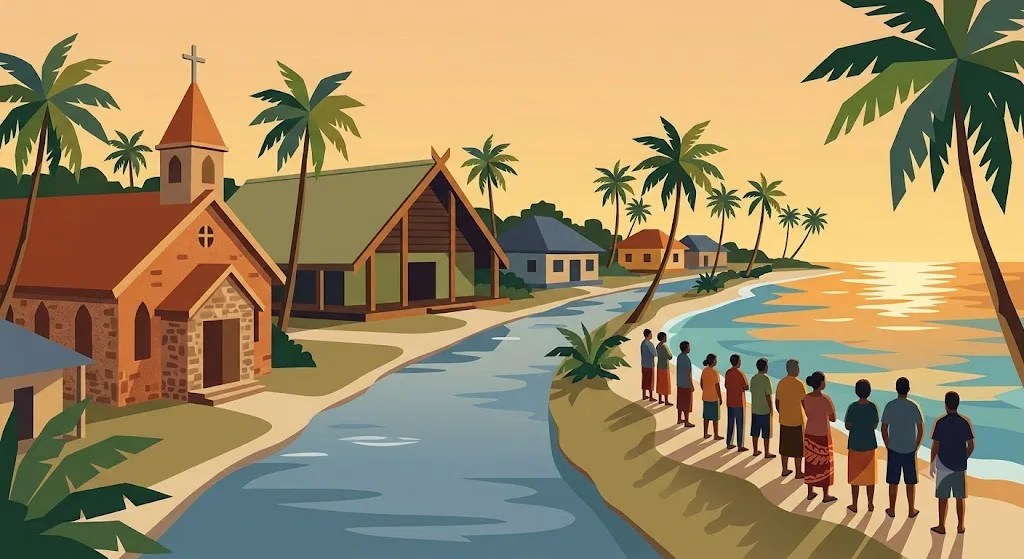
The clearest documented case began in 2003 on Nanumaga, when the island’s traditional assembly and council moved against the recently established Tuvalu Brethren Church. According to contemporary religious-freedom reporting, the local authorities believed that the church’s evangelism was creating serious division within the community. A resolution effectively prevented it from seeking converts and holding activities on the island.[Department of Justice]justice.govDepartment of Justice TuvaluDepartment of JusticeTuvaluAugust 15, 2005 — The Constitution provides for freedom of religion, and the Government generally respects thi…
The conflict centred on competing ideas of harm. Brethren members saw themselves as exercising constitutional freedoms of belief, speech and association. Their opponents presented religious fragmentation as a threat to peace, tradition and the collective life of Nanumaga. The disagreement was therefore not simply about doctrine. It concerned who had authority to decide which forms of worship were compatible with island unity.
Reports from the period described harassment, employment losses and acts or threats of violence against some Brethren members. Several reportedly left Nanumaga. The exact details were contested, and official accounts did not always accept every allegation, but the evidence is strong enough to show that the dispute caused genuine intimidation and social injury rather than merely heated theological debate.[U.S. Department of State]2009-2017.state.govU.S. Department of State TuvaluU.S. Department of State Tuvalu
Pastor Mase Teonea challenged the prohibition in court. The resulting litigation, commonly known as Teonea v Pule o Kaupule of Nanumaga, asked whether customary institutions could restrict religious activity to preserve harmony. The case became an important test of the relationship between individual constitutional rights and Tuvaluan communal values.[Samoa Digital Library]sadil.wsOpen source on sadil.ws.
Was it a moral panic?
The episode has some features associated with a moral panic: a minority group was portrayed as endangering social cohesion, established leaders acted to suppress it, and fear of division appears to have exceeded any evidence that the congregation posed a physical danger. Yet describing the whole affair as a moral panic would be incomplete.
Religious competition could produce real disagreements over Sunday observance, family loyalties, communal labour and respect for elders. The fear was therefore not wholly invented. What made the response troubling was that concern about disruption was used to justify collective restrictions and alleged mistreatment of people whose beliefs differed from the majority.
The term “cult” is especially unhelpful here. The Brethren Church was a minority Christian denomination, not a secretive apocalyptic organisation, and official records generally treated the case as one of religious freedom. Calling it a cult would reproduce the hostile labelling at the heart of the dispute rather than explain it.
Jehovah’s Witnesses on Nanumaga later reported discrimination and threats as well, although government representatives disputed some allegations. These later complaints suggest that suspicion was not confined to one congregation but reflected a broader tension between minority proselytising religions and the expectation of island-wide Christian conformity.[Refworld]refworld.orgOpen source on refworld.org.
The flood promise and climate fear
Tuvalu’s most culturally important collective-belief story concerns climate change. International reporting often presents the country as a doomed nation waiting to disappear beneath the sea. Within Tuvalu, that scientific and political warning has sometimes met a Christian counter-narrative based on God’s covenant with Noah: after the biblical flood, God promises never again to destroy the world by flood.
Researchers studying Pacific climate narratives have found several different uses of the Noah story. Some believers have interpreted the promise as assurance that Tuvalu cannot be destroyed by rising seas. Others treat Noah as a model of preparation: divine protection does not remove the obligation to build, plan and respond to warnings. A third interpretation presents Tuvaluans as people unjustly left outside the wealthy world’s “ark”, suffering from emissions largely produced elsewhere.[wiley.com]rgs-ibg.onlinelibrary.wiley.comOpen source on wiley.com.
This diversity is important. Western accounts have sometimes reduced Tuvaluan Christianity to simple climate denial, suggesting that literal belief in Noah prevents adaptation. Tuvaluan church figures themselves have challenged denialist preaching, while theologians and researchers argue that faith may support climate action, justice campaigns and community resilience as readily as passivity.[MDPI]mdpi.comOpen source on mdpi.com.
The argument is not a contest between irrational religion and uncontested science. Religious language helps people interpret an unprecedented threat to land, ancestry and nationhood. It can lessen fear, strengthen resolve or discourage preparation, depending on how the story is told. Treating all religious confidence as delusion risks overlooking those differences.
The “sinking nation” narrative
The outside world has created its own contagious story about Tuvalu: that the islands are steadily shrinking and will soon vanish in a single, simple process. The underlying danger is real. Tuvalu’s national adaptation plan describes an extremely low-lying country facing severe threats from sea-level rise, coastal flooding, saltwater intrusion, heat and storms. Reporting from Funafuti has documented damaged groundwater and agriculture, anxiety about relocation and government efforts to build sea defences and raised land.[UNFCCC]unfccc.intTuvalu - National Adaptation Plan15 Aug 2025 — Tuvalu, as one of the most vulnerable Small Island. Developing States (SIDS) with on…
But “Tuvalu is sinking” is an imperfect description. Coral islands are dynamic structures that can erode in one place while accumulating sand and sediment elsewhere. A major study of aerial photographs and satellite images found that Tuvalu’s total land area increased by about 2.9 per cent between 1971 and 2014, with most surveyed islands growing despite rising sea levels.[Nature]nature.comOpen source on nature.com.
That result does not mean climate change is harmless. An island may gain land while becoming less habitable because of repeated flooding, heat, water shortages, damaged crops, overcrowding or the loss of particular homes and cultural sites. Nor does past growth guarantee that reef islands will continue to adjust successfully as sea-level rise accelerates.
The finding does expose a common false choice, however. Claims that Tuvalu will shortly disappear altogether can be exaggerated, while claims that land growth disproves danger are equally misleading. Both convert a complex physical and social future into a reassuringly simple story.
Researchers have criticised international “climate refugee” narratives for portraying Tuvaluans as a doomed population with no agency. Migration from Tuvalu has long been shaped by education, work, family connections and access to services, not solely by environmental fear. Presenting every migrant as a refugee from a vanishing island can erase these ordinary motives and make departure seem inevitable.[sciencedirect.com]sciencedirect.comOpen source on sciencedirect.com.
This global narrative has features of an apocalyptic social scare. Striking images of flooded roads and narrow islands circulate easily; complex evidence about sediment movement, adaptation and migration travels less well. Tuvalu becomes a symbol onto which outsiders project fear, guilt, scepticism or political arguments about climate change. Scholars have described the country as alternately cast as an innocent victim and accused of exaggerating its plight—two roles that leave limited room for Tuvaluans to describe their own future.[ScienceDirect]sciencedirect.comOpen source on sciencedirect.com.

Fear, faith and political action
Climate anxiety in Tuvalu has not produced a single nationwide delusion. It has produced a range of practical and symbolic responses: coastal protection, land reclamation, international climate diplomacy, migration agreements and legal attempts to preserve statehood and maritime rights even if habitable territory is severely reduced.
The 2023 Constitution declares that Tuvalu’s statehood and maritime boundaries will endure despite climate change or territorial loss. This is not evidence that the government expects the country to vanish on a fixed date. It is an attempt to prevent physical damage from causing a second disaster: the legal disappearance of Tuvalu’s sovereignty, citizenship and control over its surrounding ocean.[constituteproject.org]constituteproject.orgTuvalu 2023Constitute ProjectTuvalu 2023 ConstitutionIn the case of leaders, to respect Island Community customs and traditions; to encourage Christ…
Such measures show why apocalyptic language can be both useful and dangerous. Dramatic warnings have helped Tuvalu gain international attention and climate support. They can also encourage the belief that adaptation is pointless, that mass flight is unavoidable or that Tuvalu exists only as a lesson for larger countries.
For residents, the central fear is not merely drowning. It is the possible breaking apart of families, language, church life, customary authority and attachment to particular islands. A technically safe migration route does not resolve those losses. This helps explain why apparently contradictory beliefs—confidence in divine protection, support for climate science, determination to remain and preparation for migration—can coexist in the same community.
What the evidence supports
Tuvalu’s record is best understood through careful distinctions rather than dramatic labels.
- No substantiated classic mass-hysteria outbreak has emerged from the available historical and medical literature.
- The Nanumaga conflict was documented religious persecution and social conflict, although fear of communal fragmentation helped justify the response.
- Minority churches should not casually be called cults. In the strongest documented case, “dangerous sect” language would obscure a constitutional dispute over evangelism, custom and authority.
- Biblical flood beliefs have influenced climate interpretation, but Tuvaluan Christian responses range from denial and reassurance to preparation, justice activism and adaptation.
- Climate danger is real, while total-disappearance narratives are often oversimplified. Growing land area does not cancel worsening flood exposure or threats to habitability.
- The most powerful contagious belief about Tuvalu may be international: the image of a passive, doomed population destined to become the world’s first nation of climate refugees.
Tuvalu matters to the history of panics and collective belief precisely because its story resists the familiar categories. The country is not a theatre of spectacular witch hunts or mass possession. It is a place where communal fear, religious conviction, scientific warning and global apocalyptic storytelling meet—and where the greatest analytical mistake is to confuse a complicated struggle for survival with either irrational panic or inevitable doom.
Amazon book picks
Further Reading
Books and field guides related to How Fear and Belief Spread Across Tuvalu. Use these as the next step if you want deeper reading beyond the article.
How to Avoid a Climate Disaster
Relevant to discussions of climate risks facing Tuvalu.

The god species
First published 2011. Subjects: Climatic changes, Environmental protection, Effect of climate on, Human beings, Biotic communities.

Sea People
First published 2019. Subjects: Polynesia, history, Polynesians, History, Navigation, Discovery and exploration.

Endnotes
1.
Source: justice.gov
Title: Department of Justice Tuvalu
Link:https://www.justice.gov/eoir/media/279296/dl?inline=
Source snippet
Department of JusticeTuvaluAugust 15, 2005 — The Constitution provides for freedom of religion, and the Government generally respects thi...
Published: August 15, 2005
2.
Source: commission-on-legal-pluralism.com
Link:https://commission-on-legal-pluralism.com/system/commission-on-legal-pluralism/volumes/52/farran-art.htm.html
Source snippet
Commission on Legal PLuralismFarranIn this case a missionary (Teonea) from the Brethren Church sought to establish a branch of the church...
3.
Source: unfccc.int
Link:https://unfccc.int/sites/default/files/resource/NAP_Tuvalu_2025.pdf
Source snippet
Tuvalu - National Adaptation Plan15 Aug 2025 — Tuvalu, as one of the most vulnerable Small Island. Developing States (SIDS) with on...
4.
Source: reuters.com
Link:https://www.reuters.com/investigations/sinking-tuvalu-fights-keep-maritime-boundaries-sea-levels-rise-2024-09-24/
Source snippet
With a mean elevation of just 2 meters, Tuvalu has already seen a sea-level increase of 15 cm over the past three decades. NASA projects...
5.
Source: state.gov
Title: 547499 TUVALU 2023 INTERNATIONAL RELIGIOUS FREEDOM REPORT
Link:https://www.state.gov/wp-content/uploads/2024/04/547499-TUVALU-2023-INTERNATIONAL-RELIGIOUS-FREEDOM-REPORT.pdf
Source snippet
State DepartmentTUVALU 2023 INTERNATIONAL RELIGIOUS FREEDOM...The constitution provides for the freedom to change religion or belief and...
6.
Source: devpolicy.org
Title: tuvalu constitution updated culture climate change and decolonisation 20230921
Link:https://devpolicy.org/tuvalu-constitution-updated-culture-climate-change-and-decolonisation-20230921/
Source snippet
Devpolicy BlogTuvalu Constitution updated: culture, climate change and...21 Sept 2023 — Tuvalu's 2023 constitutional amendments show mov...
7.
Source: 2009-2017.state.gov
Title: U.S. Department of State Tuvalu
Link:https://2009-2017.state.gov/j/drl/rls/irf/2006/71361.htm
8.
Source: 2009-2017.state.gov
Title: U.S. Department of State Tuvalu
Link:https://2009-2017.state.gov/j/drl/rls/irf/2008/108428.htm
9.
Source: refworld.org
Link:https://www.refworld.org/country%2C%2CUSDOS%2C%2C%2C%2C5621053715%2C0.html
10.
Source: rgs-ibg.onlinelibrary.wiley.com
Link:https://rgs-ibg.onlinelibrary.wiley.com/doi/abs/10.1002/geo2.68
11.
Source: mdpi.com
Link:https://www.mdpi.com/2077-1444/16/6/773
12.
Source: nature.com
Link:https://www.nature.com/articles/s41467-018-02954-1
13.
Source: sciencedirect.com
Link:https://www.sciencedirect.com/science/article/abs/pii/S0959378011002019
14.
Source: sciencedirect.com
Link:https://www.sciencedirect.com/science/article/pii/S0962629823001166
15.
Source: 2021-2025.state.gov
Title: marshall islands
Link:https://2021-2025.state.gov/reports/2023-report-on-international-religious-freedom/marshall-islands/
16.
Source: rgs-ibg.onlinelibrary.wiley.com
Link:https://rgs-ibg.onlinelibrary.wiley.com/doi/10.1002/geo2.68
17.
Source: history.com
Title: salem witch trials hysteria factors
Link:https://www.history.com/articles/salem-witch-trials-hysteria-factors
18.
Source: constituteproject.org
Title: Tuvalu 2023
Link:https://www.constituteproject.org/constitution/Tuvalu_2023
Source snippet
Constitute ProjectTuvalu 2023 ConstitutionIn the case of leaders, to respect Island Community customs and traditions; to encourage Christ...
19.
Source: sadil.ws
Link:https://sadil.ws/bitstream/handle/123456789/3125/32.pdf?isAllowed=y&sequence=1
20.
Source: eprints.soton.ac.uk
Link:https://eprints.soton.ac.uk/494661/1/Geography_and_Environment_-2018-Fair-_Three_stories_of_Noah_Navigating_religious_climate_change_narratives_in_the.pdf
21.
Source: pearl.reading.ac.uk
Link:https://pearl.reading.ac.uk/wp-content/uploads/2024/10/Jan-25-talk-_Asia-Pacific-Viewpoint-2010-Farbotko-Wishful-sinking-Disappearing-islands-climate-refugees-and-cosmopolitan-1.pdf
22.
Source: Wikipedia
Title: Moral panic
Link:https://en.wikipedia.org/wiki/Moral_panic
Additional References
23.
Source: youtube.com
Title: Tuvalu: Living on borrowed time and shaky foundations
Link:https://www.youtube.com/watch?v=InTVdhufUUw
Source snippet
First climate migrants from Tuvalu arrive in Australia • FRANCE 24 English...
24.
Source: youtube.com
Title: Tuvalu Is Disappearing: Life at Ground Zero of the Climate Crisis
Link:https://www.youtube.com/watch?v=TXyWKG3diHs
Source snippet
A country being lost to rising sea levels - documentary...
25.
Source: youtube.com
Title: A country being lost to rising sea levels
Link:https://www.youtube.com/watch?v=H-ar5drhjzU
Source snippet
Tuvalu: Living on borrowed time and shaky foundations...
26.
Source: facebook.com
Link:https://www.facebook.com/kathmandupost/posts/mass-hysteria-is-a-misunderstood-psychological-phenomenon-in-which-stress-and-an/1459992042828712/
27.
Source: academia.edu
Link:https://www.academia.edu/5368224/Apocalyptic_and_Millenarian_Movements
28.
Source: researchgate.net
Link:https://www.researchgate.net/publication/329708387_Three_stories_of_Noah_Navigating_religious_climate_change_narratives_in_the_Pacific_Island_region
29.
Source: research.fit.edu
Link:https://research.fit.edu/media/site-specific/researchfitedu/coast-climate-adaptation-library/pacific-islands/melanesia/Bertana.–2020.–The-Impact-of-Faith-Based-Narratives-on-Climate-Change-Adaptation-in-Narikoso%2C-Fiji.pdf
30.
Source: crimejusticejournal.com
Link:https://www.crimejusticejournal.com/article/download/4222/1657/16311
31.
Source: judiciary.uk
Link:https://www.judiciary.uk/wp-content/uploads/JCO/Documents/judicial-college/ETBB_Religion__finalised_.pdf
32.
Source: facebook.com
Link:https://www.facebook.com/aigkenham/posts/do-biblical-creationists-believe-in-climate-change-of-course-they-do-the-event-o/3777659365597725/
Topic Tree
Follow this branch
Related pages 192
- Antigua and Barbuda
- Argentina Belief Scares
- Azerbaijan Belief
- Bahrain Beliefs
- North Korea
- +187 more in sidebar