Within France's Strange Fears
Why France Never Had One National Witch Hunt
France's witch trials grew through local crises and weak oversight, then declined as appellate courts demanded stronger evidence.
On this page
- Where prosecutions became most intense
- How village conflict became satanic conspiracy
- How courts and royal law restrained trials
Page outline Jump by section
Introduction
France did not end its witch hunts through a single dramatic reform or nationwide change of heart. Instead, the country’s regional persecutions gradually faded because royal institutions increasingly limited the power of local courts, senior judges demanded stronger evidence, and the monarchy became less willing to treat accusations of witchcraft as proof of a vast satanic conspiracy. This mattered because France never had one unified national witch hunt. Some regions experienced intense waves of prosecution, while others saw relatively few executions. The key story is therefore not simply why belief in witchcraft declined, but why some legal systems became effective at restraining panic while others did not. Historians increasingly see the French experience as an example of how stronger judicial oversight could interrupt cycles of fear before they became self-sustaining.[OUP Academic]academic.oup.comOUP AcademicWitchcraft Trials in France | The Oxford Handbook of Witchcraft in Early Modern Europe and Colonial America | Oxford Academic…
Where prosecutions became most intense
Early modern France was a patchwork of legal traditions rather than a centrally controlled judicial state. Local magistrates often handled witchcraft cases, and their willingness to prosecute varied enormously.
The harshest persecutions tended to occur in eastern and north-eastern frontier regions such as Lorraine, Franche-Comté and Alsace, where political boundaries, religious conflict and overlapping jurisdictions complicated legal oversight. Some of these territories were not fully integrated into the French kingdom when the worst persecutions occurred, and several lay within or beside the Holy Roman Empire, where some of Europe’s largest witch hunts unfolded. By contrast, areas under the stronger influence of the Parlement of Paris generally experienced greater restraint.[oup.com]academic.oup.comOUP AcademicWitchcraft Trials in France | The Oxford Handbook of Witchcraft in Early Modern Europe and Colonial America | Oxford Academic…
This uneven geography explains why historians reject the idea of a single “French witch hunt”. Local conditions—including harvest failures, plague, religious tension and village rivalries—could produce intense outbreaks in one district while neighbouring regions remained comparatively quiet.[OUP Academic]academic.oup.comOUP AcademicWitchcraft Trials in France | The Oxford Handbook of Witchcraft in Early Modern Europe and Colonial America | Oxford Academic…
How village conflict became satanic conspiracy
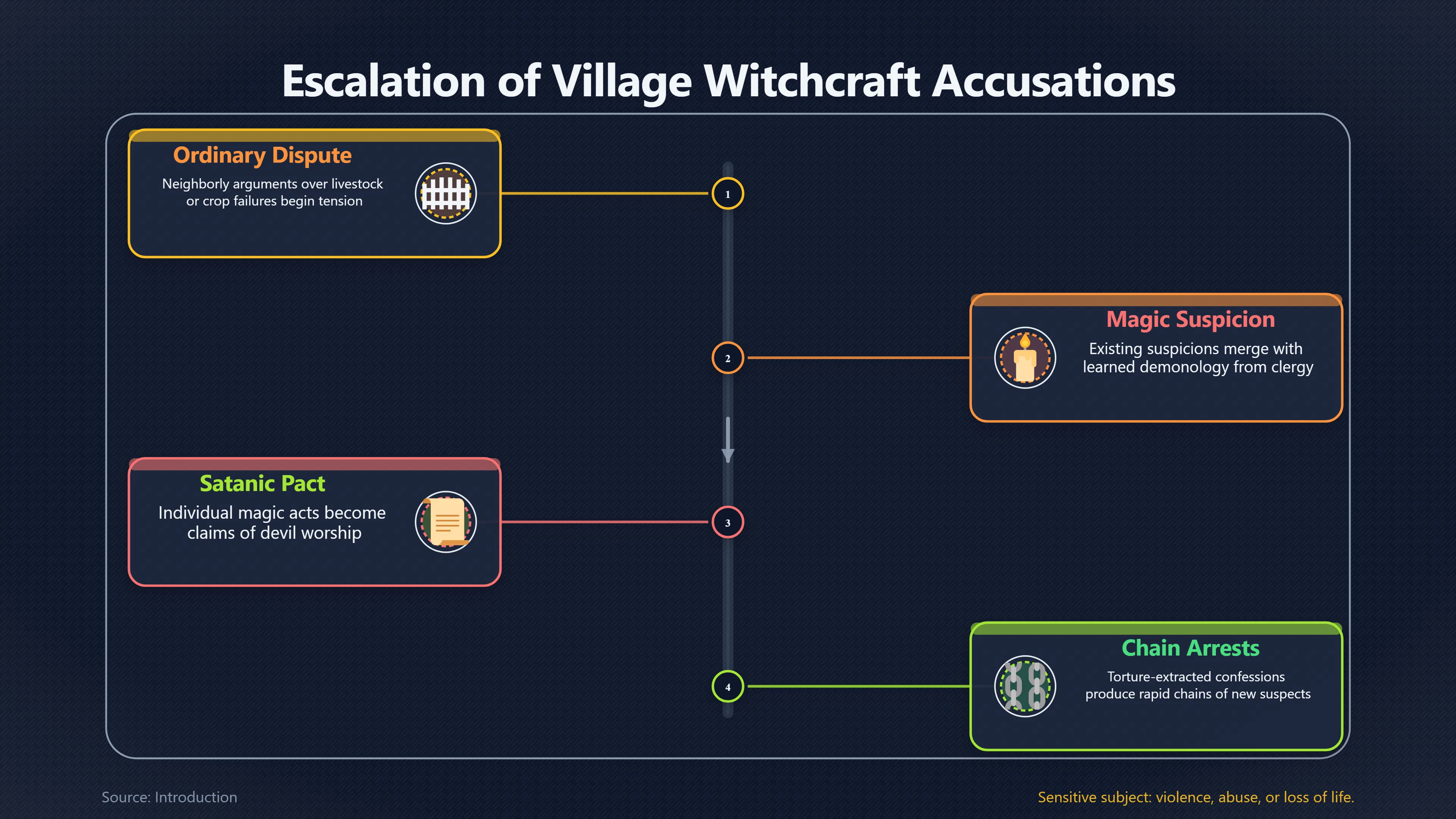
Most accusations did not begin with elaborate theories about organised devil worship. They usually started with ordinary disputes.
A neighbour might be blamed after livestock died, a child fell ill or a crop failed following an argument. Existing suspicions then merged with learned demonology promoted by judges, clergy and legal writers. Individual acts of alleged harmful magic were transformed into claims that the accused had entered a pact with Satan, attended secret assemblies and threatened Christian society itself.[Cambridge University Press & Assessment]cambridge.orgCambridge University Press & AssessmentFrench Catholic Demonologists and Their Enemies in the Late Sixteenth and Early Seventeenth Centur…
This escalation mattered because it changed what courts believed they were investigating. Instead of resolving neighbourhood disputes, magistrates came to think they were uncovering hidden conspiracies. Once confessions extracted under torture named additional suspects, accusations could spread rapidly through villages and families, producing chains of arrests.[OUP Academic]academic.oup.comOUP AcademicRendering justice in witch trials: the case of the val de Lièpvre | French History | Oxford AcademicNovember 11, 2011…
How courts and royal law restrained trials
The most important brake on French witch hunting came from appellate justice rather than from disbelief in witchcraft itself.
The Parlement of Paris, the kingdom’s highest appellate court for roughly half of France, developed a reputation for scepticism towards witchcraft prosecutions. Its judges increasingly questioned convictions based on rumours, forced confessions, improbable testimony or unsupported claims of supernatural activity. Rather than automatically confirming local verdicts, they frequently overturned death sentences or reduced punishments.[OUP Academic]academic.oup.comOUP AcademicWitchcraft Trials in France | The Oxford Handbook of Witchcraft in Early Modern Europe and Colonial America | Oxford Academic…
Over time, this scepticism became institutional rather than exceptional.
- Appeals subjected local enthusiasm to review by experienced professional judges.
- Higher courts became increasingly reluctant to approve executions based on confessions obtained under torture.
- Greater attention was paid to procedural errors and evidential weaknesses.
- Local magistrates learned that convictions were unlikely to survive appeal, reducing incentives to pursue aggressive prosecutions.[OUP Academic]academic.oup.comOUP AcademicWitchcraft Trials in France | The Oxford Handbook of Witchcraft in Early Modern Europe and Colonial America | Oxford Academic…
Historians identify the late sixteenth and early seventeenth centuries as the period when this appellate restraint became increasingly significant. After major hunts in the 1580s, the Parlement of Paris expanded its supervision of witchcraft cases, and by the early seventeenth century it was consistently refusing to endorse many death sentences. Other French parlements increasingly followed this example.[OUP Academic]academic.oup.comOUP AcademicWitchcraft Trials in France | The Oxford Handbook of Witchcraft in Early Modern Europe and Colonial America | Oxford Academic…
Why stronger government mattered
France’s experience illustrates a broader historical pattern across Europe: the most destructive witch hunts usually occurred where local courts could act with limited supervision.
As the French monarchy expanded its administrative reach, royal justice increasingly displaced purely local decision-making. Professional magistrates were generally more cautious than village courts or smaller regional tribunals. They were not necessarily sceptical about the existence of witchcraft, but they became far less willing to accept extraordinary claims without convincing legal proof.[OUP Academic]academic.oup.comOUP AcademicWitchcraft Trials in France | The Oxford Handbook of Witchcraft in Early Modern Europe and Colonial America | Oxford Academic…
This shift reflected changes in governance as much as changes in belief. Better organised states were increasingly concerned with consistent legal procedure, reducing arbitrary local justice and asserting royal authority over criminal prosecutions. Witchcraft accusations therefore became another area in which central government limited regional autonomy.[OUP Academic]academic.oup.comOUP AcademicWitchcraft Trials in France | The Oxford Handbook of Witchcraft in Early Modern Europe and Colonial America | Oxford Academic…
The importance of the 1682 royal edict
A significant milestone came under Louis XIV with the royal edict of 1682.
Rather than treating every alleged magical act as evidence of a genuine pact with the Devil, the edict redirected many prosecutions towards offences such as fraud, poisoning, sacrilege or superstition. The government did not declare that magic was impossible, but it substantially reduced the legal basis for prosecuting people as members of a supernatural satanic conspiracy.[OUP Academic]academic.oup.comOUP AcademicWitchcraft Trials in France | The Oxford Handbook of Witchcraft in Early Modern Europe and Colonial America | Oxford Academic…
This reflected a broader change in official priorities. Authorities became more concerned with maintaining public order and prosecuting demonstrable crimes than with pursuing invisible conspiracies whose evidence depended heavily on confession and rumour. The legal framework itself therefore made large-scale witch hunts increasingly difficult to sustain.[OUP Academic]academic.oup.comOUP AcademicWitchcraft Trials in France | The Oxford Handbook of Witchcraft in Early Modern Europe and Colonial America | Oxford Academic…
Why persecution faded without disappearing overnight
The decline of witch trials was gradual rather than sudden.
Belief in witchcraft remained widespread among ordinary people long after executions became rare. Villagers continued to accuse neighbours of harmful magic, consult healers and fear curses. What changed first was not popular belief but the willingness of higher courts to convert those accusations into death sentences.[OUP Academic]academic.oup.comOUP AcademicWitchcraft Trials in France | The Oxford Handbook of Witchcraft in Early Modern Europe and Colonial America | Oxford Academic…
This distinction is important because it shows that institutional reform can interrupt collective fear even when underlying beliefs remain. French authorities increasingly insisted that extraordinary allegations required extraordinary proof, making regional panics less likely to escalate into judicial persecution.
Why France never had one national witch hunt
France’s history demonstrates that witch hunting depended as much on legal institutions as on popular fears.
Where local courts operated with limited oversight, accusations could expand into regional persecutions fuelled by demonological ideas and community conflict. Where appellate courts imposed demanding standards of evidence and royal government asserted greater control, those same accusations were increasingly contained.
Rather than ending through a single intellectual revolution, French witch hunts were largely stopped by changes in governance: stronger appellate review, more professional judicial procedures, closer royal supervision and a legal shift away from prosecuting alleged supernatural conspiracies. That combination explains why France experienced sharp regional differences in persecution—and why, over time, those regional hunts became increasingly difficult to sustain.[oup.com]academic.oup.comOUP AcademicWitchcraft Trials in France | The Oxford Handbook of Witchcraft in Early Modern Europe and Colonial America | Oxford Academic…

Amazon book picks
Further Reading
Books and field guides related to Why France Never Had One National Witch Hunt. Use these as the next step if you want deeper reading beyond the article.
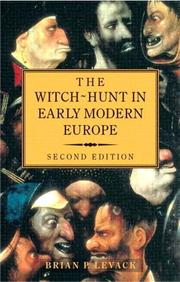
The witch-hunt in early modern Europe
Best overview for understanding regional French witch hunts.



Endnotes
1.
Source: academic.oup.com
Link:https://academic.oup.com/edited-volume/34335/chapter-abstract/291370604
Source snippet
OUP AcademicWitchcraft Trials in France | The Oxford Handbook of Witchcraft in Early Modern Europe and Colonial America | Oxford Academic...
2.
Source: cambridge.org
Link:https://www.cambridge.org/core/journals/church-history/article/french-catholic-demonologists-and-their-enemies-in-the-late-sixteenth-and-early-seventeenth-centuries/F5D9798477647ED7BBF09BC40CAD8408
Source snippet
Cambridge University Press & AssessmentFrench Catholic Demonologists and Their Enemies in the Late Sixteenth and Early Seventeenth Centur...
3.
Source: academic.oup.com
Link:https://academic.oup.com/fh/article-abstract/25/4/453/620019
Source snippet
OUP AcademicRendering justice in witch trials: the case of the val de Lièpvre | French History | Oxford AcademicNovember 11, 2011...
Published: November 11, 2011
4.
Source: cambridge.org
Link:https://www.cambridge.org/core/journals/annales-histoire-sciences-sociales/article/abs/aspects-socioculturels-des-conflits-religieux-a-paris-dans-la-seconde-moitie-du-xvie-siecle/D108FC37F576317C0619F2CEE17ED4B6
5.
Source: academic.oup.com
Link:https://academic.oup.com/edited-volume/34335/chapter-abstract/291375410
6.
Source: guides.loc.gov
Title: Research Guides Witch Trials & Witchcraft
Link:https://guides.loc.gov/feminism-french-women-history/witch-trials-witchcraft
Source snippet
Research GuidesWitch Trials & Witchcraft - French Women & Feminists in History: A Resource Guide - Research Guides at Library of Congress...
Additional References
7.
Source: research-information.bris.ac.uk
Link:https://research-information.bris.ac.uk/en/publications/e6f7edf8-49c6-4095-9dcd-516848603e87/
8.
Source: reddit.com
Link:https://www.reddit.com/r/AskHistorians/comments/12ed96g
Source snippet
How dangerous was it to deny witchcraft or defend/provide support to accused at the heights of witch panics?...
9.
Source: larousse.fr
Title: Archive Larousse: Dictionnaire de l’Histoire de France
Link:https://www.larousse.fr/archives/histoire_de_france/page/1183
Source snippet
Archive Larousse: Dictionnaire de l'Histoire de France - sorcellerie. - sorcellerie...
10.
Source: youtube.com
Title: Demonic Possession, Sorcery & Satanic Pacts
Link:https://www.youtube.com/watch?v=qRGI6i4rULA
Source snippet
The Dark Secret Behind the Basque Witch Trials...
11.
Source: youtube.com
Title: Secrets of the Basque Witch Hunt with Jan Machielsen
Link:https://www.youtube.com/watch?v=389wgCchHMY
Source snippet
Demonic Possession, Sorcery & Satanic Pacts - Witchcraft and Exorcism in 17th Century Loudon France...
12.
Source: youtube.com
Link:https://www.youtube.com/watch?v=plN6onTiJpw
Source snippet
Secrets of the Basque Witch Hunt with Jan Machielsen...
13.
Source: psupress.org
Link:https://www.psupress.org/books/titles/978-0-271-02915-3.html
14.
Source: routledgetextbooks.com
Link:https://routledgetextbooks.com/textbooks/9781138808102/
15.
Source: aeternum.fr
Link:https://aeternum.fr/en/blogs/les-carnets-daeternum/quand-louis-xiv-mit-fin-au-crime-de-sorcellerie
16.
Source: undergradjournal.history.ucsb.edu
Link:https://undergradjournal.history.ucsb.edu/our-journal/past-issues/fall-2021/ouerbacker/
Topic Tree