When Fear, Faith and Power Collided in Benin
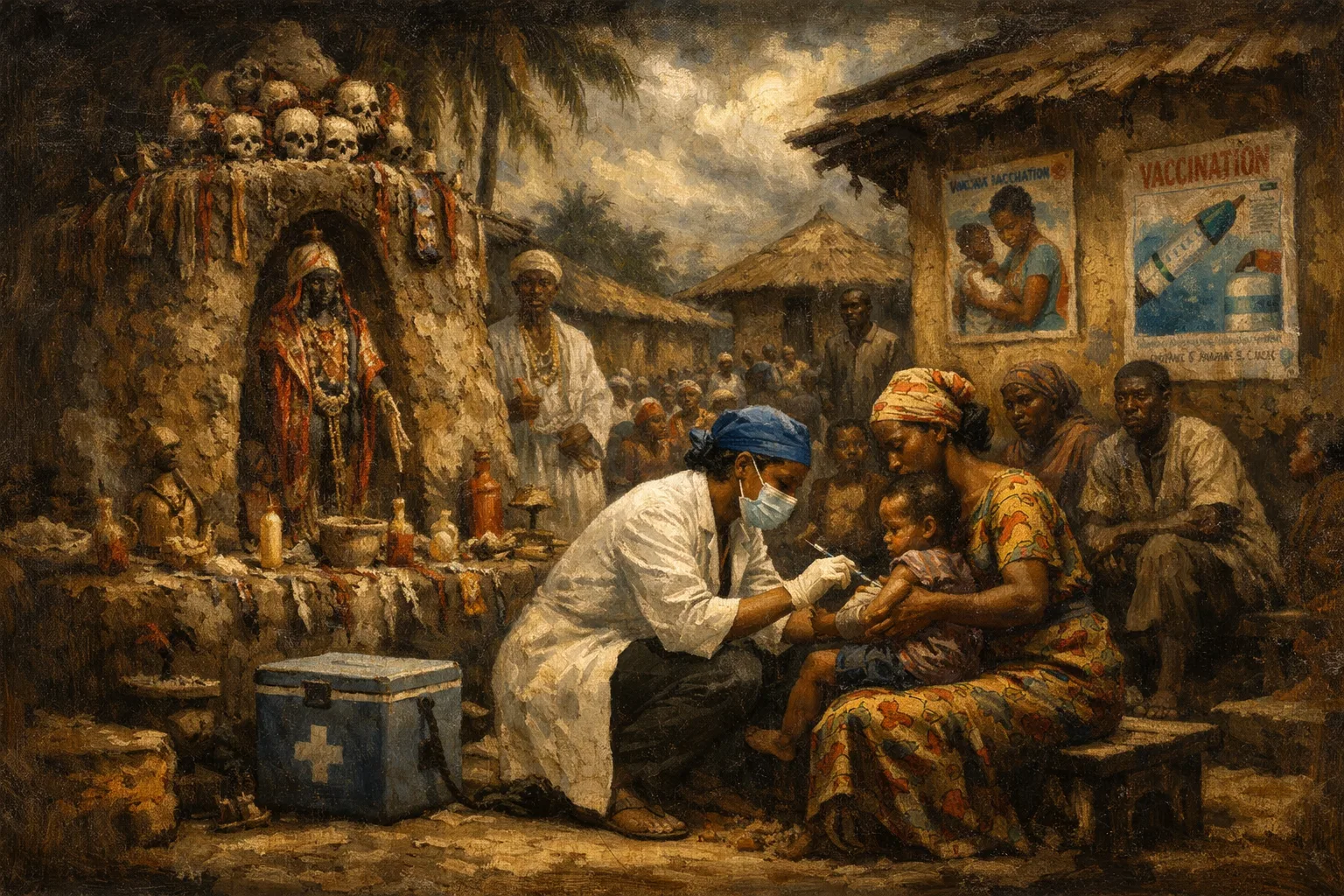
Benin’s history of collective fear is not dominated by one famous “mass hysteria” episode. Its most important cases are better understood as recurring struggles over witchcraft, dangerous births, epidemic disease and religious authority.
Page outline Jump by section
Introduction
These cases should not be collapsed into a story about irrational crowds. They arose where illness, bereavement, political upheaval and limited access to reliable institutions created an urgent demand for explanations. Nor should Benin’s Vodun traditions be treated as synonymous with witchcraft. Practitioners themselves strongly reject that stereotype, and modern Benin legally protects religious freedom while publicly celebrating traditional religion.[nih.gov]pubmed.ncbi.nlm.nih.govcult priests play a leading role in making diagnoses and prescribing remedies, mostly based on medicinal plants. The prominence of Sakpat…
Why “cult” and “mass hysteria” can mislead
Older colonial and missionary accounts commonly described African religious organisations as “cults”, “fetishism” or superstition. Those labels often told readers more about European attitudes than about the communities being described. In modern religious studies, a cult can simply mean an organised body devoted to a particular sacred being. In popular speech, however, it suggests manipulation, isolation and abuse. Applying that modern meaning to every Vodun temple, healing society or initiation group would be inaccurate.
“Mass hysteria” is also too broad for most Beninese examples. The term is properly associated with shared symptoms or behaviour spreading through a group without an identified infectious or toxic cause. There is little strong evidence for a well-documented Beninese equivalent of the classic school fainting or factory illness outbreak. Benin’s better-attested cases concern moral panic and witch-hunting: communities or governments accepting that hidden enemies are causing illness and misfortune, then authorising specialists to expose them.
Several different processes therefore need to be kept separate:
- Vodun religion: a varied body of worship, healing, divination and community ritual, not a single secret organisation.
- Witchcraft belief: an explanation that hidden human agency has caused sickness, death or failure.
- Anti-witchcraft movements: organisations promising to detect, neutralise or protect against such threats.
- Persecution: punishment of people accused of possessing harmful powers.
- State panic: political authorities turning fears of occult enemies into an official campaign.
- Harmful birth beliefs: the classification of particular newborns as supernatural dangers.
The distinctions matter because a community may regard witchcraft as real while opposing accusations, or participate in Vodun ceremonies without accepting the authority of a witch-finder. Anthropological work in southern Benin describes supernatural power as morally ambiguous rather than simply evil: power may protect, heal or punish, depending on its purpose and use.[google.com]books.google.comGoogle BooksWitchcraft, Vodun, and Healing in Southern Benin27 Nov 2018 — Beninese people's discourse about such mystical confrontations…

Smallpox, Sakpata and the search for control
Before vaccination and modern epidemiology, smallpox was both physically devastating and difficult to predict. Fever could be followed by an eruption of painful lesions, permanent scarring, blindness or death. An apparently healthy settlement might suddenly face an outbreak, while neighbouring households escaped. In such circumstances, attributing the disease to a powerful spiritual agent offered more than a supernatural explanation: it provided rules, specialists and possible courses of action.
In nineteenth-century Dahomey, the kingdom occupying much of southern modern Benin, smallpox was closely associated with Sakpata, a divinity connected with the earth and epidemic disease. Historian Elisée Soumonni argues that Sakpata’s religious organisation became intertwined with Dahomey’s political history. Priests diagnosed cases, prescribed plant-based treatments and directed ritual responses. Their role combined what modern readers might divide into medicine, public health, religion and social authority.[PubMed]pubmed.ncbi.nlm.nih.govcult priests play a leading role in making diagnoses and prescribing remedies, mostly based on medicinal plants. The prominence of Sakpat…
This was not simply a panic in which frightened people abandoned reason. Herbal knowledge, isolation practices and restrictions on movement could sometimes have practical value, even when the stated explanation involved divine agency. At the same time, religious control over diagnosis could create fear of priestly power. If an outbreak was interpreted as punishment, questions followed about who had violated a prohibition, offended the divinity or concealed wrongdoing.
Royal authorities also had reasons to regulate Sakpata’s representatives. An institution able to explain epidemics, command obedience and mobilise frightened communities possessed political influence. The resulting tension was not “science versus superstition” in a simple sense. It was a contest over who could define danger and who had the authority to manage it.
The arrival of European medicine did not instantly displace these systems. Vaccination had to compete with distrust of colonial officials, uneven availability and local therapeutic knowledge. People could adopt an injection while continuing to interpret the epidemic through Sakpata, or consult both a clinic and a religious healer. This layering of explanations remains important when studying epidemic fears: new medical ideas usually enter an existing moral world rather than replacing it overnight.
Anti-witchcraft movements promised safety—and generated suspicion
From the late nineteenth century onwards, anti-witchcraft religious movements travelled through parts of present-day Ghana, Togo, Benin and Nigeria. They offered protection against invisible attack, misfortune and unexplained death. In Benin, Tron became a broad name for several such organisations rather than one centrally controlled church. Scholar Emmanuelle Kadya Tall describes these movements as products of both local religious innovation and encounters with Christianity, Islam and neighbouring ritual traditions.[Cambridge University Press & Assessment]cambridge.orgCambridge University Press & AssessmentPORTRAIT OF A VODUN LEADER IN PRESENT-DAY BENINby EK Tall · 2014 · Cited by 13 — In this paper, th…
Their appeal is understandable. A household suffering repeated illness, infertility, business failure or premature deaths might feel that ordinary remedies had failed. An anti-witchcraft shrine promised a stronger diagnosis: the misfortunes were linked, an aggressor could be identified, and ritual protection was available.
These movements could reduce fear by offering oaths, medicines, purification and rules against harmful conduct. Yet the same system could increase anxiety. Once a specialist claimed that hidden witches were active, almost any ambiguous event became evidence: a quarrel before a death, an elderly relative’s resentment, an unusual dream or a neighbour’s success. The promise of certainty encouraged people to reinterpret previous conflicts as occult attacks.
Witch-finding also gave authority to whoever controlled the test or oracle. Those identified might face demands for confession, payments, public humiliation or expulsion. Even where leaders concealed names and emphasised protection rather than punishment, the movement’s existence reinforced the belief that secret attackers were everywhere. Tall’s research notes that some modern Beninese anti-witchcraft leaders deliberately keep alleged identities hidden, suggesting awareness that open naming can provoke retaliation.[HAL Science]hal.scienceOpen source on hal.science.
This produces a familiar paradox in the history of moral panics. The institution established to suppress a threat becomes one of the main ways the threat is publicised, classified and reproduced. Every successful protection ritual appears to confirm the danger; every new misfortune suggests that stronger enemies remain at work.
Anti-witchcraft movements were also transregional. Ritual objects, techniques and reputations crossed colonial borders more easily than official administrations did. A shrine’s foreign origin could increase its prestige because distance implied access to unfamiliar powers. The story therefore belongs not only to Benin but to a wider corridor of religious exchange around the Gulf of Guinea.
When the revolutionary state hunted “evil”
Benin’s clearest state-driven witch panic occurred during the rule of Mathieu Kérékou. After taking power in 1972 and adopting Marxism-Leninism, his government presented itself as a force of modernisation. Traditional authorities and religious specialists could be described as remnants of feudalism, obstacles to progress or exploiters of public credulity.
From the mid-1970s, the government launched a campaign against what it called obscurantism, witchcraft and harmful religious practices. The apparent aim was to eliminate fear of supernatural power. In practice, the campaign encouraged searches for the very witches whose existence revolutionary ideology was supposed to dismiss. Researcher Maartje van den Berg describes the result as state-sponsored witch-hunting: officials used occult accusations to define enemies of national progress while cooperating with selected religious specialists who claimed the ability to identify them.[brill.com]brill.comOpen source on brill.com.
The contradiction was striking. A modernising state announced that witchcraft was backward or unreal, yet behaved as though witches posed a genuine national-security problem. By licensing approved witch-finders, it gave official weight to accusations. Political dissent, local feuds and personal grievances could be expressed in the language of supernatural sabotage.
The campaign shows how a moral panic can operate without sensationalist newspapers or spontaneous crowds. Government speeches, administrative orders, public meetings and official investigations can perform the same amplifying role. Once “evil” becomes an elastic political category, evidence is difficult to test. Failure to meet agricultural targets, unexplained illness or resistance to state policy may all be blamed on hidden enemies.
Economist and sociologist Dirk Kohnert concluded that political anti-witchcraft campaigns of this kind were counterproductive. Instead of weakening occult belief, state intervention strengthened it by treating supernatural accusations as administratively meaningful.[Ssoar]ssoar.infoOpen source on ssoar.info.
The campaign also blurred the distinction between suppressing harmful conduct and persecuting a religion. Some practices could involve coercion, fear or financial exploitation. But a blanket attack on traditional religion threatened healers, priests and community leaders regardless of whether they had harmed anyone. The state’s categories were ideological and unstable, allowing religious practice, political opposition and alleged sorcery to merge into one suspect field.

The “witch child” fear in northern Benin
The most serious continuing harm associated with supernatural fear in Benin concerns children classified as dangerous because of the circumstances of their birth or development. Reports from northern districts describe babies being labelled “witches”, cursed or abnormal if they were born feet-first, born prematurely, developed teeth in an unexpected order, had a disability, or were associated with the mother’s death in childbirth. The precise criteria vary between communities and reports.[reliefweb.int]reliefweb.intbenin fears witchcraft lead widespread infanticide remote northbenin fears witchcraft lead widespread infanticide remote north
The underlying belief is not usually that an infant has deliberately chosen evil. Rather, the child is considered a sign or carrier of disorder whose continued presence may bring death, infertility, poor harvests or other calamity upon the family. That distinction helps explain the practice, but it does not reduce the harm. Children have reportedly been abandoned, handed to intermediaries or killed.
Reliable national totals are unavailable. The acts may occur privately, births may not be formally registered, and families have strong reasons not to report them. This makes sensational numerical claims unsafe. What is well established is that international and local organisations have repeatedly raised the issue. During Benin’s United Nations human-rights reviews, civil-society groups called for implementation of the 2015 Children’s Code and stronger action against the killing of so-called witch children.[OHCHR]ohchr.orghuman rights council adopts universal periodic review outcomes beninwitch children” in Benin. International Catholic Child Bureau, in a… children being accused of witchcraft. The Government was…Read…
The fear persists because it connects several pressures:
Maternal and infant mortality. Where childbirth is dangerous, families repeatedly encounter deaths that demand explanation. A child born during a medical emergency may become associated with the tragedy.
Limited access to maternity care. Home births and weak birth registration make it easier for harmful decisions to remain hidden. More contact with trained health workers can create opportunities to protect the baby and explain unusual deliveries medically.
Disability stigma. Congenital differences or atypical development may be interpreted as signs that the child belongs outside the human social order.
Family insecurity. Poverty and fear of future medical costs can make a supernatural explanation serve as a justification for abandonment.
Community enforcement. Parents may fear that keeping a suspect child will expose the wider household to blame if another misfortune occurs.
The response has included rescue centres, community education, maternity services and legal reform. Some religious workers and local campaigners have taken endangered children into care. This work can save lives, although it requires sensitivity: presenting whole ethnic or rural communities as barbaric may deepen mistrust and drive the practice further underground.
It is also misleading to merge these birth-based classifications with every African case of children accused by revivalist churches. Elsewhere, older children may be blamed for a relative’s unemployment or illness and subjected to paid exorcisms. Benin has experienced wider Christian and anti-witchcraft influences, but the northern newborn cases have a particular history linked to birth circumstances and ideas about social order. UNICEF’s regional study accordingly distinguishes several types of child-witchcraft accusation rather than treating them as one uniform phenomenon.[UNICEF]unicef.orgChildren Accused of WitchcraftChildren Accused of Witchcraft
Vodun is not the panic
Perhaps the largest misconception is that Benin’s history of witchcraft scares reveals the true nature of Vodun. It does not. Vodun encompasses relationships with divinities, ancestors, landscapes, healing, divination, initiation and community responsibility. Witchcraft may exist within the religious universe as a feared misuse of power, but it is not a synonym for the religion itself.
Popular Western images have often reduced Vodun to dolls, curses and possession. These representations grew from colonial literature, horror entertainment and misunderstandings of Caribbean religions descended partly from West African traditions. At Benin’s modern Vodun Days festival, priests and organisers explicitly challenge such portrayals, describing the religion as a way of relating to nature and the surrounding world rather than a system for harming enemies.[Reuters]reuters.comModeste Zinsou, manager of the Python Temple and a practitioner, emphasizes that voodoo is about spirituality, not the commonly misconcei…
The political reversal since the Kérékou era is therefore significant. Benin’s 1990 Constitution protects freedom of conscience and religion within a secular state. During the democratic period, traditional religion was rehabilitated as national heritage, and an annual public celebration developed in Ouidah. The 2013 census recorded 11.6 per cent of the population as Vodun practitioners, although formal affiliation understates the degree to which people combine traditional observances with Christianity or Islam.[constituteproject.org]constituteproject.orgBenin 1990Constitute ProjectBenin 1990 ConstitutionEvery person has the right to freedom of thought, of conscience, of religion, of creed, of opini…
This public recognition does not mean that every practice attributed to tradition is beyond criticism. Religious freedom cannot excuse assault, child killing or coercive accusation. The important principle is to judge documented acts rather than criminalising an entire belief system. Benin’s history shows what happens when authorities fail to make that distinction.
What the evidence supports—and what it does not
The strongest evidence supports a history of contagious accusation, not a catalogue of mysterious collective illnesses. Epidemics, sudden deaths and political crises repeatedly produced demand for specialists who could identify hidden causes. Priests, healers, anti-witchcraft leaders and state officials sometimes calmed fear, but they could also amplify it by validating the presence of secret enemies.
Several conclusions follow.
First, witchcraft panics were rarely random eruptions. They grew from recognisable pressures: infectious disease, unsafe childbirth, bereavement, economic insecurity, rivalry and political upheaval. Supernatural explanations made these events morally intelligible, turning accident into intention.
Second, accusation followed power. People with authority to diagnose danger—royal officials, shrine leaders, revolutionary administrators or family elders—could direct suspicion towards weaker people. Children were particularly defenceless, while other targets could include socially isolated relatives or political opponents.
Third, suppression could strengthen belief. Kérékou’s campaign publicly condemned occult thinking but institutionalised a hunt for occult enemies. Colonial and missionary attacks on traditional religion likewise helped create a defensive field in which secrecy and spiritual resistance acquired greater importance.
Fourth, religious change did not replace one complete worldview with another. Christianity, Islam, Vodun, biomedical treatment and anti-witchcraft practice have often overlapped. A person may attend church, seek hospital treatment and consult a diviner without experiencing those choices as mutually exclusive.
Finally, later storytelling has exaggerated some elements while obscuring others. “Voodoo terror” makes an easy headline, but it conceals the political history of state witch-hunting and the practical roles of healing institutions. Conversely, romantic celebrations of spiritual heritage can overlook the real victims of accusations. A responsible account must hold both truths together: Benin’s religious traditions are culturally rich and historically misrepresented, while particular fear-driven practices have caused grave harm.
Why this history still matters
Benin offers a valuable example of how collective belief becomes dangerous not merely because people accept supernatural ideas, but because an institution turns those ideas into accusations. Fear becomes persecution when someone is authorised to name the source of misfortune and the alleged culprit has no safe means of appeal.
The country’s experience also challenges the familiar contrast between traditional superstition and modern government. A revolutionary administration claiming scientific authority produced one of Benin’s most organised witch-hunts. Meanwhile, traditional healers could sometimes provide care, social support and practical knowledge during epidemics. Institutions must therefore be judged by what they do, not simply by whether they describe themselves as modern, religious or scientific.
Today, constitutional religious freedom and the public rehabilitation of Vodun represent a rejection of blanket cultural persecution. Child-protection campaigning addresses a different problem: the need to intervene decisively when supernatural classification threatens a child’s life. The two goals are compatible. Protecting a religion from hostile stereotyping does not require protecting violence, and opposing violence does not require portraying an entire country’s spiritual heritage as a panic or a “cult”.
Amazon book picks
Further Reading
Books and field guides related to When Fear, Faith and Power Collided in Benin. Use these as the next step if you want deeper reading beyond the article.
African Religions A Very Short Introduction
Explains indigenous belief systems often misunderstood by colonial authorities.
The fate of Africa
Places Benin's political and social developments in wider African history.
In sorcery's shadow
Explores West African beliefs about sorcery, religion and social power.

The spirits and the law
Examines legal and social responses to spiritual accusations in the region.
Endnotes
1.
Source: ohchr.org
Title: human rights council adopts universal periodic review outcomes benin
Link:https://www.ohchr.org/en/press-releases/2018/03/human-rights-council-adopts-universal-periodic-review-outcomes-benin
Source snippet
witch children” in Benin. International Catholic Child Bureau, in a... children being accused of witchcraft. The Government was...Read...
2.
Source: reuters.com
Link:https://www.reuters.com/world/africa/benin-festival-seeks-dispel-voodoo-stereotypes-2025-01-14/
Source snippet
Modeste Zinsou, manager of the Python Temple and a practitioner, emphasizes that voodoo is about spirituality, not the commonly misconcei...
3.
Source: books.google.com
Link:https://books.google.com/books/about/African_Science.html?id=0S93DwAAQBAJ
Source snippet
Google BooksWitchcraft, Vodun, and Healing in Southern Benin27 Nov 2018 — Beninese people's discourse about such mystical confrontations...
4.
Source: cambridge.org
Link:https://www.cambridge.org/core/journals/africa/article/on-representation-and-power-portrait-of-a-vodun-leader-in-presentday-benin/26E0D49FA664763F014DD9A7A717A7AB
Source snippet
Cambridge University Press & AssessmentPORTRAIT OF A VODUN LEADER IN PRESENT-DAY BENINby EK Tall · 2014 · Cited by 13 — In this paper, th...
5.
Source: hal.science
Link:https://hal.science/hal-01435644v1/document
6.
Source: brill.com
Link:https://brill.com/view/journals/jra/41/1/article-p4_2.xml?language=de&result=1&rskey=2EjiQu&srsltid=AfmBOopYW8c7uTJe1gIR9qXlMnnfJpnOVXsKnpElEDCATFQgvTwhyuJo
7.
Source: researchgate.net
Link:https://www.researchgate.net/publication/233545781_Policing_Evil%27_State-sponsored_Witch-hunting_in_the_People%27s_Republic_of_Benin
8.
Source: ssoar.info
Link:https://www.ssoar.info/ssoar/bitstream/handle/document/55638/ssoar-worlddevelopment-1996-8-kohnert-Magic_and_Witchcraft_Implications_for.pdf?isAllowed=y&sequence=1
9.
Source: reliefweb.int
Title: benin fears witchcraft lead widespread infanticide remote north
Link:https://reliefweb.int/report/benin/benin-fears-witchcraft-lead-widespread-infanticide-remote-north
10.
Source: ohchr.org
Link:https://www.ohchr.org/en/press-releases/2009/10/human-rights-council-concludes-general-debate-promotion-civil-political
11.
Source: ohchr.org
Title: AHRC229 English
Link:https://www.ohchr.org/Documents/HRBodies/HRCouncil/RegularSession/Session22/AHRC229_English.PDF
12.
Source: unicef.org
Title: Children Accused of Witchcraft
Link:https://www.unicef.org/nigeria/media/1326/file/%20Children-accused-of-witchcraft-in-Africa.pdf.pdf
13.
Source: state.gov
Link:https://www.state.gov/reports/2022-report-on-international-religious-freedom/benin
14.
Source: researchgate.net
Title: 399408606 African Science Witchcraft Vodun and Healing in Southern Benin
Link:https://www.researchgate.net/publication/399408606_African_Science_Witchcraft_Vodun_and_Healing_in_Southern_Benin
15.
Source: researchgate.net
Title: 262444119 Disease religion and medicine smallpox in nineteenth century Benin
Link:https://www.researchgate.net/publication/262444119_Disease_religion_and_medicine_smallpox_in_nineteenth-century_Benin
16.
Source: researchgate.net
Link:https://www.researchgate.net/publication/231979854_Witchcraft_anti-witchcraft_and_trans-regional_ritual_innovation_in_early_colonial_Ghana_Sakrabundi_and_Aberewa
17.
Source: researchgate.net
Link:https://www.researchgate.net/publication/265897981_On_representation_and_power_portrait_of_Vodun_leader_in_present-day_in_Benin
18.
Source: researchgate.net
Title: 407708841 Yoruba Pentecostalism and Child Witchcraft Accusations
Link:https://www.researchgate.net/publication/407708841_Yoruba_Pentecostalism_and_Child_Witchcraft_Accusations
19.
Source: 2009-2017.state.gov
Link:https://2009-2017.state.gov/documents/organization/171600.pdf
20.
Source: ohchr.org
Link:https://www.ohchr.org/sites/default/files/2022-12/PAP-Guidelines-EN.pdf
21.
Source: ohchr.org
Title: witchcraft beliefs triggers attacks against people albinism un expert warns
Link:https://www.ohchr.org/en/press-releases/2016/03/witchcraft-beliefs-triggers-attacks-against-people-albinism-un-expert-warns
22.
Source: ohchr.org
Title: committee rights child examines report ghana
Link:https://www.ohchr.org/en/press-releases/2015/05/committee-rights-child-examines-report-ghana
23.
Source: ohchr.org
Link:https://www.ohchr.org/Documents/HRBodies/CEDAW/HarmfulPractices/PlanInternational.pdf
24.
Source: tbinternet.ohchr.org
Title: Download Draft.aspx
Link:https://tbinternet.ohchr.org/_layouts/15/TreatyBodyExternal/DownloadDraft.aspx?key=xCQkR9Xbd2x8URs3wBWcM9hmsNjODabyLD39zVlGKz9l%2FboPvByrX+Da24ijAXWT
25.
Source: ohchr.org
Title: HR PUB 16 2 HR and Traditional Justice Systems in Africa
Link:https://www.ohchr.org/sites/default/files/Documents/Publications/HR%20PUB_16_2_HR_and_Traditional_Justice_Systems_in_Africa.pdf
26.
Source: docstore.ohchr.org
Title: Files Handler.ashx
Link:https://docstore.ohchr.org/SelfServices/FilesHandler.ashx?enc=S4YVTBTmHZ%2BYQFm11QzBd%2BBHus910mXTSucF7ABaH3CATL7nSFxSsG97fYDb25px5Yc86kn9pAZpSbEqOcMc8A%3D%3D
27.
Source: ohchr.org
Title: les droits de lhomme sont le levier pour sauver le programme de
Link:https://www.ohchr.org/en/meeting-summaries/2023/03/les-droits-de-lhomme-sont-le-levier-pour-sauver-le-programme-de
28.
Source: brill.com
Link:https://brill.com/downloadpdf/book/9789004341258/B9789004341258_003.pdf?srsltid=AfmBOoql8EkyqgjpwLpeLQzCAN6QSmVgdHkzzLz7Ar05yMbQqVi3HBhY
29.
Source: referenceworks.brill.com
Title: COM 00000011.xml
Link:https://referenceworks.brill.com/display/entries/ELRO/COM-00000011.xml?language=en
30.
Source: cambridge.org
Link:https://www.cambridge.org/core/books/precolonial-state-in-west-africa/dahomey-and-the-royal-palace-sphere/DA7C55D20CD20F61D1F8EB262C36C2D9
31.
Source: pubmed.ncbi.nlm.nih.gov
Link:https://pubmed.ncbi.nlm.nih.gov/23370098/
Source snippet
cult priests play a leading role in making diagnoses and prescribing remedies, mostly based on medicinal plants. The prominence of Sakpat...
32.
Source: constituteproject.org
Title: Benin 1990
Link:https://www.constituteproject.org/constitution/Benin_1990
Source snippet
Constitute ProjectBenin 1990 ConstitutionEvery person has the right to freedom of thought, of conscience, of religion, of creed, of opini...
33.
Source: thenewhumanitarian.org
Title: benin sorcery linked infanticides persist north
Link:https://www.thenewhumanitarian.org/report/83149/benin-sorcery-linked-infanticides-persist-north
34.
Source: thenewhumanitarian.org
Title: rights child witchcraft allegations rise
Link:https://www.thenewhumanitarian.org/report/89858/rights-child-witchcraft-allegations-rise
35.
Source: pmc.ncbi.nlm.nih.gov
Link:https://pmc.ncbi.nlm.nih.gov/articles/PMC12860665/
36.
Source: aceproject.org
Link:https://aceproject.org/ero-en/regions/africa/BJ/benins-constitution-1990/at_download/file
37.
Source: franciscansinternational.org
Title: UNICEF infanticide Benin
Link:https://franciscansinternational.org/wp-content/uploads/2023/02/UNICEF_infanticide_Benin.pdf
38.
Source: sajp.org.za
Link:https://sajp.org.za/index.php/sajp/article/view/1671/2648
39.
Source: ebsco.com
Link:https://www.ebsco.com/research-starters/social-sciences-and-humanities/mass-hysteria
40.
Source: healthline.com
Title: mass hysteria
Link:https://www.healthline.com/health/mental-health/mass-hysteria
41.
Source: journeysbydesign.com
Link:https://journeysbydesign.com/destinations/benin
42.
Source: rightspedia.org
Link:https://www.rightspedia.org/Benin
Additional References
43.
Source: apnews.com
Link:https://apnews.com/article/df831990ce900c99b927c75e7179e461
Source snippet
Vodún, deeply rooted in Beninese society, emphasizes a spiritual connection to nature and plays a central role in communal identity. Desp...
44.
Source: youtube.com
Title: The Secret Of Zangbeto Voodoo Dance
Link:https://www.youtube.com/watch?v=sp6QDP_FtFU
Source snippet
4 The Secret Inside Zangbeto Revealed What They've Hidden for Centuries...
45.
Source: waunet.org
Title: World Anthropological Union
Link:https://www.waunet.org/wcaa/archive/downloads/wcaa/dejalu/dejalu10/Anthropological%20Forum.pdf
Source snippet
WAURace and the Other in Beninese Witchcraftby DJ Falen · 2020 · Cited by 11 — Although Beninese take pride in their own indigenous witch...
46.
Source: m.youtube.com
Title: The Secret Inside Zangbeto Revealed What They’ve Hidden for Centuries
Link:https://m.youtube.com/watch?v=0T-GVALDoJI
Source snippet
5 i Was Beaten by A Voodoo Spirit For Exposing The TRUTH About Extreme Rituals: Voodoo | Benin...
47.
Source: youtube.com
Title: Voodoo festival in Benin
Link:https://www.youtube.com/watch?v=1pX-mLRKf1c
Source snippet
3 The Secret Of Zangbeto Voodoo Dance - Benin's Spiritual Guardianship In Meko Village, Ouidah...
48.
Source: academia.edu
Link:https://www.academia.edu/16271106/The_Good_the_Bad_and_the_Ambiguous_Vodun_and_Development_in_Benin
49.
Source: academia.edu
Link:https://www.academia.edu/44420231/Gorovodu_The_Genesis_of_a_Hausa_Vodun_
50.
Source: sahistory.org.za
Link:https://sahistory.org.za/place/benin
51.
Source: facebook.com
Link:https://www.facebook.com/cgtnafrica/posts/benin-holds-the-vodun-day-celebrations-every-january-attracting-visitors-from-ac/1348592467307134/
52.
Source: cath.ch
Link:https://cath.ch/newsf/benin-un-pretre-veut-lutter-contre-le-sacrifice-de-bebes
Topic Tree
Follow this branch
Related pages 192
- Antigua and Barbuda
- Argentina Belief Scares
- Azerbaijan Belief
- Bahrain Beliefs
- North Korea
- +187 more in sidebar