Within Rwanda
How Propaganda Made Genocide Seem Defensive
Extremist leaders turned rumours, racist history and repeated warnings into a campaign that made organised killing appear defensive.
On this page
- The myth of an existential Tutsi threat
- Radio, newspapers and repeated dehumanisation
- Why organised violence was not mass hysteria
Page outline Jump by section
Introduction
Before and during the 1994 genocide against the Tutsi in Rwanda, extremist political leaders did not simply exploit existing fear: they systematically manufactured it. Through newspapers, radio broadcasts, speeches, local officials and militia networks, they promoted the false claim that all Tutsi civilians formed part of an existential conspiracy to destroy the Hutu majority. By presenting planned mass murder as pre-emptive self-defence, this propaganda helped create the conditions in which genocide became possible.
Understanding this process is essential because it explains why the violence should not be described as spontaneous “mass hysteria”. Historians, legal investigators and the International Criminal Tribunal for Rwanda (ICTR) have instead shown that fear was deliberately cultivated, repeated and organised. The propaganda campaign did not merely express hatred; it encouraged, coordinated and legitimised killing through carefully constructed narratives of imminent danger.[ICRC Casebook]casebook.icrc.orgCasebook ICTR, The Media Case | How does law protect in war?ICRC CasebookICTR, The Media Case | How does law protect in war? - Online casebookDecember 3, 2003…
The myth of an existential Tutsi threat
The central message of extremist propaganda was that the Tutsi population posed a mortal danger to Rwanda. This narrative drew on several different themes.
First, propagandists deliberately blurred the distinction between the armed Rwandan Patriotic Front (RPF), which invaded Rwanda from Uganda in 1990, and ordinary Tutsi civilians. Instead of recognising that many Tutsi had no connection with the rebel movement, propaganda portrayed the entire ethnic group as a hidden military force or “internal enemy”. Any Tutsi neighbour could therefore be presented as a future attacker rather than a civilian.
Secondly, decades of colonial racial thinking and earlier ethnic violence were selectively rewritten into a story of permanent Tutsi domination. Extremist newspapers and broadcasters claimed that Hutu people faced extermination or re-enslavement unless they acted first. These claims ignored political realities but proved emotionally powerful because they mixed genuine memories of conflict with fabricated warnings about an imminent catastrophe.[ICRC Casebook]casebook.icrc.orgCasebook ICTR, The Media Case | How does law protect in war?ICRC CasebookICTR, The Media Case | How does law protect in war? - Online casebookDecember 3, 2003…
This framing transformed offensive violence into supposed self-defence. Rather than openly arguing that innocent people should be murdered, propagandists insisted that killing was necessary to prevent an imagined genocide against Hutu. Modern genocide scholars regard this inversion of victim and aggressor as one of the defining features of genocidal propaganda.
Radio, newspapers and repeated dehumanisation
The propaganda campaign worked because it appeared through many channels simultaneously rather than relying on a single speech or publication.
The newspaper Kangura became one of the earliest and most influential voices of the extremist “Hutu Power” movement. It repeatedly warned readers that Tutsi were infiltrating government, society and families in preparation for domination. Its notorious “Ten Hutu Commandments” encouraged social separation, portrayed cooperation with Tutsi as betrayal and normalised exclusion years before the genocide began.[UNICTR]unictr.irmct.orgOpen source on irmct.org.
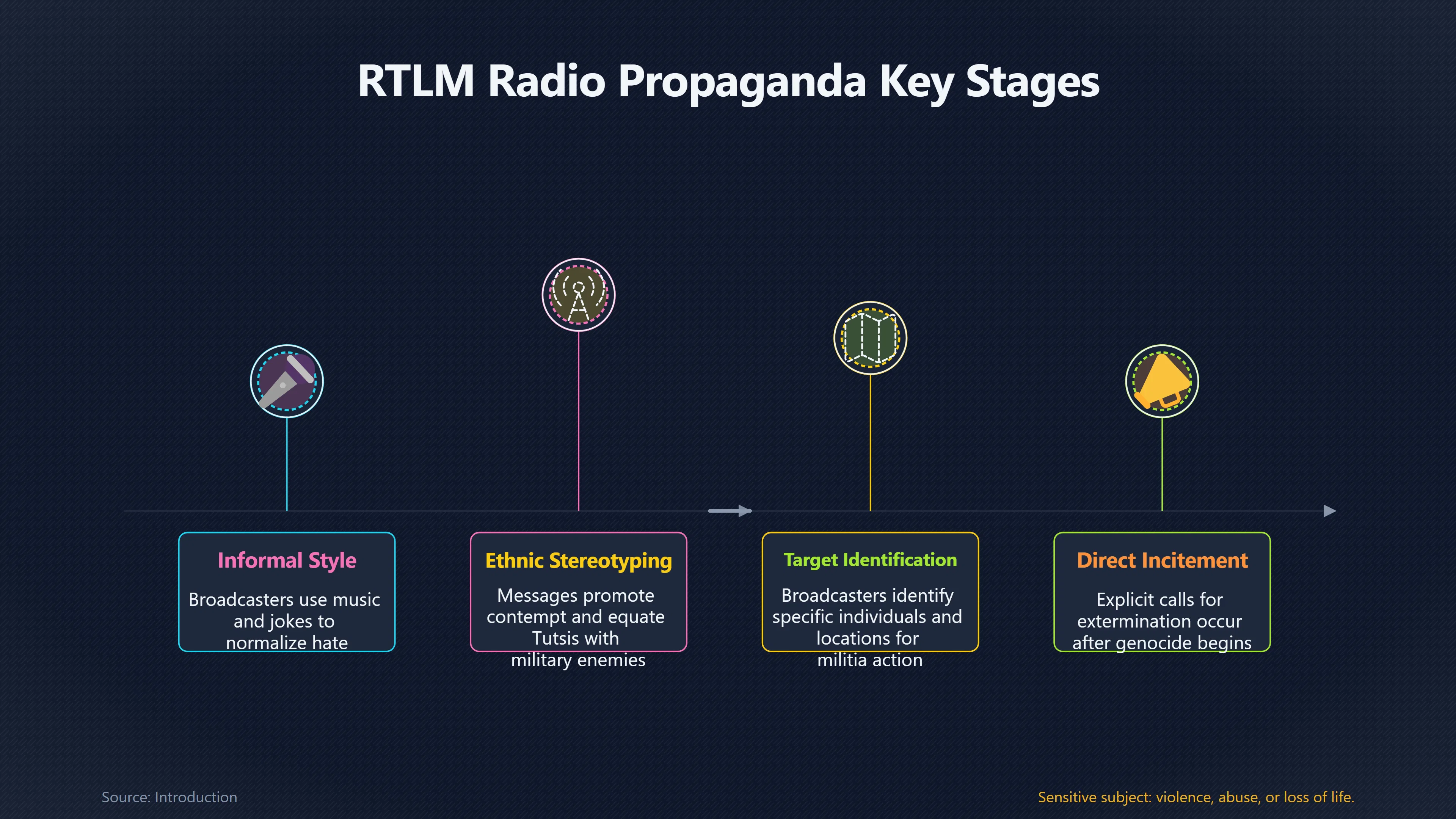
Radio proved even more influential. Radio Télévision Libre des Mille Collines (RTLM), founded in 1993, adopted an informal, entertaining style that made political messaging appear conversational rather than official. Listeners heard music, jokes and sports alongside increasingly extreme political commentary. This mixture helped normalise hateful messages through repetition.
The ICTR found that RTLM broadcasts:
- promoted ethnic stereotyping and contempt for Tutsi people;
- repeatedly equated all Tutsi with the military enemy;
- encouraged listeners to arm themselves;
- identified individuals by name and location;
- urged militias and civilians to hunt people in hiding; and
- explicitly called for the extermination of the Tutsi population after the genocide began.[ICRC Casebook]casebook.icrc.orgCasebook ICTR, The Media Case | How does law protect in war?ICRC CasebookICTR, The Media Case | How does law protect in war? - Online casebookDecember 3, 2003…
Dehumanising language formed part of this campaign. Tutsi were repeatedly described with labels that denied their humanity and encouraged listeners to view killing as extermination rather than murder. Historians stress that such language mattered not because insulting words automatically produce violence, but because constant repetition helped remove normal moral barriers against harming neighbours.
How fear was spread through local communities
The effectiveness of the propaganda did not depend solely on newspapers or radio.
Messages circulated through government officials, local administrators, party activists, militia organisations and community meetings. Rumours spread rapidly that hidden weapons caches existed, that Tutsi civilians were preparing coordinated attacks or that delaying action would mean death for Hutu families.
Many of these stories had no factual basis, but they became persuasive because they were repeated through multiple trusted local figures. Hearing identical warnings from broadcasters, officials, neighbours and political leaders created the impression that the threat had been independently confirmed.
This process illustrates an important feature of manufactured collective fear. People often judge information by how frequently and consistently they encounter it rather than by independently verifying it. Repetition across different institutions can therefore create an illusion of overwhelming evidence even when the underlying claims are false.
Why organised violence was not mass hysteria
It is tempting to describe the genocide as an outbreak of collective madness, but this obscures how the violence actually developed.
Mass hysteria or mass psychogenic illness refers to the contagious spread of symptoms or beliefs without deliberate central direction. Rwanda’s genocide followed a very different pattern.
The propaganda campaign involved identifiable organisations, political leaders and media figures who consciously produced and distributed messages designed to mobilise violence. The killings were supported by administrative structures, roadblocks, militia coordination, weapons distribution and local command systems. Fear made participation easier for some perpetrators, but the fear itself was intentionally cultivated rather than spontaneously emerging.
The ICTR’s landmark “Media Case” reflected this distinction. The Tribunal concluded that RTLM broadcasts and Kangura articles were not simply expressions of opinion but constituted direct and public incitement to commit genocide. The court found that broadcasts encouraged listeners to locate victims, identified targets and contributed to killings that followed. Several senior media figures were convicted for genocide-related crimes and incitement.[ICRC Casebook]casebook.icrc.orgCasebook ICTR, The Media Case | How does law protect in war?ICRC CasebookICTR, The Media Case | How does law protect in war? - Online casebookDecember 3, 2003…
Why the propaganda proved persuasive
No single explanation accounts for why so many people accepted extremist narratives. Historians instead point to several reinforcing pressures.
Political instability during the civil war created genuine uncertainty, making fabricated stories easier to believe. State authority gave propaganda institutional credibility, while radio reached audiences across both urban and rural Rwanda. Local officials often echoed the same messages, reinforcing them through face-to-face contact.
Social pressure also mattered. In many communities, refusing to participate in violence or questioning official narratives could expose individuals to intimidation or accusations of sympathising with the enemy. Manufactured fear therefore interacted with coercion, conformity and political organisation rather than replacing them.
This combination helps explain why propaganda alone cannot account for the genocide, yet remains indispensable to understanding how organised killing became publicly justified.
Lasting significance
The Rwandan genocide has become one of the world’s most closely studied examples of how propaganda can transform fabricated threats into justification for mass violence.
Its importance lies not in demonstrating that ordinary people suddenly became irrational, but in showing how sustained campaigns of misinformation, dehumanisation and fear can reshape public perceptions over time. By repeatedly portraying an entire civilian population as an existential danger, extremist leaders reframed genocide as defence, making organised murder appear both necessary and patriotic to many participants.
For this reason, Rwanda is widely studied in history, law, psychology and media studies as an example of manufactured collective fear rather than spontaneous mass hysteria. The case illustrates how propaganda operates not merely by spreading hatred, but by convincing people that extraordinary violence is the only way to survive.[ICRC Casebook]casebook.icrc.orgCasebook ICTR, The Media Case | How does law protect in war?ICRC CasebookICTR, The Media Case | How does law protect in war? - Online casebookDecember 3, 2003…
Amazon book picks
Further Reading
Books and field guides related to How Propaganda Made Genocide Seem Defensive. Use these as the next step if you want deeper reading beyond the article.
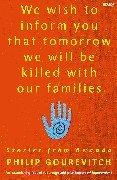
We wish to inform you that tomorrow we will be killed with ou...
Directly addresses propaganda, fear and genocide.
"Leave none to tell the story"
Detailed evidence on planning, propaganda and violence.
Influence
This is a Summary of the original book, Influence: The Psychology of Persuasion by Robert Cialdini.The book is an authoritative work on t...
Endnotes
1.
Source: casebook.icrc.org
Title: Casebook ICTR, The Media Case | How does law protect in war?
Link:https://casebook.icrc.org/case-study/ictr-media-case
Source snippet
ICRC CasebookICTR, The Media Case | How does law protect in war? - Online casebookDecember 3, 2003...
Published: December 3, 2003
2.
Source: unictr.irmct.org
Link:https://unictr.irmct.org/en/news/three-media-leaders-convicted-genocide
3.
Source: unictr.irmct.org
Title: appeals chamber concludes hearing media case
Link:https://unictr.irmct.org/en/news/appeals-chamber-concludes-hearing-media-case
Additional References
4.
Source: ijssr.ridwaninstitute.co.id
Link:https://ijssr.ridwaninstitute.co.id/index.php/ijssr/article/view/359
Source snippet
role of Radio-Télévision Libre des Mille Collines in the Rwandan genocide: An analysis from the theoretical perspectives of intergroup t...
5.
Source: journals.ed.ac.uk
Link:https://journals.ed.ac.uk/ccj/article/view/10257
Source snippet
Role of Hate Speech in Inciting Genocide: A Case Study of Radio Television Libre des Mille Collines in Rwanda | Contemporary Challenges...
6.
Source: hscentre.org
Title: This contributed to a post-colonial precedent of anti-Tutsi propaganda, which w
Link:https://www.hscentre.org/sub-saharan-africa/media-tool-war-propaganda-rwandan-genocide/
Source snippet
The Media as a Tool of War: Propaganda in the Rwandan Genocide - Human Security CentreMay 9, 2014 — Robert Guest[iv] argues that propagan...
Published: May 9, 2014
7.
Source: genocidewatch.com
Title: It was a radio station that disseminated hate propagan
Link:https://www.genocidewatch.com/single-post/2019/04/02/debating-media-s-role-in-driving-rwanda-s-genocide
Source snippet
Debating media’s role in driving Rwanda’s genocideApril 2, 2019 — Hardliners from the party also launched Radio Télévision Libre des Mill...
Published: April 2, 2019
8.
Source: cambridge.org
Link:https://www.cambridge.org/core/journals/law-and-social-inquiry/article/darfur-model-rwanda-and-the-ictr-john-hagans-sociology-of-genocide-continued/CF8F28BB1B950C60F981354BEEF2C5A2
Source snippet
Darfur Model, Rwanda, and the ICTR: John Hagan’s Sociology of Genocide Continued | Law & Social Inquiry | Cambridge CoreNovember 27, 2023...
Published: November 27, 2023
9.
Source: cambridge.org
Title: Incitement to Genocide and the Rwanda Media Case (Chapter 10)
Link:https://www.cambridge.org/core/books/abs/genocide/incitement-to-genocide-and-the-rwanda-media-case/A253C09ABA1FB19D914A2E4E40D0EFBF
Source snippet
One scholar has said that it is rare that there are prosecutions for incitement, but the Rwan...
10.
Source: youtube.com
Title: Not My Words: The Actor Who Carries the Voice of Genocide | United Nations
Link:https://www.youtube.com/watch?v=izDR4W68txE
Source snippet
RTLM Broadcast Excerpt of April 3, 1994 (Death of President was "predicted")...
Published: April 3, 1994
11.
Source: hrw.org
Link:https://www.hrw.org/reports/2004/ij/ictr/3.htm
12.
Source: hrw.org
Link:https://www.hrw.org/legacy/reports/1996/Rwanda.htm
13.
Source: doaj.org
Link:https://doaj.org/article/2da35d06010d45b5993783dce20fd73c
Topic Tree