Belief, Fear and Performance in North Korea
North Korea has few well-documented equivalents of the classic witch panic, dancing plague or school fainting outbreak.
Page outline Jump by section
Introduction
Calling all of this “mass hysteria” would be misleading. North Koreans are not simply a population gripped by irrational enthusiasm. Their behaviour is shaped by surveillance, punishment, genuine socialisation, inherited Korean mourning traditions, personal calculation and, at times, sincere attachment. The clearest examples are the enormous public grief following the deaths of Kim Il-sung and Kim Jong-il, the regime’s use of miracle-like stories about the ruling family, and repeated crackdowns on Christianity, fortune-telling and other practices treated as threats to political loyalty.[asienforschung.de]asienforschung.deNational Loss and the Politics of Mourning in North KoreaMarch 4, 2021 — 16 Apr 2020 — Confucian rites for the dead, Kim Jong Il ordered the people to uphold a three-year mourning period for his…
North Korea is also unusually vulnerable to mythmaking from outside. Because independent access is so limited, doubtful reports about executions, compulsory haircuts and supernatural claims have repeatedly circulated through international media. Understanding the country’s collective-belief history therefore requires two kinds of caution: separating private belief from enforced performance inside North Korea, and separating credible evidence from sensational stories outside it.[The Guardian]theguardian.comThe GuardianMythbusters: help us find the truth about North KoreaApril 22, 2014 — 22 Apr 2014 — Have all North Korean students been requi…
Is North Korea itself a political religion?
North Korea is formally a socialist state, not a religious movement. Nevertheless, scholars, human-rights investigators and former residents have often described its ruling ideology as “quasi-religious” because it surrounds the Kim family with sacred history, ritual obligations, moral commandments and claims to unique wisdom.
Kim Il-sung is presented not merely as a former president but as the founding father of the nation, the source of its liberation and the model of ideal conduct. Official narratives place his family within a heroic revolutionary lineage and associate significant places, especially Mount Paektu, with national destiny. Kim Jong-il’s official life story was similarly woven into a landscape of sacred birth, heavenly signs and revolutionary inheritance. The language is political, but its structure can resemble hagiography: the idealised life of a revered figure retold to establish authority and inspire imitation.[ejournals.eu]ejournals.euTowards a Supernatural PropagandaThe DPRK Myth in…January 8, 2021 — by R Husarski · Cited by 8 — The language of propaganda increasing- ly suggested miraculous and mag…
This system is reinforced through everyday objects and repeated acts. Portraits of the leaders are displayed in homes, schools and workplaces; monuments serve as sites for organised tribute; citizens attend ideological meetings; and major anniversaries are marked by mass ceremonies. Investigations into freedom of religion have argued that such observances are not optional civic customs but part of a political order that punishes insufficient conformity.[uscirf.gov]uscirf.govOpen source on uscirf.gov.
The word “cult” is useful only if handled carefully. “Personality cult” is an established political term for the organised glorification of a ruler. It does not mean that every North Korean privately believes every official claim, nor that the population forms a voluntary sect. The system is better understood as a state-managed culture of reverence operating through education, censorship, ritual, emotional pressure and coercion.
The belief system has also changed rather than remaining frozen. Kim Jong-un initially appeared less frequently in iconography than his father and grandfather, but portraits, badges, monuments and large murals featuring him have become more prominent. By 2026, his individual image was increasingly displayed in ways that placed him alongside, and sometimes visually apart from, his predecessors.[The Times]thetimes.comThe Times North Korea's giant Kim murals take personality cult to new heightsThe Times North Korea's giant Kim murals take personality cult to new heights

Why did entire crowds appear to collapse in grief?
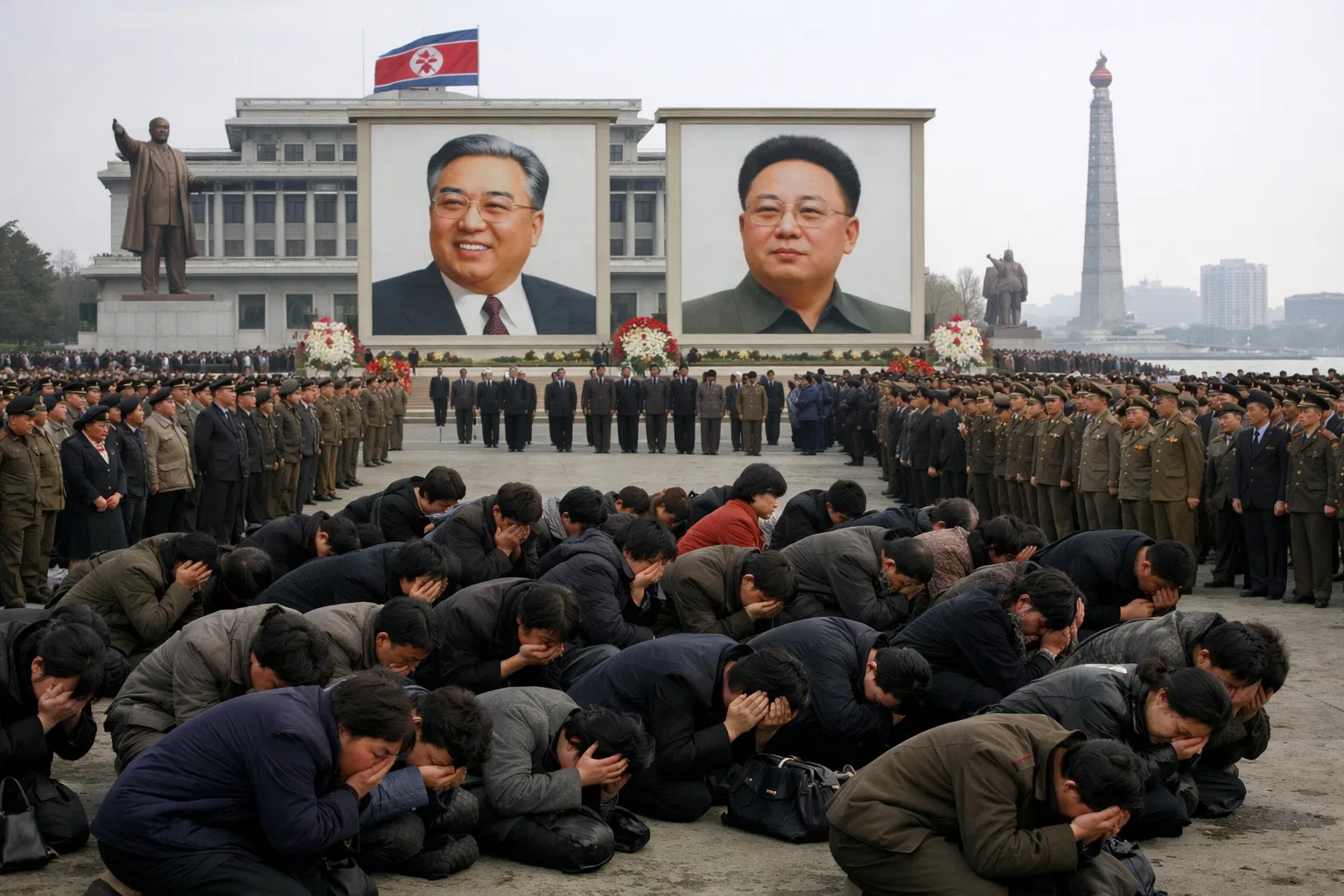
The deaths of Kim Il-sung in July 1994 and Kim Jong-il in December 2011 produced the most famous images of apparently contagious emotion in North Korean history. Television showed crowds sobbing, striking the ground, bending double and crying out in public spaces. To foreign audiences, the scenes looked either like proof of mass indoctrination or an obviously staged performance.
Neither explanation is sufficient on its own.
Public mourning was politically organised. Workplaces, neighbourhood units and other institutions brought people together, while cameras selected scenes that fitted the state’s image of a nation united in bereavement. North Koreans knew that emotional restraint could be interpreted as disloyalty. Under such conditions, visible grief becomes a safety signal: each individual demonstrates loyalty while watching whether others are doing the same.[jstor.org]jstor.orgOpen source on jstor.org.
Yet performance does not prove that all feeling was false. Kim Il-sung had dominated public life for nearly half a century. Many citizens had known no other national leader and had been taught since childhood to regard him as a protective father. Even people who privately resented the government could experience fear, uncertainty or genuine loss when the familiar centre of the political order disappeared.
Korean mourning traditions also matter. Loud lamentation, bodily expressions of sorrow and collective funeral rites have a cultural history that predates North Korea. The regime did not invent public wailing from nothing; it enlarged, organised and politicised familiar forms of grief. Kim Jong-il declared a three-year mourning period after his father’s death, echoing older Confucian expectations surrounding filial duty.[asienforschung.de]asienforschung.deNational Loss and the Politics of Mourning in North KoreaMarch 4, 2021 — 16 Apr 2020 — Confucian rites for the dead, Kim Jong Il ordered the people to uphold a three-year mourning period for his…
The best interpretation is therefore a mixture of cult, culture and coercion. Some mourners may have been sincere, some frightened, some acting, and many experiencing several of these states at once. Collective rituals can also generate real emotion even when participation begins under pressure. Hearing hundreds of people cry, seeing others collapse and knowing that a national crisis is under way can intensify distress through ordinary emotional contagion.
Describing the scenes simply as “fake tears” denies North Koreans emotional complexity. Describing them as spontaneous national devotion ignores the surrounding system of surveillance and punishment.
Miracle stories and the manufacture of sacred history
North Korean propaganda has sometimes attributed extraordinary signs to the ruling family: unusual weather, rainbows, obedient animals or natural events supposedly marking births, deaths and historic achievements. These stories are better classified as state mythology than as evidence of a spontaneous miracle panic.
Their purpose is political. By presenting the leaders as figures whose lives are recognised by nature and history, propaganda moves their authority beyond ordinary government. Loyalty becomes part of the moral order of the universe rather than a temporary political choice. Research on North Korean visual and written culture has noted that this supernatural language became especially prominent as the leadership reinforced national myths following the collapse of the Soviet bloc.[ejournals.eu]ejournals.euTowards a Supernatural PropagandaThe DPRK Myth in…January 8, 2021 — by R Husarski · Cited by 8 — The language of propaganda increasing- ly suggested miraculous and mag…
The stories draw on several traditions at once. They contain traces of Korean sacred geography, family-centred Confucian morality, revolutionary legend and, according to one recent interpretation, patterns inherited from the strong Protestant culture that existed in northern Korea before communist rule. Kim Il-sung grew up in a region where Christianity had substantial influence, and official accounts of sacred mothers, providential births and a redemptive national leader can be read as political adaptations of religious forms. This argument is suggestive rather than universally accepted, especially because North Korean archives remain largely closed.[Financial Times]ft.comFinancial Times Korean MessiahCheng traces this phenomenon back to the late 19th century arrival of American missionaries like Samuel A. Moffett and the subsequent spr…
It is impossible to measure how literally ordinary people accept these claims. Citizens may repeat miracle stories because they believe them, because repetition is expected, because they treat them as patriotic symbolism, or because challenging them would be dangerous. In a closed society, public agreement is poor evidence of private conviction.
Why fortune-telling survives repeated crackdowns
Alongside official ideology, North Korea has a less visible world of fortune-tellers, diviners and informal spiritual practitioners. Their persistence is one of the clearest signs that state indoctrination has never fully erased older patterns of belief.
Fortune-telling reportedly grew during and after the devastating famine of the 1990s. The collapse of dependable food distribution, widespread death, migration and the expansion of unofficial markets left many people facing decisions that could determine whether their families survived. In such conditions, divination offered emotional reassurance and a way of managing uncertainty, even when its predictions could not be verified.[hrnk.org]hrnk.orgOpen source on hrnk.org.
People have reportedly consulted practitioners about marriage, illness, trading, official inspections, possible arrest and the chances of safely crossing the border. Some officials are also said to use such services privately while enforcing prohibitions publicly. This makes the practice more than a survival of “superstition”: it is an informal system for making choices where trustworthy institutions, legal protection and reliable information are weak.
The authorities periodically describe fortune-telling and shamanic practice as antisocialist, fraudulent or politically dangerous. Predictions about the future of the government are especially sensitive because they can turn private anxiety into rumours of collapse or leadership change. Reports of enforcement are difficult to verify independently, but testimony collected over many years consistently indicates arrests and punishment for fortune-telling alongside the persecution of unauthorised religious activity.[nknews.org]nknews.orgNK NewsNK News
Recent reporting suggests that harsher campaigns have driven the trade further underground rather than eliminating demand. This is a familiar pattern in moral panics: official suppression increases secrecy, secrecy increases uncertainty, and uncertainty can make both rumours and specialist intermediaries more valuable.[DailyNK]dailynk.comDaily NKNorth Korea's war on superstition backfires as fortuneDaily NKNorth Korea's war on superstition backfires as fortune
North Korea’s campaign is not a witch hunt in the classic European sense. There is no good evidence of mass village accusations producing widespread trials for supernatural harm. It is closer to an authoritarian campaign against unauthorised knowledge: the state claims the sole right to explain the past, direct the present and predict the future.
Religious minorities as objects of political fear
The persecution of Christians and other independent believers is sometimes described as religious intolerance, but it also functions as a prolonged state security panic. The government presents unauthorised religious networks not merely as theological rivals but as channels for espionage, foreign influence and organised disloyalty.
This fear is partly geopolitical. Protestant networks have operated across the border with China, sometimes helping North Koreans escape or providing outside information and assistance. The regime therefore treats independent worship, foreign contact and political subversion as overlapping dangers. Human-rights investigations describe arrest, imprisonment, torture and severe punishment for clandestine religious activity.[uscirf.gov]uscirf.govOpen source on uscirf.gov.
Calling this a “cult scare” would risk trivialising the victims. There is no evidence that underground believers collectively posed the vast threat claimed by the state. The panic lies in the authorities’ exaggerated interpretation of independent conscience as an existential danger.
The political personality cult and religious repression support one another. A private faith can provide moral authority outside the ruling family, a community outside state organisations and stories about history that the government does not control. In an ordinary political system, these differences need not be threatening. In North Korea, where ideological unity is treated as a condition of national survival, even small autonomous groups can be portrayed as agents of contamination.
Famine, markets and the power of rumour
Rumour becomes socially powerful when official information is both untrustworthy and dangerous to question. North Korea’s famine of the 1990s created precisely those conditions.
The government publicly framed the crisis as an “Arduous March”, invoking revolutionary endurance rather than openly acknowledging political and economic failure. At the same time, the public food-distribution system broke down across much of the country. People increasingly depended on markets, personal contacts, smuggling and local knowledge.[wikipedia.org]Wikipedia1990s North Korean famine1990s North Korean famine
In this setting, informal reports about food arrivals, border controls, currency changes or police inspections could trigger rapid changes in behaviour. A rumour did not have to be fantastical to produce panic; it only had to concern something essential and be impossible to confirm. The disastrous 2009 currency revaluation is a striking example. Limits on exchanging old money wiped out savings accumulated through market activity, causing widespread alarm and worsening shortages.[The New Yorker]newyorker.comThe New Yorker Nothing LeftSong-hee's journey brought her to Yanji, a Chinese city with a significant Korean population, where she lived in fear of being caught by…
Markets also created new forms of social trust. Traders had to judge which partners, brokers and officials could be relied upon, often in activities that existed in a grey area between toleration and illegality. Research suggests that repeated market participation can build practical trust outside formal state structures, although it does not automatically produce open political opposition.[Taylor & Francis Online]tandfonline.comOpen source on tandfonline.com.
The importance of rumour should not be confused with evidence that North Koreans are unusually credulous. Rumour is often a rational response to censorship. When official media cannot be corrected, independent journalists cannot investigate and citizens risk punishment for asking questions, unverified personal networks become the only available information system.
The panic outside North Korea
Some of the most contagious North Korean stories have spread not inside the country but through foreign newspapers, television and social media.
Reports have claimed, among other things, that all men were required to copy Kim Jong-un’s haircut, that officials were killed by exceptionally theatrical methods, and that the government announced the literal discovery of unicorns. Several such stories were unsupported, exaggerated or based on mistranslation. The “unicorn lair” episode, for example, concerned an archaeological place-name linked to an animal from Korean legend, not a government declaration that unicorns had been scientifically proven.[The Guardian]theguardian.comThe GuardianMythbusters: help us find the truth about North KoreaApril 22, 2014 — 22 Apr 2014 — Have all North Korean students been requi…
These stories spread because they fit an existing picture of North Korea as a place where anything, however bizarre, seems possible. The state’s genuine secrecy and documented brutality make doubtful claims feel plausible. Media competition then rewards accounts that are visually striking, morally simple and easy to repeat.
Sources from inside North Korea present genuine problems. Anonymous testimony may be necessary to protect people, but it can be difficult to corroborate. Defectors have direct experience, yet no single person can represent an entire country, and recollections may reflect one region, period or social class. State media is valuable for analysing official messages but cannot be treated as an independent record of public opinion. Researchers increasingly warn that North Korea is a particularly high-risk subject for confident misinformation, including errors generated by artificial-intelligence systems.[arXiv]arxiv.orgOpen source on arxiv.org.
A careful account therefore asks:
- Is the claim confirmed by more than one independent source?
- Does it come from direct testimony, official propaganda, satellite evidence or second-hand rumour?
- Is the source describing one locality or the whole country?
- Could translation or cultural context have changed the meaning?
- Has a person reported dead later appeared in public?
- Does the story reveal North Korean behaviour, or mainly foreign expectations about North Korea?
These checks do not require dismissing defector testimony or assuming that every dramatic report is false. They recognise that secrecy creates ideal conditions for both state mythology and international folklore.
What the North Korean cases actually show
North Korea’s history does not support the image of an entire population permanently hypnotised by one doctrine. It shows something more complicated: a society in which public emotion and belief are continually shaped by unequal power.
The Kim personality cult combines genuine national history with manufactured biography, sacred symbolism, repetitive ritual and severe political pressure. Public mourning demonstrates how sincere emotion, cultural convention and enforced performance can coexist. Fortune-telling shows how unofficial belief returns when everyday life becomes insecure. Religious persecution reveals how authorities can turn small independent communities into imagined threats to the whole social order. Rumour demonstrates the predictable effects of censorship, while sensational foreign reporting shows that outsiders are also susceptible to contagious belief.
The central lesson is that collective behaviour cannot be understood by asking only whether people “really believe”. In North Korea, the more revealing questions are what people must say, what they dare not say, what they may privately hope or fear, and what happens when millions of individuals must interpret one another without access to trustworthy public information.
Amazon book picks
Further Reading
Books and field guides related to Belief, Fear and Performance in North Korea. Use these as the next step if you want deeper reading beyond the article.

The cleanest race
First published 2010. Subjects: North Korean Propaganda, Social aspects, Korean National characteristics, Social conditions, Nationalism.

Without you, there is no us
First published 2014. Subjects: Politics and government, Elite (Social sciences), Social conditions, Education and state, Biography.
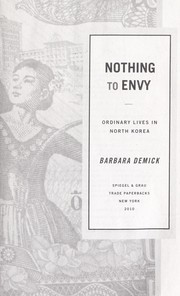
Nothing to envy
First published 2009. Subjects: Koreans, Social conditions, Case studies, Economic conditions, Nonfiction.
Real North Korea
First published 2013. Subjects: Korea (north), politics and government, Korea, foreign relations.
Endnotes
1.
Source: asienforschung.de
Title: National Loss and the Politics of Mourning in North Korea
Link:https://asienforschung.de/img/2020/03/08_RA_Ballbach_final.pdf
Source snippet
March 4, 2021 — 16 Apr 2020 — Confucian rites for the dead, Kim Jong Il ordered the people to uphold a three-year mourning period for his...
Published: March 4, 2021
2.
Source: arxiv.org
Link:https://arxiv.org/abs/2501.05981
3.
Source: ejournals.eu
Title: Towards a Supernatural Propaganda
Link:https://ejournals.eu/pliki_artykulu_czasopisma/pelny_tekst/04cbf802-a0bd-4724-9335-ae9ecbf622d0/pobierz
Source snippet
The DPRK Myth in...January 8, 2021 — by R Husarski · Cited by 8 — The language of propaganda increasing- ly suggested miraculous and mag...
Published: January 8, 2021
4.
Source: uscirf.gov
Link:https://www.uscirf.gov/sites/default/files/resources/AR2008/prison%20without%20bars.pdf
5.
Source: uscirf.gov
Title: releases thank you father kim il sung eyewitness accounts 0
Link:https://www.uscirf.gov/news-room/releases-statements/uscirf-releases-thank-you-father-kim-il-sung-eyewitness-accounts-0
6.
Source: uscirf.gov
Link:https://www.uscirf.gov/publications/did-you-knownorth-korea
7.
Source: jstor.org
Link:https://www.jstor.org/stable/48579382
8.
Source: Wikipedia
Title: Media coverage of North Korea
Link:https://en.wikipedia.org/wiki/Media_coverage_of_North_Korea
9.
Source: hrnk.org
Link:https://www.hrnk.org/wp-content/uploads/2018/12/Hawk_The_Parallel_Gulag_Web.pdf
10.
Source: nknews.org
Title: NK News
Link:https://www.nknews.org/2021/09/the-kim-regimes-failed-witch-hunt-against-magic-and-superstition/
11.
Source: uscirf.gov
Link:https://www.uscirf.gov/sites/default/files/resources/North%20Korea%202013.pdf
12.
Source: dailynk.com
Title: Daily NKNorth Korea’s war on superstition backfires as fortune
Link:https://www.dailynk.com/english/north-koreas-war-on-superstition-backfires-as-fortune-telling-goes-underground/
13.
Source: uscirf.gov
Link:https://www.uscirf.gov/sites/default/files/resources/NORTH%20KOREA%202%20Pager%202013%20final.pdf
14.
Source: uscirf.gov
Link:https://www.uscirf.gov/news-room/releases-statements/event-advisory-release-uscirf-report-north-korea-0
15.
Source: Wikipedia
Title: 1990s North Korean famine
Link:https://en.wikipedia.org/wiki/1990s_North_Korean_famine
16.
Source: uscirf.gov
Link:https://www.uscirf.gov/sites/default/files/North%20Korea%202014.pdf
17.
Source: uscirf.gov
Title: releases thank you father kim il sung eyewitness accounts 1
Link:https://www.uscirf.gov/news-room/releases-statements/uscirf-releases-thank-you-father-kim-il-sung-eyewitness-accounts-1
18.
Source: uscirf.gov
Title: north korea uscirf commissioner bansal moderate panel asia society
Link:https://www.uscirf.gov/news-room/releases-statements/north-korea-uscirf-commissioner-bansal-moderate-panel-asia-society
19.
Source: uscirf.gov
Title: national interest there shall be no god kim religious freedom north korea
Link:https://www.uscirf.gov/news-room/op-eds/national-interest-there-shall-be-no-god-kim-religious-freedom-north-korea
20.
Source: dailynk.com
Title: kim jong un cult of personality north korea ninth party congress
Link:https://www.dailynk.com/english/kim-jong-un-cult-of-personality-north-korea-ninth-party-congress/
21.
Source: dailynk.com
Title: superstition thrives young north koreans seeking life guidance
Link:https://www.dailynk.com/english/superstition-thrives-young-north-koreans-seeking-life-guidance/
22.
Source: hrnk.org
Title: IS THERE A FAMINE IN NORTH KOREA
Link:https://www.hrnk.org/wp-content/uploads/2025/06/IS-THERE-A-FAMINE-IN-NORTH-KOREA.pdf
23.
Source: hrnk.org
Link:https://www.hrnk.org/wp-content/uploads/2024/07/Hunger_and_Human_Rights.pdf
24.
Source: Wikipedia
Title: Religion in North Korea
Link:https://en.wikipedia.org/wiki/Religion_in_North_Korea
25.
Source: Wikipedia
Title: UFO religion
Link:https://en.wikipedia.org/wiki/UFO_religion
26.
Source: Wikipedia
Title: List of mass panic cases
Link:https://en.wikipedia.org/wiki/List_of_mass_panic_cases
27.
Source: Wikipedia
Title: North Korean cult of personality
Link:https://en.wikipedia.org/wiki/North_Korean_cult_of_personality
28.
Source: anthrosource.onlinelibrary.wiley.com
Link:https://anthrosource.onlinelibrary.wiley.com/doi/pdf/10.14506/ca30.1.06
Source snippet
TOTALITARIAN TEARS: Does the Crowd Really Mean It?by W MAZZARELLA · 2015 · Cited by 57 — On the one hand, the North Koreans w...
29.
Source: theguardian.com
Link:https://www.theguardian.com/world/2014/apr/22/mythbusters-the-truth-about-north-korea
Source snippet
The GuardianMythbusters: help us find the truth about North KoreaApril 22, 2014 — 22 Apr 2014 — Have all North Korean students been requi...
Published: April 22, 2014
30.
Source: newyorker.com
Link:https://www.newyorker.com/magazine/1994/09/19/following-the-great-leader
Source snippet
After Japan's defeat in WWII, a myth emerged that Kim Il Sung had led guerrilla warfare from a secret base on Mt. Paekdu, although he was...
31.
Source: ft.com
Title: Financial Times Korean Messiah
Link:https://www.ft.com/content/46ed0447-43cf-4465-9522-2403fe30997f
Source snippet
Cheng traces this phenomenon back to the late 19th century arrival of American missionaries like Samuel A. Moffett and the subsequent spr...
32.
Source: thetimes.com
Title: The Times North Korea’s giant Kim murals take personality cult to new heights
Link:https://www.thetimes.com/world/asia/article/north-korea-kim-jong-un-murals-0hm8vxvs0
33.
Source: mpra.ub.uni-muenchen.de
Title: MPRA paper 92548
Link:https://mpra.ub.uni-muenchen.de/92548/1/MPRA_paper_92548.pdf
34.
Source: newyorker.com
Title: The New Yorker Nothing Left
Link:https://www.newyorker.com/magazine/2010/07/12/nothing-left-2
Source snippet
Song-hee's journey brought her to Yanji, a Chinese city with a significant Korean population, where she lived in fear of being caught by...
35.
Source: tandfonline.com
Link:https://www.tandfonline.com/doi/full/10.1080/10357823.2023.2280692
36.
Source: theguardian.com
Title: north korea kim jong il birthday
Link:https://www.theguardian.com/world/2015/feb/16/north-korea-kim-jong-il-birthday
37.
Source: theguardian.com
Title: true or false kooky north korea stories
Link:https://www.theguardian.com/books/2015/jun/01/true-or-false-kooky-north-korea-stories
38.
Source: nknews.org
Title: how north koreas bizarre propaganda could outlive the kim dynasty
Link:https://www.nknews.org/2022/08/how-north-koreas-bizarre-propaganda-could-outlive-the-kim-dynasty/
Additional References
39.
Source: ohchr.org
Title: north korea un commission documents wide ranging and ongoing crimes against
Link:https://www.ohchr.org/en/press-releases/2014/02/north-korea-un-commission-documents-wide-ranging-and-ongoing-crimes-against
Source snippet
Crimes against humanity / North Korea17 Feb 2014 — North Korea: UN Commission documents wide-ranging and ongoing crimes against huma...
40.
Source: youtube.com
Title: North Korea: The cult that outlasted Stalin and Mao
Link:https://www.youtube.com/watch?v=P2S_TRUAC5w
Source snippet
The belief system behind North Korea's dictatorship...
41.
Source: youtube.com
Title: The belief system behind North Korea’s dictatorship
Link:https://www.youtube.com/watch?v=eLHhSK64u6E
Source snippet
Inside North Korea's Religious Cult of Personality...
42.
Source: academia.edu
Link:https://www.academia.edu/2395018/Apocalypse_in_Early_UFO_and_Alien_Based_Religions_Christian_and_Theosophical_Themes
43.
Source: researchgate.net
Link:https://www.researchgate.net/publication/313714001_Apocalypse_in_Early_UFO_and_Alien-Based_Religions_Christian_and_Theosophical_Themes
44.
Source: youngpioneertours.com
Link:https://www.youngpioneertours.com/top-five-best-fake-north-korea-stories/
45.
Source: facebook.com
Link:https://www.facebook.com/thekoreatimes/posts/a-new-un-human-rights-report-called-on-north-korea-to-stop-crackdowns-on-market-/2240720636035758/
46.
Source: aei.org
Link:https://www.aei.org/events/korean-messiah-the-religious-and-ideological-roots-of-north-koreas-personality-cult/
47.
Source: dokumen.pub
Link:https://dokumen.pub/apocalyptic-anxiety-religion-science-and-americas-obsession-with-the-end-of-the-world-1607324709-9781607324706.html
48.
Source: reddit.com
Link:https://www.reddit.com/r/northkorea/comments/156rh8t/dprk_fake_news/
Topic Tree
Follow this branch
Related pages 192
- Antigua and Barbuda
- Argentina Belief Scares
- Azerbaijan Belief
- Bahrain Beliefs
- Bosnia and Herzegovina
- +187 more in sidebar