Within Bosnia and Herzegovina
How Wartime Propaganda Turned Fear Into Violence
During the Bosnian War, real violence and organised propaganda combined to turn fear, rumour and collective blame into weapons.
On this page
- Media escalation before and during the war
- Rumour, real atrocities and collective guilt
- Denial, memory and the struggle over evidence
Page outline Jump by section
Introduction
During the 1992–1995 Bosnian War, fear was not simply a reaction to violence: it became a weapon in its own right. Political leaders, partisan media and local rumours encouraged many people to see entire ethnic communities as existential threats rather than as neighbours. These narratives did not invent the dangers of war—atrocities, displacement and killings were tragically real—but they often transformed isolated incidents, historical grievances and genuine fears into sweeping claims about collective guilt and imminent extermination. The result was a powerful cycle in which propaganda, rumour and violence reinforced one another, making compromise appear impossible and helping to justify persecution, ethnic cleansing and other war crimes. Understanding this process is essential to understanding not only how the conflict escalated, but also why competing memories and denial remain politically influential in Bosnia and Herzegovina today.[ICTY]icty.orgAchievements | International Criminal Tribunal for the former YugoslaviaAchievements | International Criminal Tribunal for the former Yugoslavia…
How nationalist media turned anxiety into collective fear
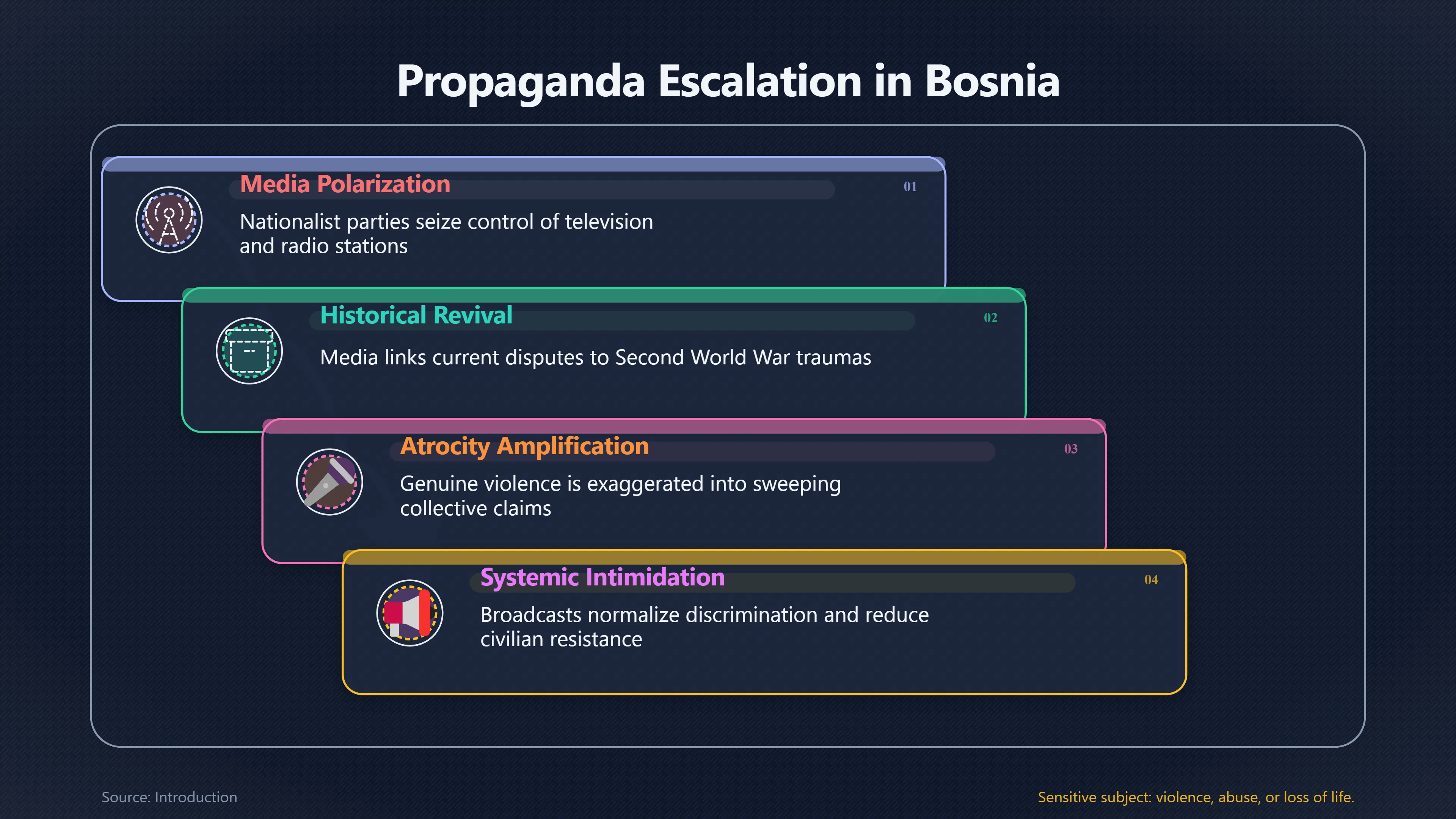
The collapse of socialist Yugoslavia coincided with an increasingly polarised media environment. Television, newspapers and radio stations that had once operated within a shared state increasingly came under the influence of nationalist political parties. Rather than presenting citizens as members of a multi-ethnic society, many outlets framed politics as a struggle for collective survival.
Across the former Yugoslavia, political messaging repeatedly suggested that one ethnic group’s safety depended upon defeating another. Historical traumas, particularly memories of the Second World War, were revived through emotionally charged reporting. Stories about past massacres, whether accurately reported or selectively presented, were often linked to current political disputes, encouraging audiences to believe that history was about to repeat itself. Scholars argue that this continual emphasis on existential danger helped create an atmosphere in which ordinary political disagreements became interpreted as life-or-death conflicts.[Wikipedia]WikipediaPropaganda during the Yugoslav WarsPropaganda during the Yugoslav Wars
In Bosnia and Herzegovina, where Bosniaks, Serbs and Croats had long lived alongside one another, this rhetoric proved especially destructive. Neighbours increasingly encountered media portraying other communities not as political rivals but as collective enemies.
Media escalation before and during the war
Once fighting began, propaganda evolved alongside military operations. Reports of genuine atrocities circulated rapidly, but so did exaggerated claims, fabricated stories and unverified rumours. Because civilians were already experiencing violence, displacement and uncertainty, many frightening stories appeared plausible even when evidence was lacking.
Several recurring techniques became especially influential:
- Collective blame: Crimes committed by armed groups were presented as evidence that an entire ethnic community was dangerous.
- Selective reporting: Atrocities against one group’s civilians received extensive coverage, while violence against others was minimised or ignored.
- Dehumanising language: Opponents were increasingly portrayed as inherently violent or incapable of peaceful coexistence.
- Constant repetition: Television broadcasts, newspapers and radio reinforced identical themes until they appeared self-evident.
International Criminal Tribunal for the former Yugoslavia (ICTY) judgements later documented how propaganda formed part of broader campaigns accompanying persecution in places such as Prijedor. Tribunal findings describe radio broadcasts that spread anti-Muslim and anti-Croat messaging while non-Serb residents were systematically removed from public life, arrested and subjected to organised violence. These communications were not merely inflammatory speech; they formed part of a wider system of intimidation that reduced resistance and normalised discrimination.[ICTY]icty.orgAchievements | International Criminal Tribunal for the former YugoslaviaAchievements | International Criminal Tribunal for the former Yugoslavia…
Importantly, historians distinguish between recognising the reality of wartime atrocities and accepting propagandistic conclusions drawn from them. Mass killings, ethnic cleansing and other war crimes were real and extensively documented. Propaganda worked by presenting these events as proof that entire populations deserved punishment or could never coexist peacefully.
Rumour, real atrocities and collective guilt
Rumours flourished because normal sources of trustworthy information had broken down. Telephone lines failed, independent journalism became harder to sustain and communities became physically separated by front lines. In that environment, frightening stories often travelled through relatives, refugees, soldiers and local gossip before any verification was possible.
Some rumours reflected genuine events but exaggerated their scale or meaning. Others were entirely false. Either way, they often produced similar effects:
- people fled before violence reached their communities;
- armed groups justified pre-emptive attacks;
- civilians became increasingly suspicious of neighbours;
- revenge became easier to portray as self-defence.
The distinction between fear and propaganda therefore became blurred. Civilians often faced authentic danger while simultaneously consuming distorted information about who posed that danger and why. This combination proved particularly effective because propaganda did not require inventing violence; it only needed to reinterpret violence through an ethnic lens.
Researchers studying collective violence frequently argue that fear becomes contagious when individuals believe everyone else already accepts the same narrative. In Bosnia, repeated warnings that “they” intended to destroy “us” encouraged conformity and discouraged scepticism, especially as communities became increasingly segregated by the conflict.[OUP Academic]academic.oup.comOUP AcademicSome Kind of Justice: The ICTY's Impact in Bosnia and Serbia | Oxford Academic…
Why fear spread so quickly
The rapid spread of ethnic fear cannot be explained by propaganda alone. Several wider pressures made communities especially vulnerable to alarming narratives.
First, state institutions were collapsing. Police, courts and political structures no longer appeared capable of guaranteeing security. People therefore relied more heavily on family networks, local leaders and ethnically aligned media.
Second, genuine atrocities continually reinforced expectations of further violence. Each massacre or forced displacement increased the credibility of rumours predicting additional attacks.
Third, wartime conditions reduced opportunities for independent verification. Journalists faced intimidation, communications were disrupted and communities became physically isolated.
Finally, propaganda appealed to identity as much as information. It encouraged people to interpret personal safety through membership of an ethnic group rather than through individual experience. Once this shift occurred, isolated crimes could more easily be interpreted as evidence of collective intent.
Denial, memory and the struggle over evidence
The end of the war did not end battles over truth. Competing narratives about responsibility, victimhood and justice remain deeply contested in Bosnia and Herzegovina.
The ICTY established extensive judicial records documenting war crimes, crimes against humanity and, in the case of Srebrenica, genocide. Thousands of witness testimonies, forensic investigations and documentary records have created one of the most detailed archives for any modern conflict.[ICTY]icty.orgAchievements | International Criminal Tribunal for the former YugoslaviaAchievements | International Criminal Tribunal for the former Yugoslavia…
Nevertheless, denial and revisionism continue to circulate in parts of the region. Rather than rejecting every documented crime outright, denial often works by minimising atrocities, questioning established legal findings, shifting blame exclusively onto other groups or portraying convicted perpetrators as defenders of their nation. Scholars describe these practices as part of broader struggles over collective identity, in which acknowledging crimes committed by members of one’s own community is perceived by some as threatening the community itself.[ibs.preporod.ba]ibs.preporod.banian Thought and CultureApril 22, 2022…
Media continue to play an important role in these debates. Research comparing Bosniak and Bosnian Serb newspapers has found that coverage of the 1992–1995 war often reflects incompatible historical narratives, with each side tending to emphasise its own victims while giving comparatively little attention to the suffering experienced by others. Although examples of more inclusive reporting exist, they remain less prominent than competing national narratives.[MUNI Journals]journals.muni.czMUNI JournalsMisunderstanding the Other and Shy Signs of Openness: Discourse on the 1992-1995 War in the Current Bosniak and Bosnian Serb…
Why this history still matters
The Bosnian experience demonstrates that contagious fear does not require imaginary threats. Real violence can become even more destructive when interpreted through narratives that assign permanent collective guilt to entire populations.
For historians, psychologists and media scholars, Bosnia illustrates how propaganda operates most effectively when it builds upon authentic anxieties instead of replacing them. Genuine atrocities, selective reporting, emotionally powerful historical memories and repeated rumours combined to create an environment in which many people came to believe coexistence had become impossible.
The legacy extends beyond the war itself. Contemporary debates over memorials, school curricula, media reporting and public commemorations continue to reflect unresolved disagreements about responsibility and historical truth. Efforts by journalists, educators, survivors and memory activists seek to preserve evidence-based accounts of wartime events while resisting narratives that recycle the same patterns of collective suspicion that helped fuel the conflict in the first place.[sagepub.com]journals.sagepub.comMedia memory activism in post-conflict Bosnia-HerzegovinaVéronique Labonté, 2025September 28, 2024…
Amazon book picks
Further Reading
Books and field guides related to How Wartime Propaganda Turned Fear Into Violence. Use these as the next step if you want deeper reading beyond the article.


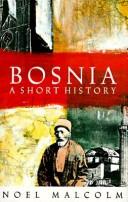
Bosnia: A Short History
Provides essential background to the war and competing narratives.
Endnotes
1.
Source: icty.org
Title: Achievements | International Criminal Tribunal for the former Yugoslavia
Link:https://www.icty.org/en/about/tribunal/achievements
Source snippet
Achievements | International Criminal Tribunal for the former Yugoslavia...
2.
Source: academic.oup.com
Link:https://academic.oup.com/book/35970
Source snippet
OUP AcademicSome Kind of Justice: The ICTY's Impact in Bosnia and Serbia | Oxford Academic...
3.
Source: Wikipedia
Title: Propaganda during the Yugoslav Wars
Link:https://en.wikipedia.org/wiki/Propaganda_during_the_Yugoslav_Wars
4.
Source: ibs.preporod.ba
Link:https://ibs.preporod.ba/bosnian-studies/index.php/journal/article/view/61
Source snippet
nian Thought and CultureApril 22, 2022...
Published: April 22, 2022
5.
Source: journals.muni.cz
Link:https://journals.muni.cz/cepsr/article/view/3768
Source snippet
MUNI JournalsMisunderstanding the Other and Shy Signs of Openness: Discourse on the 1992-1995 War in the Current Bosniak and Bosnian Serb...
6.
Source: journals.sagepub.com
Title: Media memory activism in post-conflict Bosnia-Herzegovina
Link:https://journals.sagepub.com/doi/10.1177/17506980241270857
Source snippet
Véronique Labonté, 2025September 28, 2024...
Published: September 28, 2024
7.
Source: journals.sagepub.com
Link:https://journals.sagepub.com/doi/abs/10.1177/17506980241270857
Source snippet
memory activism in post-conflict Bosnia-Herzegovina - Véronique Labonté, 2025September 28, 2024 — First published online September 28, 20...
Published: September 28, 2024
8.
Source: icty.org
Title: Prosecution Case
Link:https://www.icty.org/en/content/prosecution-case-croatia-and-bosnia-and-herzegovina
9.
Source: doi.org
Link:https://doi.org/10.1007/s10746
Additional References
10.
Source: researchcentre.trtworld.com
Title: the srebrenica genocide and the denial narrative
Link:https://researchcentre.trtworld.com/publications/discussion-paper/the-srebrenica-genocide-and-the-denial-narrative/
Source snippet
Srebrenica Genocide and the Denial Narrative - TRT World Research CentreJuly 8, 2021 — Discussion PaperSociety & Human Rights THE SREBREN...
Published: July 8, 2021
11.
Source: ipv4.pregled.unsa.ba
Link:https://ipv4.pregled.unsa.ba/index.php/pregled/article/view/776
Source snippet
d: časopis za društvena pitanja / Periodical for social issues...
12.
Source: youtube.com
Title: The Yugoslav Wars: How a Nation Destroyed Itself | Extra Long Documentary
Link:https://www.youtube.com/watch?v=OkQOQUrayxo
Source snippet
The Brutal End of Yugoslavia | Full Documentary...
13.
Source: youtube.com
Title: Divided Bosnia: A War That Never Truly Ended
Link:https://www.youtube.com/watch?v=JAdyBjO5TjM
Source snippet
Europe's Most Fractured State | Bosnia: A Fragile Peace Full Documentary...
14.
Source: tandfonline.com
Link:https://www.tandfonline.com/doi/full/10.1080/14650040490442908
15.
Source: dwp-balkan.org
Link:https://dwp-balkan.org/role-of-social-media-in-the-affirmation-of-revisionism-re-writing-the-past-and-the-culture-of-forgetting-2/
16.
Source: revistas.usp.br
Link:https://revistas.usp.br/caligrama/article/view/65486
17.
Source: journals.unibuc.ro
Link:https://journals.unibuc.ro/index.php/cmp/article/view/3114
18.
Source: cambridge.org
Link:https://www.cambridge.org/core/books/abs/memory-and-power-in-postwar-europe/memory-the-media-and-nato-information-intervention-in-bosniahercegovina/FE26D2FEBF1051D0C0D577846DF6C232
19.
Source: cambridge.org
Link:https://www.cambridge.org/core/books/memory-and-power-in-postwar-europe/memory-the-media-and-nato-information-intervention-in-bosniahercegovina/FE26D2FEBF1051D0C0D577846DF6C232
Topic Tree