Within Saudi Arabia
Why Did Militants Seize the Grand Mosque?
The 1979 seizure of Islam's holiest mosque fused end-times belief, political rebellion and anger over rapid social change.
On this page
- Juhayman al Otaybi and the proclaimed redeemer
- Why the apocalyptic message attracted followers
- How the siege changed Saudi politics and public life
Page outline Jump by section
Introduction
On 20 November 1979, the first day of a new Islamic century according to the Islamic calendar, hundreds of armed militants seized the Grand Mosque in Mecca, Islam’s holiest site. Their leader, Juhayman al-Otaybi, declared that his brother-in-law, Muhammad al-Qahtani, was the long-awaited redeemer whose appearance would herald the end times. What followed was not simply a terrorist attack or an attempted coup. It was an apocalyptic rebellion rooted in millenarian belief, religious dissent and profound unease about the direction of Saudi society. The two-week siege shocked the Muslim world, forced the Saudi state into an unprecedented military operation inside the Grand Mosque, and reshaped the kingdom’s religious and political landscape for decades.[wikipedia.org]WikipediaGrand Mosque seizureGrand Mosque seizure
Why did militants seize the Grand Mosque?
The seizure was driven by a conviction that history had reached a decisive religious moment. Juhayman al-Otaybi and his followers believed that Muhammad al-Qahtani fulfilled traditional descriptions of the Mahdi, a righteous leader who, in many Islamic traditions, appears before the Day of Judgement to restore justice. Choosing the first day of the new Islamic century reinforced the symbolism, as some traditions also speak of religious renewal at the beginning of each century.[Wikipedia]WikipediaGrand Mosque seizureGrand Mosque seizure
The movement emerged from conservative religious circles rather than from an entirely separate faith. Juhayman had once studied in respected religious environments, but he became increasingly convinced that the Saudi monarchy had abandoned authentic Islam through its wealth, close relationship with Western governments, consumer culture and rapid modernisation. His followers argued that religious corruption had become so severe that only the appearance of the Mahdi could restore divine order.[ResearchGate]researchgate.netOpen source on researchgate.net.
Recent scholarship has challenged older descriptions that portrayed the seizure primarily as a political revolt with a list of reform demands. By examining Juhayman’s own writings, historians have concluded that apocalyptic expectation was central rather than incidental. Political criticism existed, but it was embedded within a worldview that interpreted current events as signs of the approaching end times.[ResearchGate]researchgate.netOpen source on researchgate.net.
Juhayman al-Otaybi and the proclaimed redeemer
Juhayman al-Otaybi came from a family connected to the historical Ikhwan, tribal fighters who had helped establish the Saudi state before later rebelling against it in the 1920s. By invoking that legacy, his movement presented itself as restoring an earlier vision of religious purity rather than inventing something new.[Wikipedia]WikipediaGrand Mosque seizureGrand Mosque seizure
Muhammad al-Qahtani, Juhayman’s brother-in-law, was presented as the promised Mahdi because supporters believed his name and ancestry matched traditional descriptions found in religious literature. The group regarded these correspondences not as coincidences but as confirmation that prophecy was unfolding before their eyes. During the siege, however, al-Qahtani was killed. His death created an immediate theological crisis for the movement because the expected redeemer had not brought about the divine victory his followers anticipated. The rebellion rapidly lost both military momentum and religious credibility.[Wikipedia]WikipediaGrand Mosque seizureGrand Mosque seizure
Unlike many revolutionary organisations, the group did not seek to persuade the public through a lengthy political programme. Instead, its authority rested on the belief that sacred history itself had entered its final stage. That conviction explains why many followers accepted extraordinary risks that would have appeared irrational from a purely political perspective.[ResearchGate]researchgate.netOpen source on researchgate.net.
Why did the apocalyptic message attract followers?
The movement remained relatively small—estimates generally place the number of militants between roughly 300 and 600—but it attracted committed supporters because it addressed several anxieties simultaneously.[Wikipedia]WikipediaGrand Mosque seizureGrand Mosque seizure
Saudi Arabia had changed dramatically during the oil boom of the 1970s. Cities expanded rapidly, foreign workers arrived in large numbers, television and consumer goods became widespread, and state wealth transformed everyday life. For some conservative believers, these developments appeared to signal moral decline rather than progress. Juhayman reframed these concerns as evidence that the final struggle between righteousness and corruption had begun.[Cambridge University Press & Assessment]cambridge.orgCambridge University Press & AssessmentSaudi Arabia and the Islamic Revival | International Journal of Middle East Studies | Cambridge Core…
Millenarian movements often flourish during periods of rapid social change because they provide certainty amid uncertainty. Instead of interpreting political, economic and cultural changes as complicated historical processes, they organise them into a single sacred narrative with clear heroes, villains and an inevitable conclusion. Juhayman’s movement offered followers both moral certainty and a prominent role in what they believed would be God’s final intervention in history.[Cambridge University Press & Assessment]cambridge.orgCambridge University Press & AssessmentSaudi Arabia and the Islamic Revival | International Journal of Middle East Studies | Cambridge Core…
The attraction therefore cannot be explained simply as religious extremism or collective irrationality. The movement drew upon familiar religious traditions but combined them into a distinctive interpretation that placed one contemporary individual at the centre of an unfolding apocalyptic drama. Historians generally distinguish this from mass hysteria: it was an organised ideological movement built around specific theological claims rather than a spontaneous outbreak of contagious belief.[ResearchGate]researchgate.netOpen source on researchgate.net.

How did the siege unfold?
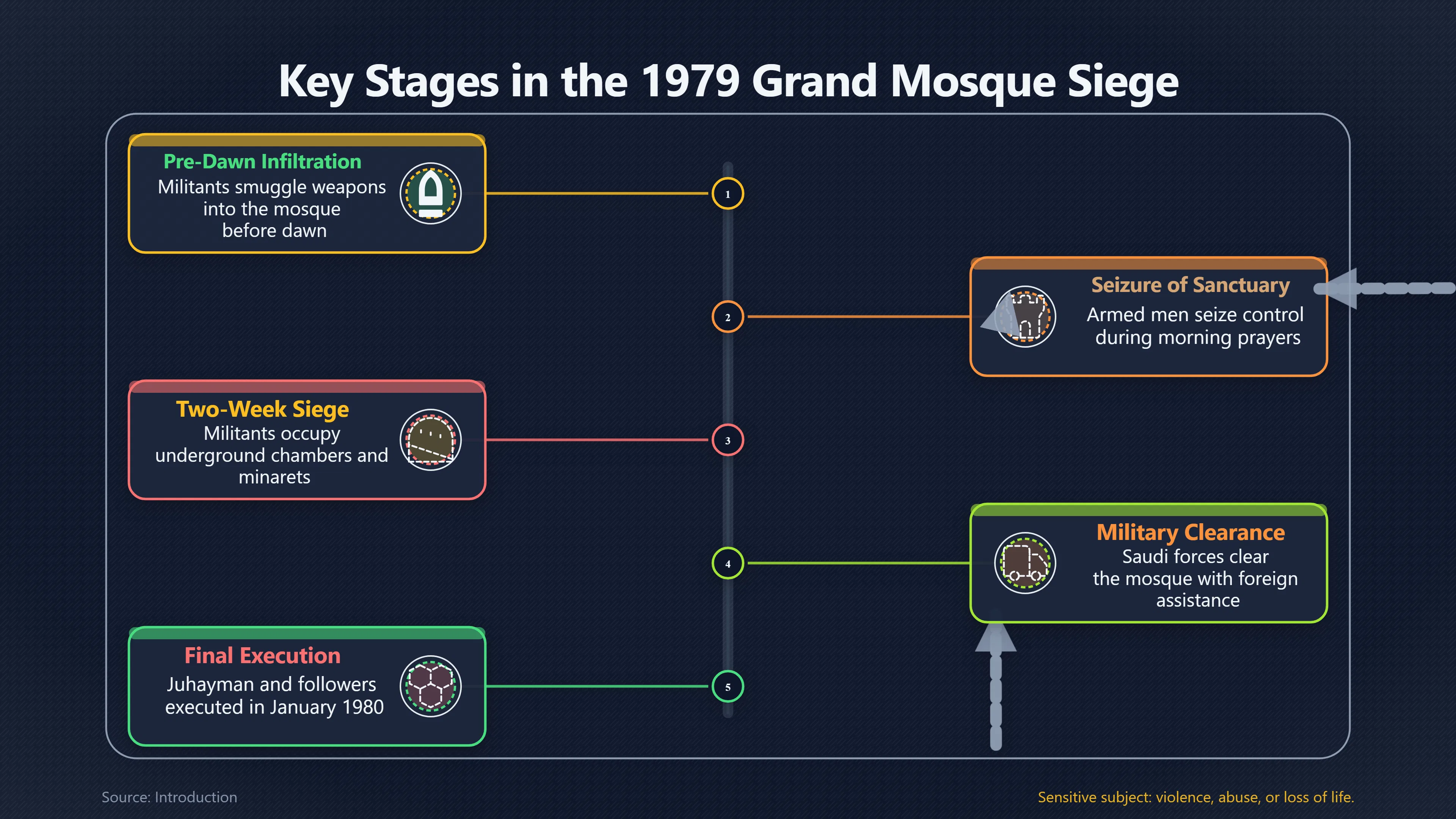
The militants smuggled weapons into the Grand Mosque before dawn and seized control as thousands of worshippers gathered for morning prayers. They took hostages, occupied the mosque’s extensive underground chambers and placed marksmen in the minarets overlooking the complex, making an immediate assault extremely difficult.[Wikipedia]WikipediaGrand Mosque seizureGrand Mosque seizure
Saudi authorities faced an unprecedented dilemma. Using force inside Islam’s holiest sanctuary risked provoking outrage across the Muslim world, yet allowing the occupation to continue threatened both religious legitimacy and state authority. Religious scholars were consulted before military action proceeded, providing legal justification for using force after efforts to persuade the militants to surrender failed.[OUP Academic]academic.oup.comOUP AcademicAt the Crossroads: The Religious Establishment Put to the Test of the Saudi Politico-Religious Space | Clerics of Islam: Reli…
The battle lasted approximately two weeks. Saudi forces gradually cleared the mosque, including its underground passages, with technical assistance from foreign specialists. Casualty figures vary between sources, reflecting the confusion surrounding the siege and the secrecy that followed, but hundreds of people were killed or wounded. Juhayman survived the assault, was captured and later executed alongside dozens of followers in January 1980.[Wikipedia]WikipediaGrand Mosque seizureGrand Mosque seizure
How the siege changed Saudi politics and public life
The immediate military victory did not end the episode’s influence. Instead, it triggered a profound reassessment within the Saudi leadership about religious legitimacy and political stability. Many historians argue that the monarchy responded by strengthening the public role of conservative religious institutions in order to reinforce its Islamic credentials and reduce the appeal of similar challenges from religious critics.[OUP Academic]academic.oup.comOUP AcademicAt the Crossroads: The Religious Establishment Put to the Test of the Saudi Politico-Religious Space | Clerics of Islam: Reli…
In practical terms, religious policing became more visible, social restrictions increased in several areas of public life, and conservative religious voices gained greater influence over education and cultural policy during the following years. While Saudi society had already been moving in some of these directions before 1979, the mosque seizure accelerated and reinforced the trend.[cambridge.org]cambridge.orgCambridge University Press & AssessmentSaudi Arabia and the Islamic Revival | International Journal of Middle East Studies | Cambridge Core…
The event also transformed the relationship between the monarchy and the religious establishment. Scholars note that the crisis tested the longstanding partnership between political rulers and religious authorities, requiring both to defend the legitimacy of the state while condemning militants who themselves claimed to be restoring authentic religion.[OUP Academic]academic.oup.comOUP AcademicAt the Crossroads: The Religious Establishment Put to the Test of the Saudi Politico-Religious Space | Clerics of Islam: Reli…

Why the event still matters
The Grand Mosque seizure remains one of the defining events in modern Saudi history because it demonstrated that revolutionary opposition could emerge not from secular or foreign ideologies but from people who believed the kingdom itself had become insufficiently religious. That paradox has shaped discussions of Saudi politics ever since.[Cambridge University Press & Assessment]cambridge.orgCambridge University Press & AssessmentSaudi Arabia and the Islamic Revival | International Journal of Middle East Studies | Cambridge Core…
For historians of millenarian movements, the siege illustrates recurring patterns seen in many religious traditions. Charismatic leaders reinterpret established beliefs, identify contemporary signs that prophecy is unfolding, proclaim the arrival of a chosen figure and persuade followers that extraordinary action is both necessary and divinely sanctioned. The Grand Mosque seizure therefore belongs not only to Saudi political history but also to the broader history of apocalyptic movements and collective religious expectation.[ResearchGate]researchgate.netOpen source on researchgate.net.
At the same time, scholars caution against treating the episode as an example of “mass hysteria”. The rebellion involved a relatively small, disciplined group acting from a coherent—if highly contested—religious worldview. Its significance lies less in the number of believers than in the extraordinary consequences that their apocalyptic convictions produced for Saudi Arabia, the wider Muslim world and the study of millenarian movements.[ResearchGate]researchgate.netOpen source on researchgate.net.

Endnotes
1.
Source: Wikipedia
Title: Grand Mosque seizure
Link:https://en.wikipedia.org/wiki/Grand_Mosque_seizure
2.
Source: cambridge.org
Link:https://www.cambridge.org/core/journals/international-journal-of-middle-east-studies/article/abs/saudi-arabia-and-the-islamic-revival/60CDCC3BE0468DDB4FE27790C380ACA4
Source snippet
Cambridge University Press & AssessmentSaudi Arabia and the Islamic Revival | International Journal of Middle East Studies | Cambridge Core...
3.
Source: researchgate.net
Link:https://www.researchgate.net/publication/374671137_Toward_the_Seizure_of_the_Grand_Mosque_in_Mecca_The_Writings_and_Ideology_of_Juhayman_al-Utaybi_and_the_Ikhwan
4.
Source: academic.oup.com
Link:https://academic.oup.com/yale-scholarship-online/book/18816/chapter-abstract/177095157
Source snippet
OUP AcademicAt the Crossroads: The Religious Establishment Put to the Test of the Saudi Politico-Religious Space | Clerics of Islam: Reli...
5.
Source: cambridge.org
Title: Battle of sects?
Link:https://www.cambridge.org/core/journals/politics-and-religion/article/battle-of-sects-iran-and-saudi-arabias-role-conflict/E38F2B0C660E9943F75CCFF6CA6AEE87
Source snippet
Iran and Saudi Arabia’s role conflict | Politics and Religion | Cambridge CoreSeptember 1, 2025 — IRAN-SAUDI ARABIA RIVALRY: BATTLE OF TH...
Published: September 1, 2025
6.
Source: academic.oup.com
Link:https://academic.oup.com/cornell-scholarship-online/book/61315/chapter-abstract/532715730
Source snippet
"Hassner [https://doi.org/10.7591/cornell/9781501780141.001.0001..."](https://doi.org/10.7591/cornell/9781501780141.001.0001...")...
7.
Source: academic.oup.com
Link:https://academic.oup.com/yale-scholarship-online/book/18816/chapter/177095157
8.
Source: cambridge.org
Link:https://www.cambridge.org/core/journals/international-journal-of-middle-east-studies/article/abs/role-of-the-ulama-in-the-politics-of-an-islamic-state-the-case-of-saudi-arabia/32993CD923052A5AB4E4812ABF554DFB
9.
Source: academic.oup.com
Link:https://academic.oup.com/book/2336/chapter-abstract/142493488
10.
Source: cambridge.org
Link:https://www.cambridge.org/core/journals/international-journal-of-middle-east-studies/article/abs/rejectionist-islamism-in-saudi-arabia-the-story-of-juhayman-alutaybi-revisited/2CDB9097D66FA5702504523E5FE61BA5
11.
Source: cambridge.org
Link:https://www.cambridge.org/core/journals/international-journal-of-middle-east-studies/article/rejectionist-islamism-in-saudi-arabia-the-story-of-juhayman-alutaybi-revisited/294D1F95102BA3A5029F308523EB6074
12.
Source: cambridge.org
Link:https://www.cambridge.org/core/journals/international-journal-of-middle-east-studies/article/abs/rejectionist-islamism-in-saudi-arabia-the-story-of-juhayman-alutaybi-revisited/294D1F95102BA3A5029F308523EB6074
13.
Source: history.state.gov
Link:https://history.state.gov/historicaldocuments/frus1977-80v18/d201
14.
Source: history.state.gov
Link:https://history.state.gov//historicaldocuments/frus1977-80v18/d201
15.
Source: history.state.gov
Link:https://history.state.gov//historicaldocuments/frus1977-80v19/d375
16.
Source: researchgate.net
Link:https://www.researchgate.net/publication/292492769The_seizure_of_the_Mecca%27s_Grand_Mosque_in_1979-_The_social_profile_and_ideology_of_the_Ihwan
17.
Source: reference.org
Title: Grand Mosque seizure
Link:https://reference.org/facts/Grand_Mosque_seizure/oFf6fEKL
Additional References
18.
Source: ft.com
Title: Financial Times Saudi Arabia: A Modern History
Link:https://www.ft.com/content/8c4c9672-8cfb-4dfc-b840-6de0af864dd8
Source snippet
The book contextualizes Saudi Arabia's socio-political development from the 18th-century alliance between Muhammad ibn Saud and the Wahha...
19.
Source: sauditimes.org
Title: the siege of grand mosque 1979 makkah
Link:https://sauditimes.org/narratives/viewpoints/the-siege-of-grand-mosque-1979-makkah/
Source snippet
The 1979 Grand Mosque Siege: Uncovering the Roots of Extremism (Part 1)November 17, 2019 — THE 1979 GRAND MOSQUE SIEGE: UNCOVERING THE RO...
Published: November 17, 2019
20.
Source: youtube.com
Link:https://www.youtube.com/watch?v=FWYHJLh94Zk
Source snippet
Mecca's Grand Mosque siege: When a preacher tried to overthrow the Saudi royal family...
21.
Source: youtube.com
Link:https://www.youtube.com/watch?v=cYi_b0efxzI
Source snippet
The Day Kaaba Tawaf Stopped: The 1979 Siege of Makkah...
22.
Source: dergipark.org.tr
Link:https://dergipark.org.tr/en/pub/ecsbd/article/1869186
Source snippet
1979 Mescid-İ Haram Olayı: Suudi Arabistan’da Dini Meşruiyet, Selefilik ve Siyasal Kriz - Evliya Çelebi Journal of Political SciencesMay...
23.
Source: youtube.com
Link:https://www.youtube.com/watch?v=FbR1s_TWFxM
Source snippet
The Siege of Mecca (2018) | Full Documentary...
24.
Source: youtube.com
Link:https://www.youtube.com/watch?v=yBBYrbc8t4Q
Source snippet
1979 Grand Mosque Massacre - Forgotten History...
25.
Source: brookings.edu
Title: Terrorism in Saudi Arabia: Past and Present | Brookings
Link:https://www.brookings.edu/events/terrorism-in-saudi-arabia-past-and-present/
26.
Source: washingtonpost.com
Title: Armed Men Seize Mecca’s Great Mosque
Link:https://www.washingtonpost.com/archive/politics/1979/11/21/armed-men-seize-meccas-great-mosque/6e27c732-b822-4923-a7a2-2de3652969f5/
27.
Source: scholarworks.brandeis.edu
Link:https://scholarworks.brandeis.edu/esploro/outputs/bookChapter/Fighting-for-the-Holy-Mosque-The/9924103490401921
Topic Tree